EURASIP Journal on Applied Signal Processing 2005:13, 2146–2152
c
2005 Hindawi Publishing Corporation
Color Seal Extraction from Documents: Robustness
through Soft Data Fusion
Aureli Soria-Frisch
Department of Security Technologies, Fraunhofer Institute for Production Systems and Design Technology (Fraunhofer IPK),
Pascalstrasse 8-9, 10587 Berlin, Germany
Email: aureli.soria-frisch@ieee.org
Received 11 January 2004; Revised 3 January 2005
This paper presents a framework for the extraction of elements characterized by a particular color hue from color document
images. The presented approach attains the detection of official seals, which will be thence analyzed by an embedding system in
order to detect possible falsifications. The framework is based on the fusion operator denoted as fuzzy integral, whose robustness
with respect to changes in the luminance and the saturation of particular hues is due to the use of the ranking among the input
data as an influencing factor in the fusion result. The approach is evaluated on a real data set of tax forms delivered by custom
houses, showing its successful performance.
Keywords and phrases: data fusion, fuzzy integral, image segmentation, color processing, document analysis.
1. INTRODUCTION
Offices are one of the human environments rapidly changing
due to the evolution of information technologies. Informa-
tion is abandoning its paper-centered universe to a digital-
data-centered one. Administrative, communication, and fil-
ing procedures are driven into a digital domain by the ubiq-
uity of different computation facilities. In this context, im-
age processing methodologies for document analysis inter-
face between these two domains, therefore, continuously be-
ing challenged by the real world. The here-presented paper
takes into consideration an application for the automated
analysis of tax forms in custom houses, whose goal is the de-
tection of falsified seals in these documents. In this context,
the approach presented in this paper attains the extraction of
the seal from the document color image. Once this segmen-
tation methodology has extracted the pixels corresponding
to the seal, the image analysis system embedding it proceeds
to the detection of its possible falsification. Thus the paper is
centered in the analysis of the segmentation stage.
Few methodologies for seal extraction [1,2,3]havebeen
hitherto presented in the literature. In [1] the approach is
based on the analysis of the seal shape. Since the geometrical
aspect of the seals stamped in real officesisextremelyvariable
(i.e., this process cannot be always realized carefully enough),
this feature cannot be taken into consideration for the appli-
cation on hand. Far otherwise the here-presented approach
takes the color of the seals as the discriminatory feature in or-
der to segment them from the rest of the document as done
in [2,3]. These approaches attain the full-color segmenta-
tion of the document. The segmented images present in this
case no special problems. On the other hand, the segmenta-
tion approach detailed in this paper attains the segmentation
of hand-printed items in a document, which present a high
variability in the luminance and the saturation due to a care-
less stamping process. Furthermore, this approach succeeds
in extracting a particular color cluster without fully segment-
ing the image. This same goal is fulfilled by an application for
text extraction on color document images recently presented
[4]. Nevertheless, that approach successfully solves the pres-
ence of mesh noise in high-quality images, which differs from
the seal variability problem formerly described.
The segmentation approach presented here is based on
data fusion by considering the color image as a multisensory
signal. In multisensory systems, the fusion operator reduces
the n-dimensionality introduced in the system by the use of n
information sources, for example, the color channels of most
usual color models. Thus the fusion operator is a mean for
combining the data coming from different sensors into one
representational form [5]. A large number of aggregation op-
erators have been developed in the field of soft computing,
for example, uninorms [6], OWAs [7], weighted ranking op-
erators [8], and fuzzy integrals [9]. These operators offer a
greater flexibility than operators traditionally employed for
image fusion.
The fuzzy integral has already been applied to image
segmentation [10,11,12]. However, the here-presented ap-
proach differs from these segmentation procedures, since it
Color Seal Extraction through Soft Data Fusion 2147
Stat. moments
(average)
Weighted
sum
Choquet fi
OWA
Ranking op.
(min, median, max)
Weighted ranking
(WMIN, WMED, WMAX)
Sugeno fi
T-conorm fi
Logical op.
(and, or)
T-, S-norms
Uninorms
Algebraic op.
(sum, prod.) Classical
operators
Weighting
operators
Fuzzy logic
related operators
Fuzzy
integrals
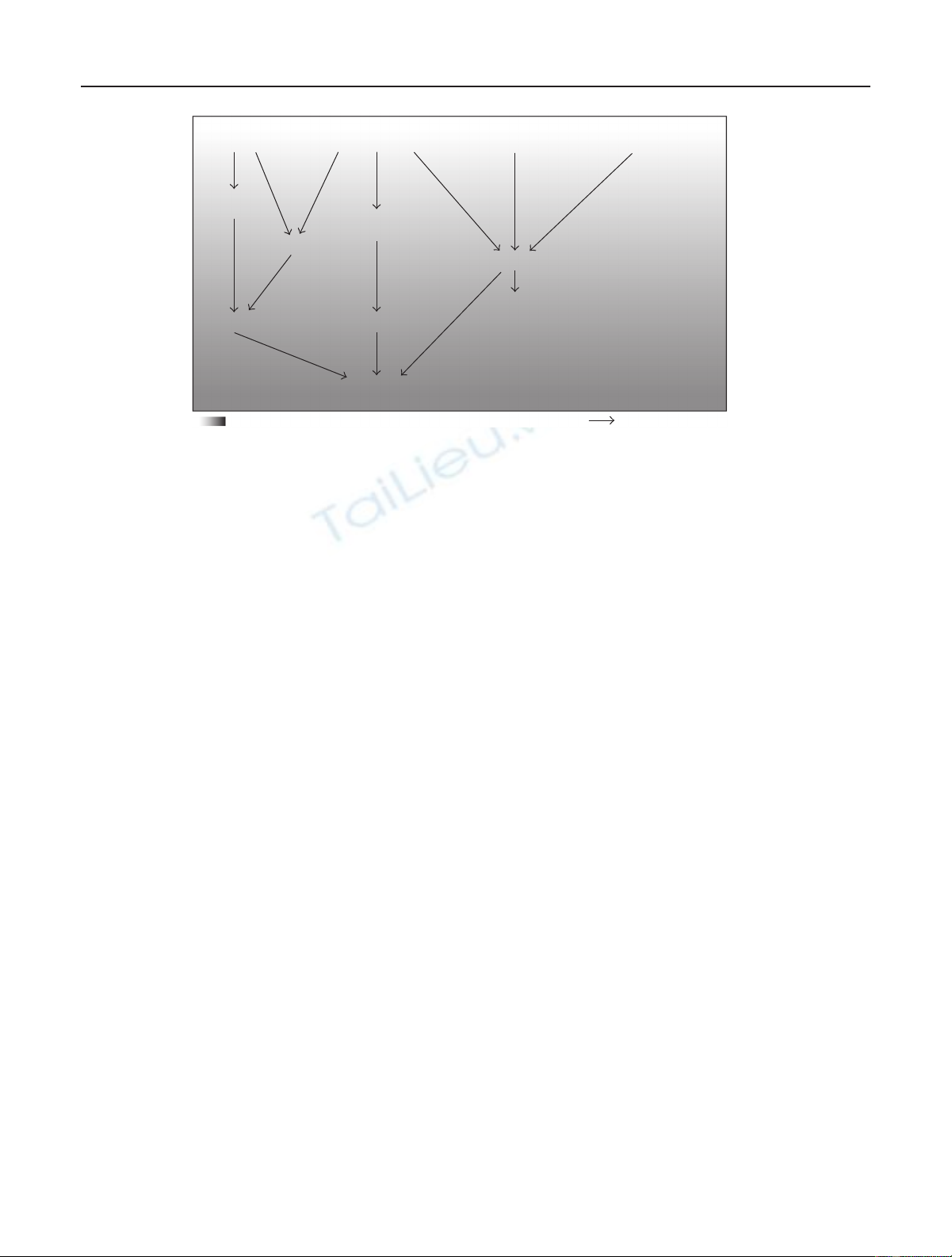
Grade of hard-/softiness Generalization relationship
Figure 1: Relational map of different fusion operators. The grade of softness increases in the vertical axis from the top to the bottom and is
a result of successive generalizations. In the horizontal axis, the operators are grouped upon their flavor, which defines different families of
operators. In the vertical axis, the operators are grouped upon different theoretical frameworks in operations research.
does not attain the complete segmentation of the image but
the discrimination of a particular color cluster, that is, this of
the seal. Moreover, the fuzzy integral is a weighted operator,
where so-called fuzzy measures undertake the weighting of
the input data. The presented methodology realizes the com-
putation of the fuzzy integral with respect to two different
fuzzy measures, which are selected in order for the seal color
cluster to present a maximal variation in the two resulting
gray value images. This strategy takes advantage of the soft
condition of the fuzzy integral as fusion operator in order to
robustly cope with the variable aspect of the seal. This con-
cept is presented in Section 2.Section 3 describes the color
cluster extraction algorithm. The results on an evaluation
data set obtained from the system for the detection of false
seals are analyzed in Section 4. Finally, the conclusions are
given in Section 5.
2. SOFT DATA FUSION
Soft data fusion is a conceptual framework presented in [13].
This section gives a general overview on it. The fuzzy integral,
which exemplary characterizes this framework, is briefly pre-
sented. Furthermore, the reasons of its robustness for image
processing are explained.
2.1. Generalization of fusion operators
Fusion operators traditionally used can be considered as hard
ones. Furthermore, fuzzy fusion operators were established
as generalizations of classical ones (see Figure 1). This math-
ematical generalization can be considered as a softening pro-
cess of the operator. The evolution of fuzzy fusion operators
from harder to softer ones is based on the inclusion of differ-
ent parameters influencing the fusion result. Increasing the
operator complexity allows as a tradeoffenhancing its ro-
bustness, as it is shown in the following paragraphs.
In classical operators, the fusion result exclusively de-
pends on the value being operated on, for example, the result
of the sum operator just depends on the summands and thus
1.9+3.1 is always 5. In the weighted operators, for exam-
ple, weighted sum, an additional factor is taken into consid-
eration, namely, the aprioriimportance of the information
sources.
In the theoretical framework of fuzzy logic, the new de-
gree of softness is achieved through the parameterization
of the aggregation, for example, T- and S-norms [14], or
the consideration of the ranking as a factor upon which
the already-mentioned aprioriimportance can be modified.
This last strategy is employed in ordered weighted averaging
(OWA) operators [7]. Taking into account the ranking of the
input data increases the adaptability of the operators and its
capability concerning compatibility, partial aggregation, and
reinforcement [15].
Fuzzy integrals reflect in the fusion result all the men-
tioned information: the value delivered by the different
sources, their aprioriimportance, and their ranking. The
fuzzy integral presents the following positive features in con-
trast to classical approaches: adaptability, reinforcement ca-
pability [15], inclusion of meta-knowledge [15], characteri-
zation of the interaction between information sources [16],
and tractability of fuzzy information. Moreover, it general-
izes both traditionally used fusion operators (e.g., product,
sum, minimum, maximum) and other fuzzy fusion opera-
tors (e.g., OWAs, weighted ranking operators) [13,16].
2.2. Soft data fusion through the fuzzy integral
The generalization of classical measures led to the defini-
tion of a new type of integrals, which were denoted as fuzzy
integrals [9]. This work meant to make more flexible and
robust the fusion operation. The fuzzy integral pursues the

2148 EURASIP Journal on Applied Signal Processing
approximation of the information binding undertaken by
human beings in decision making and subjective evaluation
processes. In these processes, different criteria are taken into
consideration, weighted and thence joined together in or-
der to generate an answer. Three elements capture the flavor
of such a process of bioinspired information fusion, respec-
tively: the linguistic expression of the criteria through fuzzy
variables, the weighting through fuzzy measures, and the use
of a combination of T- and S-norms [14]asoperators.
Fuzzy measure coefficients characterize the aprioriim-
portance of the different data in the fusion result. Fuzzy mea-
sures generalize classical measures by relaxing the additivity
axiom of classical measures, that is, probability measures. Be-
ing Xthe set of ninformation sources, each fuzzy measure
coefficient, µ(Aj), characterizes the aprioriimportance of
each subset Ajof X,where j=1, ...,2
n−1. Thus mathemat-
ically the fuzzy measures, which are denoted by µ,arefunc-
tions on fuzzy sets, µ:P(X)→[0, 1], satisfying in the dis-
crete case the following conditions: (I) µ{∅} = 0; µ{X}=1,
and (II) Aj⊂Ak→µ(Aj)≤µ(Ak)forallAj,Ak∈P(X)
[16].
There are multiple types of fuzzy integrals, but those
known as Sugeno and Choquet fuzzy integrals are the most
used ones in applications [16]. The Sugeno fuzzy integral
(Sµ) is the generalization of other ranking operators as the
weighted minimum or the median and thus presents a com-
bination of the norms minimum (∧) and maximum (∨),
whereas the Choquet fuzzy integral (Cµ) uses a combination
of the algebraic product and the addition, becoming a gen-
eralization of operators such as the arithmetic mean or the
OWAs. The mathematical expressions of these integrals are
Sµ(x)=Sµx1,...,xn=
n
i=1x(i)∧µA(i),(1)
Cµ(x)=Cµx1,...,xn=
n
i=1
x(i)·µA(i)−µ(A(i−1),
(2)
where µ(A(0))=µ(∅). The enclosed subindices state for the
result of a sort operation previous to the aggregation itself,
for example, if x1≥x3≥x2, then x(1) =x1;x(2) =x3;
x(3) =x2. This operation fixes up the coefficients of the fuzzy
measures employed in the integration, for example, for the
former sorting µ(A(1))=µ({x1}), µ(A(2))=µ({x1,x3}), and
µ(A(3))=µ({x1,x2,x3}). Therefore, the fuzzy integral defines
adifferent set of weights for each canonical region of the fea-
ture hypercube [16], which are defined for the different rank-
ing of the features to be integrated.
From an engineering point of view, it is worth comment-
ing on the robustness of taking the ranking into account.
The ranking of the input data is more stable than the value
itself, for example, a change in the illumination conditions
changes the value of the color values but probably not its
ranking relationship. In document analysis, this property ap-
plies as well for a change in the stamping pressure, which
provokes the aforementioned variability in the luminance
and the saturation of ink seals (see Figures 2a and 3a). This
robustness is exploited in the here-presented methodology,
which is detailed in the following section.
3. FRAMEWORK FOR ROBUST COLOR
CLUSTER DETECTION
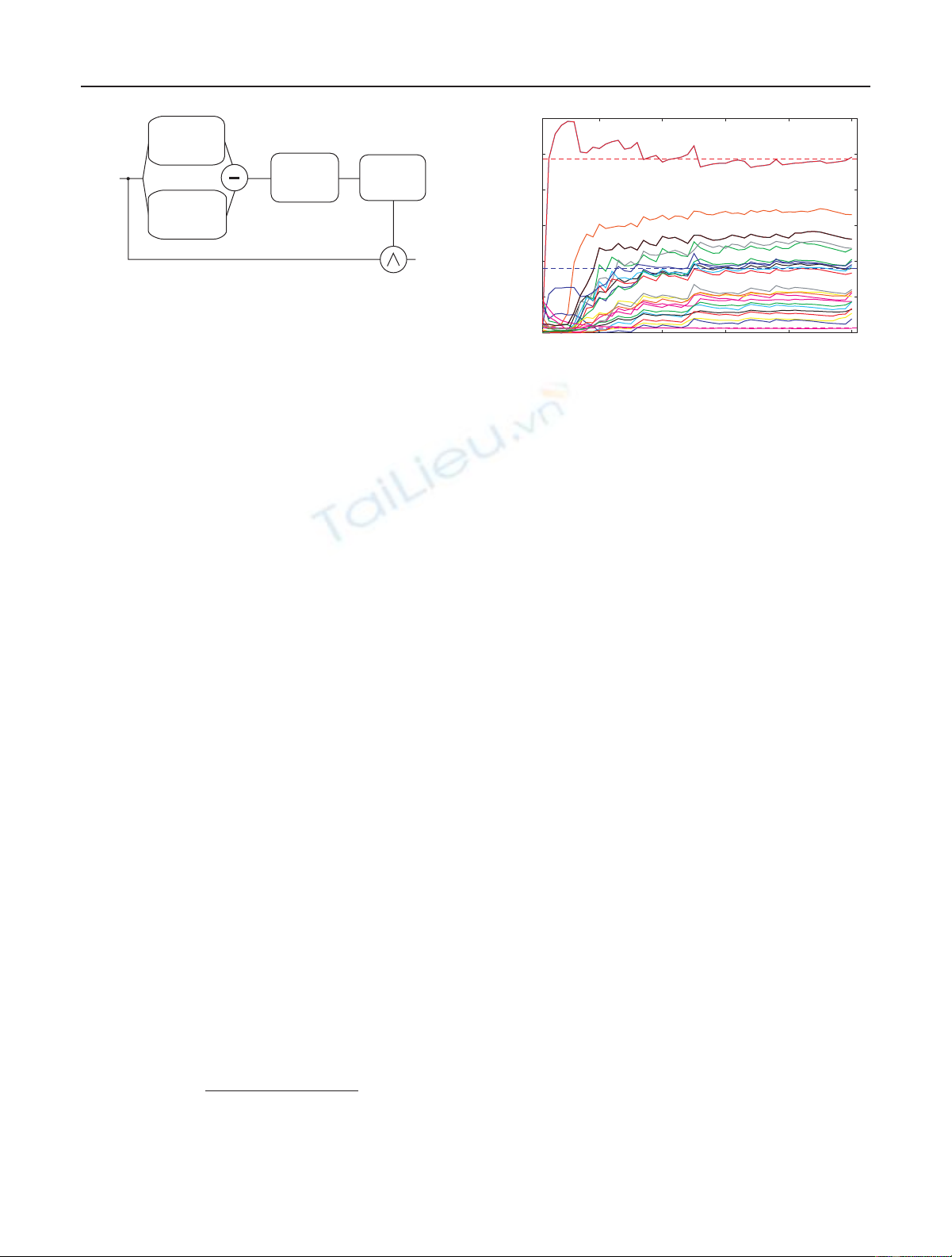
A framework, whose block diagram is depicted in Figure 4,
has been implemented for the detection of color clusters. Al-
though the here-presented approach for seal detection is un-
dertaken on an RGB color model, the framework can be ap-
plied on any multidimensional one. The used strategy con-
siders the computation of the fuzzy integral on the color
channels of the input image with respect to two different
fuzzy measures. These are selected in order for the color clus-
tertobedetectedtobemaximallyaffected by the change
in its coefficients. Thus two gray value images are obtained.
Thence the difference image of these results is computed and
thresholded in order to generate a binary mask. This mask is
dilated and used on the input image in order to segment the
seal (see Figure 4). The methodology is formally detailed in
the following paragraphs.
Being I(x,y)={IR(x,y), IG(x,y), IB(x,y)}the input
color image in the RGB color model, in the first stage, a dif-
ference image Id(x,y) is obtained by applying
Id(x,y)=
Fµ1(x,y)−Fµ2(x,y)
,(3)
where Fµistates for the images resulting from the compu-
tation of the fuzzy integral with respect to the fuzzy mea-
sure µion each color pixel, as expressed by (1)or(2)for
x1=IR(xi,yi), x2=IG(xi,yi), x3=IB(xi,yi). A binary im-
age Ib(x,y) is thence generated by applying a threshold θon
Id(x,y):
Ib(x,y)=
1, Id(x,y)≥θ,
0, Id(x,y)<θ. (4)
Any binarization procedure based on histogram analysis can
be applied for this purpose. In order to get rid of possible
failing parts, the mask image Im(x,y) results from the appli-
cation of a once iterated morphological dilation on this im-
age:
Im(x,y)=Ib(x,y)⊕S,(5)
where Sis a structuring element usually taken as a 4-
neighborhood. Finally, the output image Io(x,y)iscomputed
by filtering the input image with the obtained mask with a
logical AND operator:
Io(x,y)=I(x,y)∧Im(x,y).(6)
The obtained results on a first test image show the re-
sults of different stages of the framework (see Figure 2). A
comparison of the framework performance by applying the
Choquet and the Sugeno fuzzy integrals can be undertaken
Color Seal Extraction through Soft Data Fusion 2149
(a) (c)
(b) (d)
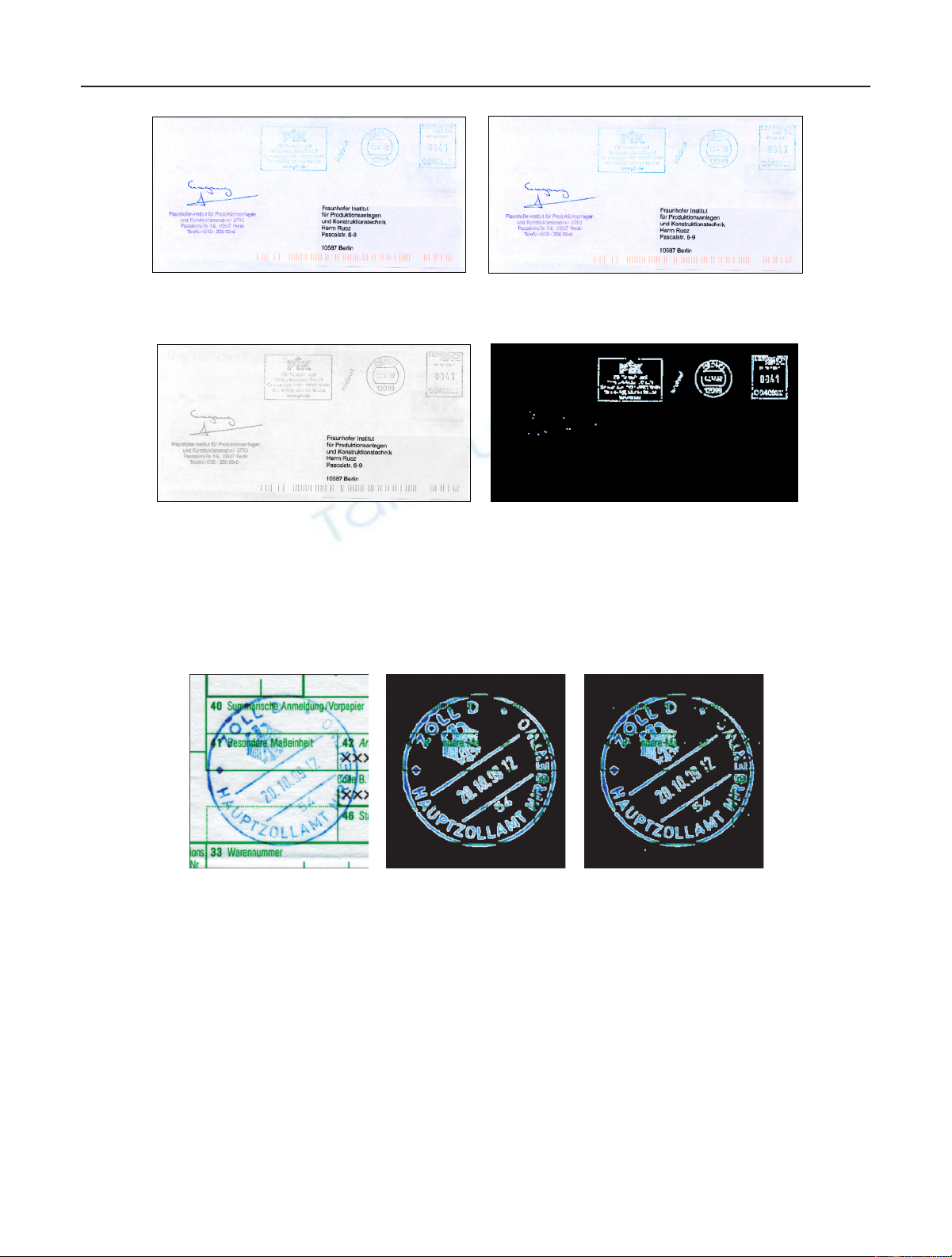
Figure 2: Example on the application of the Sugeno fuzzy integral for segmentation of seals on a post letter through the here-presented
framework (see Figure 4). (a) Input image. (b) Sugeno fuzzy integral result with the first fuzzy measure, Sµ1(x,y). (c) Sugeno fuzzy integral
result with the second fuzzy measure, Sµ2(x,y). (d) Final result, Io(x,y).
(a) (b) (c)
Figure 3: Segmentation of seals on a tax form achieved by applying the here-presented framework based on the two types of fuzzy integrals.
(a) Input image. (b) Choquet fuzzy integral. (c) Sugeno fuzzy integral.
on Figure 3. The suitability of one or another type of inte-
gral is application dependent. Although hitherto no general
statements on the selection of the fuzzy integral type can be
made [16], our experiments showed a better performance of
the Choquet fuzzy integral (compare Figures 3b and 3c).
Lastly, it is worth mentioning how the fuzzy measure co-
efficients have to be selected. This is undertaken by first de-
termining the canonical region occupied by the color cluster
to be extracted. The coefficients that control this canonical
region are selected. The value of these coefficients can be set
up by a process of extensive search. In this search, a maximal
value of Id(x,y) should be attained when applying these val-
ues. The process can be automated by applying numerical
optimization procedures, for example, genetic algorithms,
although this possibility has not been considered in the here-
presented framework.
2150 EURASIP Journal on Applied Signal Processing
Input
image
Fuzzy integral
measure 1
Fuzzy integral
measure 2
Threshold Dilation
Output
image
Ᏺµ1
Ᏺµ2
IdIb
Im
Figure 4: Block diagram of the here-presented framework for the
detection of seals on document images. A fuzzy integral is firstly
computed with respect to two different fuzzy measures. The change
of fuzzy measure mainly affects the seal color cluster, leaving the
other components of the image unmodified. A binary mask image
is obtained by subtracting those images, thresholding, and dilating
the result. This mask is finally applied in order to extract the seal of
the input image.
3.1. Application for color seal detection on
document images
In the presented application, which attain the segmentation
of seals as the one depicted in Figure 3, the color cluster of
the seal is maximally affected by a change in the coefficient
µi({xG,xB})=µi
GB. This fact is a consequence of the position
of the bluish color cluster in the canonical region of the color
feature space where IB(x,y)≥IG(x,y)≥IR(x,y). Thus the
two employed fuzzy measures differ in the coefficient µGB.
The used strategy exploits in this way the flexibility of the
fuzzy integral related to the ranking-based weighting men-
tioned in the previous section.
In the application on hand, it is suitable to set the coeffi-
cients of the first fuzzy measure in order for the fuzzy integral
to be equivalent to a minimum operator among the pixels
of the color channels. This is achieved by setting µ1
RGB =1
and the remaining coefficients of µ1to 0. The purpose of
this setting is the reduction of parameters. Since µ1
GB =0,
the methodology just presents two parameters, that is, µ2
GB
and θ.
3.2. Numerical analysis of performance
Due to a nondisclosure agreement with the enterprise deliv-
ering the stamped tax-form images, these and the results ob-
tained on them cannot be depicted. Therefore, the segmen-
tation results are commented on hand of an analytical crite-
rion.
Among the criteria presented in [17] the so-called good-
ness from region shape is selected. Since the seal to be seg-
mented presents a circular shape as the one depicted in
Figure 3, the following eccentricity coefficient [18]iscom-
puted on the obtained difference images Id(x,y):
ε=m2,0 −m0,22+4·m2
1,1
m2,0 +m0,22,(7)
where mp,qfor all p+q=2 are the second-order moments of
the gray value image [18].Therealvalueofε, which charac-
0
0.05
0.1
0.15
0.2
0.25
0.3
0.196%
0.065%
50 100 150 200 250
Fuzzy measure coefficient µ2
GB (gray value)
Eccentricity coefficient
Figure 5: Eccentricity coefficient [18](y-axis) for 20 tax forms of a
real data set of seals as the one depicted in Figure 3. The coefficient is
computed on Id(x,y)(3) obtained with the Choquet fuzzy integral.
The two used fuzzy measures differ in µj
GB:µ1
GB =0.0andµ2
GB =
i/255 for all i=5, 10, ..., 250 (x-axis). The eccentricity coefficient
of two reference images is included for comparison (the mean value
of these references is depicted through a dotted line together labeled
with the percentage of false segmented pixels). A third reference is
given by the mean value of the eccentricity coefficient for the image
depicted in Figure 3a (dotted line at the bottom of the figure).
.
terizes shape information, ranges from 0.0 for circular shapes
to 1.0 for linear ones. The eccentricity coefficientisrotation,
scale, and translation invariant, which compensates for the
different position and orientation of the seals in the different
images.
4. ANALYSIS OF RESULTS
The described methodology was applied on 20 documents
from the application at hand, which attains the segmentation
of the seals for its posterior falsification detection. These doc-
uments include a seal that presents all the same motif, which
is analogous to the one depicted in Figure 3. The documents
are taken from real offices, that is, documents worked out in
real offices. Thus they present the seal to be segmented to-
gether with different other elements of similar color hue, for
example, pen notations, other seals.
The Choquet fuzzy integral outperforms the results of
the Sugeno fuzzy integral on the evaluation set due to its
smoother response (see Figure 3). The eccentricity coeffi-
cient of the difference image computed by applying (3)
is computed for different values of µ2
GB anddepictedin
Figure 5. Because of the circular form of the analyzed seal
(see Figure 3), the coefficient should present a value as low-
est as possible.
For the sake of comparison, two images with artificial er-
rors are added to the data set. Thus a compact area with the
same color hue as the seal was synthetically added on one
of the images of the evaluation set. The first disturbing re-
gion was placed at 180 pixel distance of the seal center and