Note
Identification
of
the
two
common
alleles
of
the
bovine
κ-casein
locus
by
the
RFLP
technique,
using
the
enzyme
Hind
III
H.
LEVÉZIEL
Liliane
MÉTÉNIER
Marie-Françoise
MAHÉ
J.
CHOPLAIN,
J.-P. FURET
G.
PABŒUF
J.-C.
MERCIER
F.
GROSCLAUDE
Institut
National
de
la
Recherche
Agronomique,
Gaboratoire
de
Génétique
Biochimigue,
Centre de
Recherches
de
Jouy-en-Josas,
78350
Jouy-en-Josas,
France
Summary
As
could
be
predicted
from
a
comparison
of
the
cDNA
sequences
established
by
S
TEWART
et
al.
(1984)
and
G
ORODETSKIY
&
K
ALEDIN
(1987)
the
two
common
alleles
of
the
bovine
K
-casein
locus,
K
-Cn’
and
K
-Cn’,
can
be
identified
by
the
restriction
fragment
length
polymorphism
(RFLP)
technique
using
either
Hind
III
or
Taq
I.
The
latter
endonuclease
also
detects
a
polymorphism
of
the
DNA
strand
carrying
the
allele
K
-Cn’.
However,
for
determination
of
both
alleles,
the
use
of
Hind
III
is
preferable
because,
according
to
the
data
of
the
above
authors,
the
RFLP
detected
by
that
enzyme
is
specific
for
the
amino-acid
substitution
responsible
for
the
difference
in
charge
of
the
two
K
-casein
variants.
When
DNA
is
prepared
from
blood
leucocytes,
the
occurrence
of
chimaerism
in
twins
may
cause
difficulties
in
interpretation.
Key
words :
cattle,
K
-casein,
genetic
variants,
RFLP.
Résumé
Identification
des
deux
allèles
communs
du
locus
de
la
caséine
K
-bovine
par
un
polymorphisme
de
longueur
des
fragments
de
restriction
obtenus
avec
l’enzyme
Hind
III
Comme
on
pouvait
le
prédire
par
comparaison
des
séquences
d’ADN
complémentaire
établies
par
S
TEWART
et
al.
(1984)
et
G
ORODETSKIY
&
K
ALEDIN
(1987),
les
deux
allèles
communs
du
locus
de
la
caséine
K
bovine,
K
-Cn"
et
K
-Cn
B,
sont
identifiables
par
un
polymorphisme
de
longueur
des
fragments
de
restriction,
en
utilisant
soit
Hind
III,
soit
Taq
I.
Cette
dernière
endonucléase
révèle
aussi
un
polymorphisme
du
brin
d’ADN
portant
l’allèle
K
-Cn".
Pour
la
détermination
des
deux
allèles,
l’utilisation
de
Hind
III
est
préférable
car,
d’après
les
données
des
auteurs
ci-dessus,
le
polymorphisme
détecté
par
cet
enzyme
est
spécifique
de
la
substitution
d’acides
aminés
responsa-
ble
de
la
différence
de
charge
entre
les
deux
variants
de
la
caséine
K.
Si
l’ADN
a
été
préparé
à
partir
de
leucocytes
du
sang,
l’existence
d’un
chimérisme
chez
les
jumeaux
peut
causer
des
difficultés
d’interprétation.
Mots
clés :
bovins,
caséine
K,
variants
génétigues,
polymorphisme
de
longueur
des
fragments
de
restriction.

Bovine
K
-casein,
of
which
the
primary
structure
(169
amino-acid
residues)
was
determined
by
ME
xciEx et
al.
(1973),
is
polymorphic
in
all
breeds,
with
two
common
variants,
K
-CnA
and
K
-CnB,
detectable
by
alkaline
gel
electrophoresis.
The
difference
in
electrophoretic
mobility
between
those
variants
results
from
the
substitution
148
Asp
(K-CnA) !
Ala
(K
-CnB)
(G
ROSCLAUDE
et
al.,
1972).
In
addition
this
substitution
was,
in
the
small
number
of
samples
analysed,
associated
with
a
second
substitution,
136
Thr
(K-CnA) !
Ile
(K
-CnB),
which
has
no
effect
on
the
net
charge
of
the
protein.
It
may
be
concluded
from
several
concordant
studies
that,
as
compared
to
variant
K
-CnA,
variant
K
-CnB
gives
the
milk
better
cheese
making
properties,
mainly
shorter
rennet
clotting
time
and
rate
of
firmness,
firmer
curd,
and,
for
certain
types
of
cheese,
higher
yielding
capacity
(see
review
by
G
ROSCLAUDE
,
1988).
This
would
recommend
a
selection
for
allele
K
-Cn’
in
dairy
breeds.
Unfortunately
the
possibility
of
determining
the
genotype
of
bulls
at
locus
K
-Cn
by
testing
progeny
milk
samples
takes
about
five
years.
The
detection
of
alleles
K
-Cn’
and
K
-Cn
B
at
birth,
by
DNA
analysis,
could
thus
be
of
a
real
practical
interest.
A
comparison
of
the
cDNA
sequences
of
the
alleles
K
-Cn
A
(S
TEWART
et
al.,
1984)
and
K
-Cn
l
(G
ORODETSKIY
&
K
ALEDIN
,
1987)
reveals
that
the
mutation
A !
C,
respon-
sible
for
the
substitution
148
Asp -
Ala,
induces
a
Hind
III
site
in
the
allele
K
-Cn
B
(fig.
1),
and
that
the
mutation
C -
T
responsible
for
the
substitution
136
Thr -
Ile
induces
a
Taq
I
site
in
the
same
allele.
Moreover,
no
other
Hind
III
or
Taq
I
site
exists
within
these
two
published
cDNA
sequences.
Those
observations
suggested
a
possible
identification
of
alleles
K
-Cn
A
and
K
-Cn
l
by
the
technique
of
restriction
fragment
length
polymorphism
(RFLP)
using
enzymes
Hind
III
and
Taq
I.

II.
Materials
and
methods
A. Animals
Forty-five
Normande
or
Holstein
cows
from
the
INRA
experimental
herd
at
Le
Pin-au-Haras,
in
Normandy,
comprising
the
female
progeny
of
25
different
bulls,
were
investigated
(table
1).
Only
14
cows
formed
dam-daughter
pairs :
6
dams
and
their
8
daughters,
including
2
half-sisters
and
2
twins.
B.
Preparation
and
phenotype
analysis
of
whole
casein
Bovine whole
casein
was
prepared
by
isoelectric
precipitation
of
individual
skim-
milk
samples
and
analyzed
by
starch
gel
electrophoresis
at
pH
8.6,
as
previously
described
(G
ROSCLAUDE
et
al.,
1965).
C.
K
-casein
cDNA
probe
A
648
bp
long
ovine
K
-casein
cDNA
starting
at
the
211th
nucleotide
of
the
full-
length
counterpart,
at
the
level
of
the
47th
codon
(F
URET
et
al. ,
1988,
submitted),
was
radiolabelled
with
((Xl
2p)dCTP
to
a
specific
activity
of
10
9
dpm/ f.Lg,
using
the
«
multi-
prime
DNA
labelling
system
RPN
1601
»
of
Amersham.
D.
Preparation
and
Southern
blot
analysis
of
genomic
DNA
Southern
blot
analysis
was
performed
according
to
the
10th
HLA
workshop’s
reference
protocol
(M
ARCADET
et
al. ,
1988).
Briefly,
20
ml
blood
samples
were
collected
in
EDTA,
and
after
elimination
of
red
cells
by
lysis,
the
leucocytes
were
incubated
overnight
at
42
°C
in
lysis
buffer
containing
proteinase
K.
Genomic
DNA
was
then
isolated
by
two
phenol-chloroform-isoamyl
alcohol
extractions,
then
precipitated
by
isopropanol
with
NaCI
(60
mM),
and
after
three
washes
with
70
%
ethanol,
resuspen-
ded
in
Tris-EDTA
(1
mM ;
0.1
mM ;
pH
7.6).
The
endonucleases
Hind
III
and
Taq
I
were
used
as
specified
by
the
manufacturer
(Boehringer),
but
spermidine
(2
mM)
was
added
to
Hind
III
digestions
and
the
enzymes
were
always
added
in
three
stages,
to

give
a
total
of
5
U/wg
DNA.
After
43 h
electrophoresis
(0.9
%
agarose ;
25
V),
and
alkaline transfer
(0.4
M
NaOH,
18
h
at
room
temperature)
onto
nylon
membrane
(Biotrace),
the
blots
were
incubated
for
5
h
at
42 °C
in
individual
plastic
bags
contai-
ning
30 ml
prehybridizing
solution :
50 %
formamide,
5 %
dextran
sulfate,
0.1 %
denhardt,
5
X
SSPE
(0.9
M
NaCI ;
50
mM
NaH,
P0
4
;
5
mM
EDTA ;
pH
7.7),
1
%
SDS
and
200
wg
salmon
sperm
DNA/ml.
Hybridization
was
carried
out
in
20
ml
of
the
above
(fresh)
solution
containing
25
ng
of
the
radiolabelled
cDNA
probe
(40
h ;
42 °C).
Membranes
were
washed
twice
with
2
X
9SPE
(room
temperature ;
5
min),
once
with
2
X
SSPE,
0.5
%
SDS
(65
°C ;
15
min),
and
finally
once
with
0.5
X
SSPE
(65
°C ;
15
min)
before
autoradiography
(X-OMAT-AR
films ;
Kodak).
Sizes
of
restriction
fragments
were
estimated
according
to
S
CHAFFER
&
S
EDEROFF
(1981)
by
running
both
&dquo;
Hind
III/Smal
&dquo;
and
&dquo; Kpnl/BstEll
&dquo;
phage
X
DNA
fragments
in
parallel,
as
well
as
the
standard
BRL
&dquo;
5615
SA/SB
&dquo;
molecular
size
marker
(data
not
shown).
III.
Results
Figure
2
shows
examples
of
patterns
found
after
hybridization
of
Hind
III
digests.
Besides
a
0.8
kb
fragment
present
in
all
samples,
a
polymorphism
made
up
of
fragments
of
approximately
2.2,
3.3
and
5.5
kb
may
be
observed.
A
comparison
of
this
polymorphism
with
the
genotypes
deduced
from
electrophoresis
of
the
protein
indicated
that
the
genotype
K
-Cn^’&dquo;
gave
only
the
5.5
kb
fragment,
while
the
genotype
K
-Cn
8
’b
gave
both
the
2.2
and
3.3
kb
fragments,
a
result
compatible
with
the
existence
of
an
additional
Hind
III
site
in
allele
K
-Cn’.
As
expected,
the
heterozygous
genotype,
K
-CnAIB
,
gave
all
three
fragments,
except
in
one
case
(Holstein
cow
042,
a
twin)
for
which
the
DNA
pattern
was
that
otherwise
associated
with
the
K
-Cn
B’B
genotype.
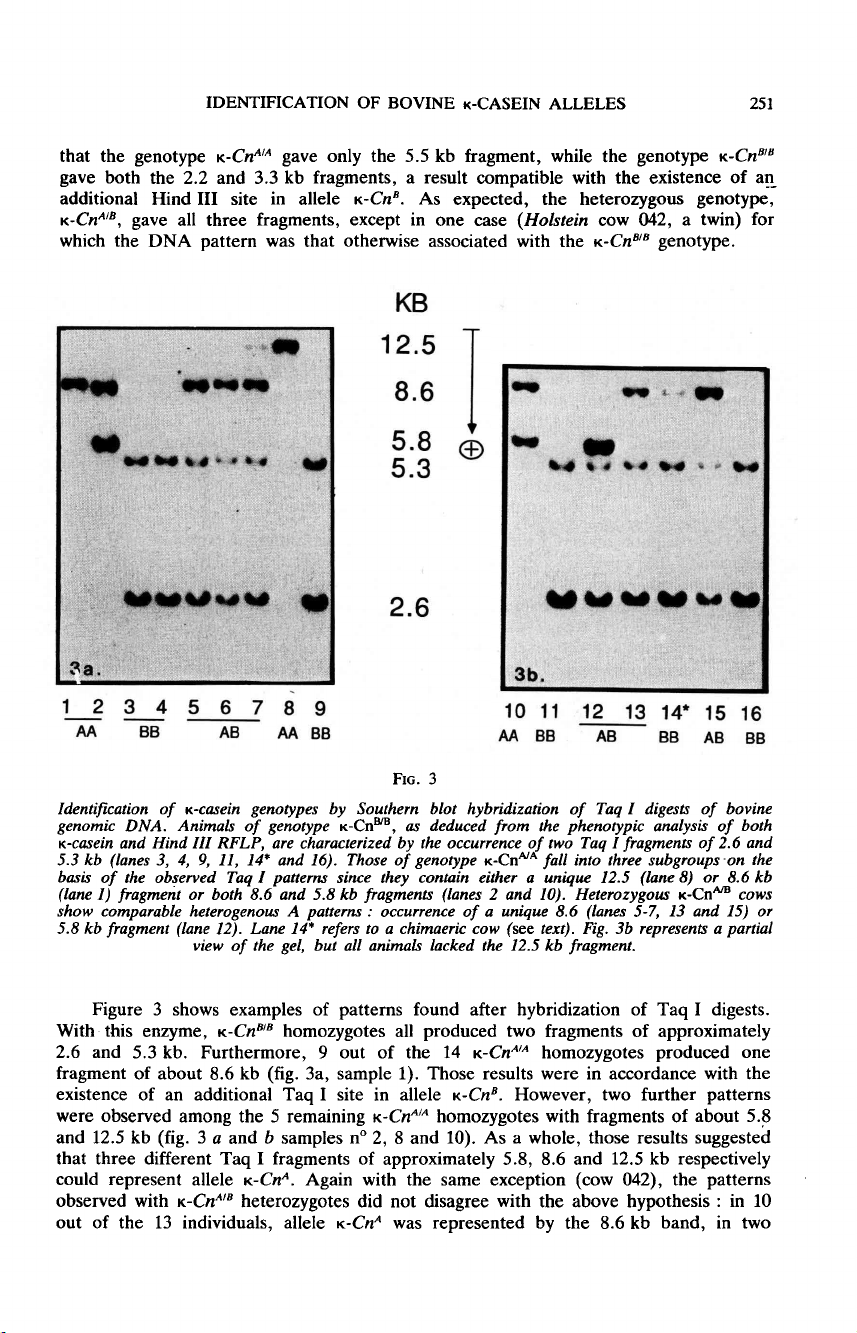
Figure
3
shows
examples
of
patterns
found
after
hybridization
of
Taq
I
digests.
With
this
enzyme,
K
-Cn,&dquo;’
homozygotes
all
produced
two
fragments
of
approximately
2.6
and
5.3
kb.
Furthermore,
9
out
of
the
14
K
-Cn&dquo;’&dquo;
homozygotes
produced
one
fragment
of
about
8.6
kb
(fig.
3a,
sample
1).
Those
results
were
in
accordance
with
the
existence
of
an
additional
Taq
I
site
in
allele
K
-Cn
B.
However,
two
further
patterns
were
observed
among
the
5
remaining
K
-Cn&dquo;’&dquo;
homozygotes
with
fragments
of
about
5.8
and
12.5
kb
(fig.
3
a
and
b
samples
n°
2,
8
and
10).
As
a
whole,
those
results
suggested
that
three
different
Taq
I
fragments
of
approximately
5.8,
8.6
and
12.5
kb
respectively
could
represent
allele
K
-Cn&dquo;.
Again
with
the
same
exception
(cow
042),
the
patterns
observed
with
K
-Cn
A
ll
heterozygotes
did
not
disagree
with
the
above
hypothesis :
in
10
out
of
the
13
individuals,
allele
K-Cn!
was
represented
by
the
8.6
kb
band,
in
two