
BioMed Central
Page 1 of 16
(page number not for citation purposes)
Algorithms for Molecular Biology
Open Access
Software article
A basic analysis toolkit for biological sequences
Raffaele Giancarlo*, Alessandro Siragusa, Enrico Siragusa and Filippo Utro
Address: Dipartimento di Matematica Applicazioni, Università di Palermo, Italy
Email: Raffaele Giancarlo* - raffaele@math.unipa.it; Alessandro Siragusa - alessandro.siragusa@gmail.com; Enrico Siragusa - enricos@imap.cc;
Filippo Utro - filippo.utro@gmail.com
* Corresponding author
Abstract
This paper presents a software library, nicknamed BATS, for some basic sequence analysis tasks.
Namely, local alignments, via approximate string matching, and global alignments, via longest
common subsequence and alignments with affine and concave gap cost functions. Moreover, it also
supports filtering operations to select strings from a set and establish their statistical significance,
via z-score computation. None of the algorithms is new, but although they are generally regarded
as fundamental for sequence analysis, they have not been implemented in a single and consistent
software package, as we do here. Therefore, our main contribution is to fill this gap between
algorithmic theory and practice by providing an extensible and easy to use software library that
includes algorithms for the mentioned string matching and alignment problems. The library consists
of C/C++ library functions as well as Perl library functions. It can be interfaced with Bioperl and
can also be used as a stand-alone system with a GUI. The software is available at http://
www.math.unipa.it/~raffaele/BATS/ under the GNU GPL.
1 Introduction
Computational analysis of biological sequences has
became an extremely rich field of modern science and a
highly interdisciplinary area, where statistical and algo-
rithmic methods play a key role [1,2]. In particular,
sequence alignment tools have been at the hearth of this
field for nearly 50 years and it is commonly accepted that
the initial investigation of the mathematical notion of
alignment and distance is one of the major contributions
of S. Ulam to sequence analysis in molecular biology [3].
Moreover, alignment techniques have a wealth of applica-
tions in other domains, as pointed out for the first time in
[4].
Here we concentrate on alignment problems involving
only two sequences. In general, they can be divided in two
areas: local and global alignments [1]. Local alignment
methods try to find regions of high similarity between two
strings, e.g. BLAST [5], as opposed to global alignment
methods that assess an overall structural similarity
between the two strings, e.g. the Gotoh alignment algo-
rithm [6]. However, at the algorithmic level, both classes
often share the same ideas and techniques, being in most
cases all based on dynamic programming algorithms and
related speed-ups [7]. More in detail, we have implemen-
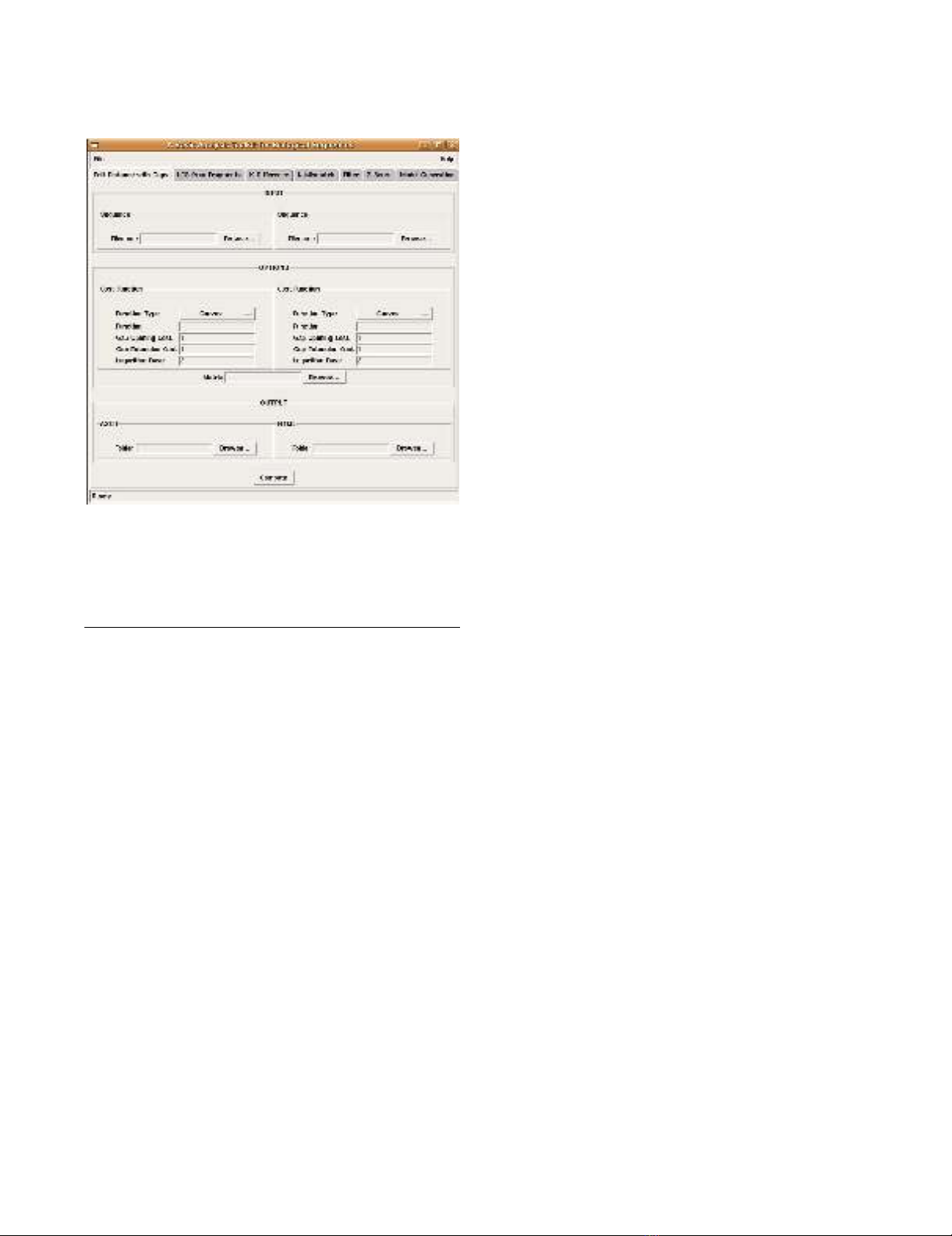
tations for (see also Fig. 1 for the corresponding function
in the GUI):
(a) Approximate string matching with k mismatches. That
is, given a pattern and text string and an integer k, we are
interested in finding all occurrences of the pattern in the
text with at most k mismatching characters per occurrence.
We provide an implementation of an algorithm given in
[8]. It is a simplification of the first efficient algorithm
Published: 18 September 2007
Algorithms for Molecular Biology 2007, 2:10 doi:10.1186/1748-7188-2-10
Received: 7 May 2007
Accepted: 18 September 2007
This article is available from: http://www.almob.org/content/2/1/10
© 2007 Giancarlo et al; licensee BioMed Central Ltd.
This is an Open Access article distributed under the terms of the Creative Commons Attribution License (http://creativecommons.org/licenses/by/2.0),
which permits unrestricted use, distribution, and reproduction in any medium, provided the original work is properly cited.
Algorithms for Molecular Biology 2007, 2:10 http://www.almob.org/content/2/1/10
Page 2 of 16
(page number not for citation purposes)
obtained for this problem, due to Landau and Vishkin [9].
The asymptotically fastest known algorithm to date is due
to Amir, Lewenstein and Porat [10]. Formalization of the
problem, as well as description of the algorithm and
library functions, both in C/C++ and Perl, is given in sec-
tion 2.
(b) Approximate string matching with k differences. That
is, given a pattern and text string and an integer k, we are
interested in finding all occurrences of the pattern in the
text with at most k differences where, for each occurrence
a "difference" is a character to be inserted, deleted or sub-
stituted in the pattern. We provide an implementation of
the algorithm by Landau and Vishkin [11], although the
asymptotically most efficient one, to date, has been
recently obtained by Cole and Hariharan [12]. Formaliza-
tion of the problem, as well as description of the algo-
rithm and library functions, both in C/C++ and Perl, is
given in section 3.
(c) The longest common subsequence from fragments, a
generalization of the well known longest common subse-
quence problem [1], considered by Baker and Giancarlo
[13]. Formalization of the problem, as well as description
of the algorithm and library functions, both in C/C++ and
Perl, is given in section 4.
(d) Edit distance with concave and affine gap penalties. It
is the well known generalization of the edit distance
between two strings introduced by M.S. Waterman [14],
i.e., with the use of concave gap costs. We provide an
implementation of the algorithm obtained by Galil and
Giancarlo [15] (GG algorithm for short). An analogous
algorithm was obtained independently by Miller and
Myers [16]. We also point out that the asymptotically
most efficient algorithm, to date, is still the one given by
Klawe and Kleitman [17], although it seems to be mainly
of theoretic interest. It is also worth mentioning that the
GG algorithm naturally specializes to deal with affine gap
costs. Formalization of the problem, as well as description
of the algorithm and library functions, both in C/C++ and
Perl, is given in section 5.
(e) Filtering, statistical significance computation and
organism model generation. The first two functions allow
to select a subset of strings from a given set and to assess
its statistical significance via z-score computation [18].
The third function is required in order to give to the first
two, a probabilistic model of the input data. While the fil-
tering techniques are quite standard, the implementation
of the z-score computation is a specialization of a non-
trivial implementation by Sinha and Tompa, used for
motif discovery [19]. Our code, as the one by Sinha and
Tompa, works only for DNA sequences. The function
allowing for the generation of a user-specified model
organism gives, in a suitable format, all probabilistic
information needed by the z-score function. Description
of this part of the system, as well as presentation of the
corresponding library functions, both in C/C++ and Perl,
is given in section 6.
As it is self-evident from the description just given, this
software library is not intended as a generic programming
environment, like Leda for combinatorial and geometric
computing [20]. An initial attempt, in that direction, for
string algorithms is described in [21]. The software pre-
sented here is more tailored at specific alignment prob-
lems. We also point out that most of the algorithms
implemented in BATS are based on suffix trees [22]. Here
we use the algorithm by Ukkonen [23] in the Strmat
library [24]. It is not particularly memory-efficient (17
bytes/character) and that may be problematic for genome-
wide applications of the corresponding algorithms. We
finally point out that the entire library can be used as a
stand-alone system with a GUI and it can be interfaced
with Bioperl. A detailed user manual, together with instal-
lation procedures, file formats etc., is given at the supple-
mentary web site [25].
a snapshot of the GUIFigure 1
a snapshot of the GUI. An overview of the GUI of BATS.
The top bar has a specific button for each of the algorithms
and functions implemented. Then, each function has its own
parameter selection interface. The Edit Distance function
interface is shown here.

Algorithms for Molecular Biology 2007, 2:10 http://www.almob.org/content/2/1/10
Page 3 of 16
(page number not for citation purposes)
2 Approximate string matching with k
mismatches
Given a text string text = t[1, n], a pattern string pattern =
p[1, m] and an integer k, k ≤ m ≤ n, we are interested in
finding all occurrences of the pattern in the text with at
most k mismatches, i.e. with at most k locations in which
the pattern and a text substring have different symbols.
Let Prefix(i, j) be a function that returns the length of the
longest common prefix between p[i, m] and t[j, n]. It can
be computed in O(1) time, after the following preprocess-
ing step: (A) build the suffix tree T [22] of the strings p[1,
m]$t[1, n], where $ is a delimiter not appearing anywhere
else in the two strings; (B) preprocess T so that Lowest
Common Ancestor (LCA for short) queries can be
answered in constant time [26]. The preprocessing step
takes O(n + m) time and it is well known that the compu-
tation of Prefix(i, j) reduces to the computation of one
LCA query on the leaves of T [8].
Once that the preprocessing step is completed, we can
find the first (leftmost) mismatch between p[1, m] and t[j,
j + m - 1] in O(1) time by use of Prefix(1, j). If we keep
track of where this mismatch occurs, say
1: Algorithm SM
2: for j = 1 to n do
3: pt ← j; v ← 1; num_mismatch ← 0;
4: **t[j, j + m - 1] is aligned with p[1, m] and no mis-
match has been found**
5: while v ≤ m - 1 and num_mismatch ≤ k do
6:
7: **find leftmost mismatch between t[pt, pt + m - 1]
and p[v, m]**
8: ᐍ ← Prefix(v, pt)
9: if v + ᐍ ≤ m then
10: num_mismatch ← num_mismatch + 1
11: end if
12: pt ← pt + ᐍ + 1; v ← v + ᐍ + 1;
13: end while
14: if num_mismatch ≤ k then
15: found match
16: end if
17: end for
at position l of pattern, we can locate the second mis-
match, in O(1) time, by finding the leftmost mismatch
between p[l + 1, m] and t[j + l - 1, j + m - 1]. In general, the
q-th mismatch between p[1, m] and t[j, j + m - 1] can be
found in O(1) time by knowing the location of the (q - 1)-
th mismatch. Algorithm SM gives the needed pseudo-
code. We have:
Theorem 2.1 [8,9]Given a pattern p and a text t of length m
and n respectively, Algorithm SM finds all occurrences of p in t
with at most k mismatches in O(m + n + nk) time, including
the preprocessing step.
2.1 The C/C++ library functions
The function below returns all occurrences, with at most k
mismatches, of a pattern within a text.
Synopsis
#include "k_mismatch.h"
OCCURRENCES
k_mismatch(char*text, char*pattern, int k);
Arguments:
• text: points to a text string;
• pattern: points to a pattern string;
• k: is an integer giving the maximum number of allowed
mismatches.
Return Values: k_mismatch returns a pointer to
OCCURRENCES_STRUCT, defined as:
typedef struct occurrences
{
int start, end;
int errors;
char*text;
char*pattern;

Algorithms for Molecular Biology 2007, 2:10 http://www.almob.org/content/2/1/10
Page 4 of 16
(page number not for citation purposes)
struct occurrences*next;
} OCCURRENCES_STRUCT, *OCCURRENCES;
where:
• start: is the start position of this occurrence in the text
string;
• end: is the end position of this occurrence in the text
string;
• errors: the number of mismatches of this occurrence;
• text: is a pointer to the aligned substring corresponding
to the occurrence found;
• pattern: is a pointer to the aligned pattern string.
2.2 The PERL library functions
The function below returns all occurrences, with at most k
mismatches, of a pattern within a text.
Synopsis
use BSAT::K_Mismatch;
K_Mismatch Text Pattern K
Arguments:
• Text: is a scalar containing the text string;
• Pattern: is a scalar containing the pattern string;
• K: is a scalar giving the maximum number of allowed
mismatches.
Return values: The function returns an array of occur-
rences. Each occurrence consists of a hash:
my %occurrence = (
errors => 0,
start => 0,
end => 0,
text => "",
pattern => "");
where the above fields are as in the
OCCURRENCES_STRUCT defined earlier.
3 Approximate string matching with k
differences
In this section we consider a more general problem of
approximate string matching by extending the set of
allowed differences between strings. Letting text, pattern
and k be as in section 2, we are interested in finding all
occurrences of pattern in text with at most k differences.
The allowed differences are:
(a) A symbol of the pattern corresponds to a different
symbol of the text, i.e., a mismatch.
(b) A symbol of the pattern corresponds to no symbol in
the text.
(c) A symbol of the text corresponds to no symbol in the
pattern.
Let A be an (m + 1) × (n + 1) dynamic programming
matrix and consider the following recurrence:
A[0, j] = 0, 0 ≤ j <n.(1)
A[i, 0] = i, 0 ≤ i <m.(2)
A[i, j] = min(A[i - 1, j] + 1, A[i, j - 1] + 1, if p[i] = t[j] then
A[i - 1, j - 1] else A[i - 1, j - 1] + 1). (3)
Matrix A can be computed row by row, or column by col-
umn, in O(nm) time. Moreover, it can be easily shown
that A[i, j] is the minimal edit distance between p[1, i] and
a substring of text ending at position j. Thus, it follows that
there is an occurrence of the pattern in the text ending at
position j of the text if and only if A[m, j] ≤ k. The compu-
tation of A can be substantially sped-up by observing that,
for any i and j, either A[i + 1, j + 1] = A[i, j] or A[i + 1, j +
1] = A[i, j] + 1. That is, the elements along any diagonal of
A form a non-decreasing sequence of integers. Thus, the
computation of A can be performed by finding, for all
diagonals, the rows in which A[i + 1, j + 1] = A[i, j] + 1 ≤
k. Such an observation was exploited by Ukkonen [27] in
order to obtain a space efficient algorithm for the compu-
tation of the edit distance between two strings. Landau
and Vishkin [11] cleverly extended the method by Ukko-
nen to obtain an efficient algorithm that handles the more
general problem of string matching with k differences. We
present their algorithm here, although the asymptotically
most efficient one, to date, has been recently obtained by
Cole and Hariharan [12].
Let Ld,e denote the largest row i such that A[i, j] = e and j -
i = d. The definition of Ld, e implies that e is the minimal
number of differences between p[1, Ld,e] and the sub-
strings of the text ending at t[Ld,e + d], with p[Ld,e + 1] ≠
t[Ld,e + d + 1]. In order to solve the k differences problem,

Algorithms for Molecular Biology 2007, 2:10 http://www.almob.org/content/2/1/10
Page 5 of 16
(page number not for citation purposes)
we need to compute the values of Ld,e that satisfy e ≤ k.
Assuming that Ld+1,e-1, Ld-1,e-1 and Ld,e-1 have been correctly
computed, Ld,e is computed as follows. Let row =
max(Ld+1,e-1 + 1, Ld-1,e-1, Ld,e-1 + 1) and let ᐍ be the largest
integer such that p[row + 1, row + ᐍ] = t[d + row + 1, d + row
+ ᐍ]. Then, Ld,e = row + ᐍ. The proof of correctness of such
a computation is a simple exercise, left to the reader.
Moreover, if one makes use of the preprocessing algo-
rithms presented in section 2, Ld,e can be computed in
O(1) time as follows:
Ld,e = row + Prefix(row + 1, row + d + 1). Algorithm SD gives
the needed pseudo-code. We have:
Theorem 3.1 [11]Given a pattern p and a text t, of length m
and n, respectively, Algorithm SD finds all occurrences of p in
t with at most k differences in O(m + n + nk) time, including
the preprocessing step.
3.1 The C/C++ library functions
The function below returns all occurrences of a pattern
within a text with at most k differences.
Synopsis
#include " k_difference.h"
OCCURRENCES
k_difference (char*text, char*pattern, intk);
Arguments: As in function k_mismatch
Return Values: As in function k_mismatch
1: Algorithm SD
2: **Initial Conditions Start Here**
3: for d := 0 to n do
4: L[d, -1] ← -1
5: end for
6: for d := -(k + 1) to -1 do
7: L[d, |d| - 1] ← |d| - 1
8: L[d, |d| - 2] ← |d| - 2
9: end for
10: for e := -1 to k do
11: L[n + 1, e] ← -1
12: end for
13: **Initial Conditions End Here**
14: for e := 0 to k do
15: for d := -e to n do
16: row ← max(L[d, e - 1] + 1, L[d - 1, e - 1], L[d + 1, e
- 1] + 1
17: row ← min(row, m)
18: if row <m and row + d <n then
19: row ← row + Prefix(row + 1, row + d + 1)
20: end if
21: L[d, e] ← row
22: if L[d, e] = m and d + m ≤ n then
23: **Occurrence Found**
24: end if
25: end for
26: end for
3.2 The PERL library functions
The function below returns all occurrences of a pattern
within a text with at most k differences.
Synopsis
use BSAT::K_Difference;
K_Difference Text Pattern K
Arguments: As in function K_Mismatch
Return values: As in function K_Mismatch
4 Longest common subsequence from
fragments
In this section we consider the problem of identifying a
longest common subsequence (LCS for short) of two
strings X and Y, using a set M of matching fragments. That
is, strings of a given length that appear in both X and Y.
We start by reviewing some basic notions about LCS com-
putation and relate them to approximate string matching,