
A DETERMINANT OF THE CHUDNOVSKYS
GENERALIZING THE ELLIPTIC FROBENIUS-STICKELBERGER-CAUCHY
DETERMINANTAL IDENTITY
Tewodros Amdeberhan
Mathematics, DeVry Institute of Technology, North Brunswick, NJ 08902, USA
amdberha@nj.devry.edu, tewodros@math.temple.edu
Submitted: October 16, 2000. Accepted: October 23, 2000.
Abstract.
D.V. Chudnovsky and G.V. Chudnovsky [CH] introduced a generalization of the Frobenius-
Stickelberger determinantal identity involving elliptic functions that generalize the Cauchy determinant.
The purpose of this note is to provide a simple essentially non-analytic proof of this evaluation. This method
of proof is inspired by D. Zeilberger’s creative application in [Z1].
AMS Subject Classification: Primary 05A, 11A, 15A
One of the most famous alternants is the Cauchy determinant which is only a special case of a
determinant with symbolic entries:
(1) det 1
xi−yj1≤i,j≤n
=(−1)n(n−1)/2Qi<j(xi−xj)(yi−yj)
Qn
i=1 Qn
j=1(xi−yj).
This expression lends itself to explicit formulas in Pad´e approximation theory and further applications
in transcendental theory. On the other hand, the Cauchy determinant cannot be readily generalized to
trigonometric or elliptic functions. However, its associate can.
A natural elliptic generalization of the 1/x Cauchy kernel to the corresponding Riemann surface
would be the Weierstraß ζ-function. Such a generalization was supplied by Frobenius and Stickelberger
[FS], with references given to Euler and Jacobi.
D.V. Chudnovsky and G.V. Chudnovsky [CH] introduced a generalization of the Frobenius Stickel-
berger determinantal identity involving elliptic functions that generalizes the Cauchy determinant.
The purpose of this note is to provide a simple essentially non-analytic proof of this evaluation. This
method of proof is inspired by D. Zeilberger’s creative application in [Z1].
We begin by recalling some notations. Given the Weierstraß elliptic function, ℘(z), then the
Weierstraß ζ-function and σ-function are defined respectively by
(2) ℘(z)=−d
dz ζ(z),and ζ(z)= d
dz log σ(z).
Typeset by A
M
S-T
E
X
1
the electronic journal of combinatorics 7 (1) (2000), #N6
2
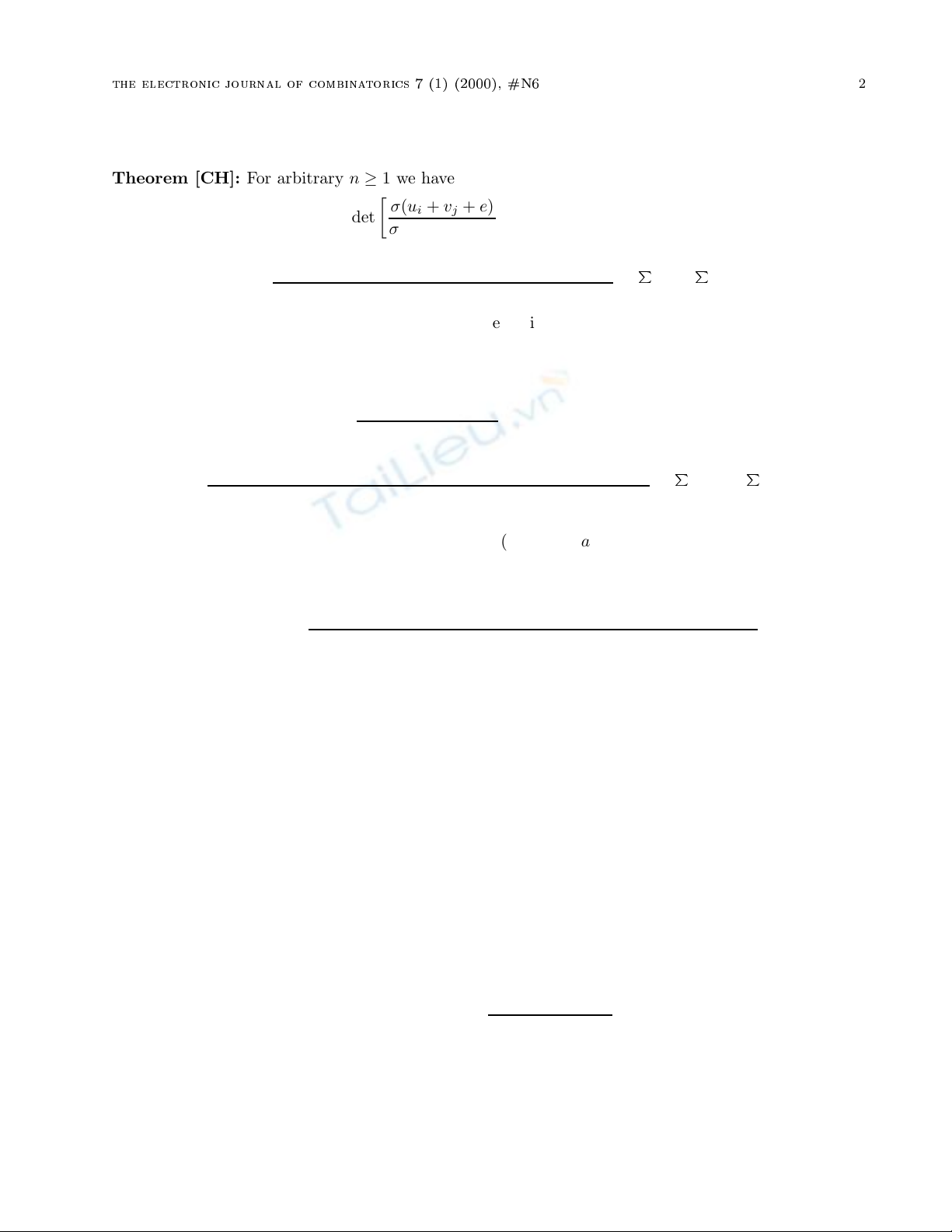
Theorem [CH]: For arbitrary n≥1wehave
det σ(ui+vj+e)
σ(ui+vj)σ(e)eγ1ui+γ2vj1≤i,j≤n
(3) = σ(Pui+Pvj+e)Qi>j σ(ui−uj)σ(vi−vj)
σ(e)Qn
i,j=1 σ(ui+vj)eγ1
P
ui+γ2
P
vj,
where ui,v
jand eare arbitrary parameters on the elliptic curve.
First, we prove a lemma (set a=b= 0 to get the result of the theorem).
Lemma: With the additional parameters aand b,wehave
det σ(ui+a+vj+b+e)
σ(ui+a+vj+b)σ(e)eγ1ui+a+γ2vj+b1≤i,j≤n
(4) = σ(Pui+a+Pvj+b+e)Qi>j σ(ui+a−uj+b)σ(vi+a−vj+b)
σ(e)Qn
i,j=1 σ(ui+a+vj+b)eγ1
P
ui+a+γ2
P
vj+b.
Proof: Let the left and right sides of equation (4) be Ln(a, b)andRn(a, b), respectively. Dodg-
son’s rule [D] (see [Z2] for a bijective proof) for evaluating determinants immediately implies [Z1] the
recurrence Lewis:
Xn(a, b)=Xn−1(a, b)Xn−1(a+1,b+1)−Xn−1(a+1,b)Xn−1(a, b +1)
Xn−2(a+1,b+1)
holds with X=L. Moreover, the same is true if X=R. Indeed the latter takes the form of a
“three-term recurrence”
σ(A1+A2)σ(A1−A2)σ(A4+A3)σ(A4−A3)=σ(A4+A1)σ(A4−A1)σ(A3+A2)σ(A3−A2)
−σ(A3+A1)σ(A3−A1)σ(A4+A2)σ(A4−A2),(5)
where
y:=
n−1
X
i=2
(ua+i+vb+i),w:= (y+ua+1 +ub+n)/2,A
1:= w−ua+1,
A2:= w−ua+n,A
3:= w+vb+1 and A4:= w+vb+n.
Equation (5) is similar to the well-known Jacobi identity on σ-functions (this is due to Weierstraß,
in lectures by Schwarz [S] p. 47):
σ(z+a)σ(z−a)σ(b+c)σ(b−c)+σ(z+b)σ(z−b)σ(c+a)σ(c−a)
+σ(z+c)σ(z−c)σ(a+b)σ(a−b)=0,
and both equations follow from θ-functions identities or the “parallelogram” identity
(6) ℘(z)−℘(y)=−σ(z+y)σ(z−y)
σ(z)2σ(y)2.

the electronic journal of combinatorics 7 (1) (2000), #N6
3
In fact, a repeated application of (6) in the former equation leads to a trivial algebraic equation in
cyclic notations
(℘(A1)−℘(A2))(℘(A4)−℘(A3)) −(℘(A4)−℘(A1))(℘(A3)−℘(A2))
+(℘(A3)−℘(A1))(℘(A4)−℘(A2)) = 0.
Since Ln(a, b)=Rn(a, b)forn= 1 (trivial!), and n= 2 (check!), it follows by induction that
Ln(a, b)=Rn(a, b)forall n.
References
[CH] D.V. Chudnovsky, G.V. Chudnovsky, Hypergeometric and modular function identities, and new rational approxi-
mations and continued fraction expansions of classical constants and functions, Contemporary Math. 143 (1993),
117-162.
[D] C.L. Dodgson, Condensation of Determinants, Proc. Royal Soc. of London 15 (1866), 150-155.
[FS] F. Frobenius, L. Stickelberger, Uber die Addition und Multiplication der elliptischen Functionen,F.Frobenius,
Gesammelte Abhandlungen, B. I (1968), Springer, New York, 612-650.
[S] H.A.Schwarz,Formeln und Lehrs¨atze zum Gebrauche der elliptichen Funktionen, Vorlesungen und Aufzeichnungen
des Herrn Prof. K. Weierstrass, Berlin, 1893.
[Z1] D. Zeilberger,, Reverend Charles to the aid of Major Percy and Fields Medalist Enrico, Amer. Math. Monthly 103
(1996), 501-502.
[Z2] D. Zeilberger,, Dodgson’s Determinant-Evaluation Rule Proved by TWO-TIMING MEN and WOMEN, Elec. J.
Comb. [Wilf Festchrifft] 4 (2) #R22 (1997).