
Even Bonds of Prescribed Directed Parity
Sven Hartmann and C.H.C. Little
Massey University, Palmerston North, New Zealand
[s.hartmann|c.little]@massey.ac.nz
Submitted: Aug 1, 2005; Accepted: Nov 8, 2005; Published: Nov 25, 2005
Mathematics Subject Classification: 05C75
Abstract
Given a set Sof vertices in a graph, the cocycle determined by Sis the set of edges
joining a vertex in Sto a vertex not in S. A bond is a minimal non-empty cocycle.
We characterise graphs that admit an orientation under which every bond of even
cardinality has a prescribed directed parity.
1 Introduction
In [2], Fischer and Little characterised those graphs that admit an orientation under which
every even circuit has directed parity in agreement with a preassigned parity. In other
words they assign a parity to every circuit of even length and determine the conditions
under which the graph can be oriented so that for every even circuit the parity of the
number of edges directed in agreement with a specified sense is equal to the parity assigned
to that circuit. In this paper we solve the corresponding problem for even bonds.
Given a graph G,letVGand EG denote its vertex set and its edge set, respectively.
An edge is called a link if it connects two distinct vertices, and a loop otherwise. Two
edges are parallel if they connect the same vertices. By G[X] we denote the subgraph of
Ginduced by a subset Xof either VG or EG. As long as no confusion arises, we will
write xinstead of Xif Xconsists of a single element xonly.
For any two subsets Sand Tof VG,let[S, T ] denote the set of all edges in EG
connecting some vertex in Sto some vertex in T. In particular, ∂S =[S, V G −S]
is called a cocycle of G. A cocycle Bis said to be elementary or a bond if Ghas a
component Csuch that B⊆EC and C−Bhas just two components. That is, deleting
the edges of Bfrom Gincreases the number of components of Gby exactly 1. It is well
known, cf. [1], that a bond is just a minimal non-empty cocycle, and that every cocycle
is a sum of disjoint bonds. (The sum of sets is defined as their symmetric difference.)
Abondiseven if it consists of an even number of edges, and odd otherwise. An
assignment of directed parities to the even bonds of Gis a mapping Jfrom the set of
even bonds of Ginto the set {0,1}.AnevenbondB=[S, T ] in a directed graph is
the electronic journal of combinatorics 12 (2005), #R64 1
J-oriented if the number of edges directed from Sto Tis congruent modulo 2 to J(B).
Note that for an even bond B=[S, T ] the number of edges directed from Sto Tis always
congruent modulo 2 to the number of edges directed from Tto S. An orientation of Gis J-
compatible if every even bond of Gis J-oriented, and J-incompatible otherwise. A graph
Gis J-orientable if there exists a J-compatible orientation of G,andJ-nonorientable
otherwise.
For a subset Aof EG,letG<A> denote the graph obtained from Gby contracting
the edges in EG −A. We call this graph a contraction of Gto A.IfEG −Acontains
only a single edge e,wesaythatG<A> is obtained from Gby contracting e.Notethat,
when contracting a link e, every link parallel to ein Gbecomes a loop in G<A>. Clearly
every bond of G<A> is a bond of G,too.
Let Hbe a contraction of G. Since bonds of Hare also bonds of G,His J-orientable
if Gis J-orientable.
Given adjacent vertices sand tin a graph G,thesetR=[s, t] containing all edges
joining sand tis called a rope of G. A graph Gis a duplication of a given graph Hif G
may be obtained from Hby adding a non-negative number of edges to each rope of H.
A duplication is even if the number of edges added to each rope is even.
The objective of this paper is to prove the following characterisation.
Theorem 1. Let Gbe a graph and Jan assignment of directed parities to the even
bonds of G. Then Gis J-nonorientable if and only if it has a contraction Hwhich is
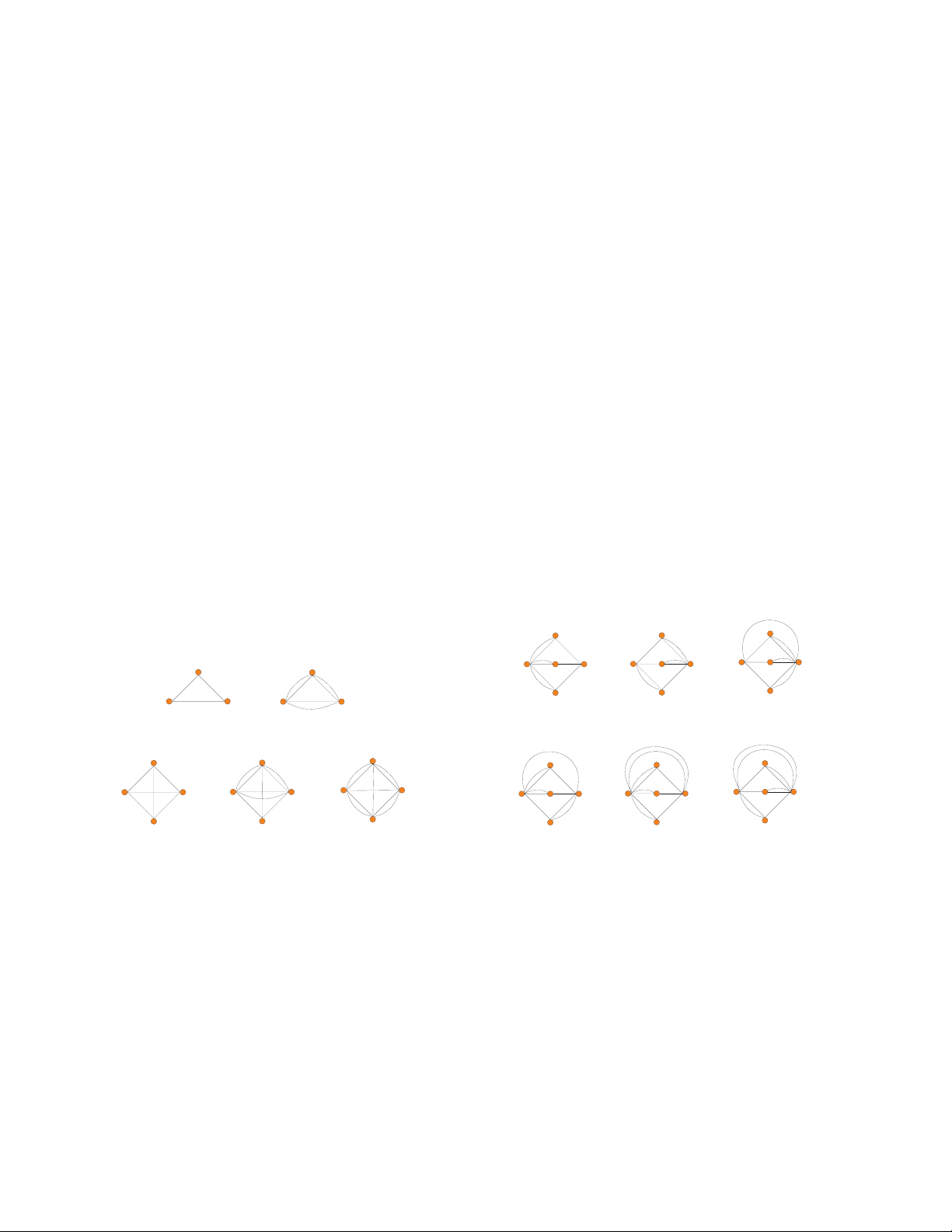
J-nonorientable and an even duplication of a graph in Figure 1.
x
xx
xx
z
zz
zz
w
ww
y
yy
y
HH
HHH
12
345
y
x
x
x
x
x
x
z
z
z
z
z
z
w
w
w
w
w
w
v
v
v
v
v
v
y
y
y
y
H
H
H
H
H
H
6
9
7
10
8
11
y
y
Figure 1: The list.
Let Jbe an assignment of directed parities to the even bonds of G.AsetMof even
bonds of Gis J-intractable if, under every orientation of G, an odd number of the bonds
in Mare not J-oriented. Note that if the set Mof even bonds is J-intractable then
the symmetric difference of the bonds in Mis empty. Clearly, Gis J-nonorientable if it
contains a J-intractable set of even bonds. It follows from linear algebra that the converse
also holds.
the electronic journal of combinatorics 12 (2005), #R64 2
The following lemma shows that the list of graphs in Figure 1 cannot be reduced any
further for the purpose of Theorem 1.
Lemma 2. For each graph Gin Figure 1 there is an assignment Jof directed parities to
the even bonds of Gsuch that Gis J-nonorientable.
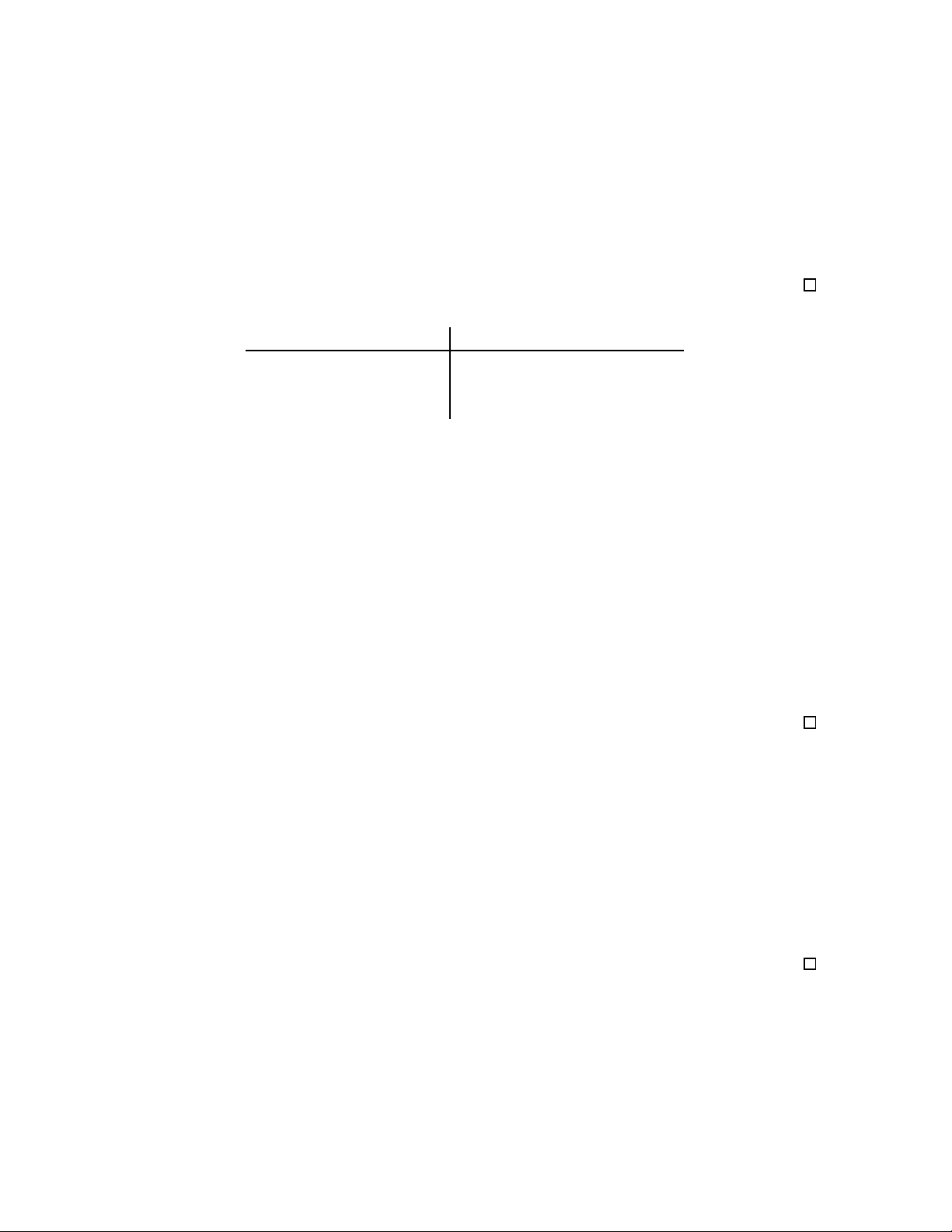
Proof. It suffices to find a non-empty set Mof even bonds for each of the graphs in
Figure 1 such that the symmetric difference of the bonds in Mis empty. The required
set Mis given for each graph in the table in Figure 2.
graphs set Mof even bonds
H1,H
2∂x, ∂y, ∂z
H3,H
4,H
5∂{w, x},∂{w, y},∂{w, z}
H6,H
7,H
8,H
9,H
10,H
11 ∂v, ∂{w, z},∂{x, z},∂{y, z}
Figure 2: Sets of even bonds in the graphs on the list.
2 Bonds
In this section we assemble further terminology and preliminary lemmas to be used later
on in the proof of Theorem 1. A digon is a duplication of the complete graph K2, while
atrigon is a duplication of K3. We record the following simple observation for further
reference.
Lemma 3. Bis a bond of a graph Gif and only if G<B> is a digon.
Proof. The statement follows immediately from the definition.
Acocycle[S, T ]separates two disjoint non-empty subsets S′and T′of VG if S′⊆S
and T′⊆T.
Lemma 4. Let H1and H2be two vertex-disjoint connected subgraphs of a connected graph
G. Then there is a bond of Gwhich separates VH
1and VH
2.
Proof. Let Sconsist of all vertices accessible in Gfrom vertices in VH
1without passing
through vertices in VH
2.AsGis connected, the vertices in VG−Smust be accessible
in Gfrom vertices in VH
2without passing through vertices in VH
1.SinceH1and H2
are connected, both G[S]andG[VG−S] are connected, and [S, V G −S] is the desired
bond.
The following lemma shows that every bond of a connected subgraph may be extended
to a bond of the whole graph by adjoining only edges that are not in the subgraph.
Lemma 5. Let Hbe a connected subgraph of a graph G, and Ba bond of H. Then there
is a bond B′of Gsuch that B′∩EH =B.
the electronic journal of combinatorics 12 (2005), #R64 3
Proof. By definition H−Bhas exactly two components H1and H2. Further, His
contained in a component Cof G. By Lemma 4, Chas a bond B′=[S, V C −S]
separating VH
1⊆Sand VH
2, and this bond is also a bond of G. By construction, we
have B⊆B′.EveryedgeinEH −Bis either in H1and thus in G[S], or in H2and thus
in G[VC−S]. In each case, the edge is not in B′. This concludes our proof.
Corollary 6. Every link in Gbelongs to some bond of G.
3 Bond-connected graphs
Acut-set of a connected graph Gis a set S⊆VG of vertices such that the subgraph
G[VG−S], derived from Gby removing the vertices in S, is no longer connected. If, in
particular, a cut-set Sconsists of a single vertex vonly, vis called a cut-vertex of G.A
connected graph Gis k-connected if it has at least k+ 1 vertices and does not contain a
cut-set of cardinality k−1, cf. [1]. It is well known that a graph with at least 3 vertices
is 2-connected if and only if any two links belong to a common circuit.
A connected graph Gis bond-connected if for every bipartition {A1,A
2}of EG there
is a bond meeting both A1and A2. Clearly, bond-connected graphs cannot have loops.
Lemma 7. Let Gbe a graph with at least 3 vertices and without loops. Gis bond-connected
if and only if Gis 2-connected.
Proof. Suppose Gis bond-connected, and thus connected. Suppose G−{v}is not con-
nected for some vertex v.LetCbe a component of G−{v}.ChooseA1=EG[VC∪{v}]
and A2=EG −A1.SinceGis bond-connected there is a bond B=[S, V G −S] meeting
both A1and A2.LetBcontainanedgeei∈Aijoining vertices siand tiwith si∈Sand
ti∈VG−Sfor each i∈{1,2}.SinceGis connected and Bis a bond, both G[S]and
G[VG−S] are connected. Without loss of generality we may assume that v∈S. Then,
Ghas no path joining t1to t2without passing through v. This, however, contradicts the
connectedness of G[VG−S] and proves Gto be 2-connected.
Suppose Gis 2-connected, and thus connected. Let {A1,A
2}be a bipartition of EG.
Choose a link ei∈Ai,i=1,2. Then there is a circuit Cof Gcontaining both e1and e2.
Clearly {e1,e
2}is a bond of G[C]. By Lemma 5 there is a bond Bof Gcontaining e1and
e2.ThisprovesGto be bond-connected.
Corollary 8. The following three propositions are equivalent for a connected graph G:
1. Gis bond-connected.
2. Gis a singleton, a digon or a 2-connected graph without loops.
3. Ghas neither a cut-vertex nor a loop.
Proof. The corollary follows immediately from Lemma 7.
Lemma 9. A graph Gis bond-connected if and only if any two of its edges belong to a
common bond.
the electronic journal of combinatorics 12 (2005), #R64 4
Proof. Suppose Gis bond-connected, and note that all edges in a bond-connected graph
are links. The statement is trivial if Ghas fewer than 3 vertices. Otherwise, let e1and
e2be distinct links in G.SinceGis 2-connected, there is a circuit Ccontaining e1and
e2. Clearly, {e1,e
2}is a bond of the induced subgraph G[C]. The claim now follows
from Lemma 5. Conversely, if any two edges of Gbelong to some bond, Gis clearly
bond-connected.
Lemma 10. Let G<A> be bond-connected, and let Bbe a bond of Gthat meets A. Then
G<A ∪B> is bond-connected.
Proof. The statement holds if A⊆B, and so we may assume that A−B6=∅.Let{X, Y }
be a bipartition of A∪B.IfA⊆Xor A⊆Y,thenBmeets both Xand Y. Otherwise
X∩A6=∅and Y∩A6=∅and, in this case, some bond in G<A> meets Xand Ysince
G<A> is bond-connected. This bond is also a bond of G<A ∪B>.
4 Vertex splits and bond-connected graphs
Given adjacent vertices sand tin a graph G,letR=[s, t]betheropeofGcontaining
all edges joining sand t. The graph H=G<E G −R> obtained from Gby contracting
the rope Rto a single vertex vis called a rope contraction of G, while Gis called a vertex
split of H, and said to be obtained from Hby splitting vinto sand t.
Since G−{s, t}=H[VH−v], a vertex w∈VG∩VH is a cut-vertex of Gif and only
if it is a cut-vertex of H. Further, vis a cut-vertex of Hif and only if {s, t}is a cut-set
of G.Moreover,ifsitself is a cut-vertex of Gthen vis a cut-vertex of Hor tis incident
only with edges in R.WecallGaproper vertex split of Hif vis the only vertex in H
or if both sand tare incident in Gwith some edge not in R. In the latter case, vis a
cut-vertex of Hif Ris a bond of G.
Lemma 11. Let Rbe a rope of G, and let H=G<E G −R> be bond-connected. Then
Gis bond-connected if and only if Gis a proper vertex split of H.
Proof. The claim is true if Hhas only a single vertex. Otherwise suppose Gis a bond-
connected graph obtained from Hby splitting a vertex vof Hinto sand t. Considering
the bipartition {R, EH}of EG, we find that Ris not a bond of Gitself and thus both s
and tare incident in Gwith some edge not in R. Hence, Gis a proper vertex split of H.
Conversely, suppose Gis a proper vertex split of Hobtained by splitting a vertex
vof H.Let{A1,A
2}be a bipartition of EG.IfA16⊆ Rand A26⊆ R, then by the
hypothesis there is a bond of Hmeeting both A1and A2. This bond is also a bond of
G. Otherwise, we note that every rope in a graph is a subset of some bond. So there is
abondofGcontaining R.SinceHis bond-connected, vis not a cut-vertex of Hand
thus Ris not a bond of Gitself, but a proper subset of some bond. This proves Gto be
bond-connected.
Remark 12. On the other hand, if Gis a bond-connected graph obtained from Hby
splitting a vertex vinto sand t, then vis the only possible cut-vertex of H.Thus,His
bond-connected if and only if {s, t}is not a cut-set of G.
the electronic journal of combinatorics 12 (2005), #R64 5