
Open Access
Available online http://arthritis-research.com/content/10/4/R85
Page 1 of 11
(page number not for citation purposes)
Vol 10 No 4
Research article
A double blind, randomized, placebo controlled study of the
efficacy and safety of 5-Loxin® for treatment of osteoarthritis of
the knee
Krishanu Sengupta1, Krishnaraju V Alluri2, Andey Rama Satish3, Simanchala Mishra4,
Trimurtulu Golakoti5, Kadainti VS Sarma6, Dipak Dey7 and Siba P Raychaudhuri8
1Cellular and Molecular Biology Division, Laila Impex R&D Center, Jawahar Autonagar, Vijayawada, 520 007 India
2Pharmacology Division, Laila Impex R&D Center, Jawahar Autonagar, Vijayawada, 520 007 India
3Department of Orthopedics, Alluri Sitarama Raju Academy of Medical Sciences (ASRAM), National Highway 5, Eluru, 534 002 India
4Department of Internal Medicine, Alluri Sitarama Raju Academy of Medical Sciences (ASRAM), National High way 5, Eluru, 534 002 India
5Drug Discovery and Development Division, Laila Impex R&D Center, Jawahar Autonagar, Vijayawada, 520 007 India
6Department of Statistics, Prakasam Road, SV University, Tirupati, 517 592 India
7Department of Statistics, 215 Glenbrook Road, University of Connecticut, Storrs, Connecticut 06269, USA
8Department of Medicine, Division of Rheumatology, Allergy and Immunology, School of Medicine, U C Davis and VA Medical Center Sacramento,
Hospital Way, Mather, California 95655, USA
Corresponding author: Siba P Raychaudhuri, sraychaudhuri@ucdavis.edu
Received: 24 Nov 2007 Revisions requested: 21 Dec 2007 Accepted: 30 Jul 2008 Published: 30 Jul 2008
Arthritis Research & Therapy 2008, 10:R85 (doi:10.1186/ar2461)
This article is online at: http://arthritis-research.com/content/10/4/R85
© 2008 Sengupta et al.; licensee BioMed Central Ltd.
This is an open access article distributed under the terms of the Creative Commons Attribution License (http://creativecommons.org/licenses/by/2.0),
which permits unrestricted use, distribution, and reproduction in any medium, provided the original work is properly cited.
Abstract
Introduction 5-Loxin® is a novel Boswellia serrata extract
enriched with 30% 3-O-acetyl-11-keto-beta-boswellic acid
(AKBA), which exhibits potential anti-inflammatory properties by
inhibiting the 5-lipoxygenase enzyme. A 90-day, double-blind,
randomized, placebo-controlled study was conducted to
evaluate the efficacy and safety of 5-Loxin® in the treatment of
osteoarthritis (OA) of the knee.
Methods Seventy-five OA patients were included in the study.
The patients received either 100 mg (n = 25) or 250 mg (n =
25) of 5-Loxin® daily or a placebo (n = 25) for 90 days. Each
patient was evaluated for pain and physical functions by using
the standard tools (visual analog scale, Lequesne's Functional
Index, and Western Ontario and McMaster Universities
Osteoarthritis Index) at the baseline (day 0), and at days 7, 30,
60 and 90. Additionally, the cartilage degrading enzyme matrix
metalloproteinase-3 was also evaluated in synovial fluid from OA
patients. Measurement of a battery of biochemical parameters in
serum and haematological parameters, and urine analysis were
performed to evaluate the safety of 5-Loxin® in OA patients.
Results Seventy patients completed the study. At the end of the
study, both doses of 5-Loxin® conferred clinically and
statistically significant improvements in pain scores and physical
function scores in OA patients. Interestingly, significant
improvements in pain score and functional ability were recorded
in the treatment group supplemented with 250 mg 5-Loxin® as
early as 7 days after the start of treatment. Corroborating the
improvements in pain scores in treatment groups, we also noted
significant reduction in synovial fluid matrix metalloproteinase-3.
In comparison with placebo, the safety parameters were almost
unchanged in the treatment groups.
Conclusion 5-Loxin® reduces pain and improves physical
functioning significantly in OA patients; and it is safe for human
consumption. 5-Loxin® may exert its beneficial effects by
controlling inflammatory responses through reducing
proinflammatory modulators, and it may improve joint health by
reducing the enzymatic degradation of cartilage in OA patients.
Trail Registration (Clinical trial registration number:
ISRCTN05212803.)
AKBA = 3-O-acetyl-11-keto-beta-boswellic acid; ANOVA = analysis of variance; ASRAM = Alluri Sitarama Raju Academy of Medical Sciences; BMI
= Body Mass Index; ELISA = enzyme-linked immunosorbent assay; LFI = Lequesne's Functional Index; MMP = matrix metalloproteinase; NSAID =
nonsteroidal anti-inflammatory drug; NU = normalized units; OA = osteoarthritis; VAS = visual analog scale; WOMAC = Western Ontario and McMas-
ter Universities Osteoarthritis Index.

Arthritis Research & Therapy Vol 10 No 4 Sengupta et al.
Page 2 of 11
(page number not for citation purposes)
Introduction
Osteoarthritis (OA) is the commonest form of inflammatory
joint disease, characterized by articular cartilage degradation
with an accompanying peri-articular bone response [1,2]. OA
affects nearly 21 million people in the USA, accounting for
25% of visits to primary care physicians. It is estimated that
80% of the population will have radiographic evidence of OA
by age 65 years, although only 60% of those will be sympto-
matic [3]. Clinical manifestations of OA of the knee include
pain in and around the joint, stiffness of the joint after rest,
crepitating on motion and limited joint motion, among others
[4]. Current recommendations for managing OA focus on
relieving pain and stiffness and improving physical function as
important goals of therapy [5,6]. Currently available medica-
tion regimens for most cases include nonopioid analgesics
such as acetaminophen and nonsteroidal anti-inflammatory
drugs (NSAIDs), including cyclo-oxygenase II inhibitors. These
pharmaceutical agents can reduce both pain and inflammation
quite effectively, but long-term use of NSAIDs has been found
to be associated with enhanced risk for gastrointestinal bleed-
ing, hypertension, congestive heart failure and renal insuffi-
ciency, among other adverse effects [7-9]. Because of the
high incidence of adverse events associated with both nonse-
lective and cyclo-oxygenase II selective NSAID therapy, effec-
tive and safer alternative treatments for OA are urgently
needed.
In recent years, the gum resin extracted from the ancient herb
Boswellia serrata has gained much attention as a potent anti-
inflammatory, anti-arthritic and analgesic agent [10,11]. 3-O-
acetyl-11-keto-beta-boswellic acid (AKBA) is the most active
component of Boswellia extract and has been demonstrated
to be a potent inhibitor of 5-lipoxygenase (5-LOX), which is a
key enzyme in the biosynthesis of leukotrienes from arachi-
donic acid in the cellular inflammatory cascade [12,13].
5-Loxin® is a novel B. serrata extract enriched to 30% AKBA
(US Patent publication no.: 2004/0073060A1). In the carra-
geenan-induced inflammation model, 5-Loxin® treatment
yielded significant improvement in paw inflammation in albino
Wister rats [14]. Cell based in vitro studies and in vivo exper-
iments conducted in Sprague-Dawley rats suggest that 5-
Loxin® can inhibit proinflammatory cytokines such as tumour
necrosis factor-α, interleukin-1β (unpublished data, Sengupta
K, Alluri KV, and Golakoti T). Furthermore, Affimatrix gene chip
analysis demonstrates 5-Loxin® can potentially inhibit the
tumour necrosis factor-α induced gene expression of matrix
metalloproteinases (MMPs), adhesion molecules such as
intercellular adhesion molecule-1, vascular cell adhesion mol-
ecule-1, and mediators of apoptosis in human microvascular
endothelial cells [14]. Importantly, extensive acute and dose-
dependent subchronic safety experiments on rats demon-
strate that 5-Loxin® does not exhibit toxic manifestations, even
at a dose 2,000 to 3,000 times higher than the human equiv-
alence dose [15]. In addition, 5-Loxin® does not exhibit geno-
toxicity in the standard AMES bacterial reverse mutation assay
(INTOX, 375, Urawade, Pirangut-Urawade Road, Tal. Mulshi,
Pune – 412108, India; study no. 4477/05).
Although a significant number of clinical study reports support
the anti-inflammatory and anti-arthritic properties of Boswellia
extract [16-19], to the best of our knowledge no reports on the
efficacy of AKBA-enriched 5-Loxin® in OA in humans have
been published. Therefore, in the present double-blind and
placebo-controlled clinical study, we sought to evaluate the
efficacy and safety of 5-Loxin® in treatment of OA of the knee.
We assessed the effectiveness of 100 mg/day and 250 mg/
day 5-Loxin® on pain, joint stiffness and mobility in OA
patients. We also explored the effect of 5-Loxin® on the carti-
lage degrading enzyme MMP-3 in OA patients treated with 5-
Loxin®.
Materials and methods
Recruitment of patients
This trial was performed at Alluri Sitarama Raju Academy of
Medical Sciences (ASRAM), Eluru, Andhra Pradesh, India
from July 2006 to October 2006 (clinical trial registration
number: ISRCTN05212803). The study protocol was evalu-
ated and approved by the ASRAM Institutional Review Board.
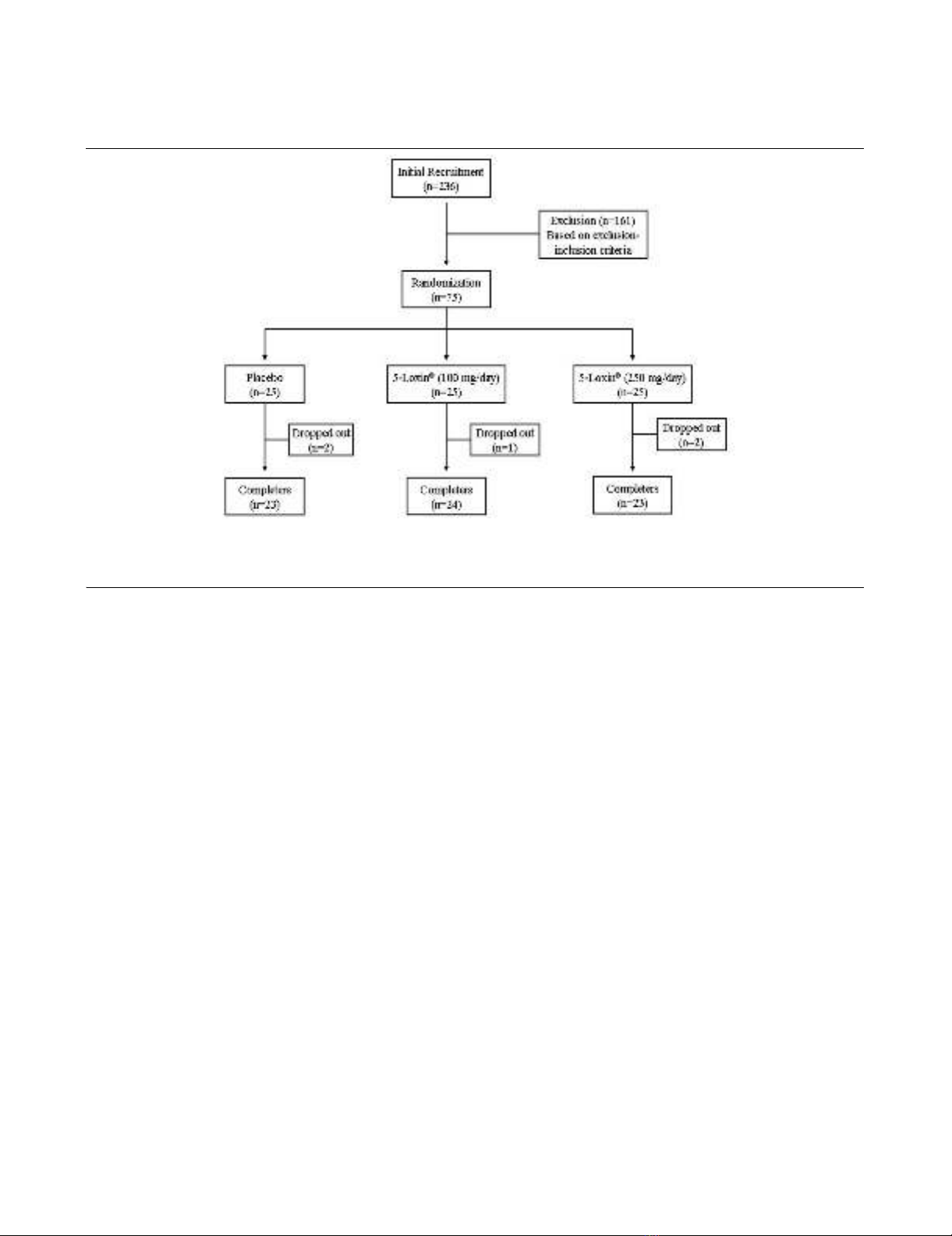
An overview of the clinical study is provided in Figure 1. Briefly,
236 patients out of 823 attending the orthopaedic Outpa-
tients Department of the ASRAM Hospital were selected,
based on the signs, symptoms and radiological changes con-
sistent with OA in the first phase of the screening procedure.
A total of 75 patients suffering for more than 3 months with
medial tibiofemoral OA were selected using inclusion/exclu-
sion criteria summarized in Table 1. All patients signed the
Institutional Review Board approved consent form. Patients
were otherwise healthy, were aged 40 years or older, and had
a diagnosis of OA, fulfilling the American College of Rheuma-
tology classification criteria [4]. After recruitment, the patients
were randomly distributed into three groups; demographic
data and baseline characteristics are summarized in Table 2.
Before study enrollment, patients were required to be taking
an NSAID at prescription strength for at least 30 days or
acetaminophen 1,200 to 4,000 mg/day on a regular basis (at
least 25 of the preceding 30 days) with a history of therapeutic
benefit. Eligibility required patients to meet specific flare crite-
ria upon medication washout. At screening, patients had to
demonstrate a visual analog scale (VAS) score between 40
and 70 mm during the most painful knee movement, and
Lequesne's Functional Index (LFI) score greater than 7 points
after 7-day withdrawal of usual medication.
Study design
A total of 75 selected patients with symptoms of moderate to
mild OA were recruited into the study. Each patient was ran-
domly assigned to a treatment group using a randomization
table generated using validated computer software (RAN-

Available online http://arthritis-research.com/content/10/4/R85
Page 3 of 11
(page number not for citation purposes)
CODE; IDV, Gauting, Germany). Treatment allocation
depended only on the time sequence in which patients
entered the study, thus minimizing selection bias. The clinical
trial pharmacist and statistician ensured that treatment codes
remained confidential. The patients were distributed into three
Table 1
Inclusion/exclusion criteria
Criteria Details
Inclusion Patients must understand risks and benefits of the protocol and be able to give informed consent
Male and female patients aged 40 to 80 years
Females of child-bearing potential must agree to use an approved form of birth control and to have a negative pregnancy test result.
Unilateral or bilateral osteoarthritis of the knee for more than 3 months
Visual analogue scale score during the most painful knee movement between 40 and 70 mm after 7 days of withdrawal of usual
medication
Lequesne's Functional Index score greater than 7 points after 7 days of withdrawal of usual medication
Ability to walk
Availability for the duration of the entire study period
Exclusion History of underlying inflammatory arthropathy or severe rheumatoid arthritis
Hyperuricaemia (>440 μmol/l) and/or past history of gout
Recent injury in the area affected by osteoarthritis of the knee (past 4 months) and expectation of surgery in the next 4 months
Intra-articular corticosteroid injections within the preceding 3 months
Hypersensitivity to nonsteroidal anti-inflammatory drugs, abnormal liver or kidney function tests, history of peptic ulceration and upper
gastrointestinal haemorrhage, congestive heart failure, hypertension, hyperkalaemia
Major abnormal findings on complete blood count, history of coagulopathies, haematological or neurological disorders
High alcohol intake (>2 standard drinks per day)
Pregnant, breastfeeding, or planning to become pregnant during the study
Use of concomitant prohibited medication other than ibuprofen
Obesity (body mass index > 30 kg/m2)
Table 2
Demographic data and baseline characteristics of the patients
Characteristics Placebo (n = 23) 100 mg/day 5-Loxin® (n = 24) 250 mg/day 5-Loxin® (n = 23)
Sex (male/female; n) 5/18 7/17 8/15
Age (years) 52.43 ± 9.65 52.37 ± 8.37 53.22 ± 8.73
Body weight (kg) 61.48 ± 10.69 61.08 ± 10.67 54.84 ± 10.19
Body mass index (kg/m2) 26.05 ± 4.29 25.91 ± 4.94 22.64 ± 4.07
Visual analog score (mm) 56.88 ± 12.04 57.05 ± 8.71 55.62 ± 9.26
Lequesne's Functional Index 12.76 ± 2.6 12.1 ± 2.76 12.04 ± 3.03
WOMAC score
Pain subscale 38.04 ± 9.7 48.08 ± 14.05 37.17 ± 13.8
Stiffness subscale 33.15 ± 13.3 31.8 ± 17.6 27.7 ± 16.8
Function subscale 41.3 ± 9.6 41.5 ± 11.1 38.6 ± 11.1
Values are expressed as mean ± standard deviation. WOMAC, Western Ontario and McMaster Universities Osteoarthritis Index.
Arthritis Research & Therapy Vol 10 No 4 Sengupta et al.
Page 4 of 11
(page number not for citation purposes)
groups: placebo (n = 25); 30% AKBA enriched B. serrata
extract (5-Loxin®) low-dose group (100 mg/day), in which
patients received 50 mg encapsulated 5-Loxin® twice daily (n
= 25); and 5-Loxin® high-dose group (250 mg/day), in which
patients received 125 mg encapsulated 5-Loxin® twice daily (n
= 25). Patients in the placebo group received two capsules of
similar color, taste and appearance but filled only with rice
bran.
Each patient completed a questionnaire, providing details
regarding demographics, medical history and nutritional sta-
tus, at the baseline evaluation and during the follow-up evalu-
ations on days 7, 30, 60 and 90. At the baseline evaluation,
and at each visit during the 90-day follow up period, all
patients were assessed for pain scores and physical ability.
Various parameters of serum biochemistry, haematology and
urine analysis were carried out on each evaluation day. Serum
samples were collected at all evaluation days for proinflamma-
tory modulators. Knee joint synovial fluid was aseptically col-
lected at baseline and at day 90 for evaluation of MMP-3
concentration. Safety was monitored by clinical and laboratory
assessments conducted at study visits and patient-reported
adverse experiences.
Functional disability and pain score evaluation
The investigators assessed the functional disability reported
by the patients at baseline and on each follow-up visit (days 7,
30, 60 and 90). Questionnaire-based assessment of pain,
stiffness and physical function were done using the Western
Ontario and McMaster Universities Osteoarthritis Index
(WOMAC) index [20], LFI [21] and VAS [22]. The WOMAC
index produces scores for three subscales: pain, stiffness and
physical function. The pain, stiffness and function subscales of
the WOMAC were converted to a 0 to 100 normalized units
(NU) scale [23]. The pain subscale was the average of the first
five questions of WOMAC and measured using the NU scale
from 0 mm ('no pain') to 100 mm ('extreme pain') for each
question. The stiffness subscale was the average of questions
6 and 7, measured using the NU scale from 0 mm ('no stiff-
ness') to 100 mm ('extreme stiffness') for each question. The
physical function subscale was the average of questions 8
through 24 of the WOMAC and measured by NU scale from
0 mm ('no difficulty') to 100 mm ('extreme difficulty') for each
question. Analyses of these end-points were based upon the
time-weighted average change from baseline over 90 days.
Haematological and biochemical evaluations
For assessment of safety of 5-Loxin®, several parameters were
evaluated in serum, urine and whole blood of all patients at
each visit of the study duration (Table 3). Serum biochemical
parameters and haematological parameters were measured
using the automated analyzer HumaStar 300 (Human, Wies-
baden, Germany) and the haematological counter Humacount
(Human), respectively. The urine analysis was carried out by
microscopy and by using UroColor™10 Dip Sticks (Standard
Diagnostics, Kyonggi-do, Korea).
Figure 1
Flow chart of the patients who participated in the clinical trialFlow chart of the patients who participated in the clinical trial. Evaluations of physical activity and pain scores, serum biochemistry, haematology,
urine biochemistry and proinflammatory cytokines were done at baseline (day 0) and on days 7, 30, 60 and 90 during follow up. Assessments of
matrix metalloproteinase-3 were done on days 0 and 90 only.

Available online http://arthritis-research.com/content/10/4/R85
Page 5 of 11
(page number not for citation purposes)
Assessment of matrix metalloproteinase-3 in synovial
fluids
MMP-3 (R&D Systems, Minneapolis, USA) were quantitatively
measured by ultrasensitive ELISA method. Assay procedures
adhered to the protocol supplied by the manufacturers. Briefly,
synovial fluid samples were incubated on capture antibody
coated 96-well microplates. Specifically bound antigen was
detected by appropriate biotinylated detection antibody and
was probed with horseradish peroxidase enzyme. The specific
immune reaction was detected by substrate solution and the
colour development was read with the help of micro-plate
reader (Bio-Rad, Hercules, CA, USA). A standard curve was
generated by plotting the optical density at respective known
concentration of MMP3. The sensitivity of MMP-3 detection
ELISA kit is 9 pg/ml.
Rescue medication
Patients were prescribed ibuprophen 400 mg tablets (maxi-
mum 400 mg thrice daily; total 1,200 mg) as rescue analgesia
on days 7, 30 and 60, based on pain intensity reported to the
study physician by the patient. However, the patients were
instructed not to take medicine at least 3 days before each
evaluation. No other OA interventions were allowed during the
study period.
Statistical analysis
We performed detailed statistical analyses using SAS soft-
ware to evaluate the efficacy of two doses of 5-Loxin® in com-
parison with the placebo group in terms of improvement in
pain and physical ability scores, and to assess biomolecular
markers at baseline and days 7, 30, 60 and 90 of treatment.
Pair-wise changes were examined by carrying out a least sig-
nificant difference test for all possible pairs. The significance
of the effects of the treatment groups was compared by using
one-way analysis of variance (ANOVA) followed by Tukey's
multiple comparison tests. Results with P < 0.05 are consid-
ered statistically significant.
This is a three-arm (two doses of 5-Loxin® and placebo), rand-
omized, double-blind, placebo-controlled, single-centre trial
conducted over 90 days. The trial's primary objective was to
determine the effects of 5-Loxin® on pain, physical function
and joint stiffness. For power calculations, the estimates for
variability and assumed mean changes for each treatment
group were based on results from previous placebo-controlled
studies of celecoxib, etoricoxib and rofecoxib conducted in
patients with OA [24-27]. We believe that an intervention that
gives an average improvement of mean change + 1 standard
deviation, rather than mean change only, will provide results of
greater significance [28]. Our trial is designed to have more
than 80% power to detect a situation in which either active
drug dosage yields an improvement to at least mean change
+ 0.9 standard deviation, under a conservative assumption,
and we tested differences between groups in mean improve-
ment using ANOVA (α = 0.05, two-sided). With 25 patients
per group, we would have a 93% chance of observing at least
one example of any side effect occurring in 10% or more of the
patient population at a specific dosage.
Results
Baseline characteristics
Descriptive statistics comparing demographic variables, base-
line disease characteristics and baseline outcome measures
(that is, WOMAC pain, function and stiffness subscores) are
provided in Table 2. Overall, the treatment groups receiving 5-
Loxin® low dose (100 mg/day, n = 25), 5-Loxin® high dose
Table 3
Parameters tested in serum biochemistry, haematology and
urine analysis
Analysis Details
Serum biochemistry Albumin
Alkaline phosphatase
Total bilirubin
Cholesterol
Creatinine
Creatine kinase-N-acetyl cysteine
Glucose
High-density lipoprotein
Low-density lipoprotein
Potassium
Serum glutamic oxaloacetate transaminase
Serum glutamate pyruvate transaminase
Triglycerides
Urea
Haematology Total count and differential count
Erythrocyte sedimentation rate
Haemoglobin
Platelet count
Mean corpuscular volume
Mean corpuscular hemoglobin
Urine analysis Specific gravity
pH
Albumin
Bile salt
Bile pigment
Glucose
Red blood cell count
Ketone bodies