
Open Access
Available online http://arthritis-research.com/content/11/6/R180
Page 1 of 10
(page number not for citation purposes)
Vol 11 No 6
Research article
A multicenter, double-blind, randomized, controlled phase III
clinical trial of chicken type II collagen in rheumatoid arthritis
Wei Wei1, Ling-Ling Zhang1, Jian-Hua Xu2, Feng Xiao1, Chun-De Bao3, Li-Qing Ni4, Xing-Fu Li5,
Yu-Qing Wu6, Ling-Yun Sun7, Rong-Hua Zhang8, Bao-Liang Sun9, Sheng-Qian Xu2, Shang Liu2,
Wei Zhang3, Jie Shen4, Hua-Xiang Liu5 and Ren-Cheng Wang9
1Institute of Clinical Pharmacology, Anhui Medical University, Key Laboratory of Anti-inflammatory and Immunopharmacology of Education Ministry,
81 Meishan Road, Hefei 230032, PR China
2Rheumatism and Immunity Department, The First Affiliated Hospital of Anhui Medical University, 218 Jixi Road, Hefei 230022, PR China
3Rheumatism and Immunity Department, The Affiliated Shanghai Renji Hospital of Shanghai Jiao Tong University, 1630 Dongfang Road, Shanghai
200127, PR China
4Rheumatism and Immunity Department, Shanghai Guanghua Hospital, 540 Xinhua Road, Shanghai 200052, PR China
5Rheumatism and Immunity Department, Qilu Hospital of Shandong University, 107 Wenhua Road, Jinan 250012, PR China
6Rheumatism and Immunity Department, The Third Affiliated Hospital of Sun Yat-Sen University, 600 Tianhe Road, Guangzhou 510630, PR China
7Rheumatism and Immunity Department, The Affiliated Drum Tower Hospital of Nanjing University Medical School, 321 Zhongshan Road, Nanjing
210008, PR China
8Rheumatism and Immunity Department, Southwest Hospital of Third Military Surgeon University, 30 Shapingba Gaotanyan Street, Chongqing
400038, PR China
9Rheumatism and Immunity Department, The Affiliated Hospital of Taishan Medical College, 706 Tanshan Street, Taian 271000, PR China
Corresponding author: Wei Wei, wwei@ahmu.edu.cn
Received: 10 Jul 2009 Revisions requested: 18 Aug 2009 Revisions received: 29 Sep 2009 Accepted: 1 Dec 2009 Published: 1 Dec 2009
Arthritis Research & Therapy 2009, 11:R180 (doi:10.1186/ar2870)
This article is online at: http://arthritis-research.com/content/11/6/R180
© 2009 Wei et al.; licensee BioMed Central Ltd.
This is an open access article distributed under the terms of the Creative Commons Attribution License (http://creativecommons.org/licenses/by/2.0),
which permits unrestricted use, distribution, and reproduction in any medium, provided the original work is properly cited.
Abstract
Introduction Chicken type II collagen (CCII) is a protein
extracted from the cartilage of chicken breast and exhibits
intriguing possibilities for the treatment of autoimmune diseases
by inducing oral tolerance. A 24-week, double-blind, double-
dummy, randomized, methotrexate (MTX)-controlled study was
conducted to evaluate the efficacy and safety of CCII in the
treatment of rheumatoid arthritis (RA).
Methods Five hundred three RA patients were included in the
study. Patients received either 0.1 mg daily of CCII (n = 326) or
10 mg once a week of MTX (n = 177) for 24 weeks. Each
patient was evaluated for pain, morning stiffness, tender joint
count, swollen joint count, health assessment questionnaire
(HAQ), assessments by investigator and patient, erythrocyte
sedimentation rate (ESR), and C-reactive protein (CRP) by
using the standard tools at baseline (week 0) and at weeks 12
and 24. Additionally, rheumatoid factor (RF) was evaluated at
weeks 0 and 24. Measurement of a battery of biochemical
parameters in serum, hematological parameters, and urine
analysis was performed to evaluate the safety of CCII.
Results Four hundred fifty-four patients (94.43%) completed
the 24-week follow-up. In both groups, there were decreases in
pain, morning stiffness, tender joint count, swollen joint count,
HAQ, and assessments by investigator and patient, and all
differences were statistically significant. In the MTX group, ESR
and CRP decreased. RF did not change in either group. At 24
weeks, 41.55% of patients in the CCII group and 57.86% in the
MTX group met the American College of Rheumatology 20%
improvement criteria (ACR-20) and 16.89% and 30.82%,
respectively, met the ACR 50% improvement criteria (ACR-50).
Both response rates for ACR-20 and ACR-50 in the CCII group
were lower than those of the MTX group, and this difference was
statistically significant (P < 0.05). The DAS28 (disease activity
score using 28 joint counts) values of the two treatment groups
were calculated, and there was a statistically significant
difference between the two treatment groups (P < 0.05).
Gastrointestinal complaints were common in both groups, but
there were fewer and milder side effects in the CCII group than
in the MTX group. The incidence of adverse events between the
two groups was statistically significant (P < 0.05).
ACR: American College of Rheumatology; ACR-20: American College of Rheumatology 20% improvement criteria; ACR-50: American College of
Rheumatology 50% improvement criteria; CCII: chicken type II collagen; CIA: collagen-induced arthritis; CII: type II collagen; CRP: C-reactive protein;
DAS28: disease activity score using 28 joint counts; ESR: erythrocyte sedimentation rate; HAQ: health assessment questionnaire; IL: interleukin; ITT:
intention-to-treat; MTX: methotrexate; NSAID: non-steroidal anti-inflammatory drug; RA: rheumatoid arthritis; RF: rheumatoid factor; TGF-β: transform-
ing growth factor-beta; Treg: regulatory T; VAS: visual analogue scale.

Arthritis Research & Therapy Vol 11 No 6 Wei et al.
Page 2 of 10
(page number not for citation purposes)
Conclusions CCII is effective in the treatment of RA and is safe
for human consumption. CCII exerts its beneficial effects by
controlling inflammatory responses through inducing oral
tolerance in RA patients.
Trials Registration Clinical trial registration number: ChiCTR-
TRC-00000093.
Introduction
Rheumatoid arthritis (RA) is a chronic inflammatory disease
characterized by pain, swelling, and stiffness of multiple joints.
It is also a highly disabling disease that limits mobility, hampers
work, and reduces quality of life. Chronic inflammation com-
monly results in progressive joint destruction, deformity, and
loss of function. Complex immune mechanisms contribute to
the pathology of RA [1,2]. Current pharmacological strategies
addressing mainly immune suppression and anti-inflammatory
mechanisms have had limited success. Currently, most drugs
for RA are steroids, non-steroidal anti-inflammatory drugs
(NSAIDs), disease-modifying drugs, and biological agents.
These therapies are associated with significant side effects
with long administration, including anorexia, dyspepsy, sup-
pression of the immune system non-specifically, and infections
[3-5].
Recently, more and more oral tolerance mechanisms have
been studied in the treatment of autoimmune diseases. Oral
tolerance has posed intriguing possibilities for the treatment of
autoimmune diseases, including RA. Oral tolerance is a state
of systemic immune suppression to an antigen induced by oral
feeding of the same antigen. Extensive research in this area
over the past 10 years has led to the conclusion that two
mechanisms are operative in the mediation of oral tolerance:
active suppression and clonal anergy or deletion. A number of
factors that determine which mechanisms of tolerance are
operative have been identified: antigen dose, antigen form,
and the timing of antigen administration [6,7].
Oral administration of autoantigen has been shown to sup-
press a variety of autoimmune pathologies induced experimen-
tally, including antigen-induced RA [8]. Modulating the
immune response to the autoantigen by oral tolerance may be
a safer and more effective treatment. A number of candidate
autoantigens have been identified in RA [9]. Type II collagen
(CII) is a major protein in articular cartilage and a potential
autoantigen. Some RA patients demonstrate immunity against
CII, and autoantibodies to CII have been detected in the sera
of both pauciarticular-onset and systemic-onset RA patients
[10]. These data support the view that autoimmunity to an anti-
gen such as CII in cartilage plays a major role in the pathogen-
esis of RA. In animal models, oral administration of CII prevents
and reduces the severity of autoimmune diseases [11]. Work
from these animal models has recently been extended into
human clinical trials of RA with differing degrees of success
[12-14]. Hence, oral tolerance has been advocated as a treat-
ment strategy for autoimmune diseases, including RA.
Investigators in our laboratory found that collagen-induced
arthritis (CIA) could be established in Wistar rats, Kunming
mice, and DBA/1 mice with chicken type II collagen (CCII)
[15,16]. Feeding CCII to rats by oral administration decreased
the arthritis index. Meanwhile, cartilage degeneration, syn-
ovium hyperplasia, and inflammatory cell infiltration in the knee
joints of mice and rats with CIA were suppressed by CCII
[17,18]. These experiments in rodents have provided the basis
for human clinical trials. In a randomized, double-blind, multi-
center, and controlled phase II clinical trial involving 236
patients with severe active RA, a decrease in the number of
swollen joints and tender joints occurred in subjects fed CCII
for 6 months. Meanwhile, CCII could reduce pain, morning
stiffness, health assessment questionnaire (HAQ), and
assessments by investigator and patient, and the incidence of
adverse events of CCII was lower than that of methotrexate
(MTX) [19]. These results demonstrate clinical efficacy of an
oral tolerance approach for RA. To evaluate the efficacy and
safety of CCII in RA patients further, we treated two groups of
RA patients with oral CCII or MTX in a randomized, double-
blind, multicenter, and controlled phase III clinical trial.
Materials and methods
Recruitment of patients
This trial was performed at eight centers from October 2004
to December 2005 (clinical trial registration number: ChiCTR-
TRC-00000093). The study protocol was evaluated and
approved by their respective investigational and ethics com-
mittees. Five hundred three intention-to-treat (ITT) population
RA patients (18 to 65 years old) who met revised American
College of Rheumatology (ACR) criteria for the diagnosis of
RA were entered into the study after giving their written
informed consent [20]. There are no patients in the phase II
study who were enrolled in this phase III trial. Table 1 defines
the study population. Admission criteria also included patients
of either gender with RA with a duration of 6 to 24 months.
Active RA was defined as the presence of at least three of the
following criteria: six or more painful or tender joints, three or
more swollen joints, morning stiffness for at least 45 minutes
(on average during the week prior to entry), and an erythrocyte
sedimentation rate (ESR) of at least 28 mm. Second-line
agents were discontinued at least 4 weeks prior to entry. Con-
tinuous doses of NSAIDs were permitted. Patients to whom
one of following applied were excluded: dysfunction of liver;
severe cardiovascular, urinary, hematopoietic, or endocrine
system disease; immunodeficiency; uncontrolled infection or
active gastrointestinal tract disease; recent vaccination; grav-
ida; women in lactation period or those recently intending to

Available online http://arthritis-research.com/content/11/6/R180
Page 3 of 10
(page number not for citation purposes)
become pregnant; hypersensitivity to CII; treatment with any
other disease-modifying anti-rheumatic drug within 30 days
before enrolment; history of alcohol abuse; history of hyperg-
lycemia or motor coordination disorder; or participation in
other clinical trials within 3 months before enrolment.
Study design
The study was a two-to-one, eight-center, 24-week follow-up,
double-blind, double-dummy, randomized, and MTX-control-
led trial comparing efficacy and safety of CCII and MTX in the
treatment of RA. Patients were randomly assigned to a CCII (n
= 326) or MTX (n = 177) group that received either CCII (0.1
mg daily) or MTX (10 mg once a week). Patients and investi-
gators were blinded to the treatment regimens throughout the
study. Efficacy variables were assessed at 0, 12, and 24
weeks after administration of drug. Patients were allowed to
remain on diclofenac sodium (50 mg daily), an NSAID. The
diclofenac sodium dosage was not changed during the study.
CCII capsules (#040328; Shanghai Materia Medica Bioengi-
neering Institute, Shanghai, China), CCII dummy capsules,
MTX tablets (#031201; Shanghai Xin Yi Pharmaceutical Fac-
tory, Shanghai, China), and MTX dummy tablets were obtained
from Shanghai Materia Medica Bioengineering Institute.
Patients were instructed to take oral CCII capsules or dummy
capsules with 200 mL of cold water 30 minutes prior to eating
breakfast every morning.
Flow sheet of production of chicken type II collagen
CCII is a protein extracted from the cartilage of chicken breast.
Its molecular weight is 115 to approximately 135 kDa by SDS-
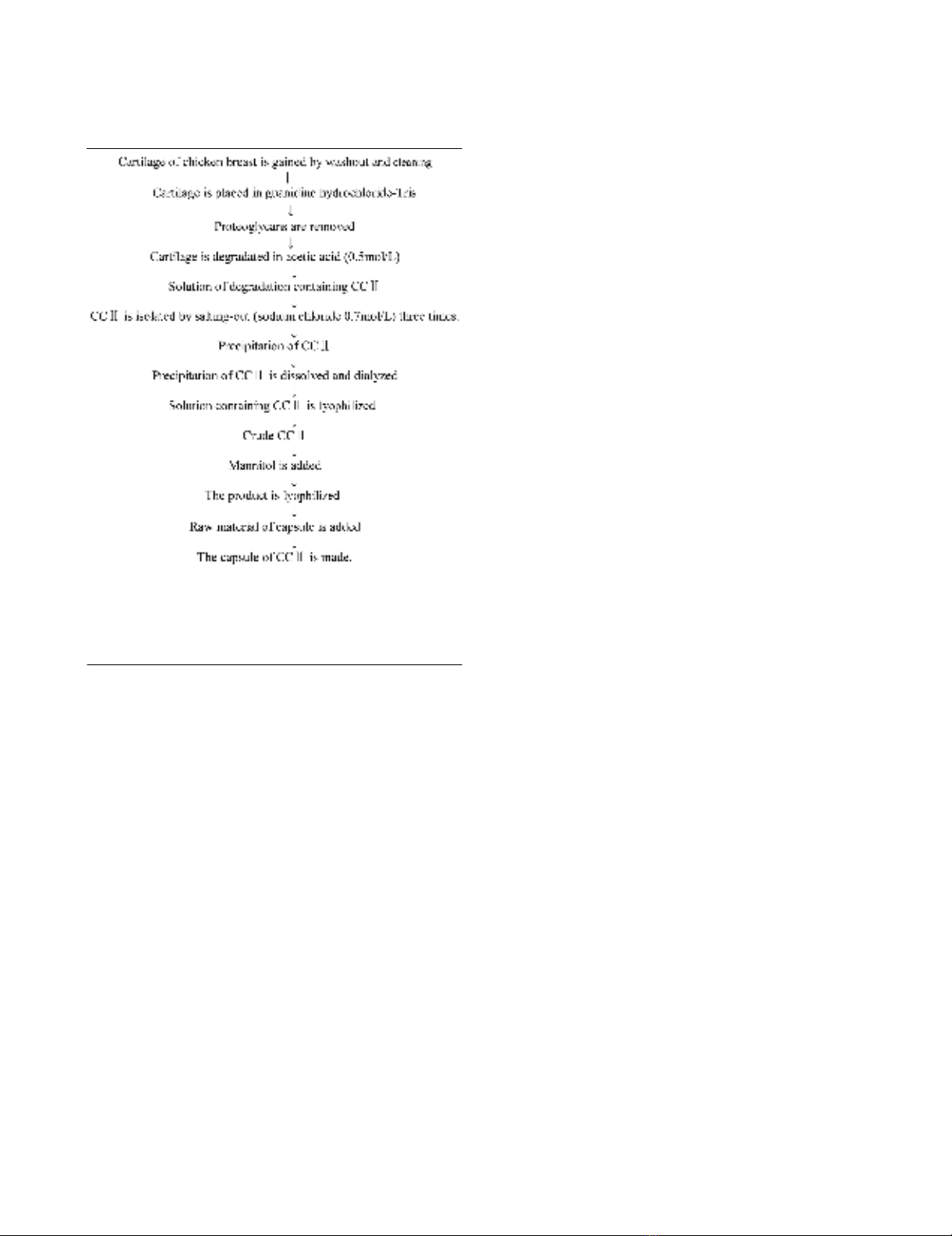
PAGE electrophoresis method. In this study, the CCII capsule
that patients received consisted of CCII and an adjuvant such
as mannitol and glidantin. Figure 1 shows the flow sheet of
production of CCII.
Clinical assessments
Clinical assessments of efficacy were made at baseline and
repeated 12 and 24 weeks later. Efficacy variables included
[21,22] pain, and pain intensity was assessed by visual ana-
logue scale (VAS) of 0 (no pain) to 10 (severe pain). Patients
were questioned about the duration of morning stiffness expe-
rienced on the day before each study visit. Joint counts for ten-
derness and swelling were the sum of the number of affected
joints. Physician and patient global assessments were rated
according to VAS of 0 (very good) to 10 (very poor). Func-
tional status was assessed at baseline and at 12 and 24
weeks using HAQ. ESR and C-reactive protein (CRP) values
were obtained at baseline and at 12 and 24 weeks. Rheuma-
toid factor (RF) positivity was determined at the screening visit
and at 24 weeks.
The primary efficacy variable was the ACR preliminary defini-
tion of improvement in RA [23]. To reach improvement accord-
ing to the ACR definition, a patient with RA must improve by at
least 20% in tender and swollen joint count and by at least
20% in three of the five other measures: patient global assess-
Table 1
Comparison of baseline clinical characteristics between the chicken type II collagen group and the methotrexate group
Variables CCII (n = 296) MTX (n = 158) P value
Gender, male/female 55/241 30/128 0.983
Age, years 47.11 ± 10.55 47.06 ± 11.14 0.967
Duration of rheumatoid arthritis, years 1.63 ± 0.75 1.72 ± 0.52 0.949
Body temperature, °C 36.66 ± 0.38 36.65 ± 0.39 0.892
Pain (VASa) 6.02 ± 1.43 5.91 ± 1.76 0.528
Morning stiffness, minutes 99.26 ± 25.14 104.89 ± 26.42 0.277
Tender joint count 13.34 ± 6.43 14.09 ± 6.82 0.233
Swollen joint count 10.38 ± 6.63 10.57 ± 7.25 0.773
HAQb0.82 ± 0.56 0.86 ± 0.55 0.454
Physician's assessment (VAS) 5.83 ± 1.54 5.78 ± 1.26 0.892
Patient's assessment (VAS) 6.01 ± 1.51 6.06 ± 1.71 0.731
ESRc, mm/hour 38.18 ± 27.58 42.51 ± 29.37 0.118
C-reactive protein, mg/L 17.52 ± 8.27 23.24 ± 9.81 0.306
Rheumatoid factor, U/mL 203.65 ± 61.95 198.99 ± 21.31 0.115
The same variables were compared between the chicken type II collagen (CCII) group and the methotrexate (MTX) group. Fisher exact test was
used for categorical variables, and t analysis of variance was used for continuous variables. cESR, erythrocyte sedimentation rate; bHAQ, health
assessment questionnaire; MTX, methotrexate; aVAS, visual analogue scale.
Arthritis Research & Therapy Vol 11 No 6 Wei et al.
Page 4 of 10
(page number not for citation purposes)
ment, physician global assessment, HAQ, acute-phase reac-
tant, and patient pain assessment. In addition to the evaluation
of 20% improvement (ACR-20), we determined RA improve-
ment based on more substantial changes in RA core set meas-
ures, such as requiring at least 50% improvement (ACR-50)
reported as secondary efficacy measures. The disease activity
score using 28 joint counts (DAS28) was evaluated [24]. Clin-
ical parameters also included body weight, blood pressure,
and heart rate. To standardize the evaluation of clinical varia-
bles, all investigators prior to study entry performed clinical
evaluation of one patient with active RA.
Adverse events
At each visit, the patient was asked whether side effects were
noticed during the interim. Side effects such as gastrointesti-
nal complaints, vomiting, anorexia, headache, dizziness,
insomnia, tetter, and mouth ulcers were known to occur fre-
quently in treatment with CCII or MTX. Moreover, at entry and
at 12 and 24 weeks, the following laboratory variables were
assessed to monitor safety: complete blood cell count, serum
levels of liver enzymes, creatinine, uric acid, and urinalysis.
Statistical analysis
Safety assessments were performed on all patients who con-
sumed any masked study medication. Efficacy analyses were
performed on the ITT population as well as on the population
of patients who completed the 24-week study. Efficacy analy-
sis of outcome variables was based on mean changes from
baseline to endpoint in the ITT population. The data in Tables
1 and 2 and Figure 2 are expressed as mean ± standard devi-
ation. The statistical software product used for these analyses
was SAS, version 8.1 (SAS Institute Inc., Cary, NC, USA). All
laboratory variables were subjected to descriptive statistics
and compared by means of the Wilcoxon signed rank test. The
randomization code was exposed only after the database was
locked. Chi-square with Fisher exact test was used for cate-
gorical variables, and t analysis of variance was used for con-
tinuous variables. Significance level was established at 0.05.
Results
Baseline characteristics
Of 503 randomly assigned patients (326 in the CCII group
and 177 in the MTX group), 49 patients withdrew early. Thirty
(9.20%) patients withdrew in the CCII group, and 19
(10.73%) patients withdrew in the MTX group. There were var-
ious reasons for early withdrawal, such as adverse events,
non-compliance, lack of response, and loss at follow-up. Three
patients (0.92%) in the CCII group reported side effects, and
five patients (2.82%) in the MTX group reported side effects.
In the CCII group, three patients (0.92%) withdrew due to lack
of compliance, and four patients (2.25%) withdrew because of
non-compliance in the MTX group. Twelve (3.68%) and four
(2.25%) patients in the CCII group and in the MTX group,
respectively, withdrew because of lack of efficacy. Twelve and
six patients in the CCII group and in the MTX group, respec-
tively, were lost to follow-up. Four hundred fifty-four patients
(296 in the CCII group and 158 in the MTX group) completed
24 weeks of therapy. There were no statistically significant dif-
ferences between the two groups in terms of adverse events,
non-compliance, lack of response, and loss at follow-up. At
study entry, the two groups were well balanced with regard to
demographic characteristics and disease parameters, and
there were no statistically significant differences between the
two groups in terms of gender, age, disease duration, body
temperature, pain, morning stiffness, tender joint count, swol-
len joint count, HAQ, physician's assessment, patient's
assessment, ESR, CRP, and RF (Table 1). Also, there were no
important differences among the eight centers.
Efficacy
In both groups, there were decreases in pain, morning stiff-
ness, tender joint count, swollen joint count, HAQ, and
assessments of efficacy by both investigator and patient.
Within-group differences (study entry versus 12 and 24
weeks) were statistically significant for the above clinical dis-
ease parameters (Table 2). At 12 weeks, there were statisti-
cally significant differences in morning stiffness, swollen joint
count, HAQ, physician's assessment, and patient's assess-
ment between the CCII group and the MTX group; there were
statistically significant differences in pain, HAQ, and patient's
Figure 1
The flow sheet of production of chicken type II collagen (CCII)The flow sheet of production of chicken type II collagen (CCII). CCII is
a protein extracted from the cartilage of chicken breast. Its molecular
weight is 115 to approximately 135 kDa by SDS-PAGE electrophore-
sis method. In this study, the CCII capsule that patients received con-
sisted of CCII and an adjuvant such as mannitol and glidantin.

Available online http://arthritis-research.com/content/11/6/R180
Page 5 of 10
(page number not for citation purposes)
Table 2
Results in outcome variables at entry and at 12 and 24 weeks
Outcome variables CCII P valueaMTX P valueaP valueb
Pain (VAS)
Entry 6.02 ± 1.43 5.91 ± 1.76 >0.05
12 weeks 4.59 ± 2.22 <0.01 4.09 ± 1.99 <0.01 >0.05
24 weeks 3.58 ± 2.55 <0.01 3.38 ± 2.35 <0.01 <0.05
Morning stiffness, minutes
Entry 99.26 ± 25.14 104.89 ± 26.42 >0.05
12 weeks 62.66 ± 25.06 <0.01 45.83 ± 21.28 <0.01 <0.01
24 weeks 36.12 ± 17.21 <0.01 33.98 ± 12.59 <0.01 >0.05
Tender joint count
Entry 13.34 ± 6.43 14.09 ± 6.82 >0.05
12 weeks 9.14 ± 6.67 <0.01 8.78 ± 6.01 <0.01 >0.05
24 weeks 6.34 ± 4.81 <0.01 7.22 ± 6.91 <0.01 >0.05
Swollen joint count
Entry 10.38 ± 6.63 10.57 ± 7.25 >0.05
12 weeks 6.89 ± 5.46 <0.01 5.63 ± 4.97 <0.01 <0.01
24 weeks 4.26 ± 2.03 <0.01 4.38 ± 2.94 <0.01 >0.05
HAQ
Entry 0.82 ± 0.56 0.86 ± 0.55 >0.05
12 weeks 0.65 ± 0.41 <0.01 0.51 ± 0.42 <0.01 <0.01
24 weeks 0.43 ± 0.27 <0.01 0.44 ± 0.21 <0.01 <0.05
Physician's assessment (VAS)
Entry 5.83 ± 1.54 5.78 ± 1.26 >0.05
12 weeks 4.68 ± 2.09 <0.01 4.03 ± 2.06 <0.01 <0.01
24 weeks 3.81 ± 1.52 <0.01 3.53 ± 1.64 <0.01 >0.05
Patient's assessment (VAS)
Entry 6.01 ± 1.51 6.06 ± 1.71 >0.05
12 weeks 4.86 ± 2.01 <0.01 4.31 ± 2.06 <0.01 <0.01
24 weeks 3.92 ± 2.45 <0.01 3.71 ± 2.04 <0.01 <0.05
ESRc, mm/hour
Entry 38.18 ± 17.58 42.51 ± 19.37 >0.05
12 weeks 38.03 ± 14.17 >0.05 35.84 ± 13.24 <0.01 <0.01
24 weeks 37.53 ± 10.22 >0.05 34.21 ± 15.25 <0.01 <0.01
C-reactive protein, mg/L
Entry 17.52 ± 8.27 23.24 ± 9.81 >0.05
12 weeks 17.27 ± 15.14 >0.05 16.01 ± 13.41 <0.01 <0.05
24 weeks 15.56 ± 12.38 >0.05 15.08 ± 12.25 <0.01 <0.05
Rheumatoid factor, U/mL
Entry 203.65 ± 61.95 198.99 ± 21.31 >0.05
24 weeks 150.21 ± 16.18 >0.05 123.35 ± 11.32 >0.05 >0.05
In both groups, there were decreases in pain, morning stiffness, tender joint count, swollen joint count, health assessment questionnaire (HAQ),
and global assessment of efficacy by investigator and patient. Within-group differences (study entry versus 12 and 24 weeks) were statistically
significant. In the methotrexate (MTX) group, erythrocyte sedimentation rate (ESR) and C-reactive protein decreased, but changes in the two
variables in the chicken type II collagen (CCII) group were not significant. Rheumatoid factor was not significantly affected by either drug therapy.
VAS, visual analogue scale. P valuea, entry versus 12 or 24 weeks in CCII group or MTX group; P valueb, CCII group versus MTX group;cESR,
erythrocyte sedimentation rate.