
BioMed Central
Page 1 of 11
(page number not for citation purposes)
Respiratory Research
Open Access
Research
Loss of a single N-linked glycan from the hemagglutinin of influenza
virus is associated with resistance to collectins and increased
virulence in mice
Patrick C Reading*1,2, Danielle L Pickett1, Michelle D Tate1, Paul G Whitney1,
Emma R Job1 and Andrew G Brooks1
Address: 1Department of Microbiology and Immunology, The University of Melbourne, Parkville, 3010, Victoria, Australia and 2WHO
Collaborating Centre for Reference and Research on Influenza, North Melbourne, 3051, Victoria, Australia
Email: Patrick C Reading* - preading@unimelb.edu.au; Danielle L Pickett - dpickett@unimelb.edu.au;
Michelle D Tate - m.tate@pgrad.unimelb.edu.au; Paul G Whitney - whitneyp@unimelb.edu.au; Emma R Job - e.job@pgrad.unimelb.edu.au;
Andrew G Brooks - agbrooks@unimelb.edu.au
* Corresponding author
Abstract
Background: Glycosylation on the globular head of the hemagglutinin (HA) protein of influenza
virus acts as an important target for recognition and destruction of virus by innate immune proteins
of the collectin family. This, in turn, modulates the virulence of different viruses for mice. The role
of particular oligosaccharide attachments on the HA in determining sensitivity to collectins has yet
to be fully elucidated.
Methods: When comparing the virulence of H3N2 subtype viruses for mice we found that viruses
isolated after 1980 were highly glycosylated and induced mild disease in mice. During these studies,
we were surprised to find a small plaque variant of strain A/Beijing/353/89 (Beij/89) emerged
following infection of mice and grew to high titres in mouse lung. In the current study we have
characterized the properties of this small plaque mutant both in vitro and in vivo.
Results: Small plaque mutants were recovered following plaquing of lung homogenates from mice
infected with influenza virus seed Beij/89. Compared to wild-type virus, small plaque mutants
showed increased virulence in mice yet did not differ in their ability to infect or replicate in airway
epithelial cells in vitro. Instead, small plaque variants were markedly resistant to neutralization by
murine collectins, a property that correlated with the acquisition of an amino acid substitution at
residue 246 on the viral HA. We present evidence that this substitution was associated with the
loss of an oligosaccharide glycan from the globular head of HA.
Conclusion: A point mutation in the gene encoding the HA of Beij/89 was shown to ablate a glycan
attachment site. This was associated with resistance to collectins and increased virulence in mice.
Background
Mammalian serum and respiratory fluids contain a com-
plex mixture of proteins, some of which can inhibit
hemagglutination activity or neutralize the infectivity of
influenza viruses. Three classes of such inhibitors have
been reported. The α and γ inhibitors are sialylated glyco-
Published: 23 November 2009
Respiratory Research 2009, 10:117 doi:10.1186/1465-9921-10-117
Received: 4 July 2009
Accepted: 23 November 2009
This article is available from: http://respiratory-research.com/content/10/1/117
© 2009 Reading et al; licensee BioMed Central Ltd.
This is an Open Access article distributed under the terms of the Creative Commons Attribution License (http://creativecommons.org/licenses/by/2.0),
which permits unrestricted use, distribution, and reproduction in any medium, provided the original work is properly cited.

Respiratory Research 2009, 10:117 http://respiratory-research.com/content/10/1/117
Page 2 of 11
(page number not for citation purposes)
proteins that act as receptor analogues, binding to the
receptor-binding site of influenza virus hemagglutinin
(HA) to block access to cellular receptors. The β inhibitors
are not receptor analogues, do not contain sialic acid and
act via a mechanism distinct to that of α and γ inhibitors.
Studies by Anders et al. demonstrated that the β inhibitors
in bovine and mouse serum were mannose-binding
lectins of the collectin family [1]. Collectins are large mul-
timeric proteins that bind to glycoconjugates rich in D-
mannose and N-acetylglucosamine in a Ca2+-dependent
manner and play an important role in innate host defence
against a range of microbial pathogens (reviewed by
[2,3]). Members of the collectin family include the serum
mannose-binding lectin (MBL), bovine serum proteins
conglutinin and collectin-43 (CL-43) and lung surfactant
proteins A (SP-A) and D (SP-D). For influenza viruses of
the H3 subtype, the oligosaccharide side-chain at the tip
of the HA spike was shown to be critical in determining
the sensitivity of the virus to the antiviral activities of col-
lectins in mouse and bovine serum [1]. Mutant viruses
selected in the presence of bovine serum (a rich source of
conglutinin) were shown to have lost this glycosylation
site and were resistant to hemagglutination inhibition by
β inhibitors [1].
Since their identification as β inhibitors, the role of col-
lectins in innate host defence against influenza viruses has
become an area of intense interest. MBL, conglutinin, CL-
43 and SP-D all act as classic β inhibitors, binding in a
Ca2+-dependent manner to oligosaccharides expressed on
the viral HA and NA glycoproteins. This mediates hemag-
glutination inhibition, neutralization, virus aggregation
and opsonization of virus to promote neutrophil respon-
siveness to the virus (reviewed by [2,4,5]). In contrast, the
collectin SP-A is a sialylated glycoprotein and therefore
acts as a γ inhibitor to mediate a similar range of antiviral
activities against influenza viruses [6,7]. Of particular
interest, both SP-A and SP-D are present in respiratory
secretions, although current evidence suggests that the
high avidity interaction between SP-D and carbohydrates
on the viral HA is a major factor contributing to the neu-
tralizing capacity of bronchoalvolar lavage fluids [8-10].
Since their appearance in the human population in 1968,
H3N2 subtype viruses have shown a progressive increase
in N-linked glycosylation in and around the globular
head of the HA molecule, while glycosylation sites located
in the stem region of HA tend to be highly conserved
[11,12]. Using a mouse model of influenza infection, we
have demonstrated that for viruses of the H3 subtype
(1968-1992), the level of glycosylation on the globular
head of HA of a particular virus strain inversely correlates
with its ability to replicate in vivo [8]. Virus strains bearing
high levels of glycosylation (1977-1992) were more sensi-
tive to neutralization by murine collectins, and this in
turn correlated with a poor ability to replicate in mouse
lung. In initial studies we were surprised to find that one
virus strain, A/Beijing/353/89 (Beij/89), did not fit this
trend and grew well in mouse lung despite the presence of
4 potential sites of N-linked glycosylation on the globular
head of HA. Studies were therefore undertaken to deter-
mine the mechanisms underlying the enhanced virulence
of this particular mutant for mice.
Methods
Viruses
A seed stock of wild-type (non-reassortant) A/Beijing/
353/89 (Beij/89) from the WHO Collaborating Centre for
Reference and Research on Influenza, Melbourne, Aus-
tralia and was propagated once at a 10-4 dilution in the
allantoic cavity of 10-day embryonated eggs to generate
an uncloned stock of Beij/89. When this stock was
plaqued on MDCK cell monolayers in the presence of
trypsin [8], two morphologically distinct plaque types
were observed; a predominant round plaque type approx-
imately 1 mm in diameter (large plaque phenotype), and
a minor subpopulation (<5%) of small, star-shaped
plaques (small plaque phenotype).
Plaque purification (PP) of virus was performed on
MDCK cells and was monitored by the distinctive plaque
morphology of the large and small plaque viruses. Well-
separated plaques were picked, resuspended in PBS and
inoculated into 10-day embryonated hens' eggs. Allantoic
fluid was harvested and the PP procedure repeated. Stocks
of allantoic fluid generated from the second PP were
plaqued to ensure appropriate morphology and frozen at
-70°C. Purified virus stocks were prepared using discon-
tinuous sucrose gradients as described [1].
Infection and treatment of mice
C57BL/6 mice were bred and maintained in the animal
facility of this department. Adult mice (6-8 weeks) were
used in all experiments. All research complied with the
University of Melbourne's Animal Experimentation Ethics
guidelines and policies. Mice were anaesthetized and
infected intranasally (i.n.) with 105 PFU of influenza virus
(unless otherwise stated) in 50 μl of PBS. Each day, mice
were weighed individually and monitored for signs of ill-
ness. To determine viral titres, mice were euthanized and
lungs and nasal tissues were removed and homogenates
were clarified by centrifugation. The samples were assayed
for infectious virus by plaque assay on MDCK monolayers
[8].
Differential leukocyte counts in bronchoalveolar lavage
(BAL) fluids
For collection of BAL cells, mice were killed and the lungs
flushed three times with 1 ml of PBS through a blunted

Respiratory Research 2009, 10:117 http://respiratory-research.com/content/10/1/117
Page 3 of 11
(page number not for citation purposes)
23-guage needle inserted into the trachea. Cells were
treated with Tris-NH4Cl (0.14 M NH4Cl in 17 mM Tris,
adjusted to pH 7.2) to lyse erythrocytes, washed in RPMI
1640 medium supplemented with 10% FCS and cell via-
bility was determined via trypan blue exclusion. For dif-
ferential counts, aliquots of approximately 5 × 10⁴ BAL
cells were cyto-centrifuged onto glass microscope slides,
dried and stained with Diff Quick (Lab Aids, Australia).
Slides were examined using a light microscope and a min-
imum of 100 cells in 4-8 random fields was counted
(×1000 magnification). Macrophages, lymphocytes and
neutrophils were identified by their distinct nuclear mor-
phologies.
Sera, mAbs and SP-D
Mouse serum was collected from blood that had clotted at
4°C overnight followed by storage at -70°C. Recom-
binant rat SP-D was a gift from Prof. Erika C. Crouch,
Department of Pathology, Washington University School
of Medicine, St. Louis, Missouri, USA. The anti-HA mAbs
CY3/3, PA1/1 and C1/1 raised against BJx109 (A/Beijing/
353/89 × A/PR/8/34) were prepared by Dr. Georgia Kapa-
kalis-Deliyannis, Department of Microbiology and
Immunology, University of Melbourne. mAb D7/1, raised
against A/Philippines/2/82 (Phil/82), was prepared by
Dr. E. M. Anders, Department of Microbiology and Immu-
nology, University of Melbourne.
Virus Neutralization assays
Neutralization of virus infectivity was measured by fluo-
rescent-focus reduction in monolayers of MDCK cells cul-
tured in 96-well plates (Nunc, Golstrup, Denmark) as
described [8]. Briefly, dilutions of mouse sera or recom-
binant rat SP-D were mixed with a constant dilution of
virus, and after incubation for 30 mins at 37°C, added to
MDCK cell monolayers. After adsorption of virus for 45
min at 37°C, the inoculum was removed and cells were
incubated a further 7-8 hrs to allow for infection of MDCK
cells. Cell monolayers were then fixed in 80% acetone and
stained for fluorescent foci by incubation with mAb A-3,
specific for the nucleoprotein (NP) of type A influenza
viruses, followed by fluorescein-conjugated rabbit anti-
mouse immunoglobulins (Silenus, Melbourne, Aus-
tralia).
Hemagglutination and Hemagglutination Inhibition (HI)
assays
Hemagglutination titrations and HI tests were performed
by standard procedures using 1% (vol/vol) chicken eryth-
rocytes in Tris-buffered saline (TBS; 0.05 M Tris-HCl, 0.15
M NaCl, pH 7.2) containing 0.1% NaN3 (TBSN3).
Sequencing of HA gene
Influenza virus RNA was extracted directly from allantoic
fluid. Virus was digested with proteinase K and 0.5%
sodium dodecylsulfate (SDS) and heated to 55°C for 5
min. RNA was extracted using hot phenol, followed by
phenol-chloroform extraction and ethanol precipitation.
Full length HA cDNA was prepared from viral RNA using
AMV reverse transcriptase (Promega, U.S.A.). Two seg-
ments were then amplified from the HA gene PCR for
direct sequencing. Sequences were determined using a
PRISM Ready Reaction Dyedeoxy terminator cycle
sequencing kit (Perkin Elmer, Applied Biosystems Divi-
sion, Foster City, CA, USA). The complete sequence of HA
for the L phenotype virus has been deposited in GeneBank
(U97740).
SDS-PAGE and immunoblot for HA
Proteins from purified preparations of influenza virus
were resolved by SDS-PAGE (5-12.5% gradient gels)
under non-reducing conditions, transferred to nitrocellu-
lose and probed with 1/500 dilution of ascitic fluid of
mAbCY3/3 in TBS containing 2.5 mg/ml BSA. After wash-
ing, bound antibody was detected with 1/400 dilution of
HRP-conjugated rabbit anti-mouse immunoglobulins
(Dako, Glostrup, Denmark). SeeBlue pre-stained stand-
ards (Novex, San Diego, California) were used to estimate
molecular weights.
Results
Small plaque mutants of Beij/89 emerge following
intranasal infection of mice
In previous studies, we have used viruses of the H3 sub-
type (1968-1992) to examine the relationship between
the degree of glycosylation of the HA glycoprotein, the
sensitivity to the antiviral activities of collectins and the
ability of a particular virus strain to grow in mouse lung
[8]. Strains isolated post-1980 were found to bear high
levels of glycosylation on the HA, were highly sensitive to
neutralization by SP-D and MBL in vitro and replicated
poorly in the lungs of mice following intranasal inocula-
tion. In these studies we were surprised to find that inoc-
ulation of mice with one virus strain, Beij/89, lead to
sporadic growth of virus in mouse lung and that the
plaques derived from the lung homogenates were notice-
ably different to those observed when plaquing the virus
inoculum.
On closer inspection, we observed a small proportion
(less than 5% of >300 plaques counted) of small plaque
variants present in the original seed stock; therefore we
picked 5 large (clones L1-5) and five small (clones S1-5)
plaques, repeated the plaque purification and propagated
each clone individually in hens' eggs. Mice were inocu-
lated with the seed stock of Beij/89 and 3 days later the
phenotype of virus present in lung homogenates was
examined following plaque assay on MDCK cells. Five
plaques (all of small plaque phenotype) were picked and
propagated individually in hens' eggs (clones Mo1-5). All
Respiratory Research 2009, 10:117 http://respiratory-research.com/content/10/1/117
Page 4 of 11
(page number not for citation purposes)
plaques of the L phenotype were significantly larger than
either S or Mo plaques (1300 +/- 100 μm for L virus com-
pared to 326 +/- 17 μm and 325 +/- 19 μm for S and Mo
viruses, respectively. n = > 10 plaques measured for each
sample). Together, these findings suggest that a mouse vir-
ulent variant of Beij/89 was present at low frequency in
the seed stock of Beij/89 and that this variant is rapidly
selected to become dominant following intranasal infec-
tion of mice.
Enhanced replication of small plaque mutants of Beij/89 in
the respiratory tract of mice
Plaque purified clones of L, S and Mo viruses were com-
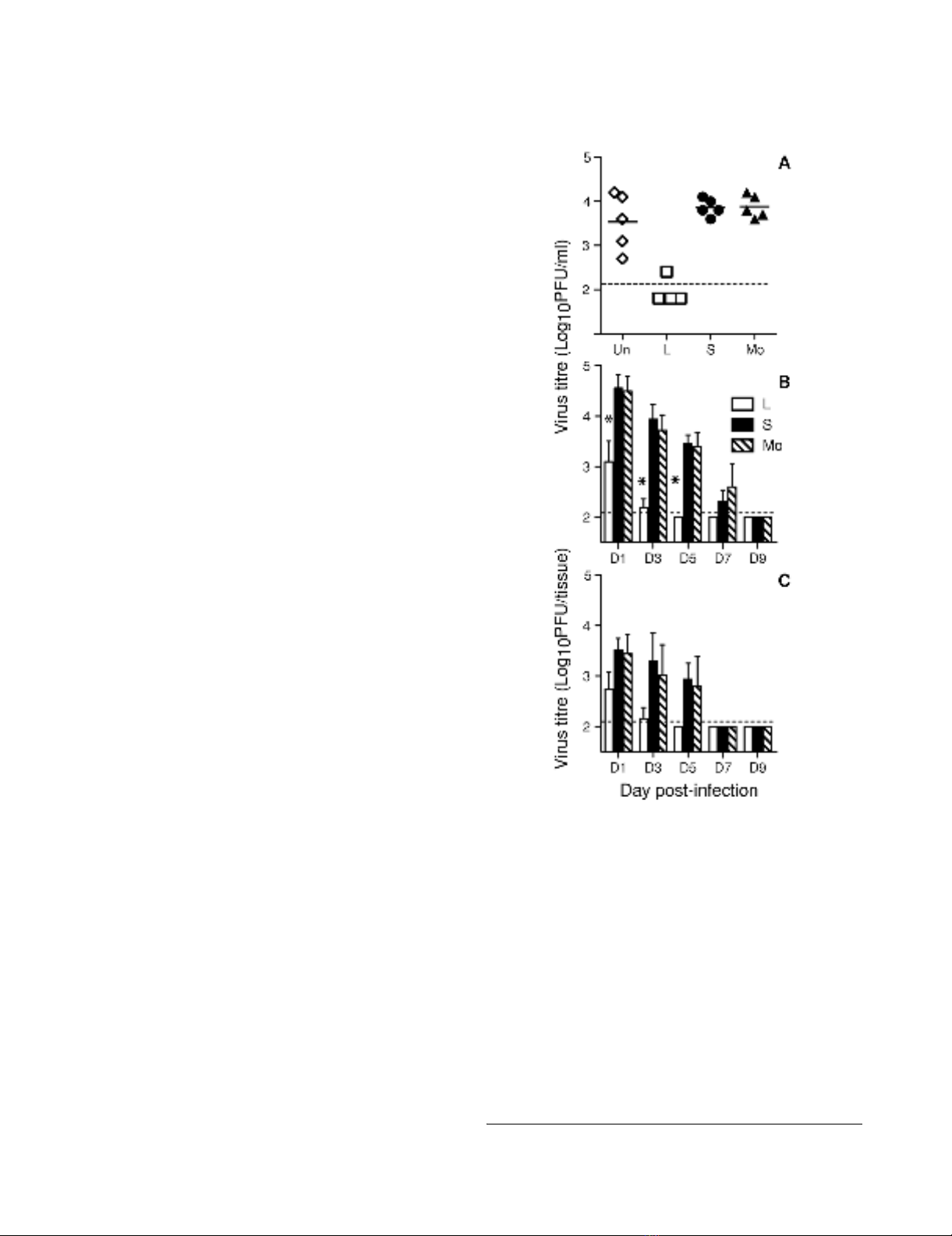
pared for their ability to replicate in mouse lung (Fig. 1A).
Mice were inoculated with 105 PFU of the uncloned stock
of Beij/89 or with an equivalent dose of L, S and Mo
viruses and, 3 days later, mice were killed and titres of
infectious virus in lung homogenates were determined
using a standard plaque assay. Variable virus titres were
recorded in the lungs of mice infected with uncloned Beij/
89 while virus titres were very low or undetectable in lung
homogenates from mice infected with L plaque virus. Of
interest, virus titres were 10-100 fold higher in the lungs
of mice infected with either S or Mo viruses.
We next examined the time course of viral replication
using 1 representative clone of each of the L, S and Mo
Beij/89 viruses. Compared to L virus, S and Mo viruses
replicated to higher titres in both the lungs (Fig. 1B) and
the nasal tissues (Fig. 1C) of infected animals at all time-
points examined. Virus could not be detected in the lungs
of mice infected with the L phenotype virus after day 3
post-infection but was recovered from most animals
infected with S or Mo viruses up to 7 days after infection
(8/10 animals infected with S virus, 7/10 animals infected
with Mo virus at day 7 post-infection), indicating a
marked delay in clearance from the lungs. A similar trend
was observed in the upper respiratory tract with delayed
clearance of S and M viruses compared to L virus-infected
mice (Fig. 1C).
Airway inflammation is exacerbated in mice infected with
small plaque mutants of Beij/89
To assess the acute inflammatory response to infection,
mice infected with L, S or Mo viruses were killed at 3 and
7 days post-infection, and the cells recruited to the air-
spaces of the lung were recovered and characterized by dif-
ferential staining. Macrophages were the predominate cell
type recovered in the BAL at day 3 and 7 post-infection
(Fig. 2A), and numbers were significantly higher in the
lungs of mice infected with S or Mo viruses at day 7 post-
infection compared to mice infected with L virus. Few
neutrophils were present in the BAL of naive mice (N; <
1% of all BAL cells) but rose markedly at day 3 post-infec-
tion and declined thereafter (Fig. 2B), consistent with
Small plaque variants of Beij/89 show enhanced virulence for miceFigure 1
Small plaque variants of Beij/89 show enhanced viru-
lence for mice. (A) Replication of uncloned Beij/89 (Un)
and plaque purified L, S or Mo viruses in mouse lung. Data
shown represent virus titres in the lungs of 5 mice inoculated
3 days prior with 105 PFU of virus. Data was confirmed with
5 independent clones of L, S and Mo viruses. (B & C) Time
course of virus titres recovered from the respiratory tract of
mice following intranasal inoculation with 105 PFU of L, S or
Mo viruses. Infectious virus present in (B) lung or (C) nasal
tissues was determined at various times post-infection by
plaque assay on MDCK cell monolayers. Virus titres are
shown as the mean ± 1 SD of 5 mice. The dashed line repre-
sents the lower limit of detection of virus in each sample
(2.1) and for statistical analysis samples with a value below
the limit of detection were assigned an arbitrary value of 2.0.
* = p < 0.01, Kruskal-Wallis test.

Respiratory Research 2009, 10:117 http://respiratory-research.com/content/10/1/117
Page 5 of 11
(page number not for citation purposes)
their role in innate host defence against influenza virus.
Mice infected with S or Mo viruses had significantly higher
neutrophil BAL counts compared to L virus-infected mice
at both day 3 and 7 post-infection. At day 7, a significant
influx of lymphocytes was observed in BAL of mice
infected with S and Mo viruses (Fig. 2C), that was not
observed in the airways of L virus-infected animals.
Together, these data indicate that infection of mice with S
or Mo viruses leads to enhanced recruitment of inflamma-
tory cells to the lungs during the early (day 3) and latter
(day 7) phases of infection.
Small plaque mutants of Beij/89 are less sensitive to
neutralization by murine collectins
Collectins function as β inhibitors against influenza
viruses, binding in a Ca2+-dependent manner to man-
nose-rich glycans at the tip of the HA spike resulting in
steric hindrance of binding of the viral HA to host cell
receptors [1,13]. Early studies demonstrated that H1 sub-
type viruses that had undergone adaptation resulting in
increased growth in mice had also developed resistance to
HI by β inhibitors [14,15], consistent with an important
role for collectins in innate host defence. Therefore, we
tested S, L and Mo viruses for their sensitivity to hemag-
glutination inhibition by rat SP-D or by MBL in mouse
serum. Both SP-D and MBL were able to mediate HI activ-
ity against L, S and Mo viruses, and activity was Ca2+-
dependent and blocked by the sugar mannose (data not
shown). Viruses did, however, differ in their sensitivity to
both SP-D (Fig. 3A) and MBL (Fig. 3B) in a neutralization
assay. L viruses were markedly more sensitive to neutrali-
zation by either murine collectin when compared to S and
Mo viruses. The neutralizing activity of SP-D or MBL
against L, S or Mo viruses was abrogated in the presence of
50 mM D-mannose (data not shown).
Loss of an N-linked glycan from the HA of small plaque
variants of Beij/89
MBL in mouse serum and rat SP-D bind to the HA and NA
glycoproteins of influenza virus, with the majority of
binding to the HA molecule [8]. Given the reduced sensi-
tivity of S and Mo viruses to neutralization by murine col-
lectins, we compared viruses for their reactivity to a panel
of HA-specific mAbs to determine if any antigenic changes
could be detected in HA (Figure 4A). L, S and Mo viruses
reacted equally well with mAbs PA1/1, CY3/3 and C1/1
however S and Mo viruses showed a 30-fold higher HI
titre that did L viruses against mAb D7/1. The enhanced
reactivity of mAb D7/1 with S and Mo viruses suggests
that amino acid changes common to the small plaque
mutants of Beij/89 affect the antigenic epitopes recog-
nized by this mAb.
To determine if the reduced sensitivity of S and Mo viruses
to neutralization by murine collectins was associated with
loss of a glycosylation site from the HA molecule, proteins
Increased recruitment of inflammatory cells to the airways of mice infected with small plaque variants of Beij/89Figure 2
Increased recruitment of inflammatory cells to the
airways of mice infected with small plaque variants of
Beij/89. Mice were infected with 105 PFU of L, S or Mo
viruses and, at day 3 or day 7 post-infection, mice were killed
and BAL performed. BAL cells were centrifuged onto glass
slides, stained with Diff Quick and the number of macro-
phages, neutrophils and lymphocytes were determined by
nuclear morphology. Cell numbers from BAL of naïve (N)
mice are included for comparison. Data represent the mean
(± 1 SD) number of (A) macrophages, (B) neutrophils or (C)
lymphocytes from groups of 5 mice and are representative of
2 independent experiments. * = p < 0.01, Kruskal-Wallis test.