
BioMed Central
Page 1 of 23
(page number not for citation purposes)
Annals of General Psychiatry
Open Access
Review
Mourning and melancholia revisited: correspondences between
principles of Freudian metapsychology and empirical findings in
neuropsychiatry
Robin L Carhart-Harris*1, Helen S Mayberg2, Andrea L Malizia1 and
David Nutt1
Address: 1Psychopharmacology Unit, University of Bristol, Bristol, UK and 2Emory University School of Medicine, Atlanta, GA 30322, USA
Email: Robin L Carhart-Harris* - R.carhart-harris@bris.ac.uk; Helen S Mayberg - hmayber@emory.edu;
Andrea L Malizia - Andrea.L.Malizia@bristol.ac.uk; David Nutt - david.j.nutt@bris.ac.uk
* Corresponding author
Abstract
Freud began his career as a neurologist studying the anatomy and physiology of the nervous system,
but it was his later work in psychology that would secure his place in history. This paper draws
attention to consistencies between physiological processes identified by modern clinical research
and psychological processes described by Freud, with a special emphasis on his famous paper on
depression entitled 'Mourning and melancholia'. Inspired by neuroimaging findings in depression and
deep brain stimulation for treatment resistant depression, some preliminary physiological
correlates are proposed for a number of key psychoanalytic processes. Specifically, activation of
the subgenual cingulate is discussed in relation to repression and the default mode network is
discussed in relation to the ego. If these correlates are found to be reliable, this may have
implications for the manner in which psychoanalysis is viewed by the wider psychological and
psychiatric communities.
Background
'When some new idea comes up in science, which is
hailed at first as a discovery and is also as a rule dis-
puted as such, objective research soon afterwards
reveals that after all it was in fact no novelty' [1].
The intention of this paper is to draw attention to consist-
encies between Freudian metapsychology and recent find-
ings in neuropsychiatry, especially those relating to
depression. A case will be made that findings in neuroim-
aging and neurophysiology can provide a fresh context for
some of the most fundamental theories of psychoanalysis.
In his famous paper 'Mourning and melancholia', Freud
carried out an elegant application of psychoanalytic the-
ory to the illness of depression. It is the task of this paper
to parallel the psychological processes described by Freud
with the physiological processes identified by modern
clinical research in order to furnish a more comprehensive
understanding of the whole phenomenon.
Under the tutelage of Meynert, Freud began his career as
neurologist studying the anatomy and physiology of the
medulla. Inspired by a Helmholtzian tradition (1821–
1894) and a 'psycho-physical parallelism' made fashiona-
ble by the likes of Hering (1838–1918), Sherrington
(1857–1952) and Hughlings-Jackson (1835–1911),
Freud began to consider more seriously how a science of
movements of energy in the brain might account for psy-
Published: 24 July 2008
Annals of General Psychiatry 2008, 7:9 doi:10.1186/1744-859X-7-9
Received: 2 February 2008
Accepted: 24 July 2008
This article is available from: http://www.annals-general-psychiatry.com/content/7/1/9
© 2008 Carhart-Harris et al; licensee BioMed Central Ltd.
This is an Open Access article distributed under the terms of the Creative Commons Attribution License (http://creativecommons.org/licenses/by/2.0),
which permits unrestricted use, distribution, and reproduction in any medium, provided the original work is properly cited.

Annals of General Psychiatry 2008, 7:9 http://www.annals-general-psychiatry.com/content/7/1/9
Page 2 of 23
(page number not for citation purposes)
chological phenomena [2]. It has been argued that Freud
never truly abandoned his physiological roots [3,4] and
that his early flirtations with psycho-physical parallelism
continued to haunt 'the whole series of [his] theoretical
works to the very end' [4].
This paper will begin with an overview of some key con-
cepts of Freudian metapsychology (libido, cathexis, object
cathexis, the ego, the super ego, the id, the unconscious,
the primary and secondary psychical process and repres-
sion) and an attempt will be made to hypothesise their
physiological correlates. This will be followed by a sum-
mary of 'Mourning and melancholia' and an extensive
look at relevant findings in neuropsychiatry. Of special
interest are neuroimaging findings in depression and
induced depressed mood, deep brain stimulation (DBS)
of the subgenual cingulate (Brodmann area 25/Cg25) for
the treatment of intractable depression, electrical stimula-
tion of medial temporal regions, and regional atrophy
and glial loss in the brains of patients suffering from
major depression.
Before beginning, it is important to make a few brief com-
ments on the principle of psycho-physical parallelism.
Drawing connections between psychological and biologi-
cal phenomena was an approach that Freud was both crit-
ical of:
'I shall carefully avoid the temptation to determine
psychical locality in any anatomical fashion' [5].
'Every attempt to discover a localisation of mental
processes...has miscarried completely. The same fate
would await any theory that attempted to recognise
the anatomical position of the system [consciousness]
– as being in the cortex, and to localise the uncon-
scious processes in the subcortical parts of the brain.
There is a hiatus here which at present cannot be filled,
nor is it one of the tasks of psychology to fill it. Our
psychical topography has for the present nothing to do
with anatomy' [6].
And receptive to:
'All our provisional ideas in psychology will presuma-
bly some day be based on an organic substructure' [7].
The ambiguity in Freud's position can be explained by his
criticism of the modular or 'segregationist' [8] approach
and preference for a more dynamic model [9]. Essentially,
Freud was opposed to 'flag polling' the anatomical causes
of psychological phenomena but not the drawing of par-
allels between psychological and physiological processes:
'It is probable that the chain of physiological events in
the nervous system does not stand in a causal connec-
tion with the psychical events. The physiological
events do not cease as soon as the psychical ones
begin; on the contrary, the physiological chain contin-
ues. What happens in simply that, after a certain point
in time, each (or some) of its links has a psychical phe-
nomena corresponding to it. Accordingly, the psychi-
cal is a process parallel to the physiological – "a
dependent concomitant"' [9].
Integrating psychoanalysis with modern neuroscience is a
difficult and controversial endeavour. It should be made
clear from the outset what we believe it is possible for this
approach to achieve. Psychoanalysis can be viewed on
two levels: a hermeneutic, interpretative or meaning based
level; and a metapsychological, mental process based level.
The hermeneutic level is inherently subjective. The ques-
tion has often been raised whether it is possible to identify
spatiotemporal coordinates of subjective meaning. This
view was shared by Paul McLean in his seminal book 'The
triune brain in evolution' [10]:
'Since the subjective brain is solely reliant on the deri-
vation of immaterial information, it can never estab-
lish an immutable yardstick of its own...Information is
information, not matter or energy' [10].
It would be incorrect to align this position with dualism.
Psychophysical parallelism is a materialist approach that
acknowledges that meaning arises through time between
networks of communicative systems. It must be stated
that the evidence cited in this paper cannot logically vali-
date psychoanalysis on the hermeneutic level and neither
does it provide evidence for the efficacy of psychoanalysis
as a treatment modality (see [11] for a review). What we
believe it can do, however, is bring together converging
lines of enquiry in support of the Freudian topography of
the mind. The findings cited below describe changes in
physiological processes paralleling changes in psycholog-
ical processes; however, the objective measures do not
shed any light on the specific content or meaning held
within these processes. Aside from interpretation, much
of Freud's work was spent theorising about dynamic psy-
chical processes; energies flowing into and out of mental
provinces, energy invested, dammed up and discharged
throughout the mind. It is this metapsychological level of
psychoanalysis that we believe is most accessible to inte-
gration with modern neuroscience.
An introduction to some key terms of Freudian
metapsychology
Libido
'Libido means in psycho-analysis in the first instance
the force (thought of as quantitatively variable and

Annals of General Psychiatry 2008, 7:9 http://www.annals-general-psychiatry.com/content/7/1/9
Page 3 of 23
(page number not for citation purposes)
measurable) of the sexual drives directed towards an
object – "sexual" in the extended sense required by
analytic theory' [12].
From its earliest recorded use [13] the term 'libido' was
used to connote the principal energy of the nervous sys-
tem. Freud differentiated 'libido' from a more general
'psychical energy':
'We have defined the concept of libido as a quantita-
tively variable force which could serve as a measure of
processes and transformations occurring in the field of
sexual excitation. We distinguish this libido in respect
of its special origin from the energy which must be
supposed to underlie the mental processes in general'
[14].
Freud's extended use of the term 'sexual' brought him into
conflict with Jung, who argued that the principal energy of
the nervous system was not inherently sexual [15]. Argua-
bly, the two perspectives are not irreconcilable. We may
view Freud's 'libido' in connection with the motivational
drive system (see The id below) and the withdrawal and
investment of cerebral energy (see The ego below). Jung's
'psychical energy' can be viewed less specifically as cere-
bral energy in general.
Cathexis
The German original 'Besetzung' literally translates as
'occupation', 'filling' or 'investment'. The neologism
'cathexis' was one that Freud was not especially fond of
[16]. Freud first used the term on an explicitly physiolog-
ical level, referring to neurons 'cathected with a certain
quantity [of energy]' [2], systems 'loaded with a sum of
excitation' [17] and 'provided with a quota of affect' [18].
Succinctly, the term 'cathexis' means 'libidinal invest-
ment'. It is a vitally important concept for the integration
of Freudian metapsychology with principles of modern
neuroscience. In this paper, we discuss changes in haemo-
dynamic response and other neurophysiological meas-
ures in relation to the withdrawal and investment of
libido.
Object cathexis
The concept of "the object" is used in a broad sense in psy-
choanalysis to refer to literal, abstract and symbolic
objects. People, tasks, work and ideas can all serve as
objects. The process of object cathexis can be compared
with the process of goal-directed cognition, since both
require libidinal investment. Based on neuroimaging data
in depression (see Neuropsychiatric findings in depres-
sion correlated with principles of Freudian metapsychol-
ogy below), we propose that activation of the dorsolateral
prefrontal cortex (DLPFC) correlates with object cathexis,
and reduced DLPFC activation correlates with reduced
object cathexis which manifests in depression as anhedo-
nia (see Hypofrontality below). As will be discussed in the
next section, activation of the DLPFC is accompanied by a
deactivation in a network of regions known as the default-
mode network (DMN) [19]. The DMN is highly active
during resting cognition. The regions engaged during
active cognition are referred to here as the object-oriented
network (ON). We propose that activation in the ON and
deactivation in the DMN correlates with the process of
object cathexis.
The ego
The German original 'das Ich' literally translates as 'the I'.
It is somewhat regrettable that Freud's terms have not
been translated more literally since the originals have an
appeal that is lost in translation. Freud used the concept
of the ego in a number of different ways; a useful way of
gaining a sense of the different applications therefore, is to
cite some examples of its use:
1. A referent to the conscious sense of self:
' [I]n each individual there is a coherent organisation
of mental processes; and this we call his ego. It is to
this ego that consciousness is attached' [1].
2. An unconscious force maintaining self-cohesion:
'It is certain that much of the ego is itself unconscious
and notably what we may call its nucleus; only a small
part of it is covered by the term "preconscious"' [20].
3. A nucleus of somatic cohesion:
'The ego is first and foremost a bodily ego' [1].
4. A reservoir of libido:
'Thus we form the idea of there being an original libid-
inal cathexis of the ego, from which some is later given
off to objects' [7].
'The ego is the true and original reservoir of libido'
[20].
5. The primary agent of repression:
' [T]he ego is the power that sets repression in motion'
[12].
Given the many different functions to the ego, it would be
counterintuitive to suggest that it is 'housed' in a single
given region of the brain. Based on a large number of neu-
roimaging studies, we propose that a highly connected
network of regions, principally incorporating the medial
Annals of General Psychiatry 2008, 7:9 http://www.annals-general-psychiatry.com/content/7/1/9
Page 4 of 23
(page number not for citation purposes)
prefrontal cortex (mPFC), posterior cingulate cortex
(PCC), inferior parietal lobule (IPL) and medial temporal
regions [19,21-31] meets many of the criteria of the
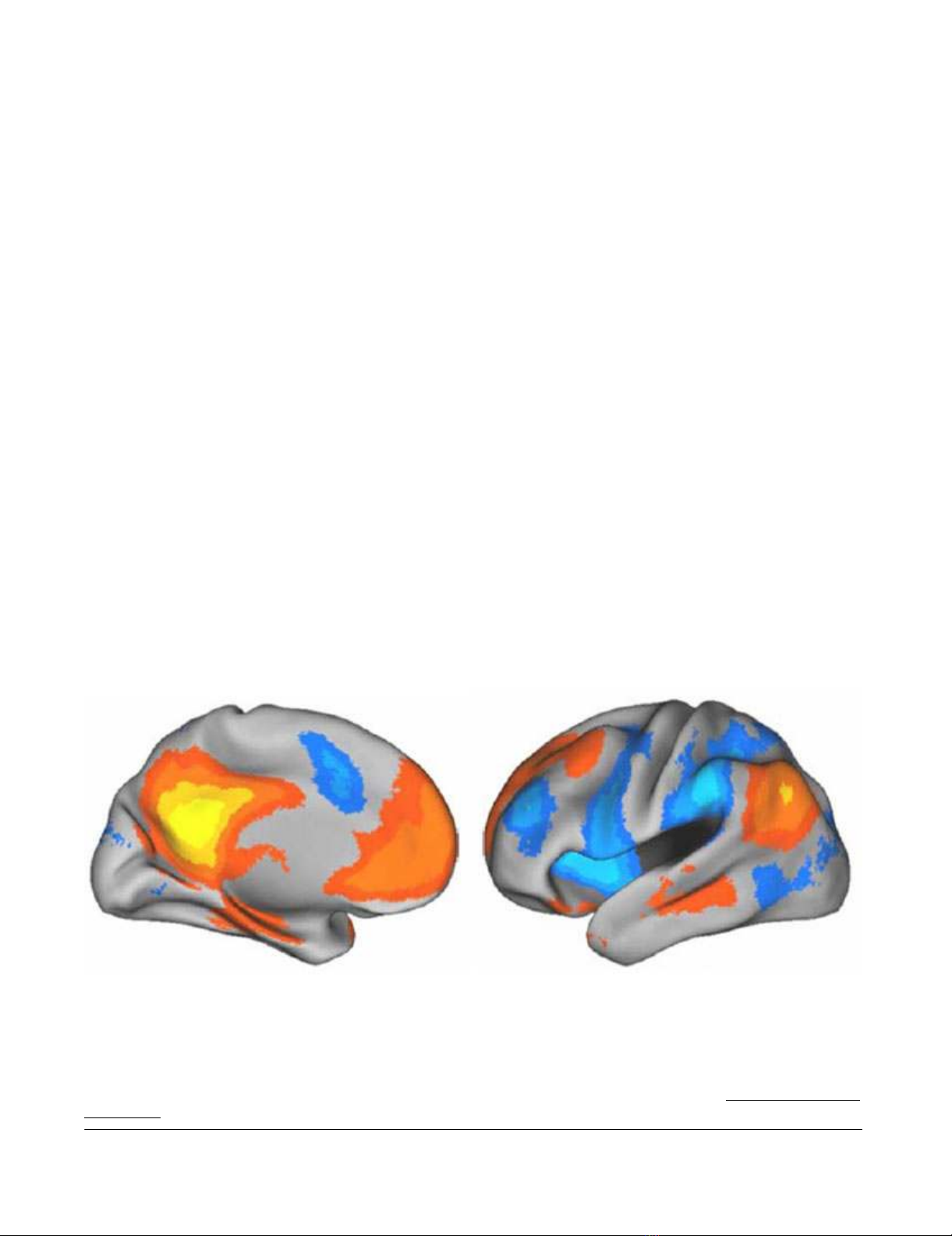
Freudian ego. This conglomeration of activity has been
named the 'default mode network' [19] (Figure 1). A
recent analysis in a large sample of healthy volunteers has
shown that connectivity within the DMN undergoes a
marked increase with maturation from childhood to
adulthood [31]. Activity in the mPFC node of the DMN
has been closely associated with self-reflection (e.g.
[22,24,27,32]) and recent evidence suggests that the
mPFC exerts the principal causality within the network
[33]. The PCC and IPL have been associated with propri-
oception [34,35] and the PCC and medial temporal
regions have been associated with the retrieval of autobi-
ographical memories [36-39]. The DMN shows a high
level of functional connectivity at rest [28,33]. Activity in
this network consistently decreases during engagement in
goal-directed cognition [28,33,40] and connectivity
within the network tends to decrease during states of
reduced consciousness [41,42]. Expressed in Freudian
terms, goal-directed cognition requires a displacement of
libido (energy) from the ego's reservoir (the DMN) and its
investment in objects (activation of the DLPFC). There is
evidence that this function is impaired in a number of
psychiatric disorders, including depression [43-48].
'The ego is a great reservoir from which the libido that
is destined for objects flows out and into which it
flows back from those objects' [49].
In addition to the mPFC and PCC nodes of the DMN and
their relation to the ego, we speculate on the basis of neu-
roimaging data and findings from deep brain stimulation
(see Neuropsychiatric findings in depression correlated
with principles of Freudian metapsychology below), that
ventromedial PFC (vmPFC) exerts a strong repressive hold
over emotional and motivational ('visceromotor') centres
[50]. This repressive force is the most primitive function
of the ego. As will be elaborated later, the posterior
vmPFC plays a major role in the pathophysiology of
depression. For example, inhibition of the region ventral
to the genu of the copus callosum, the subgenual cingu-
late or Cg25 has been found to alleviate depressive symp-
tomology in patients suffering from treatment resistant
depression (TRD) [51]. The subgenual cingulate and
regions proximal to it appear to exert a modulatory influ-
ence over key 'visceromotor' centres such as the amygdala,
the ventral tegmental area (VTA) and the nucleus
accumbens (NAc) [50,52]. Certain limbic centres (e.g., the
amygdala) have been shown to be pathologically active in
depression (see [50] for a review).
The ego ideal/super ego
The concept of the 'ego ideal' was introduced by Freud in
his paper 'On narcissism' [7], forming the basis of what
Regions positively correlated with the default mode network (orange), most notably the medial prefrontal cortex (mPFC), pos-terior cingulate cortex (PCC), inferior parietal lobule and medial temporal regionsFigure 1
Regions positively correlated with the default mode network (orange), most notably the medial prefrontal
cortex (mPFC), posterior cingulate cortex (PCC), inferior parietal lobule and medial temporal regions. Activity
in these regions has been shown to decrease during the performance of goal-directed cognition. The areas shown in blue are
negatively correlated with the default mode network (DMN) and may be described as an object-oriented network (ON). The
ON is consistently activated during goal-directed cognitions but is relatively inactive at rest. It is argued in the present work
that the DMN is functionally consistent with the Freudian ego. Image reproduced with permission from http://www.blackwell-
synergy.com[289].

Annals of General Psychiatry 2008, 7:9 http://www.annals-general-psychiatry.com/content/7/1/9
Page 5 of 23
(page number not for citation purposes)
would later become 'the super ego' [1] (German original
= 'Das über-Ich'; 'the over-I'). The ego ideal/super ego
plays a fundamental role in the aetiology of depression:
'Repression, we have said, proceeds from the ego, we
might say with greater precision that it proceeds from
the self-respect of the ego' [7].
Freud described this more fully in the following passage:
'The ego ideal is...the target of the self-love which was
enjoyed in childhood by the actual ego. The subject's
narcissism makes its appearance displaced on to this
new ideal ego, which like the infantile ego finds itself
possessed of every perfection that is of value. As always
where the libido is concerned, man has here shown
himself incapable of giving up a satisfaction he had
once enjoyed. He is not willing to forgo the narcissistic
perfection of his childhood; and when as he grows up,
he is disturbed by the admonitions of others and by
the awakening of his own critical judgement, so that
he can no longer retain that perfection, he seeks to
recover it in the new form of an ideal. What he projects
before him as his ideal is the substitute for the lost nar-
cissism of his childhood in which he was his own
ideal' [7].
It is difficult to postulate a neurodynamic correlate of such
a high-level concept as the ego ideal or super ego. The fol-
lowing model should therefore be considered speculative
and preliminary. The super ego might be thought of as an
umbrella term for high-level cognitions that work to
appraise the ego's ability to meet an imagined ideal. This
ideal-ego or 'ego ideal' is acquired through an internalisa-
tion of value judgements of others (e.g., one's early care
givers) under social and environmental demands (see
Mourning and melancholia below). Through the super
ego, the ego receives feedback on how closely it corre-
sponds with an imagined ideal. If the super ego judges the
ego as falling short of this ideal, or if the super ego judges
the ego's or the id's drives as unhealthy or dangerous in
the context of its social environment, then the ego may
repel these drives, withholding them from consciousness.
The implications of the super ego's instruction to repress
will be discussed in the next section in relation to depres-
sion.
It is highly unlikely that the ego ideal/super ego is housed
in any specific region of the brain but we may speculate
about dynamic physiological processes paralleling psy-
chological ones. Thus, paralleling the super ego's value
judgements of the ego may be feedback between the
DLPFC of the ON and the mPFC of the DMN. Informa-
tion communicated between these two systems (see The
ego above) may parallel the experience of pursuing an
ideal and judging how successfully it is met.
In relation to the unconscious, punishing aspect of the
super-ego it might be useful to consider the role of the
anterior cingulate (ACC). Activation of the ACC has been
associated with error detection and guilt [8,53,54]. It may
be significant that a recent analysis of functional connec-
tivity in the human cingulate revealed strong connectivity
between the ACC and the DLPFC [54]. Conversely, Cg25
was found to be strongly connected with regions of the
DMN such as the OFC. It is possible that feedback
between the DLPFC and the mPFC is mirrored at a lower
level by feedback between the ACC, OFC and Cg25. Feed-
back between the ON and DMN likely takes place via cor-
tico-striato-pallido-thalamo-cortical circuitry.
The super ego's control over the ego gives it a unique
power to influence the motility and expression of the
drives. Impassioned behaviours deemed dangerous to the
ego in the context of its environment may be denied
expression by activating Cg25 and the DMN. Integrating
this hypothesis into a model of depression, we can postu-
late that activating Cg25 and the DMN controls the full
expression of affective, mnemonic and motivational
behaviours promulgated by visceromotor centres. Thus,
engaging Cg25 contains limbic activity within paralimbic-
thalamic circuits maintained by the Cg25 in reaction to
sustained limbic arousal (for relevant models, see
[46,50,55-58]).
The id
The German original 'das es' literally translates as 'the it'.
As with the German word for the ego (das Ich), the origi-
nal word for the id has an appeal that is lost in translation.
The id was one of Freud's later concepts, being introduced
in his paper 'The ego and the id' [1]. Some have argued
that the id is synonymous with the unconscious, and it is
true that two are closely related:
'The id and the unconscious are as intimately linked as
the ego and the preconscious' [59].
'The truth is that it is not only the psychically repressed
that remains alien to our consciousness, but also some
of the impulses which dominate our ego' [6].
Although the id and the unconscious are related, they also
retain some important differences, both psychologically
and physiologically. Essentially, the id refers to the uncon-
scious as a system in a topographical sense [60]. Freud
described the id as an archaic psychical system governed
by primitive drives.