
BioMed Central
Page 1 of 6
(page number not for citation purposes)
Respiratory Research
Open Access
Research
Reference values for exhaled nitric oxide (reveno) study
Mario Olivieri1, Giorgio Talamini1, Massimo Corradi2, Luigi Perbellini1,
Antonio Mutti2, Claudio Tantucci3 and Mario Malerba*3
Address: 1Department of Medicine and Public Health, University of Verona, Italy, 2Department of Clinical Medicine, Nephrology and Health
Sciences, University of Parma, Italy and 3Department of Internal Medicine, University of Brescia, Italy
Email: Mario Olivieri - mario.olivieri@univr.it; Giorgio Talamini - giorgio.talamini@univr.it; Massimo Corradi - massimo.corradi@unipr.it;
Luigi Perbellini - luigi.perbellini@univr.it; Antonio Mutti - antonio.mutti@unipr.it; Claudio Tantucci - tantucci@med.unibs.it;
Mario Malerba* - malerba@med.unibs.it
* Corresponding author
Abstract
Background: Despite the widespread use of fractional exhaled nitric oxide (FENO) as a biomarker
of airways inflammation, there are no published papers describing normal FENO values in a large
group of healthy adults.
Objective: The aim of this study was to establish adult FENO reference values according to the
international guidelines.
Methods: FENO was measured in 204 healthy, non-smoking adults with normal spirometry values
using the on-line single-breath technique, and the results were analysed chemiluminescently.
Results: The main result of the study was the significant difference in FENO values between men
and women, thus indicating that gender-based reference FENO values are necessary. The FENO levels
obtained at expiratory flows of 50 ml/s ranged from 2.6 to 28.8 ppb in men, and from 1.6 to 21.5
ppb in women.
Conclusion: We propose reference FENO values for healthy adult men and women that could be
used for clinical and research purposes.
Background
The presence of nitric oxide (NO) in exhaled air was first
described in 1991 by Gustafsson et al.[1], and this was
soon followed by a number of publications reporting high
fractional concentrations of orally exhaled NO (FENO) in
subjects with various pulmonary diseases [2]. FENO is gen-
erally measured on line by having the subject blow
directly into the analyser and obtaining immediate results
[3], but breath can also be collected remotely into inert
bags and analysed subsequently (off line) [3].
Although the pathophysiological meaning is still unclear
[4], it has been demonstrated that NO levels in exhaled air
are higher in asthmatics than in healthy subjects, increase
during spontaneous or induced asthma exacerbations,
and decrease after anti-inflammatory treatment [5].
Many studies have clearly demonstrated that a number of
factors can affect FENO values, and so the European Respi-
ratory Society (ERS) and American Thoracic Society (ATS)
established particular recommendations for exhaled and
Published: 30 June 2006
Respiratory Research 2006, 7:94 doi:10.1186/1465-9921-7-94
Received: 03 February 2006
Accepted: 30 June 2006
This article is available from: http://respiratory-research.com/content/7/1/94
© 2006 Olivieri et al; licensee BioMed Central Ltd.
This is an Open Access article distributed under the terms of the Creative Commons Attribution License (http://creativecommons.org/licenses/by/2.0),
which permits unrestricted use, distribution, and reproduction in any medium, provided the original work is properly cited.

Respiratory Research 2006, 7:94 http://respiratory-research.com/content/7/1/94
Page 2 of 6
(page number not for citation purposes)
nasal NO measurements in 2005 [6] in order to allow the
comparison of data from different research centres.
Clinicians and researchers seeking to apply FENO measure-
ments in everyday practice are obviously interested in
knowing what are normal FENO values in healthy subjects,
but very few attempts have been made to establish such
reference values, and experimental findings are usually
only compared with those observed in the healthy con-
trols recruited for any particular study. Buchvald et al. [7]
have recently found that upper normal FENO levels in chil-
dren aged 4–17 years ranged from 15 parts per billion
(ppb) in the youngest to 25 ppb in adolescents, with a
mean increase of 1 ppb per year. To the best of our knowl-
edge, there are no published studies indicating similar ref-
erence values for adults.
The aim of this study was to establish reference adult FENO
values according to the international guidelines.
Materials and methods
Study subjects and protocol
This open-label study was conducted in three Italian cen-
tres (Brescia, Parma and Verona) and recruited local med-
ical school students and colleagues, who were given a
short description of the project, and the inclusion and
exclusion criteria.
Healthy subjects were defined as individuals with normal
spirometry values and without a history of any significant
diseases. Furthermore, in accordance with the ATS/ERS
guidelines [6], particular care was taken to avoid the
known confounding factors that may affect FENO measure-
ments: in particular, smokers and ex-smokers were
excluded; none of the volunteers was taking any drug or
medication or had experienced a recent upper or lower
airways infection, and none reported any clinical manifes-
tation of allergic diseases or positive skin prick tests for
common inhalant allergens.
The study was approved by the Ethics Committee of each
centre and all of the participants gave their written
informed consent.
Fractional exhaled NO measurements
Fractional exhaled NO (FENO) was measured using a
chemiluminescence analyser (CLD88, Ecomedics, Swit-
zerland) whose lower and upper limit of detection (LOD)
was respectively 0.06 ppb and 100 ppb. The same type of
instrument was used at all of the centres, and was cali-
brated at 0 and 100 ppb as recommended by the manu-
facturer.
FENO was measured in accordance with international
guidelines [6]. Briefly, after inhaling to total lung capacity,
the subjects exhaled through a mouthpiece equipped with
a 0.2-μm pore size bacterial filter into an exhalation cir-
cuit consisting of an ultrasonic flow meter, one-way valve
and one sampling port. NO was sampled directly in the
analyser (at a flow rate of 250 ml/min) through a Teflon
side arm tube attached to the sampling port. The sampling
tube was 60 cm long with an internal diameter of 1/8 of
in. Both expiratory flow and FENO values were simultane-
ously displayed on a computer attached to the analyser.
FENO was measured before the subjects underwent
spirometry.
Different expiratory flow rates were ensured by placing
expiratory resistors (Breath kit, Sievers Instruments, USA)
in the exhalation circuit, which yielded expiratory flow
rates of 50, 100 and 200 ml/s. The subjects were asked to
exhale at a constant flow, which they could readily see dis-
played on the computer screen in the form of a bar that
remained red until target flow was obtained, and then
turned green; if the flow dropped below or increased
above the desired range, the green bar changed back to
red. Although the target expiratory flows were strictly con-
trolled and maintained during the expiration, a tolerance
of ± 10% was considered acceptable, and the exhalation
continued until a stable plateau had been reached.
Three FENO plateau measurements varying by <10% were
made at each flow rate, and the average value was
recorded. As the subjects inhaled ambient air, its NO con-
centration was measured at the time of each test and, if
high (>30 ppb), the data were discarded. The influence of
ambient NO levels was further excluded by placing an
NO-scrubbing filter in the inspiratory limb of the collec-
tion apparatus. The data were stored on a computer and
analysed using NO analysis software.
Spirometry
The patients underwent spirometry using a spirometer
connected to a computer for data analysis (Vmax 22, Sen-
sor Medics, Yorba Linda, CA, USA), and FEV1 and FVC
were measured in accordance with the ATS standard pro-
cedure [8].
Data analyses
We first analysed the three subgroups of subjects from
each centre and then all of the subjects as a whole. As there
was no significant difference between the two analyses,
for the sake of simplicity, we shall here describe only the
results of the first.
Spearman's correlation test was used to verify the correla-
tions between the variables. Between-group comparisons
were made using non-parametric analysis of variance
(Kruskal-Wallis test) and, if significant, the Mann-Whit-
ney U test (M-W test). Logarithmic transformation was

Respiratory Research 2006, 7:94 http://respiratory-research.com/content/7/1/94
Page 3 of 6
(page number not for citation purposes)
applied to the NO values in order to normalise the curve
and the groups were compared using ANOVA; however, in
order to simplify the reading, the data are presented as
their original values and analysed non-parametrically.
Bonferroni's correction for multiple tests was applied.
In the multivariate analysis of the odds ratio estimates,
logistic regression was carried out backwise with pre-
assigned P values of > 0.05 controlling step removal; the
model was evaluated using three goodness-of-fit chi-
square statistics.
All of the analyses were made using SPSS Rel. 13.0 statis-
tical package (SPSS Inc., Chicago, IL).
Results
Table 1 shows the demographic data, physical and spiro-
metric parameters, and FENO values. The demographic
data, physical parameters, and mean spirometric and
FENO values of the healthy non-smoking subjects studied
in the three centres were pooled as there were no signifi-
cant between-centre differences (data not shown).
Table 2 shows the distribution of the FENO values. Of the
204 recruited subjects (male/female ratio = 1), 78 (38%)
were aged 19–30, 65 (32%) were aged 31–40, 39 (19%)
were aged 41–50, and 22 (11%) were aged 51–60 years.
There was no significant difference in age between the
sexes.
All of the subjects underwent spirometry and FENO meas-
urement at an exhaled flow of 50 mL/s, and respectively
178 (92 men and 86 women) and 179 subjects (93 men
and 86 women) also had FENO measured at the exhaled
flows of 100 and 200 mL/s. Twenty-five of the 26 subjects
who were unable to perform the FENO procedure at the
exhaled flow of 200 mL/s were also unable to do so at 100
mL/s.
There were significant gender-related differences in body
mass index (BMI), height, weight and body surface area
(BSA), forced expiratory volume at the first second (FEV1),
and forced vital capacity (FVC), but no gender-related dif-
ference in exhaled flow values.
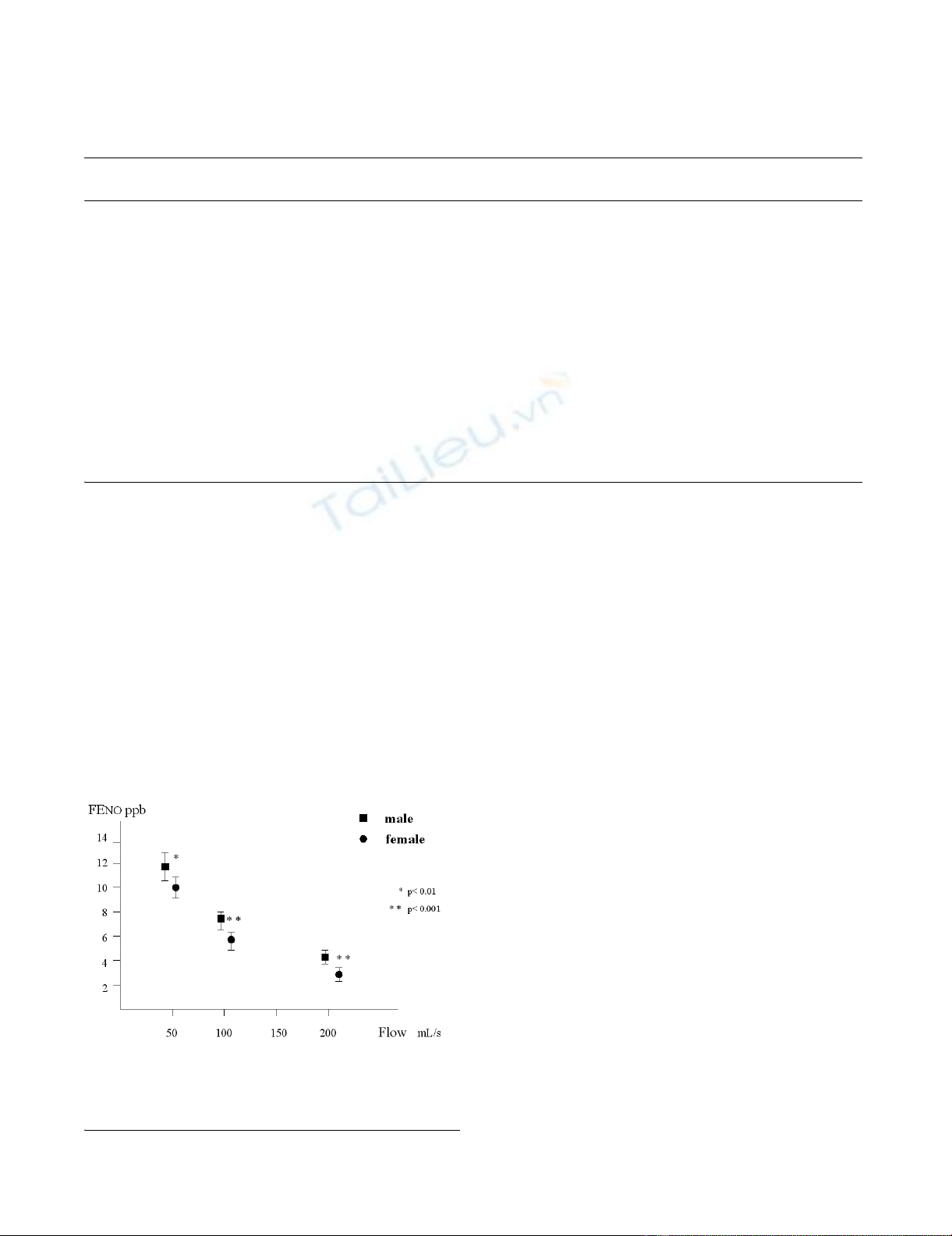
At all of the studied flow, FENO levels were significantly
lower in the women than in the men (Table 1). FENO lev-
els did not correlate with age, lung function or anthropo-
metric values.
There was a positive correlation between the FENO values
at the different exhaled flows: FENO50 vs. FENO100 r =
0.82, p < 0.001; FENO50 vs. FENO200 r = 0.74, p < 0.001;
FENO100 vs. FENO200 r = 0.9, p < 0.001.
FENO levels were not correlated with age (r = 0.1, p = 0.21,
Spearman's test) or with lung function or anthropometric
values. FENO levels at all studied flows were significantly
lower in females than those observed in men (Table 1).
Table 1: Demographic data, physical parameters and FENO values in studied subjects. Mean values and standard deviation (SD).
Males Females Total Values P value*
No. Value No. Value No. Value Min Max
Age (yrs) 102 37.0 ± 9.5 102 35.0 ± 10.1 204 36.1 ± 9,9 19 59 n.s.
Weight (kg) 102 77.6 ± 12.2 102 59.9 ± 9.8 204 68.8 ± 14.2 44 112 0.001
Height (cm) 102 176 102 164 204 170 148 190 0.001
BMI (m/kg2) 102 25.1 102 22.2 204 23.7 17.2 35.4 0.001
BSA (m2) 102 1.7 102 1.5 204 1.6 1.3 2.1 0.001
FENO 50
(ppb)
102 11.7 ± 5.0 102 9.9 ± 4.3 204 10.8 ± 4.7 0.7 28.8 0.01
FENO 100
(ppb)
92 7.1 ± 3.0 86 5.6 ± 2.5 178 6.4 ± 2.9 1.7 16.9 0.001
FENO 200
(ppb)
93 4.4 ± 2.0 86 3.5 ± 1.4 179 4.0 ± 1.8 0.9 10.7 0.001
FVC (litres) 102 5.2 ± 0.8 102 3.8 ± 0.5 204 4.5 ± 1.0 2.3 7.1 0.001
FVC %
predicted
102 108.3 ± 12.7 102 109.8 ± 12.3 204 109.1 ± 12.5 79 147.4 n.s.
FEV1 (litres/
1 sec)
102 4.2 ± 0.6 102 3.2 ± 0.4 204 3.7 ± 0.7 2.0 5.8 0.001
FEV1 %
predicted
102 105.7 ± 11.5 102 107.3 ± 9.3 204 106.5 ± 10.5 78 133.7 n.s.
Abbreviations: n.s. = not significant; FENO 50 = fractional exhaled nitric oxide in parts per billion (ppb) at an expiratory flow of 50 mL/sec; FENO
100 = fractional exhaled nitric oxide in parts per billion (ppb) at an expiratory flow of 100 mL/sec; FENO 200 = fractional exhaled nitric oxide in
parts per billion (ppb) at an expiratory flow of 200 mL/sec; FEV1 = forced expiratory volume (litres) in one second; FVC = forced vital capacity
(litres); BMI = body mass index; BSA= body surface area; Min = minimum value; Max = maximum value
* Mann-Whitney U-test comparing male and female subjects
Respiratory Research 2006, 7:94 http://respiratory-research.com/content/7/1/94
Page 4 of 6
(page number not for citation purposes)
Logistic regression analysis was performed considering sex
as dependent variable and centre, weight, height, age,
FEV1, FVC, FENO50, FENO100 and FENO200 as potentially
predictive factors.
Weight and FVC were identified as predictive variables
able to distinguish between males and females (data not
reported).
Discussion
The primary aim of this study was to measure FENO in a
population of healthy controls aged 19–65 years at a flow
rate of 50 mL/s using the on-line single breath technique.
We also analysed FENO at flow rates of 100 and 200 mL/s
in order to obtain their normal FENO values, and compare
the ability of normal adults to expire at such different
flows.
The main finding was that, even after adjusting for age,
height, weight, BMI and BSA, FENO values were signifi-
cantly lower in women at all of the studied expiratory
flows, which means that different gender-related reference
values need to be applied.
FENO levels at the most frequently used expiratory flow
rate of 50 ml/s was 2.6–28.8 ppb in men and 1.6–21.5
ppb in women. The FENO levels at 50 ml/s usually
reported in studies of healthy adults fall within the 10–20
ppb range [9] but, as in the case of other biological param-
eters, we observed some individuals with unexplained
higher or lower levels despite our strict study inclusion
and exclusion criteria. It may therefore be more prudent to
define normal FENO values in terms of percentiles, and we
would suggest considering the fifth and 95th percentiles
(4.5–20.6 ppb for males, and 3.6–18.2 ppb for females),
as references for healthy subjects, and taking further diag-
nostic and clinical steps in the case of subjects whose FENO
levels fall outside this range.
Gender-related differences in adult FENO levels were first
reported by Jilma et al.[10], who examined the concentra-
tions of exhaled NO and plasma nitrate, and were con-
firmed by Tsang et al.[11] in a cohort of 121 healthy non-
smoking subjects, and by van der Lee et al.[12] However,
our data were collected in accordance with the most recent
guidelines. It is not clear why this difference exists, but
Fractional exhaled nitric oxide (FENO) levels in men and women at three expiratory flowsFigure 1
Fractional exhaled nitric oxide (FENO) levels in men and
women at three expiratory flows. Mean values and 95% con-
fidence intervals.
Table 2: Data distribution of fractional exhaled nitric oxide values.
FENO ppb
percentile
Total
cases
5th 10th 20th 25th 30th 40th 50th 60th 70th 75th 80th 90th 95th
FENO5
0
Males 102 4.5 5.5 7.3 8.6 9.0 10.3 11.4 12.5 13.8 14.4 15.1 19.2 20.6
Femal
es
102 3.6 4.5 5.5 6.0 7.1 8.7 9.7 10.8 12.0 13.1 13.6 16.2 18.2
Total 204 3.8 5.0 6.2 7.3 8.2 9.4 10.4 11.7 13.1 13.7 14.5 17.3 19.7
FENO1
00
Males 92 2.8 3.4 4.1 4.6 5.3 6.0 6.8 7.6 8.4 9.0 9.7 11.5 12.8
Femal
es
86 2.2 2.6 3.3 3.7 4.0 4.8 5.4 6.0 6.7 7.4 8.0 9.6 10.3
Total 178 2.4 3.0 3.8 4.1 4.6 5.4 6.0 6.8 7.7 8.1 8.8 10.4 11.7
FENO2
00
Males 93 1.6 2.1 2.6 2.9 3.2 3.6 4.1 4.9 5.5 5.8 6.3 6.9 8.3
Femal
es
86 1.6 1.8 2.2 2.4 2.6 3.1 3.3 3.7 4.0 4.1 4.6 5.5 5.9
Total 179 1.6 1.9 2.5 2.6 2.9 3.3 3.6 4.1 4.7 5.2 5.5 6.6 7.1
Abbreviations: FENO50 = fractional exhaled nitric oxide at an expiratory flow of 50 mL/sec; FENO100 = fractional exhaled nitric oxide at an
expiratory flow of 100 mL/sec; FENO200 = fractional exhaled nitric oxide at an expiratory flow of 200 mL/sec; ppb= parts per billion

Respiratory Research 2006, 7:94 http://respiratory-research.com/content/7/1/94
Page 5 of 6
(page number not for citation purposes)
Grasemann et al.[13] have shown that it is partly associ-
ated with the NO synthase 1 genotype in healthy females;
factors related to hormone production are less plausible,
as Morris et al.[14] have shown that there is no temporal
relationship between the measurements of NO produc-
tion and urinary sex steroid conjugates during the men-
strual cycle, thus suggesting that estrogens do not
modulate FENO concentrations.
We speculate that a further possible reason is the differ-
ence in airway surface area and calibre [15,16]. The same
flow rate in airways of different calibres may differently
dilute NO, which moves by means of gaseous diffusion
into a smaller lumen (i.e. in females), thus leading to a
lower NO concentration. Brooks et al.[17] have demon-
strated that there is no within-gender correlation between
tracheal size and body size or maximal expiratory flows,
thus suggesting that the differences in the airway sizes of
men and women are true gender-related difference and
not simply due to differences in lung or body size. This
hypothesis is in line with the findings of Buchvald et al.
[7] showing no difference in FENO levels between boys
and girl of the same age, but a significant and positive rela-
tionship between FENO and age (which leads to a progres-
sive increase in airway surface) in both sexes; if the
hypothesis is confirmed, it could be concluded that the
low FENO levels in women may simply be an artefact due
to the use of a constant exhaled flow rate rather than a real
reduction in NO airway production. In this regard,
Nguyen et al. [18] have recently shown that the measure-
ment of both FENO and nitrogen oxides (NOX) in exhaled
breath condensate is more indicative of airway NO pro-
duction than FENO alone; further studies should be carried
out to verify whether there are any sexual differences in
exhaled NOx.
Our data confirm that FENO values are inversely related to
the exhalation flow rate [19], and demonstrated that an
exhaled flow of 50 mL/s was feasible in all our subjects,
which is in line with the published guidelines [6].
We also measured FENO levels at higher expiratory flows of
100 and 200 ml/s, because it has been suggested that
extended exhaled NO measurements can distinguish alve-
olar and bronchial inflammation [20,21]. However, we
found that there was a strong positive correlation (r =
>0.7) between FENO levels at different expiratory flows,
and that it was not always possible to obtain reproducible
expirations at higher flows in our healthy subjects. Further
studies of large numbers of patients with proximal and
distal airway inflammation should therefore be carried
out in order to evaluate whether the FENO measurements
at different expiratory flow rates may lead to information
that is as useful as that obtained at 50 ml/s.
The mean FENO levels at different expiratory flows in our
subjects are comparable with those previously reported by
some authors in healthy non-smoking subjects[18,21],
but slightly lower than those reported by others, particu-
larly those observed at the expiratory flow rate of 50 ml/s
[23]. In this regard, Borrill et al.[24] have recently com-
pared the FENO levels measured using three different com-
mercially available analysers and found significant
differences between them. This raises the important ques-
tion of variability between NO analysers. This is an impor-
tant point as Muller et al. [25] have recently shown that
the main factors responsible for the different NO readings
provided by different analysers are differences in calibra-
tion gases and procedures. Our study was not intended to
compare the NO readings provided by different analysers,
but we are confident of the reliability of our results
because Borrill et al.[24] found that the most reproducible
data was that obtained using the CLD88, probably
because it has the lowest detection limit and fastest
response time, and because it is CE MDD approved and
totally compliant to the standard required by the ATS/ERS
recommendations.
In conclusion, our study demonstrated that measuring
FENO measurement at an expiratory flow rate of 50 ml/s
was feasible in a population of 204 healthy subjects aged
19–65 years, and indicates that different normal FENO val-
ues should be defined for males and females.
Abbreviations
ATS = American Thoracic Society
CE MDD= European Community Medical Device Direc-
tive
FENO = fractional exhaled NO
ERS = European Respiratory Society
NOX = nitrogen oxides
Ppb = parts per billion
Competing interests
The author(s) declare that they have no competing inter-
est.
Authors' contributions
OM: substantial contribution to study conception and
design, sample collection, data acquisition, analysis and
interpretation; involved in drafting the article.
GT: substantial contribution to study conception and
design, data analysis and interpretation, critically review-
ing the draft for important intellectual content.