
Open Access
Available online http://arthritis-research.com/content/9/2/R38
Page 1 of 11
(page number not for citation purposes)
Vol 9 No 2
Research article
Vaccination response to tetanus toxoid and 23-valent
pneumococcal vaccines following administration of a single dose
of abatacept: a randomized, open-label, parallel group study in
healthy subjects
Lee Tay1, Francisco Leon2, George Vratsanos3, Ralph Raymond4 and Michael Corbo3
1Clinical Discovery, Bristol-Myers Squibb, PO Box 4000, Princeton, NJ 08543-4000, USA
2Clinical Development, Inflammatory Diseases, MedImmune, 1 MedImmune Way, Gaithersburg, MD 20878, USA
3Global Clinical Research, Immunology, PO Box 4000, Bristol-Myers Squibb, Princeton, NJ 08543-4000, USA
4Global Biometric Sciences, PO Box 4000, Bristol-Myers Squibb, Princeton, NJ 08543-4000, USA
Corresponding author: Lee Tay, lee.tay@bms.com
Received: 31 Jul 2006 Revisions requested: 31 Aug 2006 Revisions received: 26 Mar 2007 Accepted: 10 Apr 2007 Published: 10 Apr 2007
Arthritis Research & Therapy 2007, 9:R38 (doi:10.1186/ar2174)
This article is online at: http://arthritis-research.com/content/9/2/R38
© 2007 Tay et al., licensee BioMed Central Ltd.
This is an open access article distributed under the terms of the Creative Commons Attribution License (http://creativecommons.org/licenses/by/2.0),
which permits unrestricted use, distribution, and reproduction in any medium, provided the original work is properly cited.
Abstract
The effect of abatacept, a selective T-cell co-stimulation
modulator, on vaccination has not been previously investigated.
In this open-label, single-dose, randomized, parallel-group,
controlled study, the effect of a single 750 mg infusion of
abatacept on the antibody response to the intramuscular
tetanus toxoid vaccine (primarily a memory response to a T-cell-
dependent peptide antigen) and the intramuscular 23-valent
pneumococcal vaccine (a less T-cell-dependent response to a
polysaccharide antigen) was measured in 80 normal healthy
volunteers. Subjects were uniformly randomized to receive one
of four treatments: Group A (control group), subjects received
vaccines on day 1 only; Group B, subjects received vaccines 2
weeks before abatacept; Group C, subjects received vaccines
2 weeks after abatacept; and Group D, subjects received
vaccines 8 weeks after abatacept. Anti-tetanus and anti-
pneumococcal (Danish serotypes 2, 6B, 8, 9V, 14, 19F and
23F) antibody titers were measured 14 and 28 days after
vaccination. While there were no statistically significant
differences between the dosing groups, geometric mean titers
following tetanus or pneumococcal vaccination were generally
lower in subjects who were vaccinated 2 weeks after receiving
abatacept, compared with control subjects. A positive response
(defined as a twofold increase in antibody titer from baseline) to
tetanus vaccination at 28 days was seen, however, in ≥ 60% of
subjects across all treatment groups versus 75% of control
subjects. Similarly, over 70% of abatacept-treated subjects
versus all control subjects (100%) responded to at least three
pneumococcal serotypes, and approximately 25–30% of
abatacept-treated subjects versus 45% of control subjects
responded to at least six serotypes.
Introduction
Treatment with abatacept has demonstrated efficacy in
patients with active rheumatoid arthritis (RA) and an inade-
quate response to methotrexate, and in those with an inade-
quate response to anti-TNF therapy [1-3]. Abatacept is a
soluble fusion protein consisting of the extracellular domain of
human cytotoxic T-lymphocyte-associated antigen-4 linked to
the Fc (hinge, CH2 and CH3 domains) portion of human IgG1,
which has been modified to be noncomplement fixing. Abata-
cept is the first in a class of agents for the treatment of RA that
selectively modulates the CD80/CD86:CD28 co-stimulatory
signal required for full T-cell activation [4]. Activation of T cells
usually requires two signals from antigen-presenting cells
[5,6]. The first signal is mediated through the T-cell receptor
via an interaction with major histocompatibility complex-pre-
sented peptide antigen [6]. The second, or co-stimulatory, sig-
nal is delivered following the engagement of CD80/CD86 on
antigen-presenting cells with a cognate receptor, CD28, on
the surface of the T cell [6,7]. Abatacept, a selective co-stim-
ulation modulator, inhibits CD28-dependent T-cell activation
by binding to CD80 and CD86 [4].
AE = adverse events; ELISA = enzyme-linked immunosorbent assay; i.m. = intramuscular; i.v. = intravenous; RA = rheumatoid arthritis; TNF = tumor
necrosis factor.
Arthritis Research & Therapy Vol 9 No 2 Tay et al.
Page 2 of 11
(page number not for citation purposes)
The impact of abatacept on humoral responses to two T-cell-
dependent neoantigens, bacteriophage X174 and keyhole lim-
pet hemocyanin, was previously evaluated in psoriasis patients
treated with abatacept [8]. While the responses to these
neoantigens were reduced, the primary response to these T-
cell-dependent antigens was not completely blocked. In addi-
tion, tertiary and quaternary responses were restored following
discontinuation of abatacept administration, demonstrating
that tolerance to these neoantigens was not induced [8].
In the present article we describe the effect of a single dose of
abatacept on the humoral response in healthy subjects to two
vaccines, tetanus toxoid vaccine and 23-valent pneumococcal
vaccine. This study was carried out in normal healthy subjects
in order to evaluate the effects of abatacept on the response
to therapeutic vaccines in intact immune systems before eval-
uating the response in RA patients. Patients with active RA
may not have normal immune function parameters, and often
receive background disease-modifying antirheumatic drugs,
many of which are immunosuppressive. It was intended that
data from this study would guide the design of other studies
evaluating vaccine responses in patients with RA. These criti-
cal studies in 'real-world' RA patients are ongoing. In addition,
the effect of abatacept upon two different types of antigen
response was evaluated. The tetanus toxoid vaccine com-
prises a peptide antigen, and, since most individuals in the
United States have been vaccinated with tetanus toxoid, the
response measured in this study can be considered a T-cell-
dependent memory response. Polysaccharides, however, are
able to elicit responses in the absence of T-cell help, although
the magnitude of the response is reduced under those circum-
stances [9-11]. The response to pneumococcal vaccine
measured in the present study is therefore not entirely T-cell
independent, or the response is less T-cell dependent. Finally,
as a normal humoral response to T-cell-dependent antigens
peaks at around 2 weeks [12], we also analyzed the impact on
humoral response of the timing of vaccination relative to abata-
cept administration.
Materials and methods
Study design
This open-label, parallel-group, controlled study was con-
ducted at three study centers in the United States. Subjects
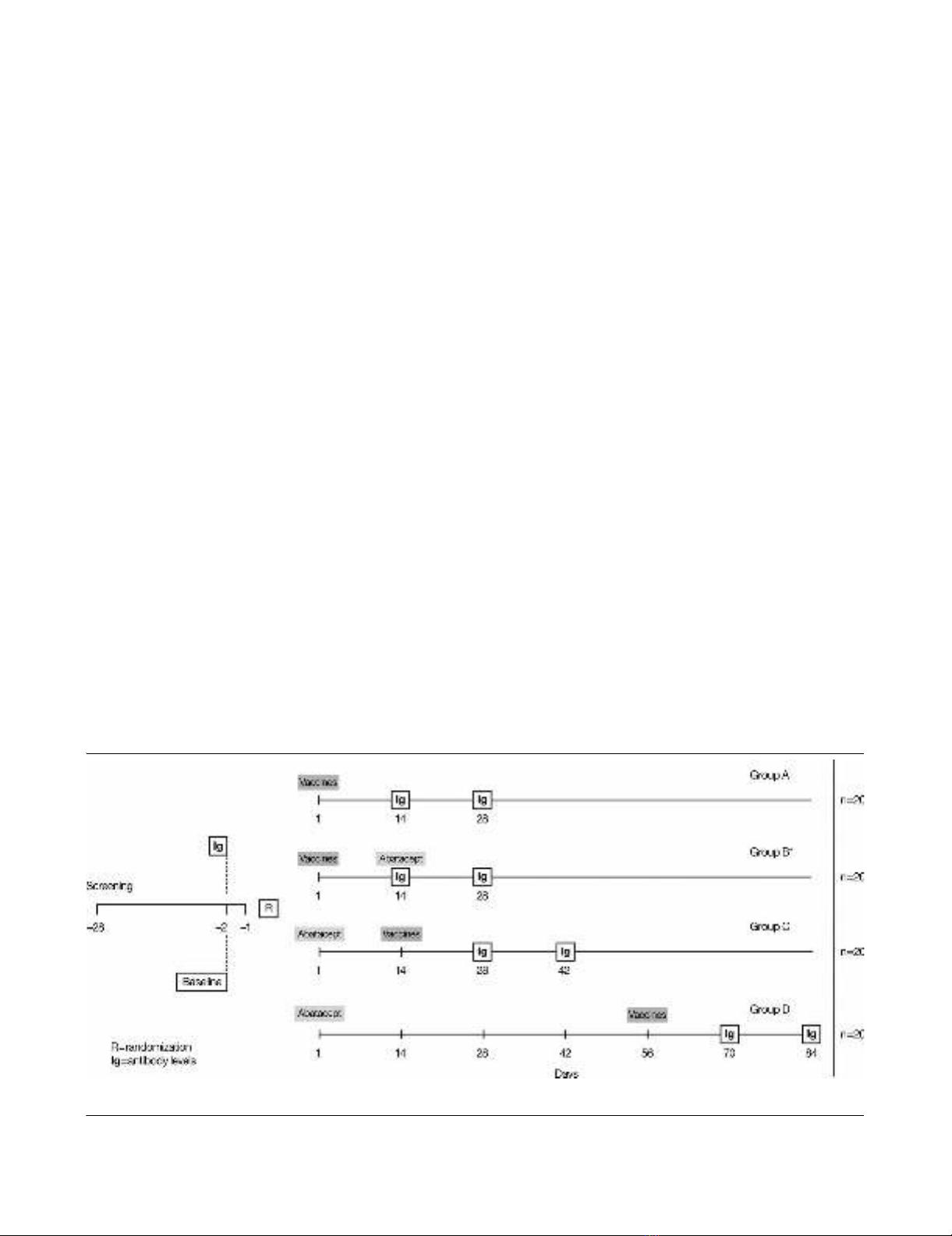
were randomized to one of four treatment groups (Figure 1).
Group A (control group) subjects received separate 0.5 ml
intramuscular (i.m.) injections of tetanus toxoid and 23-valent
pneumococcal vaccines on day 1 without abatacept.
Group B subjects (vaccines 2 weeks before abatacept)
received separate 0.5 ml i.m. injections of tetanus toxoid and
23-valent pneumococcal vaccines on day 1, followed 14 days
later by a single intravenous (i.v.) dose of 750 mg abatacept.
Serum samples were collected prior to the abatacept infusion
on study day 14 and 14 days later on study day 28.
Group C subjects (vaccines 2 weeks after abatacept)
received a single i.v. dose of 750 mg abatacept on day 1, fol-
lowed 14 days later by separate 0.5 ml i.m. injections of teta-
nus toxoid and 23-valent pneumococcal vaccines. Serum
samples were obtained on study day 14 prior to vaccinations
and at 14 and 28 days after the vaccinations (study days 28
and 42, respectively).
Figure 1
Patient disposition from enrollment to completion of the trialPatient disposition from enrollment to completion of the trial. *Abatacept administered after immunoglobulin (Ig) determination at day 14.

Available online http://arthritis-research.com/content/9/2/R38
Page 3 of 11
(page number not for citation purposes)
Group D subjects (vaccines 8 weeks after abatacept)
received a single i.v. dose of 750 mg abatacept on day 1,
followed 56 days later by separate 0.5 ml i.m. injections of tet-
anus toxoid and 23-valent pneumococcal vaccines.
Serum samples were obtained for subjects of Groups A and
B at study days 14 and 28, for Group C subjects at study days
28 and 42, and for Group D subjects at study days 70 and 84.
Healthy male or female subjects (aged 18–65 years inclusive)
with a body weight ≥ 60 kg and ≤ 100 kg were enrolled. Sub-
jects were excluded if they had received any live vaccine within
the prior 4 weeks, had received a tetanus booster or pneumo-
coccal vaccine within 5 years or if they had baseline anti-teta-
nus antibodies below clinically detectable levels. Anti-tetanus
and anti-pneumococcal (Danish serotypes 2, 6B, 8, 9V, 14,
19F and 23F) antibody titers were measured by ELISA at 14
and 28 days after vaccination by a central laboratory. Abata-
cept serum concentrations were measured at the same time
as the antibody titers were determined.
This study was carried out in accordance with the ethical prin-
ciples of the Declaration of Helsinki and was approved by Insti-
tutional Review Boards. All subjects gave informed consent.
Drug administration and vaccination
Abatacept 750 mg was administered over 30 minutes by i.v.
infusion using a calibrated, constant-rate infusion. Tetanus tox-
oid vaccine (Aventis Pasteur Inc., Swiftwater, PA, USA) and
23-valent pneumococcal vaccines (Merck & Co Inc., White-
house Station, NJ, USA) were administered separately via i.m.
injection in either the deltoid or the lateral mid-thigh.
Abatacept and antibody assays
Serum samples were used to determine antibody levels. The
assay to quantify IgG anti-tetanus toxoid antibody levels was
based on a previously described methodology [13]. The assay
to quantify IgG anti-pneumococcal antibody levels was based
on the Procedures of the World Health Organization Pneumo-
coccal Serology Reference Laboratories at the Institute of
Child Health, University College, London, UK, and on the pro-
cedures of the Department of Pathology, University of Ala-
bama at Birmingham, AL, USA [14]. All analyses were carried
out at the Center for Vaccine Research and Development, St
Louis University Health Sciences Center, St Louis, MO, USA.
The antibody response against tetanus toxoid vaccine was
expressed as absolute titers of antibodies. Serum samples for
the quantification of abatacept were collected at baseline,
prior to vaccinations, and at the time when the samples were
collected for antibody determinations [15].
Safety assessments
Subjects were monitored for adverse events (AE), serious AE
and vital signs prior to dosing with abatacept and upon
discontinuation.
Statistical methods
All subjects in all four groups were included in the safety anal-
ysis. Geometric means and the percentage of the coefficient
of variation were reported for antibody concentrations. For
each antibody, point estimates and 95% confidence intervals
were constructed for the geometric mean changes from pre-
vaccination to postvaccination antibody levels. These con-
structions were from the results of repeated-measures
analyses of covariance on the natural logarithm of the antibody
levels, with the treatment group and the study day as factors
and the log of the baseline (prevaccination) antibody level as
the covariate. For each antibody, point estimates and 95%
confidence intervals for the prevaccination to postvaccination
changes on the log scale were exponentiated to obtain esti-
mates for geometric means and ratios of geometric means
(fold increase) on the original scale. A twofold or higher
increase above the baseline levels of specific antibodies was
considered a clinically significant or positive immune response
against tetanus toxoid and to each of the seven chosen sero-
types of the 23-valent pneumococcal vaccine [16,17].
Results
The baseline demographics and clinical characteristics of the
80 subjects enrolled in this study were similar across the four
groups. The mean age of subjects was 34–36 years (Table 1).
Of the 80 subjects, 77 (96%) completed treatment and three
(4%) discontinued early from the study.
Overall, 59 AE were experienced by 29 subjects (49.2%)
treated with abatacept, compared with 25 AE reported in 13
subjects (65.0%) who did not receive abatacept (Group A,
control group). The most frequently reported AE in Group A
subjects were injection-site pain (50.0%), headache (10.0%)
and pharyngolaryngeal pain (10.0%). The most frequently
reported treatment-emergent AE in the abatacept-treated
groups were headache (20.3%), injection-site pain (10.2%)
and viral infection (10.2%).
One subject (1.7%) in Group D experienced a serious adverse
event of generalized urticaria 5 minutes after the end of the
first abatacept infusion, which re-occurred at 90 minutes
postinfusion. The investigator reported the event as moderate
in intensity and probably related to the study drug. The subject
was treated with epinephrine and diphenhydramine, remained
hospitalized overnight for observation and was discharged on
study day 2. The event was completely resolved by study day
3.

Arthritis Research & Therapy Vol 9 No 2 Tay et al.
Page 4 of 11
(page number not for citation purposes)
Abatacept serum concentration levels
The observed abatacept serum concentrations levels were
consistent with the dose of abatacept administered and its rel-
ative timing.
Subjects randomized to Group A (control group, vaccines
only) did not receive abatacept, as reflected in Table 2. Sub-
jects randomized to Group B received vaccines 2 weeks prior
to treatment with abatacept. In this group, serum samples
were collected prior to the abatacept infusion on study day 14
and on study day 28. This is reflected in serum concentrations
below the lower limit of quantification on day 14, and a mean
serum concentration of 28.6 μg/ml on study day 28.
Subjects randomized to Group C received vaccines 2 weeks
after treatment with abatacept. The mean serum concentra-
tions observed for subjects in this group – taken 14 and 28
days after vaccinations of 12.5 μg/ml and 6.1 μg/ml, respec-
tively – are again consistent with values at the corresponding
time points in previous studies in healthy subjects.
Finally, subjects randomized to Group D received vaccines 8
weeks after treatment with abatacept. The observed mean
serum concentrations of 1.3 μg/ml on study day 70 is consist-
ent with concentration levels obtained in previous studies. Fur-
thermore, the mean serum concentration of 0.4 μg/ml on study
day 84 is consistent with concentrations that would be
expected based on a half-life of approximately 14 days for
abatacept.
Antibody responses in the control group
In the control group (Group A), not all normal, healthy subjects
responded fully to the two vaccines at day 14 and 28. For the
tetanus toxoid, approximately 95% and 75% of subjects at
days 14 and 28, respectively, achieved at least a twofold
increase in antibody titers. For the pneumococcal vaccine,
Table 1
Subject demographics
Characteristic Group A (vaccines alone on day
1) (n = 20)
Group B (vaccines 2 weeks
before abatacept) (n = 20)
Group C (vaccines 2 weeks after
abatacept) (n = 20)
Group D (vaccines 8 weeks after
abatacept) (n = 20)
Age (years)
Mean 34 34 34 36
Standard deviation 12 13 11 13
Range 18–55 18–56 19–56 20–56
Gender (n (%))
Male 10 (50) 8 (40) 10 (50) 11 (55)
Female 10 (50) 12 (60) 10 (50) 9 (45)
Race (n (%))
White 15 (75) 12 (60) 14 (70) 11 (55)
Black 5 (25) 8 (40) 6 (30) 8 (40)
Other0001 (5)
Table 2
Abatacept serum concentration levels determined 14 and 28 days after vaccination
Group Baseline (μg/ml) 14 days after vaccination (μg/ml) 28 days after vaccination (μg/ml)
Group Aa (vaccines alone on day 1) N/A N/A N/A
Group Bb (vaccines 2 weeks before abatacept) N/A N/A 28.6 (26)
Group C (vaccines 2 weeks after abatacept) N/A 12.5 (19) 6.1 (20)
Group D (vaccines 8 weeks after abatacept) N/A 1.3 (56) 0.4 (106)
Data presented as the geometric means (percentage of the coefficient of variation. N/A: not applicable. aSubjects in Group A did not receive
abatacept. bSubjects in Group B received abatacept at 14 days (serum concentration taken pre-abatacept dosing).

Available online http://arthritis-research.com/content/9/2/R38
Page 5 of 11
(page number not for citation purposes)
approximately 45–95% and 50–95% of subjects at days 14
and 28, respectively, achieved at least a twofold increase in
antibody titer across all seven serotypes.
Antibody response to tetanus toxoid
The antibody responses against tetanus toxoid vaccine,
expressed as absolute titers of antibodies, are summarized in
Table 3. The corresponding abatacept serum concentrations
are presented in Table 2.
The intersubject variability in response to tetanus toxoid was
large, with the percentage of the coefficient of variation rang-
ing between 54% and 112% (Table 3). Based on the geomet-
ric mean of the antibody titers, subjects in Group B (received
vaccines 2 weeks before abatacept) appeared little affected to
not affected, with a lowered response of approximately 6%
when compared with the control group (Group A) at 28 days
after vaccination, a reduction within the variability of the assay
(Table 3). For Group C subjects (received vaccines 2 weeks
after abatacept), there appeared to be a lowered response of
approximately 48% and 39% at 14 and 28 days, respectively,
compared with Group A. Subjects in Group D (received vac-
cines 8 weeks after abatacept) were affected to a lesser
extent, with an observed lowered response of approximately
21% and 16% at 14 and 28 days, respectively, compared with
Group A.
The percentage of subjects who mounted a response that was
at least twofold from baseline is shown in Figure 2 for tetanus
toxoid. Across all treatment groups, at least 60% of subjects
were able to generate at least a twofold increase in antibody
response after 28 days. In the control group (Group A), 75%
of subjects reached this level. The responses observed at 14
and 28 days after vaccination were similar.
Antibody responses to 23-valent pneumococcal vaccine
Seven serotypes of 23-valent pneumococcal vaccine were
chosen as a representative sample of differing immunogenic
strengths of pneumococcal vaccine. Serotype 14 (the most
common), serotype 8, serotype 9V and serotype 2 are the
most immunogenic. Figure 3 illustrates the fold increases for
the seven serotypes at days 14 and 28, respectively, and
Table 4 presents the corresponding geometric mean values of
antibody titers.
As with the response to tetanus toxoid, variable response rates
were obtained in the study subjects across individual sero-
types. The percentages of subjects in all treatment groups
achieving a positive response to the different serotypes at 14
and 28 days after vaccination are illustrated in Figure 4a and
4b, respectively. In general, and as expected, the highest
responses were observed for serotypes 14 and 2. The appar-
ent decrease in vaccination response in subjects who were in
Group B cannot be accurately evaluated because of the
higher baseline values obtained in these subjects, a known
cause of reduced relative responses. This randomization vari-
ability is further illustrated by the fact that responses in Group
B subjects appeared decreased even at day 14, prior to the
administration of abatacept. In subjects of Groups C and D,
however – those who were vaccinated after abatacept – lower
average titers on days 14 and 28 were recorded for all
serotypes, except serotype 23F (Table 4). The decrease in
antibody response in Group C subjects at 14 and 28 days
after vaccination ranged from 22% to 69% and from 24% to
68%, respectively. Similarly, the decrease in antibody
response for subjects in Group D determined at 14 and 28
days after vaccination ranged between 12% and 67% and
between 25% and 64%, respectively. No correlation between
the immunogenicity of the serotype of the pneumococcal vac-
cine and the reduction in response was observed.
Figure 5a,b summarizes the number of serotypes to which
subjects responded with at least a twofold increase over base-
line at 14 and 28 days after vaccination, respectively. More
than 90% of subjects in all treatment groups responded to at
least one serotype, over 70% of subjects responded to at least
three different serotypes, and approximately 25% of subjects
responded to at least six different serotypes by day 14 (Figure
5a) and by day 28 (Figure 5b).
Table 3
Geometric means (percentage of the coefficient of variation) of anti-tetanus toxoid antibody titers taken 14 and 28 days after
tetanus toxoid vaccination
Group nBaseline titers (U/ml) Anti-tetanus antibody titers at 14 days
post-vaccination (U/ml)
Anti-tetanus antibody titers at 28 days
post-vaccination (U/ml)
Group A (vaccines alone on day 1) 20 1.6 (106) 11.4 (88) 9.3 (104)
Group B (vaccines 2 weeks before abatacept) 20 1.9 (76) 10.2 (71) 8.7 (68)a
Group C (vaccines 2 weeks after abatacept) 19b2.3 (76) 5.9 (112) 5.6 (98)
Group D (vaccines 8 weeks after abatacept) 19c2.3 (54) 9.0 (79) 7.8 (85)
an = 19 as one subject discontinued due to an adverse event (this discontinued patient only had samples collected at baseline and day 14).
bSubject discontinued prior to vaccine administration on day 14 due to toxicology. cSubject discontinued prior to vaccine administration on day 56
due to toxicology.