

Hospital Information System using HL7 and DICOM standards
Alin CORDOS1, Bogdan ORZA1 , Aurel VLAICU1,
Serban MEZA1, Carmen AVRAM2, Bogdan PETROVAN1
Technical University of Cluj Napoca1, Pixeldata Cluj Napoca2
ROMANIA
alin.cordos@pixeldata.ro http://www.ctmed.utcluj.ro
Abstract: In the medical world of nowadays, the information systems and the standardization of the transmission
protocols have been gaining more and more importance. Therefore, the integration of different kinds of medical
software applications has become mandatory. In order to achieve this, the HL7 – Health Level Seven standard has been
developed, which offers a set of rules and algorithms related to the medical field. This paper illustrates the use of HL7
and Web Services to form an integrated medical pilot system, specially adapted to the Romanian sanitary system.
Key-Words: - HIS-Hospital Information System, HL7 – Health Level Seven, eHeatlh, DICOM, Web Services, XML
1 Introduction
Informational systems and the standardization of data
transfer protocols have become an important part of
nowadays medical world. Software applications have
become an indispensable tool for the specialist engaged
in the medical act. In this sense, the use of information
and communication technology has influenced greatly
the fast and reliable (also secure) transmission of
medical data throughout informational systems,
shortening the required processing times.
The increasing use of IT&C in the medical world also
demanded for new protocols that would facilitate data
transfer (between different software application) and
data storage in a common format. Likewise, several
organizations have undertaken this difficult task of
medical digital data standardization, among which the
National Electrical Manufacturers Association (NEMA)
and American College of Radiology (ACR) are the most
important ones. Their efforts concentrate mostly in the
development of the DICOM (Digital Imaging and
Communications in Medicine) standard. It has all
started in the 1970’s with the increasing use of CT
scanners and other image-based diagnostic devices that
opened the way for large – scale deployment of software
applications in the medical field and thus the need to
interface machines and applications manufactured/
produced by various companies was born. This
translated into the need to specify a common image
format for all medical imaging devices.
• In 1983, ACR and NEMA delegated a
committee to solve this problem and propose a
standard that would allow the following:
• Data exchange concerning generated digital
medical images between devices produced by
different manufactures;
• The development of PACS (Picture Archiving
and Communication Systems);
• The development of medical databases able to
be interrogated using (geographically)
distributed software applications;
In 1985 version 1.0 of the DICOM standard was
published by ACR and NEMA, followed by 2 revisions
in October 1986 and January 1988. Version 2.0 of the
standard was issued also in 1988 and added a set of
commands for the displays, by introducing a new image
identification scheme based on „data-elements” for a
better characterization of the image parameters [2].
The last published version, 3.0, issued in 2000,
contains a large number of changes and additions with
respect to the previous ones. The DICOM standard
facilitates medical imaging equipments inter-operability
by specifying:
• A set of protocols that complaint devices must
respect;
• The commands’ semantics and syntax as well as
the associated information format that can be
transmitted using the protocol.
In a heterogeneous system, in order to integrate
medical equipments supplied by various manufactures,
the use of DICOM and HL7 standards is compulsory.
DICOM, as previously presented, is mainly dedicated to
medical imaging, whereas HL7 (Health Level Seven)
covers more general aspects of medical digital data
processing and management. HL7 is used for the
transmitting data related to patient charts and files but
also associated documents and audio recordings. The
number „7” refers to the „application” layer, the 7th one
from the OSI (Open Systems Interconnection) model
system representation [1].
The HL7 standard was first published in 1987 by a
group of medical equipment manufacturing companies.
Version 2.0 succeeded in 1988, followed by versions
WSEAS TRANSACTIONS on
INFORMATION SCIENCE and APPLICATIONS
Alin Cordos, Bogdan Orza, Aurel Vlaicu,
Serban Meza, Carmen Avram, Bogdan Petrovan
ISSN: 1790-0832
1295
Issue 10, Volume 7, October 2010

2.1, 2.2, 2.3 and 2.3.1 in 1990 to 1999. In 1994 ANSI
(American National Standards Institute) officially
recognized it as an industry standard. Currently, version
3.0 is on its way, with a draft already released.
The main objective of the HL7 standard is to produce
a set of specifications that allows free communication
and exchange of data between medical software
applications in order to eliminate or reduce
incompatibility among different applications. To achieve
this, the following measures have been proposed:
• the standard must support information exchange
between systems implemented in a large variety
of development environments (technical) and
communication environments. Its
implementation must be possible in all the major
existing programming languages.
• immediate, single transaction, transfer must be
available in the same time as file
sharing/transfer based on multiple-transactions;
• the highest degree of standardization must be
obtained when compared to the most often
encountered cases of elements formatting; the
standard must comply with the specific
necessities of each medical field. Accordingly,
the standard comprises situation specific tables,
definitions and segments that can be customized
(Z-segments)
• the standard must cope with variations suffered
in time due to inherent technical progress and
evolution;
• the standard evolution must be based on the
experience already gained and on already
existing and well known industrial protocols.
Favors given to certain producers or companies
must be avoided by all means.
• HL7 makes no presumptions related to the
architecture of the medical informatics system,
and does not try to resolve the architectural
differences present in medical informatics
systems. Due to this reason, HL7 cannot have a
„plug and play” interface.
• a first interest of the HL7 workgroup was to use
the standard as soon as possible. Once
published, HL7 was voted and recognized as a
standard by American National Standards
Institute (ANSI) and Accredited Standards
Organization (ASO).
• currently, the cooperation with other
standardizing organization from the medical
field (ACR/NEMA DICOM, ASC X12, ASTM,
IEEE/MEDIX, NCPDP, etc.) has become a
priority for HL7 and focus on a better
development of medical informational systems
has contributed to the group’s joining to the
ANSI HISPP (Health Information Systems
Planning Panel) process, ever since its debut, in
1992.
The two standards, DICOM and HL7, form the basis
of the informational integration of software based
medical processes. In November 1998, Healthcare
Information and Management Systems Society (HIMSS)
and Radiological Society of North America (RSNA)
founded the Integrating the Healthcare Enterprise
(IHE) forum, with the declared goal of helping the
integration of software application from various medical
fields and domains. Its main objective is to ensure that in
the course of the medical act all the information
necessary in the decision making and taking processes
are accurate and available in time for the medical
specialist. Its purpose is not to define new standards, but
to promote the use of the existing ones, namely DICOM
and HL7. Currently the main focus is on radiology. The
DICOM and HL7 standards provide the necessary means
and technology for developing software applications,
while IHE supervises their adoption into real-life
medical world. IHE provides support for the users of
medical software applications by ensuring a better access
to information and eliminating, as much as possible,
confusions or misunderstanding when acquiring such
applications.
From the medical software application development
point of view, the IHE specifications facilitate fast and
safe releases of new products as well as simple
mechanisms for implementing interfacing options with
other, already existing ones.
2 General overview of the HL7 standard
The HL7 standard addresses software developers and
medical equipments manufactures with the declared goal
of unifying the way the information present in medical
units and institutions is transmitted, exchanged and/or
stored, based on a common format, agreed by all
involved parties [6]. There are other standards dedicated
to the medical sector, each having a very well defined
domain and focus: pharmacy, medical devices, medical
imaging, and insurances. HL7 is, on this matter,
dedicated to the processing and management of
administrative and clinical data [3]. The HL7 focuses on
the following fields/domains:
• Patient management – admit, discharge, transfer
patient (ADT);
• Queries, resources (rooms, beds, devices, etc.),
patient scheduling;
• Scheduling of medical procedures, results,
clinical trials;
• Financial administration;
• Medical documents;
• Medical records;
• Medical treatments;
WSEAS TRANSACTIONS on
INFORMATION SCIENCE and APPLICATIONS
Alin Cordos, Bogdan Orza, Aurel Vlaicu,
Serban Meza, Carmen Avram, Bogdan Petrovan
ISSN: 1790-0832
1296
Issue 10, Volume 7, October 2010
Taking into considerations the great variety of
applications involved in the process of the medical act
and the requirement that these have to exchange
information/data between them, it is obvious that many
of such communication interfaces would greatly benefit
from using a standardizes approach [5]. The HL7
standards comes exactly to solve this problem and ease
the burden of message passing and data exchange
between various applications by providing a very precise
structure under which this must happen.
The „Level Seven” syntagm from the standard’s name
indicates that this standard belongs to the seventh layer
of OSI (Open Systems Interconnection) model, also
called the application layer.
Therefore, medical applications can use several
communication protocols, and at application level they
will communicate using the HL7 standard. The most
used communication protocol for HL7 is TCP/IP. The
OSI model when deploying TCP/IP for communication
is illustrated below:
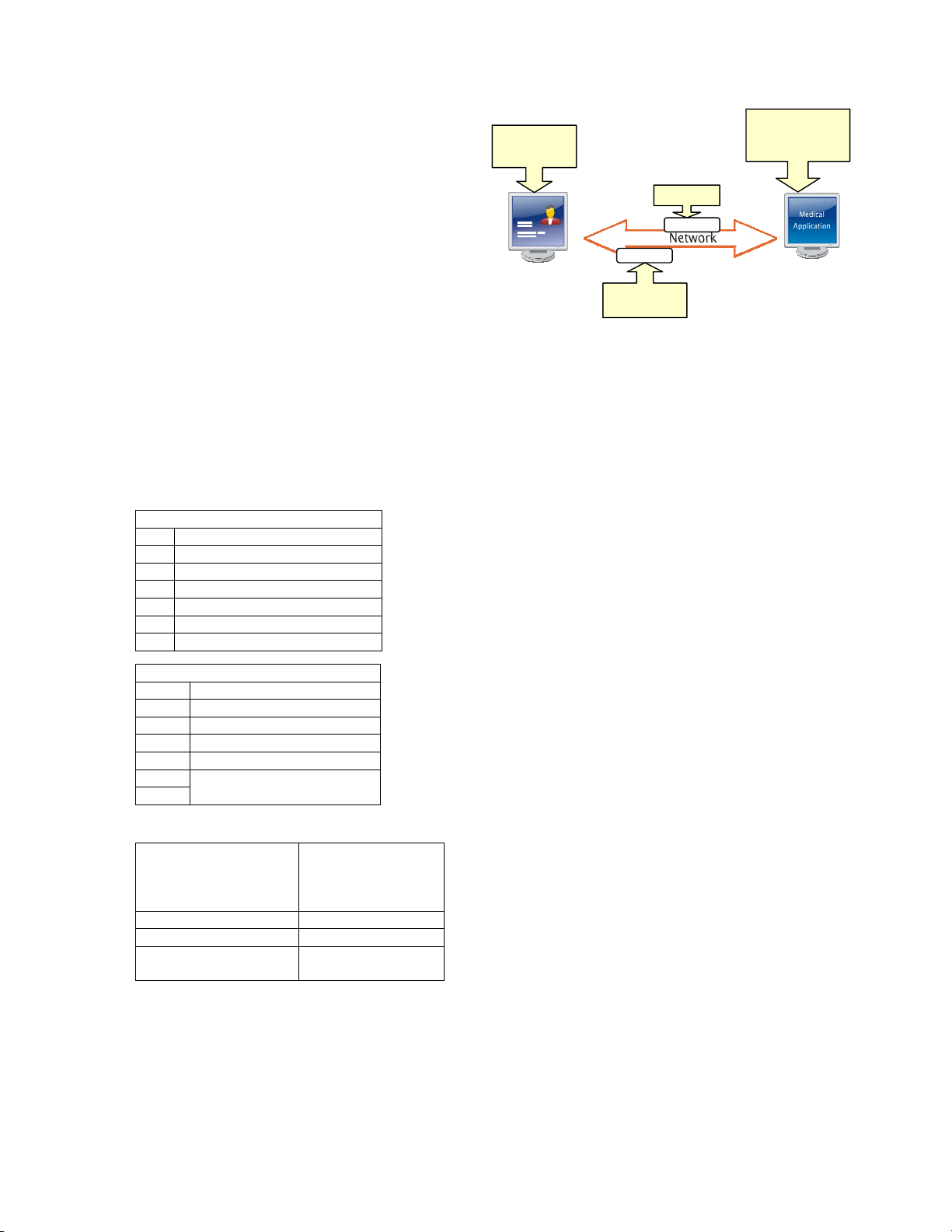
OSI Model
7 Application Layer HL7
6 Presentation Layer
5 Session Layer
4 Transport Layer
3 Network Layer
2 Data Link Layer
1 Physical Layer
Fig.1 Comparison between OSI and TCP/IP models
Fig. 2 Example of using HL7 messages
A medical application that uses the HL7 standard will
send to another application a “HL7 type” message
generated as a result of some medical event occurring in
the current activity: admit patient –A01, transfer patient
– A02, discharge patient – A03, etc. If the application
receiving the messages also complies with HL7
regulations, then it can be certain that there will be no
missing information, all information received will be
interpreted the right way and a proper response will be
issued back. Thus, the exchange of information made
would be coherent and efficient [1].
The HL7 standards define a number of messages that
cover all activities specific to medical units. The HL7
messages are characterized by the message type, made
up of a 3 character code. Message types are organized by
different domains/fields (e.g. admit, discharge, transfer,
clinical trials scheduling, etc). A HL7 message is made up
of: segments, fields, components and sub-components.
The segment is a union of fields. Each segment
begins with a three-character literal value that identifies
its type within a message. A group of segments forms a
message. The HL7 standard clearly specifies what
segment types can form a certain message type.
Each segment is composed of several fields. Not all
fields within a segment are mandatory. The compulsory
fields are defined by the HL7 standard. A HL7 field has
the following characteristics:
• data type
• predefined maximum length
• unique ID
• name
• optionality
• HL7 predefined table
• when the standard permits, the fields can be
repeated
The HL7 fields are composed of one or more
components. Subcomponents are used when dividing
components is needed.
TCP/IP Model
7 Application Layer HL7
6 Doesn’t exist
5 Doesn’t exist
4 Doesn’t exist
3 Doesn’t exist
2
1 Host-to-Network
HL7 Application (client
or server), Telnet, DNS,
FTP, SMPT, POP3,
HTTP, etc.
Application
TCP UDP Transport
IP Network
LAN, WAN, Radio with
packets
Physical and Data
Link
WSEAS TRANSACTIONS on
INFORMATION SCIENCE and APPLICATIONS
Alin Cordos, Bogdan Orza, Aurel Vlaicu,
Serban Meza, Carmen Avram, Bogdan Petrovan
ISSN: 1790-0832
1297
Issue 10, Volume 7, October 2010
3 The architecture and functionalities of
the SIMIMED
This software application is a result of a very good
collaboration in medical software research field between
Technical University of Cluj-Napoca and PixelData
Company. The project aims to develop a pilot HIS
integrated system using the latest standards available
(HL7 and DICOM), adapted to the particular case of the
Romanian National Health System and compliant with
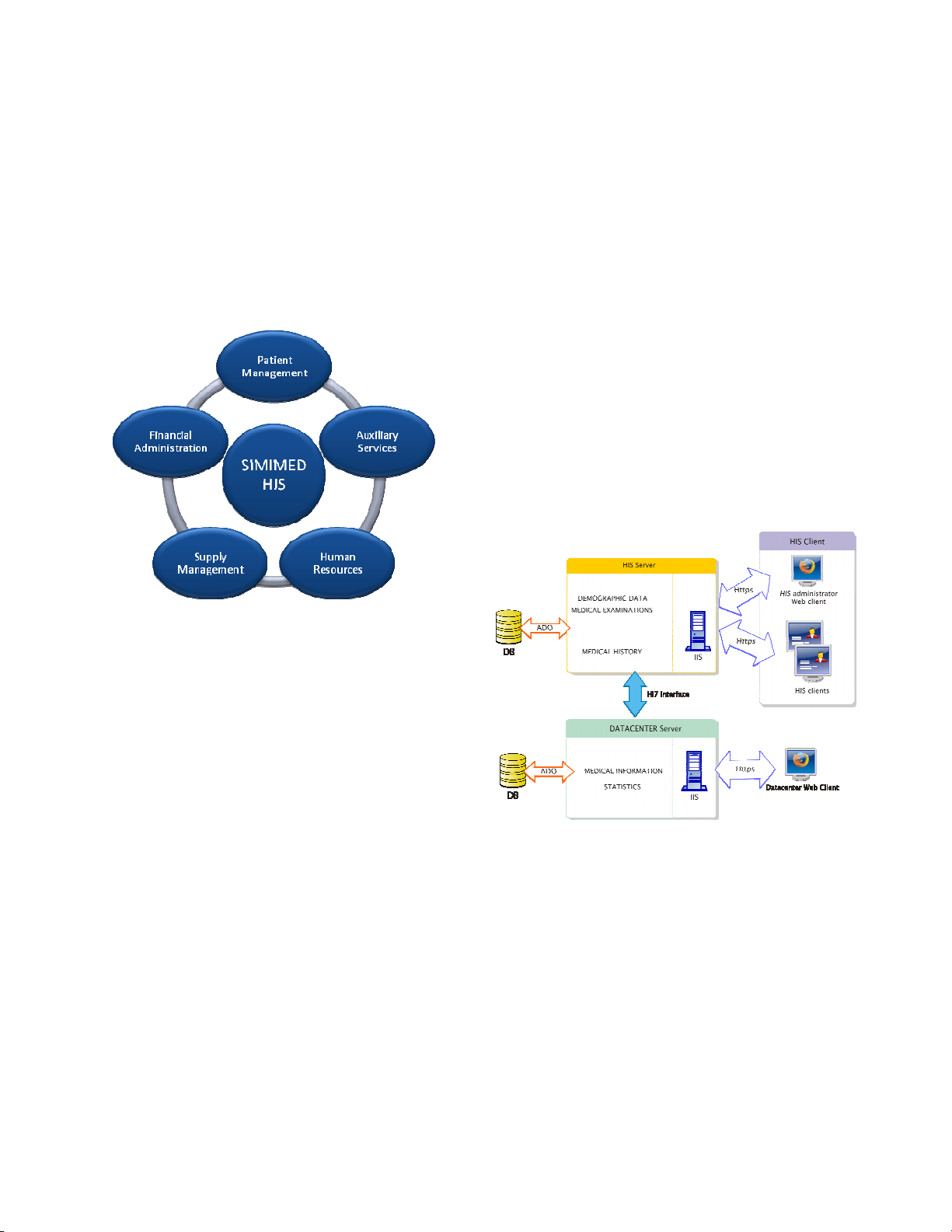
the EU requirements. Figure 3 presents the main
functionalities of the SIMIMED application.
Fig. 3 - SIMIMED packages overview
The SIMIMED application contains a packet of
software modules that provide 4 service categories:
• The HIS integrates system: is made up from a
server application and client applications
distributed by sections/departments. The system
uses the 3 tier architecture. The communication
between client and server is based on the
http/https protocol. The HIS application is used
for saving information in the database, client
application management and database querying.
The server connects to the Microsoft SQL
Server database using an ADO connection and
uses the web service principle loaded by the IIS
server; each service is workflow – oriented. The
HIS client applications offers the client a
friendly and intuitive graphical user interface
that allows the user to input or retrieve data
into/from the SIMIMED system. It is
implemented in C# and communicates with the
server using the http/https protocol [7].
• Datacenter – is a server application that
manages the data stored in the common database
by all the HIS applications running in different
hospitals/institutions. This is intended to store
medical data to be used by researchers. The
storage center will be developed based on the
Microsoft SQL server technology. The HIS
servers running at the medical institutions
involved in the project will send data to the
storage center. In the data exchange process
between the HIS servers and the Datacenter the
HL7 together with the TCP/IP protocol are used.
Due to the fact that the data stored will be used
mainly for research purposes, no information
that would allow patient identification will be
stored.
• The web application – is a web-client
application that allows access to the data stored
in the Datacenter. It will be used by the
researchers, students and PhD students to study
different cases classified by the Datacenter. The
access is controlled by the data center
administrator, who is entitled to issue access
accounts based on username/password pairs.
• The AdminTool application – is a web
application used for remote administration of the
HIS server, and allows for quick and in time
support in case of malfunctions.
Fig. 4 SIMIMED system architecture
The SIMIMED HIS client contains six important
modules: Patient List, Patient Demographic,
Examinations, Surgery, Patient History and Schedule.
Patient List module allows to retrieve a list with all
the registered patients and some basic information about
them like sex, location, status, diagnosis, hospitalization
date and criteria.
Patient Demographic module contains the graphical
controls to add/edit/search demographic data of a patient.
Using this module one can add/modify visits, document
upload/download documents, add/modify transfers or
other type of information (allergies, antecedents, and
medical history), health insurance, and patient discharge.
WSEAS TRANSACTIONS on
INFORMATION SCIENCE and APPLICATIONS
Alin Cordos, Bogdan Orza, Aurel Vlaicu,
Serban Meza, Carmen Avram, Bogdan Petrovan
ISSN: 1790-0832
1298
Issue 10, Volume 7, October 2010
Examinations module allows the editing of
information regarding examinations taken on a patient,
and contains a visit list and 4 tab-controls: general
clinical examinations – for general information (height,
weight, general condition), examinations – for surgery
procedures, specialty examinations (ex. oncology,
radiology), and evolution and treatment. Data in each
tab-control is loaded from the server based on the
selected visit, and can be modified if the selected visit is
the current one.
Surgery module contains components regarding
surgery intervention. We can edit information related to
intervention date, operating physician, assistants,
medical equipments or tools used and the list of surgery
interventions in the selected visit.
Patient History module contains in a single tab-
control all the relevant information regarding patient
visits: the list of visits, list of surgery interventions,
medications, documents, allergies, transfers.
Schedule module is used by physician to schedule
meetings with patients, interventions and other events.
This module will contain a reminder for upcoming and
important events.
4 Implementation of the SIMIMED
The main technologies and concepts used in the
implementation process of the SIMIMED HIS, are:
• Service Oriented Architecture (SOA) - provides
methods for systems development and
integration where systems package functionality
as interoperable services, by means of loose
coupling and using the Web Service Description
Language (WSDL) [4].
• Web Services – is a realization of SOA, which
relies on web standards such as SOAP, HTTP
and XML to communicate. The Microsoft
implementation of web services is Windows
Communications Foundation (WCF), through
which service endpoints are created in
SIMIMED [8],[9],[10].
• SQL Server 2005 is used as database support for
the project.
• ADO.NET – for data access and manipulation
[11],[12],[13].
• Windows Forms – API for creating user
interfaces.
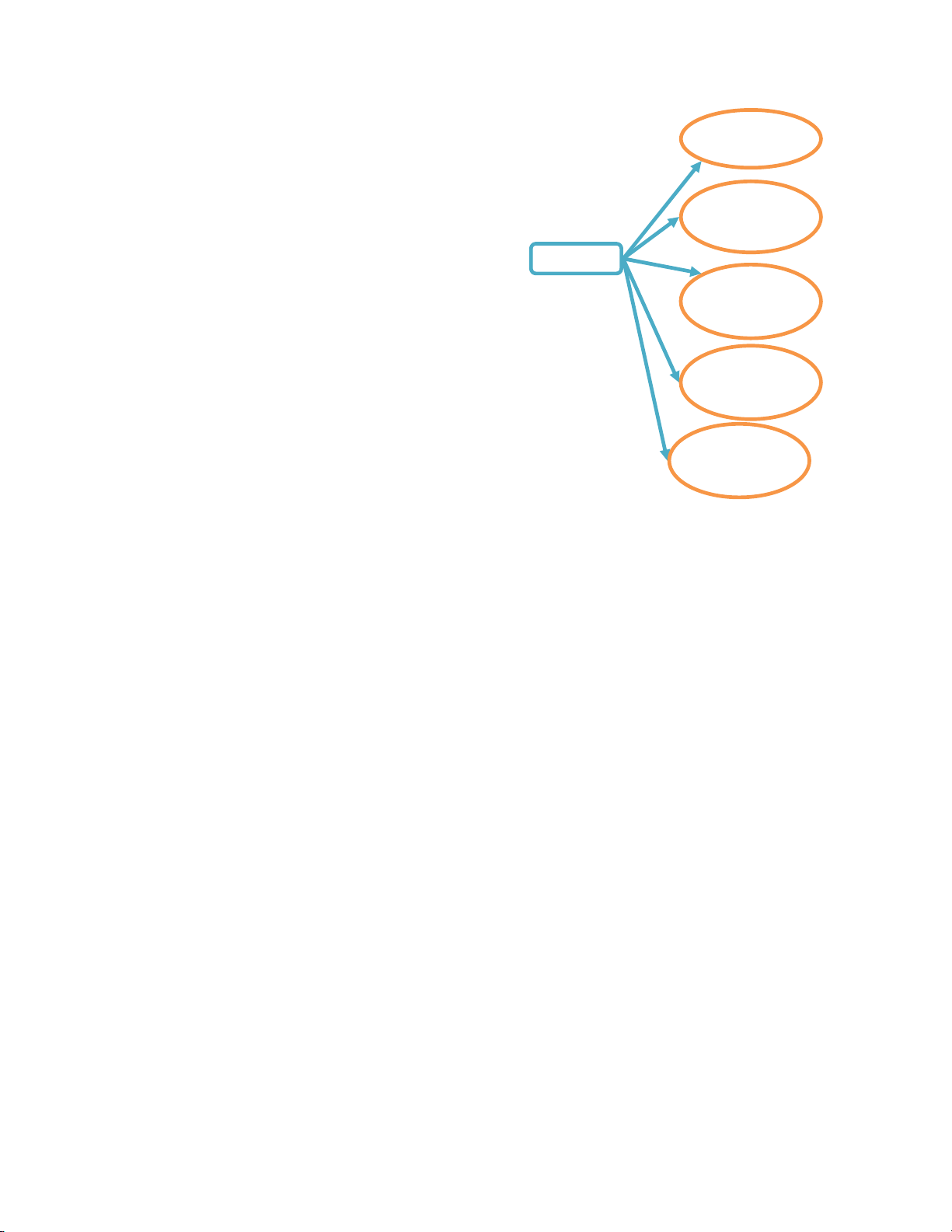
Fig. 5 Implemented web services
The Server application is built up by separate and
independent web services (figure 5). Each web service
has several methods to serve the client with the
corresponding information in a given client module.
The PatientDemographic service contains the web
service methods that are related to the demographic and
admission/transfer/discharge information of patients.
The most important ones are methods for
adding/modifying patient, visits and transfers entries, as
well as releasing a patient, searching patients and related
information.
DocumentManager service – provides the means to
upload and download any kind of document, using
streamed transfer
Surgery service – defines the methods necessary for
surgery intervention related information transfer, like:
adding new intervention, returning the list of all
interventions from a visit, adding medical personnel to
operators list.
Exams service – provides the methods related to
patient’s examinations during a visit: add/modify/delete
examinations, add/update general information for
general clinical examinations, add/update specialty
examinations, add/update evolution and treatment.
Schedule service – contains methods for scheduling
patients’ hospitalizations and interventions.
On the client side, the application is split into panels,
each one focusing on different types of medical
information. Six panels have been implemented so far:
- one for listing patients and some basic information
Surgery
Service
Document
Manager
Service
Patient
Demographic
Service
HIS Client
Exams
Service
Schedule
Service
WSEAS TRANSACTIONS on
INFORMATION SCIENCE and APPLICATIONS
Alin Cordos, Bogdan Orza, Aurel Vlaicu,
Serban Meza, Carmen Avram, Bogdan Petrovan
ISSN: 1790-0832
1299
Issue 10, Volume 7, October 2010



![Tài liệu học tập Hệ thống thông tin quản lý [mới nhất, đầy đủ]](https://cdn.tailieu.vn/images/document/thumbnail/2025/20250716/vijiraiya/135x160/512_tai-lieu-hoc-tap-he-thong-thong-tin-quan-ly.jpg)


![Hệ thống quản lý bất động sản: Giới thiệu tổng quát [chuẩn nhất]](https://cdn.tailieu.vn/images/document/thumbnail/2017/20170913/roongkloi11/135x160/557344176.jpg)




![Giáo trình Hệ thống thông tin Logistics: Phần 2 [Đầy đủ/Chi tiết]](https://cdn.tailieu.vn/images/document/thumbnail/2026/20260302/camtucau2026/135x160/27981772766910.jpg)


