

REGULAR ARTICLE
Monte Carlo MSM correction factors for control rod worth
estimates in subcritical and near-critical fast neutron reactors
Jean-Luc Lecouey
1*
, Anatoly Kochetkov
2
, Antonin Krása
2
, Peter Baeten
2
, Vicente Bécares
3
, Annick Billebaud
4
,
Sébastien Chabod
4
, Thibault Chevret
1
, Xavier Doligez
5
, François-René Lecolley
1
, Grégory Lehaut
1
, Nathalie Marie
1
,
Frédéric Mellier
6
, Wim Uyttenhove
2
, David Villamarin
3
, Guido Vittiglio
2
, and Jan Wagemans
2
1
Laboratoire de Physique Corpusculaire de Caen, ENSICAEN/Université de Caen/CNRS-IN2P3, 14050 Caen, France
2
SCK·CEN, Belgian Nuclear Research Centre, Boeretang 200, 2400 Mol, Belgium
3
Nuclear Fission Division, CIEMAT, Madrid, Spain
4
Laboratoire de Physique Subatomique et de Cosmologie, Université Grenoble-Alpes, CNRS/IN2P3, 53, rue des Martyrs, 38026
Grenoble Cedex, France
5
Institut de Physique Nucléaire d’Orsay, CNRS-IN2P3/Université Paris Sud, Orsay, France
6
Commissariat à l’Énergie Atomique et aux Énergies Alternatives, DEN, DER/SPEX, 13108 Saint-Paul-lez-Durance, France
Received: 10 June 2015 / Received in final form: 20 July 2015 / Accepted: 10 August 2015
Published online: 27 November 2015
Abstract. The GUINEVERE project was launched in 2006, within the 6th Euratom Framework Program IP-
EUROTRANS, in order to study the feasibility of transmutation in Accelerator Driven subcritical Systems
(ADS). This zero-power facility hosted at the SCK·CEN site in Mol (Belgium) couples the fast subcritical lead
reactor VENUS-F with an external neutron source provided by interaction of deuterons delivered by the
GENEPI-3C accelerator and a tritiated target located at the reactor core center. In order to test on-line
subcriticality monitoring techniques, the reactivity of all the VENUS-F configurations used must be known
beforehand to serve as benchmark values. That is why the Modified Source Multiplication Method (MSM) is
under consideration to estimate the reactivity worth of the control rods when the reactor is largely subcritical as
well as near-critical. The MSM method appears to be a technique well adapted to measure control rod worth over
a large range of subcriticality levels. The MSM factors which are required to account for spatial effects in the
reactor can be successfully calculated using a Monte Carlo neutron transport code.
1 Introduction
The GUINEVERE (Generator of Uninterrupted Intense
NEutrons at the lead VEnus REactor) project [1]was
launched in 2006, within the 6th Euratom Framework
Program IP-EUROTRANS [2], in order to study the
feasibility of transmutation in Accelerator Driven subcritical
Systems (ADS). This facility hosted at the SCK·CEN site in
Mol (Belgium) is presently used in the follow-up FREYA
project (7th European FP) [3]. It couples the fast subcritical
lead-moderated reactor VENUS-F with an external neutron
source provided by the deuteron accelerator GENEPI-3C via
T(d,n)
4
He fusion reactions occurring at the reactor core
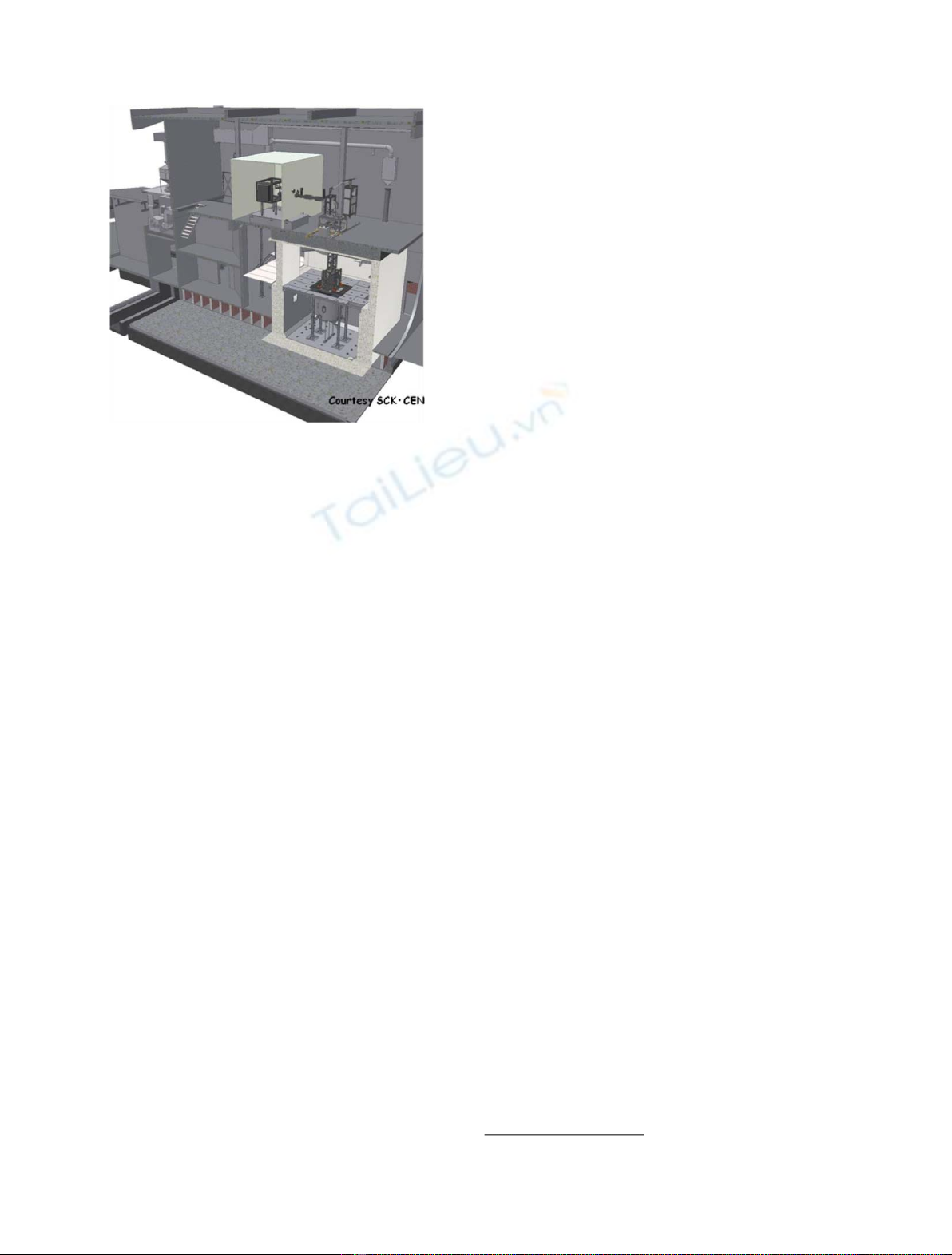
center (Fig. 1). It is partially dedicated to the investigation of
techniques of on-line subcriticality monitoring.
The VENUS-F reactor core is very modular and its
reactivity can range from deep subcritical to critical by
varying the number of fuel assemblies loaded in the core. It is
also equipped with two boron carbide control rods which
allow for a finer tuning of the reactivity. Fission chambers,
spread throughout the reactor, allow recording count rates
during either steady-state or time-dependent measurements.
In order to test on-line subcriticality monitoring
techniques, the reactivity of all the VENUS-F configu-
rations used must be known beforehand to serve as
benchmark values. Thus, the reactivity worth of the
control rods must be known as accurately as possible so that
the reactivity of every new reactor configuration created by
moving the control rods be estimated correctly.
Although the reactor asymptotic period measurement is
a usual technique to determine the reactivity worth of control
rods, it is limited to a small reactivity range (from ≈–0.3 $ to
+0.3 $) [4]. Consequently, it does not always allow measuring
the total reactivity worth of the control rods. Furthermore, it
is obviously inapplicable to control rod worth measurement
in deep subcritical reactors.
This is the reason why the Modified Source Multiplication
Method (MSM) [5] is under consideration to be used as an
*e-mail: lecouey@lpccaen.in2p3.fr
EPJ Nuclear Sci. Technol. 1, 2 (2015)
©J.-L. Lecouey et al., published by EDP Sciences, 2015
DOI: 10.1051/epjn/e2015-50041-5
Nuclear
Sciences
& Technologies
Available online at:
http://www.epj-n.org
This is an Open Access article distributed under the terms of the Creative Commons Attribution License (http://creativecommons.org/licenses/by/4.0),
which permits unrestricted use, distribution, and reproduction in any medium, provided the original work is properly cited.
alternative method for estimating the reactivity worth of the
VENUS-F control rods when the reactor is largely subcritical
as well as near-critical. In this technique, the unknown
reactivity is determined by comparing detector count rates
driven by an external neutron source in the configuration of
interest (in this paper it will be a new configuration obtained
by moving the control rods) with those obtained with the
same neutron source in another subcritical configuration
whose reactivity is already known (reference configuration).
However, to account for the flux shape differences between
the two reactor configurations, some position-dependent
correction factors (the so-called MSM factors) must be
calculated using a neutron transport code.
In this paper, we first present the GUINEVERE
facility and the various configurations of the VENUS-F
reactor studied. Then the principle of the MSM method is
briefly exposed. The results of MSM factor calculations
performed with the Monte Carlo neutron transport code
MCNP are also shown. They were carried out in support to
MSM experiments dedicated to the measurement of the
VENUS-F control rod worth when the reactor was either
subcritical or near critical. In the former case, the GENEPI-3C
was used to generate the neutron external source. In the latter
case, an Am-Be neutron source was inserted in the reactor.
General trends in the MSM factor behavior which
depend on the neutron source and detector locations, as
well as on the reactor subcriticality level are outlined.
Finally the calculated MSM correction factors are applied
to the detector count rates measured during the MSM
experiments. The consistency between the reactivity values
given by the detectors is discussed.
2 The GUINEVERE facility
2.1 The VENUS-F reactor
The VENUS-F fast reactor is contained in a cylindrical
vessel of approximately 80 cm in radius and 140 cm in
height. A 1212 grid surrounded by a square stainless steel
casing can receive up to 144 elements of ≈88cm
2
in
section which can be fuel assemblies, lead assemblies or
specific elements for accommodating detectors or absor-
bent rods. The remaining room in the vessel is filled with
semi-circular lead plates, which act as a radial neutron
reflector. In addition, the core is equipped with top and
bottom 40 cm-thick lead reflectors. Each fuel assembly
(FA) contains a 55pattern,filled with 9 fuel rodlets and
16 lead bars, surrounded by lead plates. The fuel is 30 wt.%
enriched metallic uranium provided by CEA. Among the
set of FAs, six are actually safety rods (SR) made of boron
carbide and fuel followers with the absorbent part
retracted from the core in normal operation. Two control
rods (CR) made of natural boron carbide square cuboids
can be positioned at various locations in the 1212 grid.
They can be moved vertically from 0 mm (fully inserted in
the core) to 600 mm (fully retracted). Another absorbent
rod, whose reactivity worth is very small, called PEAR
(Pellet Absorber Rod) rod, is available for performing rod
drop experiments.
Various configurations of the reactor in terms of
reactivity can be studied thanks to the modular shape of
the core. In this paper, since we are interested in measuring
the reactivity worth of the set of two CRs, all the reactor
configurations studied were obtained from either a near-
critical reactor configuration called CR0↓or a subcritical
configuration named SC1↓, by moving the two CRs
together at various heights. Since the reactivities of the
CR0↓and SC1↓configurations had been measured during
previous experiments [6], they could serve as reference
values for applying the MSM method.
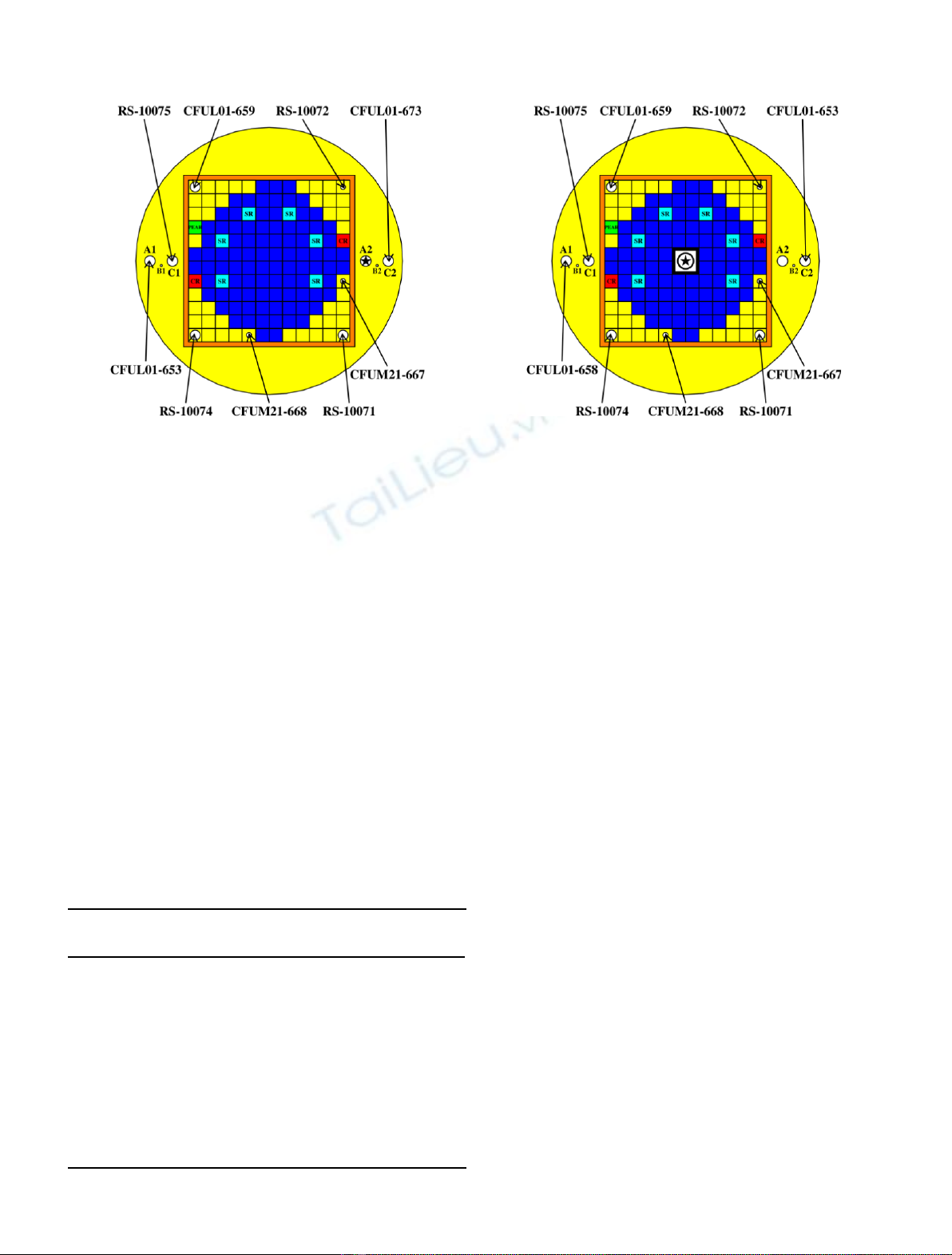
The so-called CR0↓configuration is represented in
Figure 2. Ninety-seven FAs (in blue for the regular ones, in
light blue for the SRs with fuel followers) are arranged in a
way to create a pseudo-cylindrical core. The two boron-
carbide CRs (in red) are located at the core periphery and
retracted at approximately 515 mm in height. The CR0↓
configuration was created from a critical one by dropping
the PEAR rod (in green). After analyzing the rod drop
experiments using Inverse Point Kinetics, the reactivity of
CR0↓was found to be –136(2) pcm [6]. As shown in
Figure 2, the reactor was equipped with 9 fission chambers
(FCs) working in pulse mode. Three different types of FCs
were used, either Photonis CFUL01 and CFUM21
1
,orGE
Reuter-Stokes (RS), whose specifications are listed in
Table 1. In order to help localizing the various assemblies
and detectors, an arbitrary coordinate system is used in the
1212 grid: the upper left corner is labeled (–6,6) and the
lower right one (6,–6), there is no (0,0) element. Outside the
1212 grid, six cylindrical cavities bored in the outer
reflector can receive experimental devices. They are labeled,
from left to right: A1, B1, C1, A2, B2, and C2.
The so-called SC1↓configuration is shown in Figure 3.It
is derived from the CR0↓configuration by removing the
four central FAs. This removal also permits the insertion of
the accelerator thimble inside the VENUS-F core.
Fig. 1. Overview of the GUINEVERE facility at SCK·CEN.
1
http://www.photonis.com/nuclear/products/fission-chambers-
for-out-of-core-use/
2 J-L Lecouey et al.: EPJ Nuclear Sci. Technol. 1, 2 (2015)
Compared to CR0↓, some additional minor differences
are itemized below:
–the CRs are slightly more inserted inside the core (CR
height is 479 mm instead of 515 mm);
–the detector set is slightly different: the CFUL01-673
detector is replaced by the CFUL01-653 FC. The latter is
replaced in the A1 location by the CFUL01-658 FC which
is identical to CFUL01-659 and CFUL01-653 FCs. The
reactivity of SC1↓was measured using the MSM method
and was found to be –3824(96) pcm [6].
2.2 External neutron sources
The external neutron source used for performing the MSM
experiments was different depending on whether the
reference configuration was CR0↓or SC1↓.
In the latter configuration, the external source was
created at the center of the VENUS-F core by deuterons
interacting with a tritiated titanium target. The deuteron
ions were accelerated up to an energy of 220 keV by the
GENEPI-3C particle accelerator [7] built by a collaboration
of CNRS-IN2P3 laboratories. The fusion reactions at core
mid-plane generate a quasi-isotropic field of ∼14-MeV
neutrons. The GENEPI-3C can operate in pulsed mode, in
continuous mode, and also in continuous mode with short
beam interruptions. During the MSM experiments reported
here, GENEPI-3C delivered a continuous deuteron beam
whose intensity ranged from ∼400 mAto∼500 mA.
However, the intensity of the external neutron source
created by the accelerator had to be monitored directly.
Indeed, the tritium release and the beam tuning variations
over time prevent the direct calculation of the neutron
source intensity from that of the beam on target. This is the
reason why the accelerator is equipped with two Si
detectors which can detect either alpha particles from T
(d,n)
4
He reactions or protons from D(d,p)T reactions. The
detection of aparticles allows one to quantify the amount of
14-MeV neutrons produced whereas the detection of
protons allows estimating the parasitic production of 2.5-
MeV neutrons by D(d,n)
3
He due to the implantation of
deuterons in the target. During the MSM experiments
reported here, the neutron source intensity varied from
∼110
9
to ∼310
9
14-MeV neutrons/s.
In the CR0↓configuration, the external neutron source
was an Am-Be source inserted in the outer reflector slot A2
(denoted by a star in Fig. 2) which emitted only
2.210
6
neutrons/s. Thus the Am-Be neutron source
intensity is lower than that induced by the GENEPI-3C by
three orders of magnitude. Furthermore, mainly because
the Am-Be source is off-centered, its importance is
approximately eight times lower than that of GENEPI-
3C. In terms of detector count rates, these source
dissimilarities are only (very) partially compensated by
the difference in reactivity between the two CR0↓and SC1↓
Fig. 2. Schematic view of the CR0↓configuration. The black star
shows the position of the external neutron source (Am-Be).
Control rods (CR) are in red.
Table 1. Fission chambers used in configurations CR0↓
and SC1↓.
Name Main
deposit Approximate
mass (mg) Location
in CR0↓
Location
in SC1↓
CFUL01-653
235
U 1000 A1 C2
CFUL01-658
235
U 1000 None A1
CFUL01-659
235
U 1000 (–6,6) (–6,6)
CFUL01-673
238
U 1000 C2 None
RS-10071
235
U 100 (6,–6) (6,–6)
RS-10072
235
U 100 (6,6) (6,6)
RS-10074
235
U 100 (–6,–6) (–6,–6)
RS-10075
235
U 100 C1 C1
CFUM21-667
235
U 10 (6,–2) (6,–2)
CFUM21-668
235
U10 (–2,–6) (–2,–6)
Fig. 3. Schematic view of the SC1↓configuration. The black star
shows the position of the external neutron source (GENEPI-3C).
Control rods (CR) are in red.
J-L Lecouey et al.: EPJ Nuclear Sci. Technol. 1, 2 (2015) 3

configurations. Therefore, since the two reference config-
urations are very dissimilar both in terms of reactivity and
of source location, interesting differences in the results of
the MSM experiments can be anticipated.
3 The MSM method
3.1 Principle
The MSM (Modified Source Multiplication) method is a
technique for estimating the unknown reactivity of a
subcritical configuration by comparing detector count rates
driven by an external neutron source in this configuration
with those obtained in another subcritical configuration
whose reactivity is known.
The inhomogeneous transport equation associated with
a subcritical configuration of a reactor driven by an external
neutron source reads:
AF¼PFþSð1Þ
where Pis the neutron production operator (by fission or (n,
xn) reactions), Ais the migration and loss operator and Sis
the external neutron source intensity. Fis the neutron flux
which is present inside the reactor when the external
neutron source is inserted.
This transport equation can be made homogeneous by
introducing the neutron multiplication coefficient k
eff
:
A’¼1
keff
P’:ð2Þ
In that case, wis the fundamental mode corresponding
to the associated critical reactor. l=1/k
eff
is also an
eigenvalue of the adjoint homogeneous equation:
A†’†¼1
keff
P†’†:ð3Þ
where A†and P†are the adjoint operators of Aand P,
respectively. ’†is the adjoint flux, also called neutron
importance function.
Multiplying the adjoint homogeneous equation (3) by F
and integrating over space, angle and energy, one gets:
r¼F;P†A†
’†
F;P†’†
¼’†;PAðÞF
’†;PF
hi ð4Þ
where hi denotes such an integration.
Then, multiplying the inhomogeneous equation (1) by
’†and integrating over space, angle and energy leads to:
’†;PAðÞF
¼ ’†;S
ð5Þ
and combining equation (4) and equation (5), one gets:
r¼ ’†;S
’†;PF
hi
:ð6Þ
As in reference [5], we introduce the reaction rate in the
detector C¼Sd;F
hi
, where S
d
is the macroscopic reaction
cross-section of the detector, and rewrite equation (6):
r¼ ’†;S
Sd;F
hi
’†;PF
hi
1
Sd;F
hi
¼Seff e1
Cð7Þ
where Seff ¼’†;S
is called the effective neutron source
and e¼Sd;F
hi
=’†;PF
the detector efficiency.
Now let us consider two subcritical configurations. Let
configuration 0 be the subcritical configuration of known
reactivity r
0
and configuration 1 be that of unknown
reactivity r
1
. Assuming that the neutron external source
and the detectors utilised are the same in both config-
urations, equation (7) can be used to find a relationship
between r
0
,r
1
, and the detector count rates C
0
and C
1
in
configurations 0 and 1:
r1
r0
¼Seff;1e1
Seff;0e0
C0
C1
¼fMSM C0
C1
ð8Þ
where f
MSM
is the MSM correction factor. One can also
introduce the source importance ’which is defined as the
ratio of the average importance of external source neutrons
to the average importance of fissions in the reactor [8,9]:
’¼’†;S
S
hi
’†;PF
PF
hi
–1
:ð9Þ
If one introduces the source multiplication coefficient k
s
as [9]:
ks¼PF
hi
þS
hi
S
hi ð10Þ
the source importance appears as the ratio of the neutron
gain with the external neutron source to a hypothetical gain
which would be obtained with a stabilized fission source in
the same reactor:
’¼ks
1–ks
1–keff
keff
:ð11Þ
Then the MSM factor can be rewritten with the source
importance of the two configurations:
fMSM ¼’1
’0
e1
e0
ð12Þ
where ’iand ks;iare respectively the source importance and
the source multiplication coefficient in configuration i. The
parameter e
i
is defined as:
ei¼Sd;Fi
hi
PiFi
hi
:ð13Þ
It represents the ratio of the reaction rate in the detector
to the total rate of neutron produced in the reactor. Thus,
4 J-L Lecouey et al.: EPJ Nuclear Sci. Technol. 1, 2 (2015)

formula (12) shows that the MSM factor accounts for the
differences in neutron and source importance as well as in
flux shapes between the two configurations considered.
However, if configurations 0 and 1 are very similar, such
differences may vanish and formula (8) reduces to the
Approximate Source Method (ASM) formula:
r1
r0
¼keff;0
keff;1
C0
C1
C0
C1
ð14Þ
where the approximation k
eff,0
/k
eff,1
≈1 is often made.
The MSM correction factors must be calculated using a
transport code, either deterministic or stochastic. It is
worth mentioning that the value of the MSM correction
factor is expected to depend on the detector location.
Indeed, any difference in the flux shape between the two
configurations will result in position-dependent ratios in the
f
MSM
formula.
3.2 Calculation of MSM factors
Starting from equation (8), the MSM factor reads:
fMSM ¼r1
r0
C1
C0
ð15Þ
where the reactivity of configurations 0 and 1, r
0
and r
1
,as
well as the detector count rates in configurations 0 and 1, C
0
and C
1
, can be calculated using a neutron transport code.
Although the use of deterministic codes is largely
reported in literature, MSM factors can also be calculated
using stochastic neutron transport codes. On one hand, the
use of a Monte Carlo code advantageously allows one to
transport neutrons in the reactor theoretically without any
geometry simplification (to the extent that the reactor
geometry be accurately known) and with pointwise energy
dependent cross-sections. On the other hand, Monte Carlo
calculations are much more computer-time-consuming
than deterministic ones and provide as results only
statistical estimates of quantities of interest. In this paper,
the Monte Carlo simulation code MCNP 5 [10] was
employed, together with ZZ ALEPH-LIB-JEFF3.1.1, a
continuous energy multi-temperature library created at
SCK·CEN and based on JEFF3.1.1 [11]. Once the geometry
as well as the material composition of the various elements
constituting the reactor have been described in an MCNP
input file, the corresponding multiplication factor (hence
the reactivity) can be estimated using a generation-based,
iterative fission neutron source whose spatial distribution
converges towards the fundamental mode of the reactor
(the so-called “kcode”source). On the other hand, standard
fixed-source calculations can provide estimates of reaction
rates anywhere in the reactor. So, for the calculation of
MSM factors, four Monte Carlo simulations must be run:
two fixed-source simulations for calculating the source
driven reaction rates C
0
and C
1
in the fission chambers for
configurations 0 and 1, and two “kcode”simulations for
estimating the reactivity of the same two configurations, r
0
and r
1
.
As a first step towards the calculation of MSM factors,
MCNP input files had to be built for the configurations
CR0↓and SC1↓as well as their variants created by moving
the CRs. In order to save computing times (a factor of ∼4.5
was gained), it was decided to use a simplified reactor
geometry. Indeed, the MSM method bears interest only if
the calculation of MSM factors turns out to be rather
insensitive to the details and errors on the reactor geometry,
as well as to uncertainties on material compositions and on
nuclear data: since MSM experiments are carried out to
estimate the unknown reactivity of a reactor configuration,
one can imagine that the reactor itself could be not very well
known either. Fortunately, this robustness of MSM factor
calculations has already been observed for previous MSM
experiments at the VENUS-F reactor and can be under-
stood by recalling that MSM factors are double ratios of
quantities: one can expect that any reasonable difference
between the calculated reactivity values and the real ones
will be at least partially compensated by corresponding
differences between the calculated reaction rates and the
measured ones [6].
Since the control and safety rods are nearly homoge-
neous, the principal source of geometrical simplification was
the homogenization of the fuel assemblies. Additionally,
some details of the bottom reactor reflector geometry were
not considered. Also, the GENEPI-3C accelerator was not
modelled. Instead, a 14-MeV point source was placed in
vacuum at the core center. For the Am-Be source, the
average source energy of 5 MeV was used. Finally, the FCs
were not modelled at all. Instead, use was made of the next-
event estimator MCNP tally F5 (point detector) to
estimate the fission rates of the FC deposits, at the center
of each detector location.
One MCNP input file was created for each CR height
selected for the MSM experiments (from 0 to 600 mm by
step of 60 mm around the reference CR position of the SC1↓
configuration and by step of 50 mm around the one of
CR0↓). Then, prior to calculating the four terms of formula
(15), the reactivity scale of the MCNP models of VENUS-F
configurations had to be adjusted so that the calculated
reactivities of CR0↓and SC1↓be approximately equal to
their measured values of –136 pcm and –3824 pcm,
respectively. This allowed an overall consistency between
experimental results concerning the configurations used as
references and the subsequent calculations. This was
achieved by multiplying the average number of neutrons
per fission nused inside the MCNP code by a factor of
1.001071. This slightly modified value of nwas then used for
calculating the reactivity of all the other configuration
variants obtained by changing the CR heights.
3.3 Results of MSM factor calculations
Figure 4 shows the evolution of MSM factors as a function
of the new height of the CRs after moving them away
from their position associated with the reference configura-
tion SC1↓(479 mm). Error bars were calculated using
the quadratic sum of the uncertainties on the four terms
of formula (15). The relative uncertainty is basically
J-L Lecouey et al.: EPJ Nuclear Sci. Technol. 1, 2 (2015) 5





![Đề ôn tập cuối kỳ môn Kỹ thuật nhiệt - Nhiệt động học [mới nhất]](https://cdn.tailieu.vn/images/document/thumbnail/2026/20260310/hoaphuong0906/135x160/60681773197823.jpg)

