

REGULAR ARTICLE
Why nuclear energy is essential to reduce anthropogenic
greenhouse gas emission rates
Agustin Alonso
1*
, Barry W. Brook
2
, Daniel A. Meneley
3
, Jozef Misak
4
, Tom Blees
5
, and Jan B. van Erp
6
1
University Politecnica de Madrid, Madrid, Spain
2
University of Tasmania, Hobart TAS 7005, Australia
3
CEI and AECL, Ontario, Canada
4
UJV-Rez, Prague, Czech Republic
5
Science Council for Global Initiatives, Chicago, Il, USA
6
Illinois Commission on Atomic Energy, Chicago, Il, USA
Received: 6 May 2015 / Accepted: 8 September 2015
Published online: 27 November 2015
Abstract. Reduction of anthropogenic greenhouse gas emissions is advocated by the Intergovernmental Panel
on Climate Change. To achieve this target, countries have opted for renewable energy sources, primarily wind
and solar. These renewables will be unable to supply the needed large quantities of energy to run industrial
societies sustainably, economically and reliably because they are inherently intermittent, depending on flexible
backup power or on energy storage for delivery of base-load quantities of electrical energy. The backup power is
derived in most cases from combustion of natural gas. Intermittent energy sources, if used in this way, do not meet
the requirements of sustainability, nor are they economically viable because they require redundant, under-
utilized investment in capacity both for generation and for transmission. Because methane is a potent greenhouse
gas, the equivalent carbon dioxide value of methane may cause gas-fired stations to emit more greenhouse gas
than coal-fired plants of the same power for currently reported leakage rates of the natural gas. Likewise,
intermittent wind/solar photovoltaic systems backed up by gas-fired power plants also release substantial
amounts of carbon-dioxide-equivalent greenhouse gas to make such a combination environmentally
unacceptable. In the long term, nuclear fission technology is the only known energy source that is capable of
delivering the needed large quantities of energy safely, economically, reliably and in a sustainable way, both
environmentally and as regards the available resource-base.
1 Introduction
The need to reduce anthropogenic greenhouse gas (AGHG)
emissions is of great urgency if catastrophic consequences
caused by climate change are to be prevented. However, while
the United Nations Framework Convention on Climate
Change (UNFCCC), through its various meetings of the
Conference of the Parties (COP), has emphasized the role of
renewable energy sources, it barely mentions nuclear energy
and the important contribution that it is already making in
reducing AGHG emissions and could increasingly be making
in the future. This is difficult to understand because nuclear
fission is the only major energy source that could sustainably,
reliablyandeconomically providethelargequantitiesofclean
energy that will be needed to make substantial progress in
reducing AGHG emissions.
When addressing issues related to the long-term energy
policy, two important questions need to be asked, namely:
–Is it possible to replace all or most fossil-derived energy
with renewables and, if so, would this be sustainable and
economically viable?
–Is nuclear energy sustainable and what should its role in
the energy mix be?
The term sustainable is generally understood, Brundtland
Commission [1], to mean “meeting the needs of the present
without compromising the ability of future generations to
meet their own needs”. In the context of energy options,
‘sustainable’implies the ability to provide energy for
indefinitely long time periods (i.e., on a very large civilization
spanning time scale) without depriving future generations and
in a way that is environmentally friendly, economically viable,
safe and able to be delivered reliably. It should thus be
concluded that, in this context, the term ‘sustainable’is more
restrictive than the term ‘renewable’, as large scale renewable
*e-mail: agustin.alonso@nexus5.com
EPJ Nuclear Sci. Technol. 1, 3 (2015)
©A. Alonso et al., published by EDP Sciences, 2015
DOI: 10.1051/epjn/e2015-50027-y
Nuclear
Sciences
& Technologies
Available online at:
http://www.epj-n.org
This is an Open Access article distributed under the terms of the Creative Commons Attribution License (http://creativecommons.org/licenses/by/4.0),
which permits unrestricted use, distribution, and reproduction in any medium, provided the original work is properly cited.

systems backed by fossil fuels cannot be considered clean
sources of electricity. On the other hand, nuclear energy from
fission of uranium and plutonium is sustainable, meeting all of
the above-mentioned criteria as discussed later.
The energy consumption in industrial nations may be
roughly divided in three equal parts, namely:
–generation of electrical energy;
–heat in industrial processes and space heating;
–and transportation.
Nuclear fission is a low AGHG emission energy source
that is already widely deployed for generation of electrical
energy. Therefore, one effective way to reduce fossil fuel
consumption and AGHG emissions would be by increasing
the number of nuclear power plants for electrical energy
generation.
It would be well within realistic limits to aim for
replacement of the major part of the world’s fossil fuel-
based electrical energy generating capacity. Industrial
nations should take the lead in this change because they are
more capable of doing so, having already developed the
necessary technological and mature economic base. In
parallel to this major change in the generation of electrical
energy, the use of fossil fuels for transportation should be
reduced by greater reliance on nuclear-derived electrical
energy as well as on liquid fuels produced synthetically by
means of nuclear power plants. Also the use of nuclear-
derived process heat for industrial application and services
should be encouraged [2]. Gradual conversion of the
electrical generating capacity from fossil fuel-based to
nuclear fission would be the way offering least economic
disturbance.
2 Intermittent ‘renewables’when applied
to the electric grid
Wind and solar energy have served humanity well during
centuries and in many applications, including grinding
wheat, pumping water, sawing wood, drying foods and
producing sea salt. Wind also served as an important energy
source for transportation, making possible the exploration
of the entire world by means of ships propelled by the wind.
The common characteristic of these applications is that
they are not time-constrained: if there is no wind today, the
tasks can wait to be finished tomorrow or the ships will
arrive somewhat later. This is not possible if intermittent
renewable energy sources are used for base-load delivery of
electrical energy to the grid, as strict demands have to be
fulfilled instantaneously and completely.
2.1 Grid-connected ‘renewables’with gas-fired backup
are not sustainable
Intermittent ‘renewables’are, in certain applications, not
‘sustainable’because not all necessary criteria are being
met. Intermittent ‘renewable’energy sources, when used for
large-scale delivery of energy to the electric grid, require the
availability of energy storage facilities or flexible backup
power plants capable of rapid output adjustments. This is
because wind turbines and solar/photovoltaic plants will
vary their output between 0% and 100% of nameplate
capacity, as it can be observed in the typical example given
in Figure 1.
As energy from the grid is generated and consumed
simultaneously, there can be no mismatch if grid stability
and frequency are to be maintained within strict tolerances.
The backup power is usually provided by gas-fired stations
because technology for storing large amounts of electricity
is not yet available. Although reversible pumped hydro-
power stations can be used to store potential energy, there
are siting, technical and economic limitations that prohibit
their widespread use. Gas-fired plants emit carbon dioxide
and are associated with leakage of methane (the primary
component of natural gas) into the atmosphere, which is a
strong AGHG emitter. Only if the backup energy is
delivered by hydro-electrical energy plants or similar means
to store and control the generated energy, then grid-
connected intermittent ‘renewables’can be qualified as
sustainable.
2.2 Grid-connected ‘renewables’are not
economically viable
Averaged over a year, wind/solar photovoltaic systems
deliver from 25% to 45% of their nameplate production
capacity. Therefore, the backup power plants or energy
storage facilities will have to deliver the remaining 75% to
55% of the energy. Seasonal variability is another major,
yet rarely acknowledged, impediment to all-renewables
scenarios, as it is seen in Table 1.
Advocates often dismiss the issue of seasonal variability,
pointing out that the wind blows more in the winter when
solar output is minimal, and asserting that wind and solar
balance out on a daily basis because wind blows more at
night. However, these generalizations do not hold up to
scrutiny. While some areas of the world do have more wind
in the winter, others do not.
The backup power for wind/solar photovoltaic plants
depends in most cases on combustion of less expensive
natural gas. Storage may be of various types: potential
energy storage capacity may be created by pumping up water
Fig. 1. Intermittence of wind energy in E.ON-grid in Germany
(from Ref. [3]).
2 A. Alonso et al.: EPJ Nuclear Sci. Technol. 1, 3 (2015)

or compressing air, small scale storage could be achieved in
condensers and batteries. However, most energy storage
facilities are not cost-effective for base-load application and
often have undesirable environmental impacts. Also, storage
is associated with energy losses. Consequently, grid-
connected wind/solar photovoltaic installation will usually
rely on gas-fired backup power plants.
Many wind and solar photovoltaic installations are far
removed from the load centers, requiring additional long-
distance transmission lines, sized for their peak output,
which are then under-utilized by from 55% to 75%.
Furthermore, the backup power plant will have to operate
in stand-by mode, ready to adapt to the varying output
(from 0% to 100%) of the intermittent energy source. This
results in a penalty on the overall thermal efficiency of the
backup plant, which can be as high as 20%. Grid-connected
wind and solar photovoltaic installations will thus be
dependent on subsidies because redundant and under-
utilized investments are necessary (i.e., for the intermittent
energy source, for the backup source and for the
additionally required transmission capability). In view of
the above-given reasons, it has to be concluded that the
combination of an intermittent energy source and its back-
up power plant will not be able to achieve economic
viability, as illustrated in Table 2. However, in isolated
locations and some processes without access to a large
electric grid, intermittent energy sources either directly or
combined with storage capacity may be economically
viable.
Much confusion exists concerning the generating cost
per kWh for wind and solar plants. In this respect, it is of
interest to distinguish clearly between the ‘bare’cost of a
kWh generated by wind or solar photovoltaic installations
that is consumed or stored locally and the cost of a kWh
delivered to the electrical grid. In the latter case, it is
necessary to account for the investments in the backup
power and transmission capacity. The difference between
these two prices is very substantial; the cost per kWh
delivered to the grid in most cases being several hundred
percent higher than the ‘bare’cost. As an example, Table 2
shows that for the combination of intermittent energy
source with gas-fired backup power, the cost for fuel per
kWh varies between 5 and 12 times the cost for operation
and maintenance.
2.3 Grid-connected ‘renewables’have
deleterious consequences
Grid-connected intermittent energy sources will cause grid
disturbances that will deleteriously affect the grid’s
reliability, particularly if the installed capacity of the
intermittent sources becomes a high percentage of the grid’s
total capacity. Delivery unreliability of the electrical grid
can have serious economic and social consequences as has
been observed when long-lasting blackouts occurred in
large urban areas. To date, in most grids, ‘renewables’have
only reached a relatively low market penetration and so
have been able to rely mostly on existing marginal capacity,
or on large import–export capacity of interconnected other
grids.
Problems will emerge when the percentage of grid-
connected intermittent energy sources exceeds the existing
marginal capacity (without availability of adequate
dedicated back-up power capacity) and it becomes
necessary for the base-load plants to function as back-up
plants. This mode of forced ‘accommodative’operation
penalizes nuclear power plants more than it does fossil-fired
plants because the capital-cost component of the generating
cost for the former is relatively high and the fuel cost
component is low, whereas for the latter the reverse is true,
as shown in Table 3.
This practice of distorting the energy market by
subsidies and supporting regulations has serious and
undesirable consequences, resulting in closure of base-load
Table 1. Seasonal variability of wind-generated electrical
energy in Texas, USA. Highest and lowest monthly
generation values (GWh).
Year Highest value
(month)
Lowest value
(month)
Ratio
(high/low)
2009 1,993 (April) 1,341 (July) 1.44
2010 2,721 (April) 1,589 (Sept.) 1.75
2011 3,311 (June) 1,694 (Sept.) 1.95
2012 3,131 (March) 1,821 (Aug.) 1.74
2013 3,966 (May) 2,023 (Sept.) 1.96
Source: Private communication, P. Peterson, Prof. Nuclear
Engineering, Univ. of California at Berkeley, USA
Table 2. Average power plant operating expenses for USA
electric utilities (mS/kWh).
2008 2009 2010 2011 2012
Nuclear
Operation 9.9 10.0 10.5 10.9 11.6
Maintenance 6.2 6.3 6.8 6.8 6.8
Fuel 5.3 5.4 6.7 7.0 7.1
Total 21.5 21.7 24 24.7 25.5
Intermittent plus gas turbine
Operation 3.8 3.0 2.8 2.8 2.5
Maintenance 2.7 2.6 2.7 2.9 2.7
Fuel 64.2 52.0 43.2 38.8 30.5
Total 70.7 57.6 48.7 44.5 35.7
Source: USA Energy Information Administration
Table 3. Generation cost breakdown (%).
Component Nuclear Coal Gas
Capital 59 42 17
Fuel 15 41 76
Operation & Maintenance 26 17 7
Source: OECD/International Energy Agency
A. Alonso et al.: EPJ Nuclear Sci. Technol. 1, 3 (2015) 3
generating capacity (including nuclear power plants), loss
of grid reliability and higher net greenhouse gas emissions.
This issue is of particular relevance for countries having an
interconnected grid with an adjacent country that is relying
(or is planning to rely) to a large extent on intermittent
‘renewable’energy sources. In this respect, the question
should be raised whether a country with a large installed
wind/solar electrical generating capacity should be re-
quired to pay a connection fee to compensate adjacent
countries for the use of their interconnected electric grids
for providing backup power capacity.
It is often claimed by advocates of ‘renewables’that the
problems associated with the intermittency of wind and
solar energy can be overcome by performing more research
and carrying out more engineering development. Unfortu-
nately, no level of research and development will be able to
overcome the fact that the sun does not always shine and
that the wind does not always blow. Not even the much-
praised ‘smart grid’can change this inconvenient fact.
2.4 The relevance of methane as a greenhouse gas
Methane, CH
4
, the main component of natural gas, is a
potent greenhouse gas as compared to carbon dioxide, CO
2
;
making it one of the six gases considered in the Kyoto
Protocol, the second in importance. To measure the relative
climate importance of the two gases, the International
Panel on Climate Change (IPCC) has introduced the
concept of global warming potential (GWP) [4] which is
defined (glossary) as:
“Global warming potential (GWP), index based on
radiative properties of greenhouse gases measuring the
radiative forcing following a pulse emission of a unit of gas
of a given greenhouse gas in the present day atmosphere
integrated over a chosen time horizon, relative to that of
carbon dioxide. The GWP represents the combined effect
of the different times these gases remain in the atmosphere
and their relative effectiveness in causing radiative forcing.”
The radiative forcing of a greenhouse gas is itself defined
[4] (glossary) as:
“Radiative forcing, change in the net, downward minus
upward, radiative flux (expressed in W.m
2
) at the
tropopause or top of the atmosphere due to a change in an
external driver of climate change, such as, for example in
the change in the concentration of a gas or the output of
the sun.”
The GWP of any gas is calculated through the
expression
GW P mtðÞ¼∫th
tramCmtðÞdt
∫th
tracCctðÞdt ;ð1Þ
where sub-index mrepresents methane and ccarbon
dioxide; ais the radiative forcing of the gas and C(t) the
time function, which represents the evolution of the gas in
the atmosphere after the release of a pulse emission of a unit
of gas. The integration goes from the time of release, t
r
,to
the selected time horizon, t
h
. Function C(t) takes into
account the rather complicated chemical reactions and
other removal processes that take place among the different
constituents in the atmosphere causing the disappearance
of the released gases.
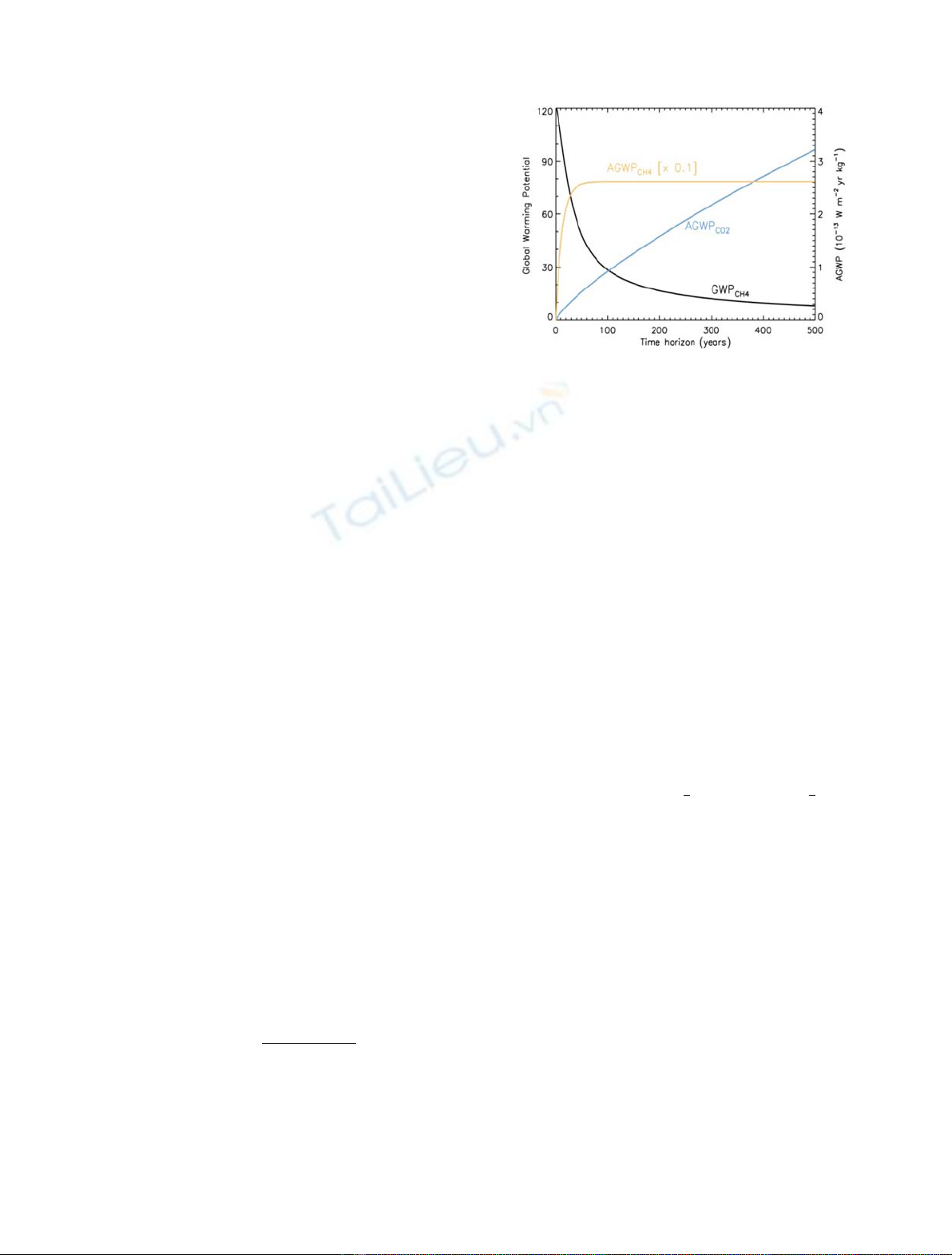
Each integral term in the definition is also called the
absolute global warming potential (AGWP) of the concerned
and the reference gas and is measured in W/m
2
/y/kg. To
estimate the magnitudes defined above, the IPCC has
provided the graph reproduced in Figure 2.
It is accepted that a pulse release of methane in the
atmosphere will be removed exponentially with time by
getting involved in chemical reactions with hydroxyl radicals
(OH) present in the atmosphere. The coefficient in the
exponential function is the inverse value of the so-called turn
over or global atmospheric lifetime of methane, represented
by symbol T. This symbol is given the value of 11.2+
1.3 years. The AGWPCH4is then obtained by the equation:
AGWPCH4¼∫t
0amet
Tdt ¼amT1et
T
:ð2Þ
In less than a century, the AGWPCH4reaches an
asymptotic value, a
m
T, which is the product of the radiative
forcing of methane multiplied by the assumed lifetime of
methane in the atmosphere measured in W/m
2
/y/kg. Note
that the graph in Figure 2 is reduced by a factor of 10.
The behavior of carbon dioxide in the atmosphere
includes a variety of phenomena, which could not be
represented by a single lifetime; as seen in the blue curve,
the AGWP
CO2
is less than the one for methane because its
radiative forcing is smaller; moreover, carbon dioxide in the
atmosphere never reaches an asymptotic value because a
small fraction of the carbon dioxide emitted is not removed
from the atmosphere by natural processes, while the rest of
the processes are described by exponential functions with
long lifetime.
The ratio of the two curves is the GWPCH4, a decreasing
function with increasing time horizon; when the time
horizon approaches the time of release the GWPCH4tends
to 120, which should be interpreted as the radiative forcing
Fig. 2. Value of methane global warming potential, GWPCH4,as
a function of time horizon (taken from Ref. [5]).
4 A. Alonso et al.: EPJ Nuclear Sci. Technol. 1, 3 (2015)

of the methane relative to the one of carbon dioxide. From
the graph it is deduced that the GWPCH4values are about
63, 21 and 3, obtained from calculations, for respective time
horizons of 20, 100, and 500 years. The IPCC recommends
using a time horizon of 100 years.
The methane contents in the atmosphere started to grow
since 1750, the year considered as the start of the industrial
revolution; at that time, the methane content in the
atmosphere was 0.722 ppm; it grew exponentially until
about 1980, in the 1990s the rise slowed down and reached
the value of 1.893 ppm in 2011, an increment of some
1.171 ppm, i.e. an average increase of 138%. This value is
compared with the same temporal increment of carbon
dioxide in the atmosphere from 280 ppm in 1750 to the
current 395 ppm, an increment of 115 ppm, i.e. an average
increase of 36%. From these values, it is deduced that from
the year 1750 to now, i.e. 260 years, for which the GWPCH4is
around 10, the increase in the climatic relevance of methane
has been 40 times larger than that for carbon dioxide. This
proves the relevance of methane as a greenhouse gas.
As in 1750, the atmospheric content of methane was
probably in equilibrium and mainly caused by natural
sources, it is considered that the noted increment is mainly
due to anthropogenic reasons. The cause of the increase has
to be attributed to direct atmospheric releases of natural
gas during its geological extraction, purification, flaring and
venting, liquefaction and transport, as well as storage,
manipulation and use of the gas in electricity-generating
station and from poor gas combustion. There is much
literature, even regulations, on the mass fraction of natural
gas leakages from all these operations. Values are quoted [6]
from 2% to 10% of natural gas releases when the complete
fuel cycle is considered: from the source to the power plant.
When natural gas is used instead of coal or to back up
the intermittency and variability of wind/solar photovol-
taic systems for load-based electricity generation, the
expected climatic effect from the natural gas directly
released to atmosphere, also called the fugitive methane, has
to be added to the corresponding release of carbon dioxide
from the natural gas combustion process. To determine the
relevance of the radiative forcing of the leaked natural gas,
the IPCC [4] has introduced the concept of equivalent
carbon dioxide emission (glossary):
“Equivalent carbon dioxide emission, the amount of
carbon dioxide emission that would cause the same
integrated radiative forcing over a given time horizon as
an emitted amount of a greenhouse gas or the mixture of
greenhouse gases. The equivalent carbon dioxide emission
is obtained by multiplying the emission of the greenhouse
gas by its global warming potential for the given time
horizon”.
The use of the equivalent carbon dioxide concept when
applied to methane permits to compare the GWP of a given
coal station with the one for a gas-fired installation of the
same power when gas leakages are included. That relation is
obtained from the following algorithm:
Rm=c¼m1þc
MCH4
MCO2
GWPðthÞðÞ
;ð3Þ
where mis the ratio between the masses of carbon dioxide
generated in the combustion of methane and coal per unit of
energy generated in the respective electrical power plants, it
depends on the quality of the fossil fuels and the efficiency of
the plant, the average value of ½ is frequently used in
calculations; cis the fraction of fugitive methane directly
discharged to the atmosphere from leakages in the natural
gas cycle; MCH4=MCO2is the ratio between the molecular
mass of methane and carbon dioxide needed to estimate the
methane carbon dioxide equivalent, and GWP(t
h
) the
global warming potential of methane for time horizon (t
h
).
In Table 4, estimations are presented for different leakage
fractions, the asymptotic and horizon times of 20 and
100 years, corresponding to the GWP (t
h
) of 120, 63 and 21.
It is observed from the table that for gas leakages of 2%,
the breakeven, although close, is not reached even for the
asymptotic value, while for leakages of 4%, the breakeven is
close for a time horizon of 20 years. Leakages superior to 6%
could not be accepted even for time horizons of 100 years.
The results clearly indicate that replacing coal-fired with
gas-fired plants does not provide any relevant climate
reduction unless gas leakage is reduced to less than 2%.
Likewise, the climatic effect of a gas-fired backup power
is obtained by adding the carbon dioxide equivalent of the
fugitive methane to the carbon dioxide generated during
the fraction of the time that the backup power is needed. In
this case, the ratio between the methane/carbon dioxide
equivalent due to the fugitive methane and the carbon
dioxide release from the combustion of the gas in the
backup plant is given by the equation:
Rm=c¼c
MCH4
MCO2
GW P th
ðÞðÞ
:ð4Þ
In Figure 3, estimations are presented for different
leakage fractions, the asymptotic and horizon times of 20
and 100 years, corresponding to the GWP(t
h
) of 120, 63
and 21.
As in Table 4, it is also observed that for gas leakages of
2%, the breakeven, although close, is not reached even for
the asymptotic value of the GWP, while for 4% leakage
breakeven is close for the 20-year GWP. It is then concluded
that for leakages above 2% and certainly superior to 4% it
will be climatically advantageous to backup wind/solar
photovoltaic systems with coal-fired instead of gas-fired
plants.
Table 4. Ratio between the greenhouse gases from a gas-
fired station including methane leakages and from a coal-
fired plant of equal power.
cGWP/t
h
120/as. 63/20 21/100
0.02 0.93 0.73 0.57
0.04 1.37 0.95 0.65
0.06 1.80 1.18 0.90
A. Alonso et al.: EPJ Nuclear Sci. Technol. 1, 3 (2015) 5









![Đề ôn tập cuối kỳ môn Kỹ thuật nhiệt - Nhiệt động học [mới nhất]](https://cdn.tailieu.vn/images/document/thumbnail/2026/20260310/hoaphuong0906/135x160/60681773197823.jpg)

![Bài giảng thang máy và thang cuốn: Tổng hợp kiến thức [chuẩn nhất]](https://cdn.tailieu.vn/images/document/thumbnail/2026/20260310/hoaphuong0906/135x160/41471773283876.jpg)
