* Corresponding author. Tel.: +91-2445-274129, Fax: +91-2445-274129
E-mail address: kakdeg44@gmail.com (G. K. Kakde)
© 2015 Growing Science Ltd. All rights reserved.
doi: 10.5267/j.ccl.2016.9.001
Current Chemistry Letters 5 (2016) 137–144
Contents lists available at GrowingScience
Current Chemistry Letters
homepage: www.GrowingScience.com
An efficient one pot three-component synthesis of dihydropyrano[3,2-c]
chromenes using ammonium metavanadate as catalyst
Balasaheb V. Shitolea, Nana V. Shitoleb, Murlidhar S. Shingarec and Gopal K. Kakded*
aVasant College,Kaij-431519 (M.S), India
bShri Shivaji College, Parbhani-431401 (M.S), India
cDr. Babasaheb Ambedkar Marathwada University, Aurangabad -431 004, India
dArts,Commers and Science College, Dharur(Kille)-431519 (M.S), India
C H R O N I C L E A B S T R A C T
Article history:
Received January 21, 2016
Received in revised form
July 10, 2016
Accepted 8 Septemver 2016
Available online
8 September 2016
We report ammonium metavanadate catalyzed one-pot synthesis of 3,4-dihydropyrano[3,2-
c]chromenes, from aldehydes, active methylene compounds malononitrile and 4-
hydroxycoumarin in water:ethanol(1:1) under reflux. The attractive features of this process are
mild reaction conditions, short reaction times, easy isolation of products, and excellent yields.
© 2016 Growing Science Ltd. All rights reserved.
Keywords:
Chromenes
Multi-component reaction
Ammonium metavanidate
1. Introduction
The development of multi-component reactions (MCRs) designed to produce elaborate biologically
active compounds has become an important area of research in organic, combinatorial and medicinal
chemistry.1 One-pot multi-component reaction strategies offer significant advantages over
conventional linear-type syntheses by virtue of their convergence, productivity, facile execution and
high yields.2 2-amino-tetrahydro-4H-chromene derivatives represent an important class of bioactive
molecules. They are often used in cosmetics, pigments3 and utilized as potential agrochemicals4. Some
derivatives of chromenes constitute a core skeleton of many naturalproducts5 and bioactive molecules
which seize various pharmacological actions, such asdiuretic6, anti-coagulant, anti-cancer7, anti-HIV8
antitumor9 anti-malarial activities10, anti-alzheimer11 anti-leukemic12-13 antibacterial14 and anti-
anaphylacticactivities15.
A number of methods have been reported for the synthesis of 3,4-dihydropyrano[c]chromenes with
the catalysts diammonium hydrogen phosphate16, H6P2W18O62·18H2O17. tetrabutylammonium
138
bromide18, hexamethylenetetramine19,1,8-diazabicyclo[5.4.0]undec-7-ene20, sodium dodecylsulfate21,
triethylenetetra ammonium trifluoroacetate22 α-Fe2O3nanoparticles23, 4-(dimethylamino)
pyridine24,CuO nanoparticles25, silica-bonded N-propylpiperazine sodium n-propionate26, silica-grafted
ionic liquid27, potassium phthalimide in aqueous media28, piperidine-functionalized poly(ethylene
glycol) bridged dicationicionic liquid29, polymer supported sulfanilic acid30, basic ionic liquid31,
ammonium acetate32, cellulose-SO3H33 electrolysis in an undivided cell in the presence of sodium
bromide as an electrolyte34, piperi-dine/triethyl amine in aqueous media35 and many of these procedures
have merit; however, most require refluxing for hours in organic solvents, complex steps, use of
expensive catalysts and tedious work-up. We decided to investigate ammonium metavanadate for use
as catalyst for the synthesis of dihydropyrano[3,2-c]chromene derivatives in aqueous ethanol. Hence the
search continues for a better catalyst in the synthesis of dihydropyrano[3,2-c] chromenes in terms of
operational simplicity and economic viability. Herein we report the use of ammonium metavanadate
(NH4VO3) as a water soluble, inorganic acid36 that meets the demand for a economic catalyst. It is
employed similar to vanadium pentoxide37 and as a catalyst in oxidation reactions with other
cocatalysts.38 It is a reagent used in analytical chemistry, the photographic industry, and the textile
industry.37This is the first report of utilizing ammonium metavanadate as a catalyst for the synthesis of
dihydropyrano[3,2-c] chromenes.
2. Results and Discussion
As a contribution of our research work devoted to the development of useful synthetic
methodologie. We herein report an eco-friendly, facile and efficient methodology for the synthesis of
dihydropyrano[3,2-c] chromene. This method involves the efficient synthesis of substituted
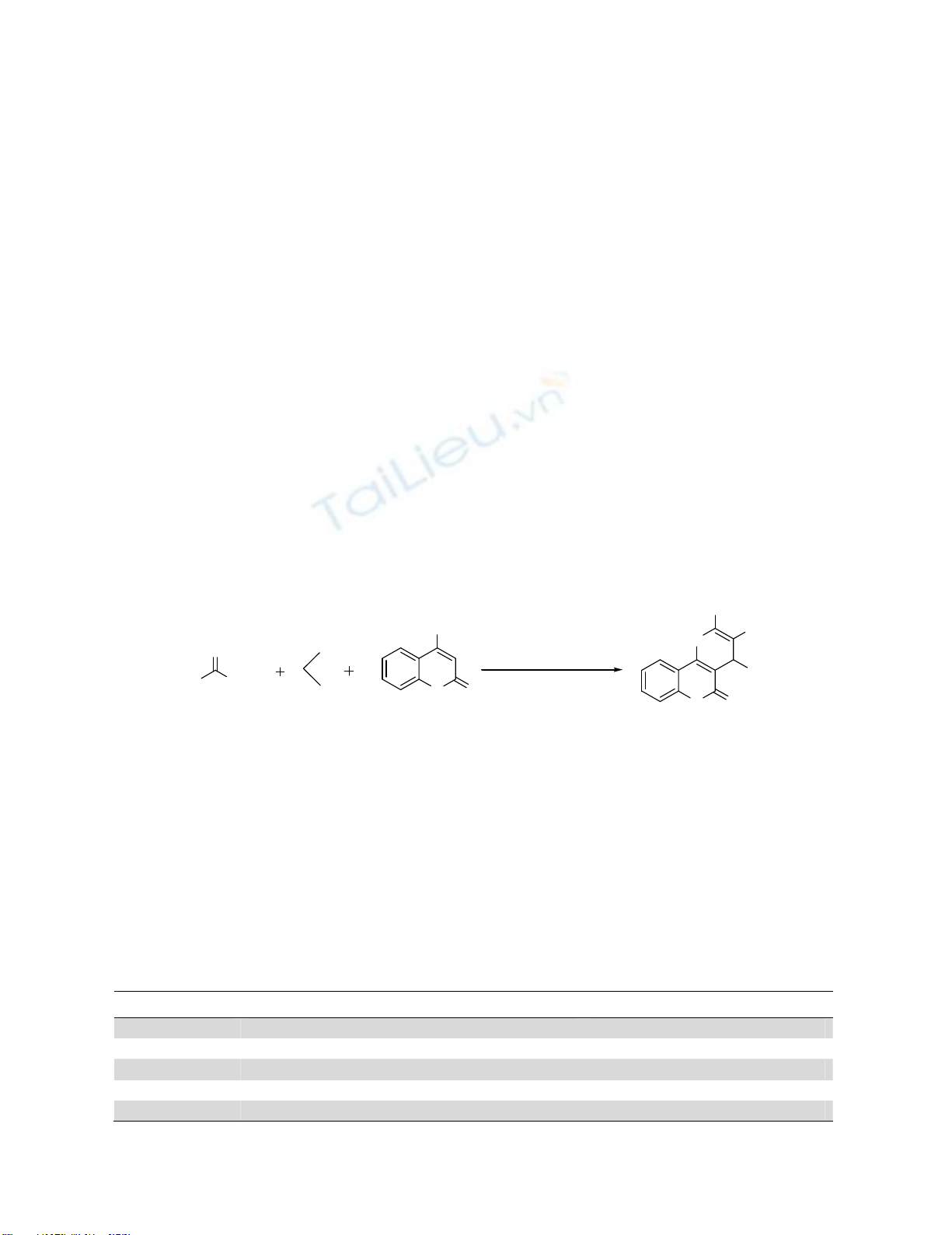
dihydropyrano[3,2-c] chromenes by treatment of 4-chlorobenzaldehyde (1mmol), malononitrile
(1mmol), 4-hydroxycoumarine (1mmol) and ammonium metavanadate (7.5mol%) as catalyst dissolved
in 5 ml of ethanol:water(1:1) at reflux temperature for 8 - 14 min (Scheme 1).
CN
CN O
O
NH
2
CN
Ar
Reflux (8-14min)
Ar H
O
O O
OH
O
NH
4
VO
3
(7.5 mol %)
1(a-n) 234(a-n)
H
2
O:EtOH (1:1)
Scheme 1. An eco-friendly, facile and efficient methodology for the synthesis of dihydropyrano[3,2-
c] chromene
To evaluate the effect of solvent, various solvents such as water, ethanol:water (1:3,v:v),
ethanol:water (1:2,v:v), ethanol:water (1:1,v:v) and ethanol were used for the model reaction. The
desired product was obtained in 39, 47, 65, 94 and 94% yields respectively after 10 min at reflux
condition. Water:ethanol (1:1) stand out as the solvent of choice among the solvents tested. Because of
the rapid conversion and excellent yield (93%) of desired product obtained (Table 1, entry 4), where
as the product formed in lower yields (39-65%) by using other solvents (Table 1, entries 1-3).
Table1. Screening of solvents
Entry Solvent Yield (%)
1 water 39
2 ethanol, water (1:3) 47
3 ethanol, water (1:2) 65
4 ethanol, water (1:1) 93
5 ethanol 93

B. V. Shitole et al. / Current Chemistry Letters 5 (2016)
139
To determine the appropriate concentration of the catalyst ammonium metavanadate, it has been
investigated the model reaction first without catalyst and very less product is obtained (i.e. trace) at
different concentrations of catalyst like 2.5, 5, 7.5and 10 mol% the product formed in 57, 72, 93 and
93% yields, respectively (Table 2). This indicates that 7.5mol% of ammonium metavanadate is
sufficient for the best result by considering the reaction time and yield of product. A role of ammonium
metavanadate has been proposed to activate the carbonyl compound by binding of ammonium
metavanadate with the carbonyl oxygen which ultimately enhances the electrophilicity of the carbonyl
carbon leads to increase in the reaction rate.
Table2. Optimization of the amount of Ammonium metavanadatea
Entry Ammonium metavanadate (mol %) Yieldb (%)
1 2.5 57
2 5 72
3 7.5 93
4 10 93
aReaction conditions: 1 (1 mmol), 2 (1 mmol), 3 ( 1mmol) ammonium metavanadate in water ethanol (1:1) at reflux temperature.;
bIsolated yields
In order to show the merit of NH4VO3 in comparison with the other catalyst used for the similar
reaction, a side by side comparison was run with some of the more common catalysts used for this
chemistry. The results are presented in Table -3. It is evident from the results that NH4VO3 was an
effective catalyst for the synthesis of dihydropyrano[3,2-c] chromenes.
Table 3. Effect of different catalysts for the synthesis of 3,4-dihydropyrano[c]chromenes from the
condensation of on the reaction of benzaldehyde, 4-hydroxycoumarin and malononitrile
Entry Catalyst Catalyst
Conc.
Solvent/
Medium
Temp (oC) Time
(min)
Yield
(%)
Reference
1 DAHP (10 mol%) Ethanol–water 25 240 85 16
2 H6P2W18O62·18H2O (10 mol%) Ethanol Reflux 30-85 80 17
3 TBAB (10 mol%) Water Reflux 45-60 93 18
4 (CH2)6N4 (10 mol%) Ethanol Reflux 40 95 19
5 SDS (20 mol%) Water 60 150 88 21
6 [TETA]TFA (10mol%) Ethanol–water Reflux 30 95 22
7 α-Fe2O3 (10 wt%) Ethanol Reflux 30 93 23
8 DMAP (20 mol%) Ethanol Reflux 4 94 24
9 CuO nanoparticles (15 mol%) Water 100 6 93 25
10 ammonium
metavanidate
(7.5 mol%) Ethanol–water Reflux 9 94 Present
method
To study the generality of this process, variety of examples were illustrated for the synthesis of
dihydropyrano[3,2-c] chromenes and the results are summarized in Table 4. The reaction is compatible
for various substituents such as -CH3, -OCH3, -OH, -N(CH3)2, and –Cl. The formation of desired
product has been confirmed by 1H NMR and IR spectroscopic analysis techniques and compared with
the corresponding literature data.

140
Table 4. Synthesis of dihydropyrano[3,2-c] chromenes using Ammonium metavanadate
Sr.No. Ar-CHO Product Time
(min) Yielda(%) M. P°C
Found Reported
1 C6H5 4a 10 94 257-259 256-258[16]
2 4-ClC6H4 4b 09 93 260-262 263-265[16]
3 4-OHC6H4 4c 14 92 262-264 266-268[27]
4 4-CH3C6H4 4d 12 93 259-261 253-255[27]
5 2-ClC6H4 4e 11 90 243-245 245-246[31]
6 3-ClC6H4 4f 10 91 244-246 241-243[27]
7 4-NO2C6H4 4g 08 95 255-257 258-260[16]
8 4-OCH3C6H4 4h 12 90 242-244 240-242[16]
9 3-NO2C6H4 4i 09 92 260-262 262-264[16]
10 2-NO2C6H4 4j 10 89 261-263 258-260[27]
11 2,4 - Cl2-C6H3 4k 12 91 260-262 257-259[16]
12 3,4,5-(OCH3)3C6H2 4l 13 90 238-240 236-238[27]
13 4-F C6H4 4m 09 94 256-258 258-259[31]
14 4-(CH3)2NC6H4 4n 14 92 262-263 265-267[31]
3. Conclusions
In conclusion, this paper has described a simple and proficient approach for the synthesis of
dihydropyrano[3,2-c] chromenescatalyzed by ammonium metavanadate in aqueous alcoholic media.
Present methodology offers very attractive features such as simple experimental procedure, higher
yields and economic viability, when compared with other method as well as with other catalysts, and
will have wide scope in organic synthesis.
Acknowledgements
We are thankful to the University Grants Commission, New Delhi, for financial support which is
gratefully acknowledged and the Sophisticated Analytical Instrument Facility, Punjab University,
Chandigarh for providing spectroscopic data.
4. Experimental
4.1. Materials and Methods
Chemicals were purchased from Merck, Fluka and Aldrich chemical companies. All yields refer to
isolated products unless otherwise stated. Melting points were determined in an open capillary. 1H
nuclear magnetic resonance (NMR) (500 MHz) with tetramethylsilane as internal standard and
dimethylsulfoxide DMSO-d6 as solvent. Fourier transform infrared (IR) spectra were obtained as KBr
discs on a Shimadzu spectrometer. Mass spectra (MS) were determined on a Varion-Saturn 2000
GC/MS instrument.
4.2. General procedure for the synthesis of substituted of 3,4-dihydropyrano[c]chromenes.
A mixture of subsutited aromatic aldehyde (1mmol), malononitrile (1mmol) and 4-
hydroxycoumarine (1mmol) in the presence of ammonium metavanadate (7.5mol %) as a catalyst was
stirred at reflux temperature in ethanol:water (1:1) (7 ml) for 8-14 minutes. After the appropriate time,
the mixture was cool than poor on ice cold water solidified the product filtered its. The crude solid
material was purified by recrystallization from ethanol.
4.3 Spectral data for selected compounds
2-amino-4,5-dihydro-5-oxo-4-phenylpyrano[3,2-c]chromene-3-carbonitrile (4a)
IR (KBr) : 3376 (NH2), 2195 (CN), 1703 (C=O) cm-1; 1H NMR (d6-DMSO, 400 MHz) δ : 4.46 (s, 1H,
CH), 7.23–7.91(m, 11H, Ar, NH2) ppm; 13C NMR (d6-DMSO, 100 MHz), δ : 37.4, 58.5, 104.5,
113.4,117.0, 119.6, 122.9, 125.1, 127.6, 128.1,128.9, 133.4, 143.8, 152.6, 153.9, 158.4, 159.9 ppm.

B. V. Shitole et al. / Current Chemistry Letters 5 (2016)
141
2-amino-4-(4-chlorophenyl)-4,5-dihydro-5-oxopyrano[3,2-c]chromene-3-carbonitrile(4b)
IR (KBr): 3281 (NH2), 2185 (CN), 1701 (C=O) cm-1;1HNMR (d6-DMSO 400 MHz) δ : 4.68 (s, 1H,
CH), 7.47–8.19 (m, 10H, Ar, NH2) ppm. 13C NMR (d6-DMSO, 100 MHz), δ : 57.2, 103.2, 113.3, 117.0,
119.3, 123.0, 124.1, 124.7, 125.1, 129.6, 129.7, 133.6, 147.0, 151.2, 152.7, 154.4, 158.5, 160.0 ppm.
2-amino-4,5-dihydro-4-(4-hydroxyphenyl)-5-oxopyrano[3,2-c]chromene-3-carbonitrile(4c)
IR (KBr) : 3353 (NH2), 2157 (CN), 1712(C=O) cm-1; 1HNMR (d6-DMSO 400 MHz) δ : 4.51 (s, 1H,
CH), 7.47–8.05 (m, 10H, Ar, NH2) 9.03 (s, OH) ppm. 13C NMR (d6-DMSO, 100 MHz), δ : 58.8, 104.5,
112.8, 115.6, 115.9, 119.8, 122.5, 125.0, 128.9, 133.2, 133.8, 152.4, 154.1, 156.8, 158.3, 160.2 ppm.
2-amino-4,5-dihydro-5-oxo-4-p-tolylpyrano[3,2-c]chromene-3-carbonitrile(4d)
IR (KBr) : 3333 (NH2), 2878 (CH3),2166 (CN), 1708(C=O) cm-1; 1HNMR (d6-DMSO 400 MHz) δ :
2.26 (s, 3H), 4.42 (s, 1H, CH), 7.32–8.61 (m, 10H, Ar, NH2) ppm. 13C NMR (d6-DMSO, 100 MHz), δ
: 21.4, 58.3, 103.9, 113.2, 116.8, 119.2, 123.2, 125.2,127.9, 128.7, 133.7, 135.9, 139.8, 152.9, 152.9,
159.1, 160.2 ppm
2-amino-4-(2-chlorophenyl)-4,5-dihydro-5-oxopyrano[3,2-c]chromene-3-carbonitrile (4e)
IR (KBr) : 3342 (NH2), 2159 (CN), 1707(C=O) cm-1; 1HNMR (d6-DMSO 400 MHz) δ : 4.46 (s, 1H,
CH), 7.52–8.91 (m, 10H, Ar, NH2) ppm. 13C NMR (d6-DMSO, 100 MHz), δ : 57.7, 103.9, 112.8, 115.6,
116.1, 119.4, 122.7, 125.3, 128.5, 132.9, 134.4, 152.4, 154.3, 157.9, 158.1, 159.9 ppm.
2-amino-4-(3-chlorophenyl)-4,5-dihydro-5-oxopyrano[3,2-c]chromene-3-carbonitrile (4f)
IR (KBr) : 3376 (NH2), 2195 (CN), 1703 (C=O) cm-1; 1H NMR (d6-DMSO, 400 MHz) δ : 4.42 (s, 1H,
CH), 7.21–8.71(m, 10H, Ar, NH2) ppm; 13C NMR (d6-DMSO, 100 MHz), δ : 57.81, 104.3, 114.3,
116.2, 119.2, 122.9, 125.1, 127.0, 127.6, 127.8, 130.3, 133.8, 132.9, 146.2, 152.6, 155.4, 158.3, 158.4,
160.3 ppm.
2-amino-4,5-dihydro-4-(4-nitrophenyl)-5-oxopyrano[3,2-c]chromene-3-carbonitrile (4g)
IR (KBr) : 3367 (NH2), 2171 (CN), 1709 (C=O) cm-1; 1H NMR (d6-DMSO, 400 MHz) δ : 4.43 (s, 1H,
CH), 7.23–8.51(m, 10H, Ar, NH2) ppm; 13C NMR (d6-DMSO, 100 MHz), δ : 57.2, 103.2, 113.3, 117.3,
119.4, 123.2, 124.2, 125.3, 129.7, 133.3, 147.3, 151.4, 152.4, 154.4, 158.5, 158.7, 160.1 ppm
2-amino-4,5-dihydro-4-(4-methoxyphenyl)-5-oxopyrano[3,2-c]chromene-3-carbonitrile (4h)
IR (KBr) : 3367 (NH2), 2887 (CH3), 2162 (CN), 1707 (C=O) cm-1; 1H NMR (d6-DMSO, 400 MHz) δ
: 3.75 (s CH3) 4.42 (s, 1H, CH), 7.33–8.22(m, 10H, Ar, NH2) ppm; 13C NMR (d6-DMSO, 100 MHz),
δ : 52.9, 57.6, 104.1, 113.1, 115.7, 116.9, 119.2, 122.9, 124.2, 124.2, 125.2, 126.7, 134.1, 138.1, 152.1,
152.5, 158.2, 159.5 ppm
2-amino-4,5-dihydro-4-(3-nitrophenyl)-5-oxopyrano[3,2-c]chromene-3-carbonitrile (4i)
IR (KBr) : 3361 (NH2), 2152 (CN), 1705 (C=O) cm-1; 1H NMR (d6-DMSO, 400 MHz) δ : 4.44 (s, 1H,
CH), 7.11–8.71(m, 10H, Ar, NH2) ppm; 13C NMR (d6-DMSO, 100 MHz), δ : 58.6, 104.3, 112.9, 118.0,
119.2, 122.3, 122.3, 122.9, 125.1, 129.8, 133.6, 135.2, 145.6, 148.3, 152.3, 153.9, 158.5, 158.7,
160.1ppm.
2-amino-4,5-dihydro-4-(2-nitrophenyl)-5-oxopyrano[3,2-c]chromene-3-carbonitrile (4j)
IR (KBr) : 3352 (NH2), 2171 (CN), 1709 (C=O) cm-1; 1H NMR (d6-DMSO, 400 MHz) δ : 4.41 (s, 1H,
CH), 7.21–8.52(m, 10H, Ar, NH2) ppm; 13C NMR (d6-DMSO, 100 MHz), δ : 57.3, 103.24, 119.3,
117.5, 118.9, 123.8, 124.6, 125.8, 129.7, 133.3, 147.3, 151.4, 152.4, 154.4, 158.5, 158.7, 161.2 ppm





![Đề thi kết thúc học phần Nguyên lí Hóa học 2 [mới nhất]](https://cdn.tailieu.vn/images/document/thumbnail/2025/20251014/anhinhduyet000/135x160/69761760428591.jpg)