
Hindawi Publishing Corporation
EURASIP Journal on Advances in Signal Processing
Volume 2007, Article ID 82874, 14 pages
doi:10.1155/2007/82874
Research Article
Spectral Content Characterization for Efficient Image
Detection Algorithm Design
Kyoung-Su Park,1Sangjin Hong,1Peom Park,2, 3 and We-Duke Cho4
1Mobile Systems Design Laboratory, Department of Electrical and Computer Engineering, Stony Brook University – SUNY,
Stony Brook, NY 11794-2350, USA
2Department of Industrial and Information Systems Engineering, Ajou University, Suwon-Si 442-749, South Korea
3Humintec Co. Ltd., Suwon-Si 443-749, South Korea
4Department of Electronics Engineering, College of Information Technology, Ajou University, Suwon-Si 442-749, South Korea
Received 8 August 2006; Revised 25 January 2007; Accepted 30 January 2007
Recommended by C.-C. Jay Kuo
This paper presents spectral characterization for efficient image detection using hyperspectral processing techniques. We investi-
gate the relationship between the number of used bands and the performance of the detection process in order to find the optimal
number of band reductions. The band reduction significantly reduces computation and implementation complexity of the algo-
rithms. Specifically, we define and characterize the contribution coefficient for each band. Based on the coefficients, we heuristically
select the required minimum bands for the detection process. We have shown that the small number of bands is efficient for effec-
tive detection. The proposed algorithm is suitable for low-complexity and real-time applications.
Copyright © 2007 Kyoung-Su Park et al. This is an open access article distributed under the Creative Commons Attribution
License, which permits unrestricted use, distribution, and reproduction in any medium, provided the original work is properly
cited.
1. INTRODUCTION
The hyperspectral imaging systems have found various civil-
ian and military applications. The high efficiency and flexi-
bility of hyperspectral sensors provide a powerful measure-
ment technology currently being demonstrated with mod-
ern airborne and spaceborne hyperspectral systems. The hy-
perspectral sensor typically gets one hundred to several hun-
dreds of bands for exact spectral classification. The property
of the hyperspectral sensor is similar to that of the sensor
used in advanced digital cameras. The hyperspectral sensor
is capable of covering infrared and/or ultraviolet radiation as
well as visible light using the enormous number of bands; a
typical digital camera sensor covers only visible light using
three bands which are called RGB. The hyperspectral pro-
cessing technology is gradually incorporated into modern
civil and military remote sensing systems along with other
sensors such as imaging radar and laser systems [1].
Hyperspectral processing requires an extremely large
amount of input data for the spectral classification. More-
over, the computational requirement for processing input is
significant. There are many approaches for analyzing hyper-
spectral data. Hardware clusters may be a feasible solution
because they are used to achieve high performance, high
availability, or horizontal scaling. Cluster technology can also
be used for highly scalable storage or data management.
These computing resources could be utilized to efficiently
process the remotely sensed data before transmission to the
ground [2]. Digital signal processors are also suitable for hy-
perspectral computations because it can be optimized for
performing multiply-and-accumulate operations. It is usu-
ally implemented in digital signal processor (DSP) clusters
for parallel processing [1,2]. Even though these process-
ing systems have been applied for hyperspectral processing,
high-speed image processing and efficient communication
within processors are still hot issues. In addition, new pro-
cessing algorithms and the highly effective memory manage-
ment are essential for the new hyperspectral sensor which
contains higher resolution and much more bands. For a real-
time processing hyperspectral system, these are some of the
key issues [3].
The objective of this paper is to characterize key pa-
rameters used in hyperspectral processing in order to min-
imize computational requirements, which are essential for
high-speed real-time processing. Even though hyperspectral
processing is often used in classification problems, we are
2 EURASIP Journal on Advances in Signal Processing
(a) Conventional (b) Hyperspectral
Figure 1: Comparison of detected images based on conventional
approach and hyperspectral approach.
focusing on target detection problems used in surveillance
applications [4].
The rest of this paper is organized as follows. Section 2
describes the background of hyperspectral signal processing.
The image data structures as well as processing data flow
are described. We also characterize various key parameters
involved in the detection process. Section 3 discusses detec-
tion characteristics as a function of the bands and libraries.
In Section 4, we present a heuristic band selection strategy.
The algorithm design and the evaluation are discussed in
Section 5,andfinallySection 6 concludes the paper.
2. BACKGROUND AND PROBLEM DESCRIPTION
2.1. Hyperspectral image processing for
detection problems
Consider the problem of detecting flowers in a garden where
a mixture of flowers and various plants are present [5].
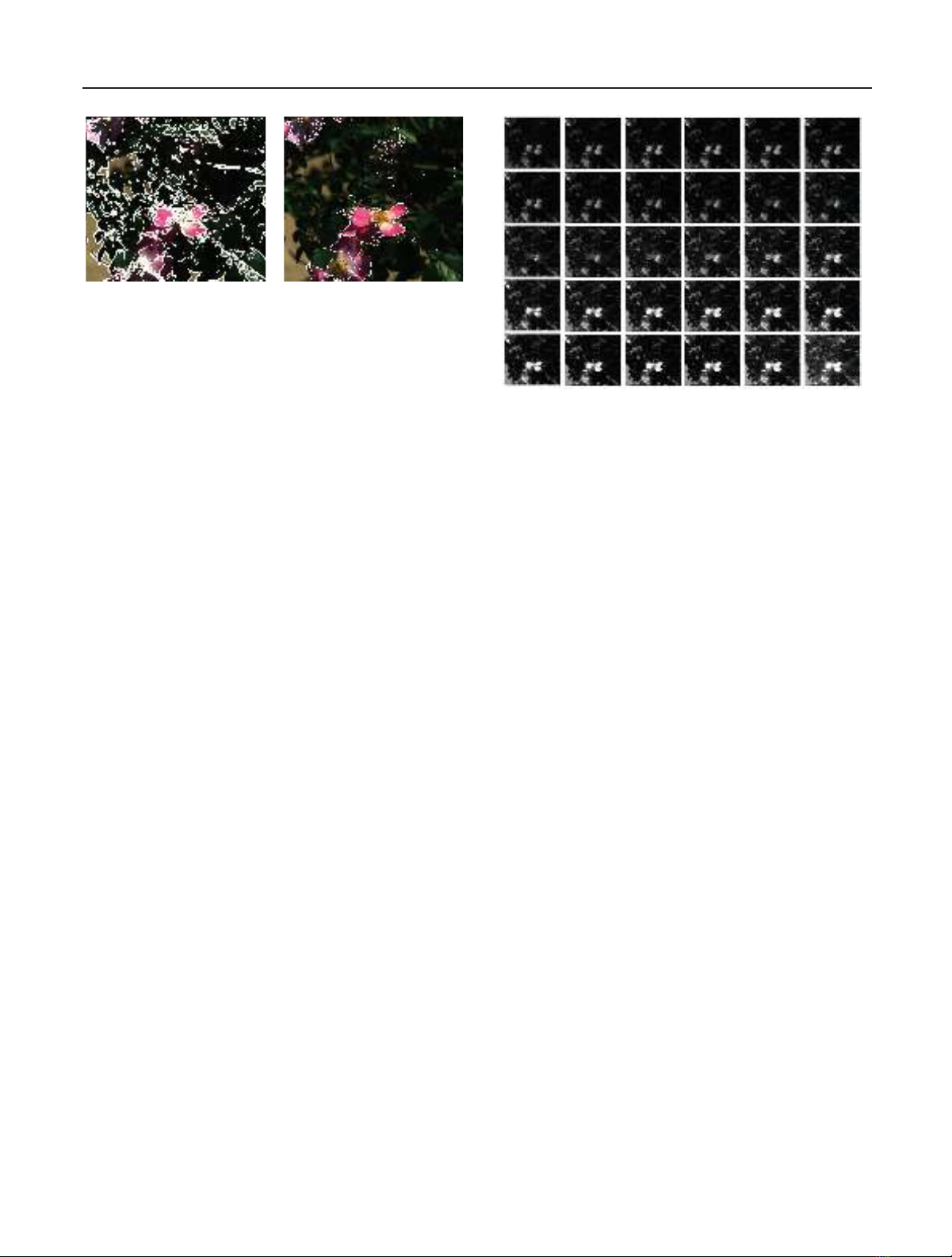
Figure 1 illustrates the results where detection based on hy-
perspectral image processing is compared to that of conven-
tional image processing. As shown in Figure 1(a), the object
is detected in conventional image processing with edge detec-
tion using RGB information. Since this image contains many
fragmented detected edges, isolating the desired target image
becomes a challenge [6]. On the other hand, edge detection
can be carried out after the hyperspectral image processing.
TheresultisshowninFigure 1(b) in which only the images
of flowers are detected. Such detection is possible because ev-
ery material has an essential spectral property [7]. In this pa-
per, Figure 1(b) is the ground truth image for comparisons.
Hyperspectral processing involves three key stages. The
first step is the calibration stage. The image data produced
by a sensor is manipulated to minimize sensor nonunifor-
mity. The sensor is also calibrated by using the initially mea-
sured samples to consider the environment of measurement
[4,8]. Each image cube contains a number of bands of spec-
tral contents. For example, the image cube representing the
garden of flowers as shown in Figure 2 consists of 30 bands of
spectral information. Each band represents the information
corresponding to a specific frequency range. Thus, a library
(or spectral information) is constituted by a set of values,
where the number of values corresponds to the number of
Figure 2: Illustration of images corresponding to different bands of
the hyperspectral cube.
bands. In other words, every pixel in the cube is represented
byasetofvalues;thus,atarget(i.e.,objectimagetobede-
tected) is represented by numerous sets of values in a library.
The second step is the detection stage. In the detection stage,
target images are detected via isolating the portion of data
which is highly correlated with the given target library. The
target library contains spectral information about the object
intended to be detected. The objective of the detection stage
is to find out the image from the input cube that correlates
with the spectral information stored in the target library. The
third step is the visualization stage which collects detected
image pixels and visualizes through color composition [8].
In this paper, we focus our discussion on the detection
stage. Figure 3 illustrates the block diagram of hyperspec-
tral processing. The main challenge of general hyperspectral
image processing is the backside of its advantages: high vol-
ume and complexity of hyperspectral data. The performance
of detection depends on the quality of spectral information
stored in the target library. The main operation in the hy-
perspectral processing for target detection is to compare the
input cube with the target library to determine correlation in
terms of spectra. The detection is based on perceptual seg-
mentation where spectra contents for each subband are cor-
related with the spectra contents stored in the library. How-
ever, not all bands are necessary since some may contain re-
dundant information where they are compared to the tar-
get library. The easiest approach is to reduce the number
of bands and the amount of library for processing. How-
ever, such reduction may eliminate the merit of hyperspec-
tral processing. Hence, one of our objectives is to determine
which bands are effective in detecting the target and selecting
them accordingly. The effectiveness is measured in terms of
the amount of target being detected with a fewer number of
bands. In practice, a perfect target library, which is a set of all
spectra comprising the target image, does not exist since ob-
jects exhibit different spectral characteristics which are sensi-
tive to environmental factors such as lighting [4,8,9]. In the
application of target detection, the basic library is a target

Kyoung-Su Park et al. 3
Calibration
Sensor
calibration table
Sensor Cube data
Sensor non
uniformity
correction
Wavelength
calibration
Target
detected
image
Color
composition Grouping
Gathering
detected
image
Visualization
Detection
Library
Step 0
Load image and
library
Step 3
Correct samples
Step 1
Get correlation
Step 4
Library
refinement
Step 2
Detection
Step 5
Effective band
selection
Figure 3: The block diagram of overall hyperspectral processing. A detailed description of steps is explained in Section 5.
spectrum which is generated in laboratories or measured in
typical environments. Hence, the spectrum of the target im-
age measured by different conditions results in mismatching
the target library. Thus, we propose to refine the target li-
brary dynamically so that effective detection can be achieved
with a small amount of target library information.
2.2. Related work
Traditional store-and-processing system performance is in-
adequate for real-time hyperspectral image processing with-
out data reduction [3]. In this work, a fine-grain, low-
memory and single-instruction multiple-data (SIMD) pro-
cessor is presented as an efficient computational solution for
hyperspectral processing. However, the SIMD processor does
not fully solve the higher resolution and a large number of
band problems.
To minimize the volume of hyperspectral image pro-
cessing, several data compression algorithms are proposed
[10]. They achieve impressive compression ratios but could
lose valuable information for detection or classification even
though the error can be minimized by the clever compression
algorithm.However,overallprocessisaffected by the decom-
pression complexity [11]. Statistical approach based on pat-
tern recognition is one of the solutions for high dimensional-
ity of hyperspectral image processing. It uses a small number
of reference measurements to distinguish material identifica-
tion. However, it requires a large number of sample pixels to
determine accurate probability density function [11].
Even though hyperspectral image processing uses hun-
dreds of bands to detect or classify targets, there is redun-
dancy which means that partial bands efficiently accomplish
the edge detection as described in [11,12]. In [11], the band
selection is based on the band add-on (BAO) procedure that
chooses an initial pair of bands and classifies two spectra by
correlation, and then adds additional bands that increase the
correlation of two spectra. It is a feasible solution to deter-
mine effective bands when an unknown pixel is classified by
using many reference classes. A set of best-bases feature ex-
traction algorithms is proposed for classification of hyper-
spectral data as well [13]. This method is simple, fast, and
highly effective so that it can reduce the input space from
183 dimensions to less than four dimensions in many cases.
However, this approach is based on classification so that it
is suitable when a spectrum of a pixel is classified by many
numbers of libraries. In the application domain of target de-
tection, the input image is compared to a few libraries which
represent the spectrum contents of the target.
2.3. Correlation coefficient of image (A)
Correlation coefficient, A, is a measure of similarity between
the stored spectra in a target library and the obtained spec-
tra from sensors. The high value of correlation indicates the
high degree of similarity between two spectra [14]. The cor-
relation coefficient is defined as
A=1−cos−1⎛
⎝NT
i=1tiri
NT
i=1t2
iNT
i=1ri2
⎞
⎠,(1)
where NTis the number of bands in input spectrum, tiis the
test spectrum of the ith band, and riis the reference spec-
trum of the ith band. The value of correlation defines a de-
gree of similarity between input spectrum and target spec-
trum stored in the target library.
The input spectra of an object is compared to the spectra
in the target library. This comparison is based on the cor-
relation coefficient. In this paper, we define Atas the mini-
mum correlation coefficient value which recognizes the tar-
get between unknown spectra. When the correlation value
is higher than or equal to At, the object is assumed to be
matched with the data in the target library. Thus, the value
is used as an indicator for the degree of confidence in detec-
tion.
If we use lower Atto detect targets, it increases the pos-
sibility of wrong detection which means that some back-
grounds are detected as a target. However, if the numbers of
4 EURASIP Journal on Advances in Signal Processing
0
10
20
30
40
50
60
70
80
90
100
Percentage of detected image (P)
0.50.55 0.60.65 0.70.75 0.80.85 0.90.95 1
Minimum correlation coefficient (At)
lib1
lib2
lib3
Tot a l
Figure 4: Relationship between the correlation value used and de-
tected image percentage of detected image (P). Thirty one bands of
input image data are used in the simulation.
libraries and bands applied in detection is increased, the per-
formance of target detection is improved. However, even if all
possible information is used to detect targets, there is a limit
value where target and background cannot be isolated. Thus,
the minimum correlation coefficient (At) is related to the
similarity within the target and background. We define Ab
as a maximum correlation value where any correlation value
below Abis considered to be a background, which means that
the pixel is not a target at least. The detected image with the
correlation value below Abmay not be the interest of objects
which may capture a large portion of the background.
2.4. Percentage of detected image (P)
Percentage of detected image (P) shows the effectiveness of
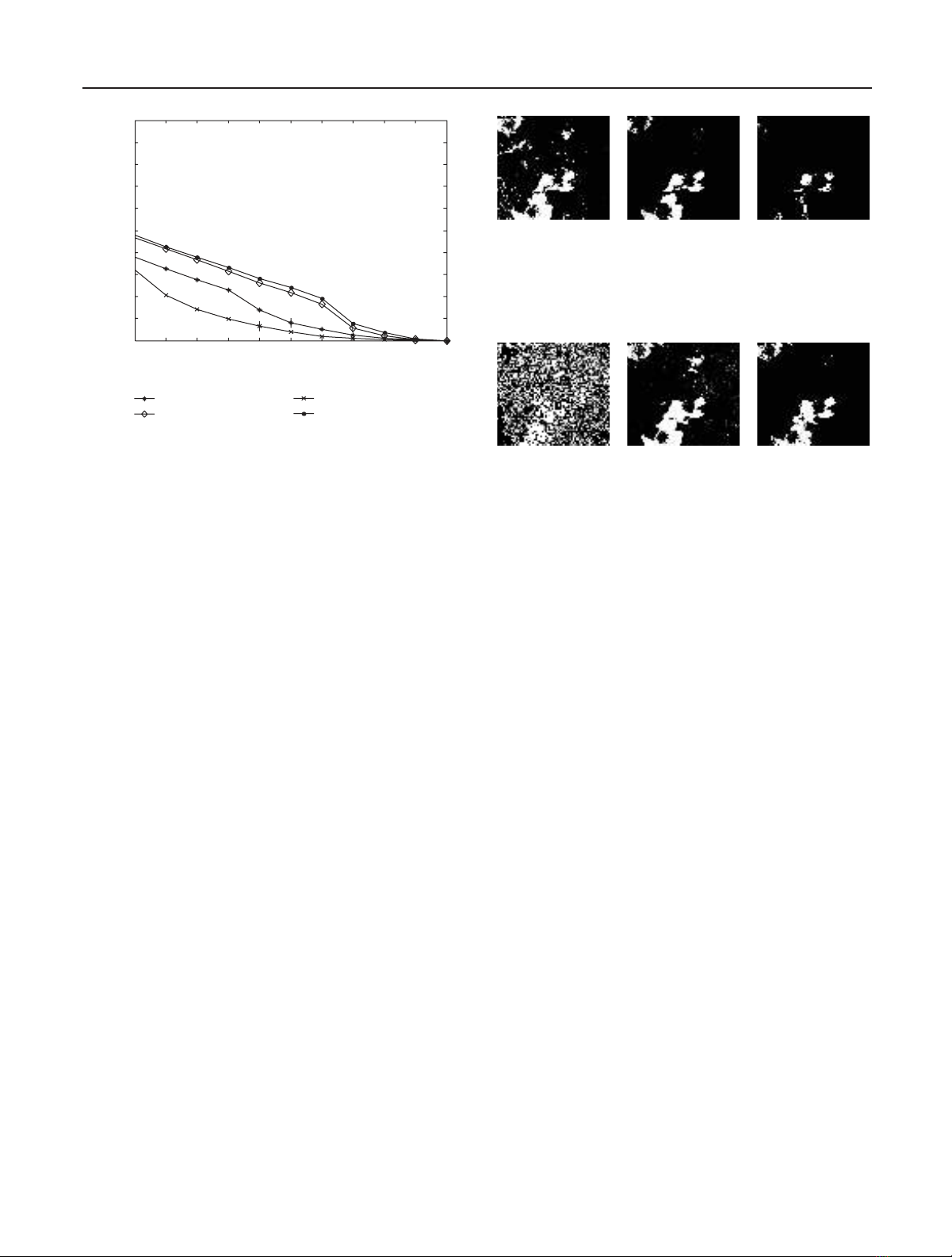
selected bands in the detection process. Figure 4 illustrates
the relationship between the correlation coefficients and per-
centage of detected image (P) where three types of target li-
braries are used. When the given correlation coefficient Atis
1, the value of percentage of detected image (P)isverylow
(i.e., approaches zero). For all libraries, when the correla-
tion coefficientisincreased,the percentage of detected image
(P) is decreased. We define Atas the correlation value where
the change in percentage of detected image (P) is smaller than
some value δas we increase the value of the correlation coef-
ficient.
Figure 5 shows the simulation results of the detected im-
age as a function of the minimum correlation values for one
target library, lib1. The detected images are shown for differ-
ent minimum correlation values: 0.70, 0.75, and 0.85. In the
case where Atof lib1 is 0.7, unwanted objects that satisfy the
minimum correlation value are detected as a target. However,
as Atis increased to 0.85, the unwanted objects almost disap-
pear in the detection at the cost of losing the target image. At
(a) At=0.7(b) At=0.75 (c) At=0.85
Figure 5: The result of detected image as a function of correlation
values Atfor lib1. Thirty one input bands are used and processed
with one library.
(a) 2 bands (b) 4 bands (c) 16 bands
Figure 6: The results of detected image as a function of the number
of bands used out of 31 input bands.
the minimum correlation Atof 0.85, the process tries to find
only the image from the input that is highly correlated with
the target library.
The values of percentage of detected image (P)havetwo
interpretations. First, the higher value of percentage of de-
tected image (P) (i.e., more images have been detected) im-
plies that more target images are detected. Second, the higher
value of percentage of detected image (P) can imply that some
of the detected images are not the target. Hence, detection
depends on the number of libraries (spectral information)
and their qualities as well as the minimum correlation values
used in the process.
Under the assumption which multiple libraries are used
in the detection, we define the total percentage of detected
image (PT) as follows:
PT=
l
Pl,At,(2)
where lis the index of each library and P(l,At) is the per-
centage of detected image (P) value at the correlation value
Atwhen library lis used. We will use the total percentage of
detected image (P) as an indicator for detection performance.
3. TARGET DETECTION
3.1. Effects of number of bands
Since the motivation of our work is to use the smaller num-
ber of bands for detecting the target, we investigate the effects
of the number of bands on detection performance. Thus, the
goal is to minimize the total percentage of detected image (PT)
at the minimum correlation (At) given the number of bands
(NE).
Kyoung-Su Park et al. 5
0
10
20
30
40
50
60
70
80
90
100
Percentage of detected image (P)
0.50.55 0.60.65 0.70.75 0.80.85 0.90.95 1
Minimum correlation coefficient (At)
lib1
lib2
lib3
Tot a l
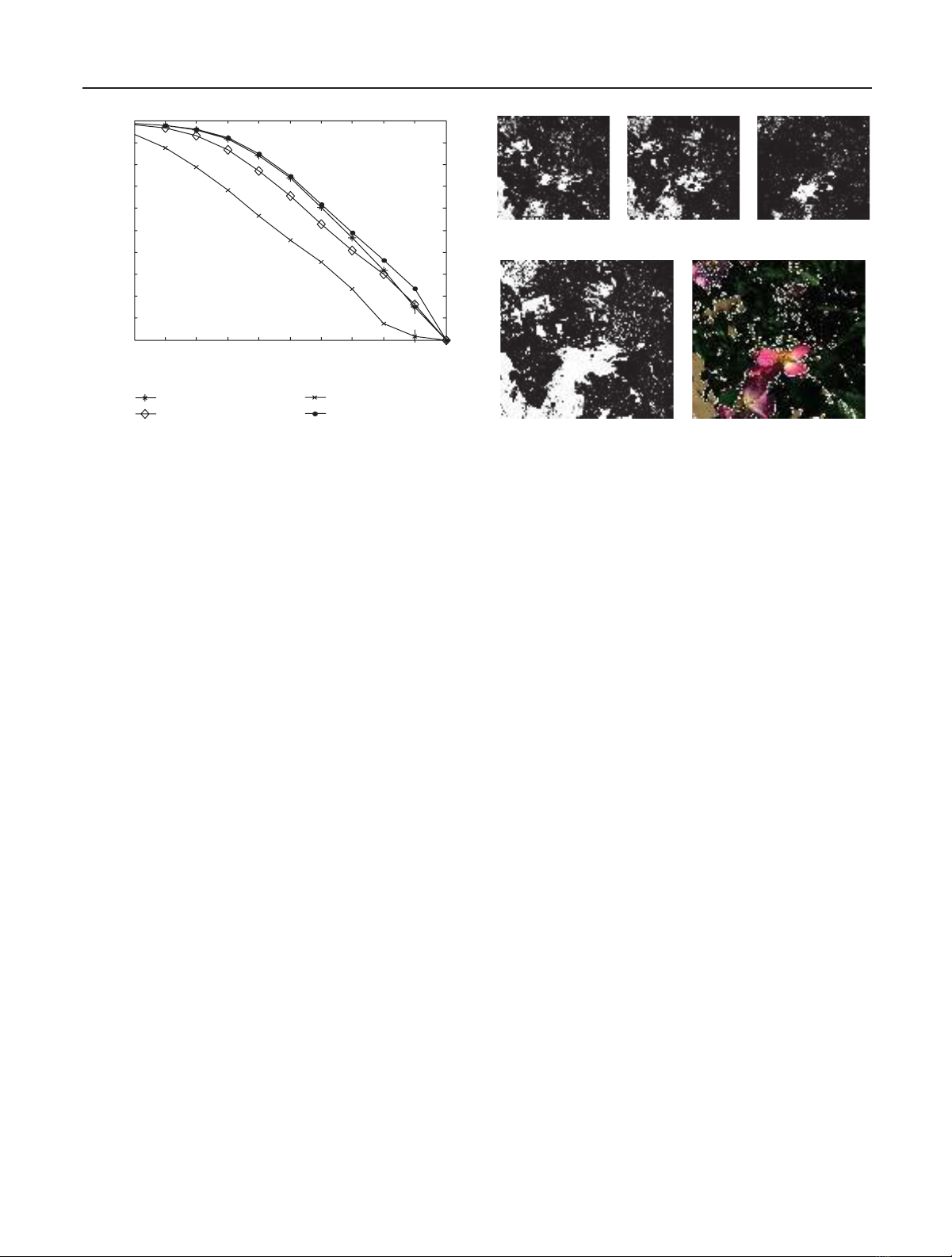
Figure 7: Relationship between the correlation values and percent-
age of detected image (P) when clustered bands (27, 28, 29, 30) are
used in the detection.
Figure 6 shows the detected image where a partial num-
ber of bands are used to detect flowers. When the number
of bands, NE, is equal to 2, the detected image includes the
targetimageaswellasotherunwantedbackgroundimages.
It implies that two bands are not effectively isolating the tar-
get image. When the number of bands is more than 4, the
detected images become isolated and percentage of detected
image (P) is lower than that of the image generated with 2
bands. However, there is only slight improvement (the total
percentage of detected image (P) is decreased) from 4 bands to
16 bands.
We define the degree of effectiveness in terms of the total
percentage of detected image (PT). As shown in Figure 6(a),to-
tal percentage of detected image (PT) is higher than that shown
in Figures 6(b) and 6(c) (i.e., more images are shown). How-
ever, total percentage of detected image (PT)isimproved(re-
duced) very slightly from 4 bands to 16 bands. This shows
that the complete use of the bands is not always necessary for
detecting the target from the input image.
3.2. Redundancy between bands
To use the partial number of bands, the simplest approach is
to select bands in random. In this section, we consider two
types of band selection in order to characterize the effect of
band selection on detection performance. We investigate the
redundancy within the bands.
3.2.1. Clustered bands
Cluster band selection selects NEconsecutive bands. Figure 7
shows the relationship between the correlation coefficient
and percentage of detected image (P) when 4 consecutive
bands are selected out of 31 possible bands. The selected
(a) With lib1 (b) With lib2 (c) With lib3
(d) Detection with clusters (e) Detected image with full
colors
Figure 8: Result of detected image when clustered bands are used
in the detection. Bands used are (27, 28, 29, 30).
bands are (27, 28, 29, 30). The figure shows a much higher
percentage of detected image (P) for the entire range of corre-
lation values when it is compared to that of Figure 4.Thus,
the figure indicates that it has detected more image from the
background. In this situation, it is likely that the detected im-
age contains a lot of unwanted images.
The analysis with the percentage of detected image (P)is
proven by the detected image illustrated in Figure 8.Eachof
the three libraries were not effective in detecting the flowers.
Even with the correlation coefficient of 0.95, the target is not
separated from the background. This simulation suggested
that those clustered bands contain redundancy and the clus-
tered bands are not effective in detecting the target. Similar
results were obtained when the other sets of clusters are used.
Thus, the clustering is not an effective way to select the bands
for detection.
3.2.2. Maximum separation bands
On the other hand, we select the bands that are maximally
separated. There are several combinations of sets of bands.
Figure 9 shows the relationship between correlation and per-
centageofdetectedimage(P) where bands are selected by
maximal separation as (2, 10, 18, 26).
As shown in Figure 9,percentage of detected image (P)val-
uesofeachlibraryaswellasthetotal percentage of detected
image (PT) are much lower than that for the entire range
of the correlation values. For example, the total percentage
of detected image (PT)ofclusteringcaseatAt=80 is 70
while maximum separation case at At=80 is 40. This im-
plies that the maximal separation performs better than the
clustering at any minimum correlation value. The detected
image by each library shown in Figure 10 contains only the
flowers. This is improved detection much over the clustering