JNERJOURNAL OF NEUROENGINEERING
AND REHABILITATION
A biofeedback cycling training to improve
locomotion: a case series study based on gait
pattern classification of 153 chronic stroke
patients
Ferrante et al.

RESEARCH Open Access
A biofeedback cycling training to improve
locomotion: a case series study based on gait
pattern classification of 153 chronic stroke
patients
Simona Ferrante
1*
, Emilia Ambrosini
1
, Paola Ravelli
1
, Eleonora Guanziroli
2
, Franco Molteni
2
, Giancarlo Ferrigno
1
and
Alessandra Pedrocchi
1
Abstract
Background: The restoration of walking ability is the main goal of post-stroke lower limb rehabilitation and
different studies suggest that pedaling may have a positive effect on locomotion. The aim of this study was to
explore the feasibility of a biofeedback pedaling treatment and its effects on cycling and walking ability in chronic
stroke patients. A case series study was designed and participants were recruited based on a gait pattern
classification of a population of 153 chronic stroke patients.
Methods: In order to optimize participants selection, a k-means cluster analysis was performed to subgroup
homogenous gait patterns in terms of gait speed and symmetry.
The training consisted of a 2-week treatment of 6 sessions. A visual biofeedback helped the subjects in maintaining
a symmetrical contribution of the two legs during pedaling. Participants were assessed before, after training and at
follow-up visits (one week after treatment). Outcome measures were the unbalance during a pedaling test, and the
temporal, spatial, and symmetry parameters during gait analysis.
Results and discussion: Three clusters, mainly differing in terms of gait speed, were identified and participants,
representative of each cluster, were selected.
An intra-subject statistical analysis (ANOVA) showed that all patients significantly decreased the pedaling unbalance
after treatment and maintained significant improvements with respect to baseline at follow-up. The 2-week
treatment induced some modifications in the gait pattern of two patients: one, the most impaired, significantly
improved mean velocity and increased gait symmetry; the other one reduced significantly the over-compensation
of the healthy limb. No benefits were produced in the gait of the last subject who maintained her slow but almost
symmetrical pattern. Thus, this study might suggest that the treatment can be beneficial for patients having a very
asymmetrical and inefficient gait and for those that overuse the healthy leg.
Conclusion: The results demonstrated that the treatment is feasible and it might be effective in translating
progresses from pedaling to locomotion. If these results are confirmed on a larger and controlled scale, the
intervention, thanks to its safety and low price, could have a significant impact as a home- rehabilitation treatment
for chronic stroke patients.
* Correspondence: simona.ferrante@polimi.it
1
NearLab, Bioengineering Department, Politecnico di Milano, Milano, Italy
Full list of author information is available at the end of the article
Ferrante et al.Journal of NeuroEngineering and Rehabilitation 2011, 8:47
http://www.jneuroengrehab.com/content/8/1/47 JNERJOURNAL OF NEUROENGINEERING
AND REHABILITATION
© 2011 Ferrante et al; licensee BioMed Central Ltd. This is an Open Access article distributed under the terms of the Creative Commons
Attribution License (http://creativecommons.org/licenses/by/2.0), which permits unrestricted use, distribution, and reproduction in
any medium, provided the original work is properly cited.

Background
Stroke is the leading cause of acquired adult disability
[1,2]. The most common and widely recognized deficit
caused by stroke is motor impairment, which typically
affects one side of the body, controlateral to the brain
hemisphere where the lesion occurs. The ensuing hemi-
paresis foresees some degrees of motor recovery
depending on the severity of the lesion and on the reha-
bilitative training [3]. Several studies have revealed that
motor experience plays a major role in the subsequent
physiological reorganization occurring in the intact tis-
sues adjacent to the lesion [4,5]. Clinical studies on cen-
tral motor neuroplasticity support the role of goal-
oriented, active, repetitive movements in the training of
the paretic limb to enhance motor relearning and recov-
ery [6-8].
The recovery of walking ability is considered the most
important objective of the lower limb rehabilitation of
individuals after stroke [9]. However, effective interven-
tions for gait training are limited because extensive
assistance is required for individuals with unstable bal-
ance, muscle weakness, and a persistent deficit in move-
ment coordination.
In the last decade different studies suggested that sig-
nificant improvements in the lower extremity function
mightresultfromusingcyclingasarehabilitative
method and that repetitive bilateral training provided by
pedaling may have a positive effect on walking ability
[10-13]. Cycling and walking share a similar kinematic
pattern: both tasks are cyclical, require reciprocal flexion
and extension movements of hip, knee, and ankle, and
have an alternating activation of agonist/antagonist mus-
cles in a well-timed and coordinated manner [14,15].
Furthermore, cycling avoids problems of balance and
can be safely performed even from a wheelchair, without
requiring expensive robotic devices or the constant
supervision of a therapist which are, on the contrary,
necessary to support body weight and to prevent falls
during gait training. For all these reasons, leg cycling
trainingisasaferandmoreeconomicinterventionto
supplement functional ambulation training after stroke
and it is also becoming an interesting option for home
rehabilitation of hemiparetic patients.
Providing an online feedback about patients’perfor-
mance to the training improves patients’motivation,
allows the therapists to assess the exercise and may lead
to an enhancement in the motor relearning process
[16]. This rehabilitative method is well known with the
term of biofeedback (BF) and consists of the use of
instrumentation to make covert physiological processes
more overt. BF refers to an artificial feedback on biolo-
gical quantities, transferred to a biological system
(human) [17]. The use of BF re-endows patients with
sensorimotor impairments with the ability to assess
physiological responses and possibly to relearn self-con-
trol of those responses [18]. Besides, continued training
could establish new sensory engrams and help the
patients to perform tasks without feedback [19]. To
maximize the effect of BF it may be important to apply
it within task-oriented activity and with a feedback
mode that facilitates motor relearning [18]. During ped-
aling, visual BF methods were developed based on EMG
activity [20] and power output produced during a treat-
ment of cycling induced by electrical stimulation [21].
Because of the laterality of the motor impairment, the
postural imbalance or asymmetrical movements between
thetwolowerlimbsarecommonlyobservedinhemi-
paretic patients, making the recovery of a symmetrical
involvement of the two legs strictly correlated with the
improvement of overground locomotion [22,23]. To
minimize gait asymmetry could be clinically crucial
since it may be associated with a number of negative
consequences such as inefficiency, challenges to balance
control, risks of musculoskeletal injury to the non-pare-
tic lower limb and loss of bone density in the paretic
lower limb [24]. During cycling, since the two legs are
simultaneously acting on a single crank, not optimal
solutions could be adopted by stroke patients: for exam-
ple, the non- paretic leg can completely compensate for
the paretic one [11], making the pedaling strategy effec-
tive in terms of speed and total power output, but
strongly unbalanced. This solution could limit the possi-
ble benefits and even worsen the gait performance in
terms of symmetry. To solve this problem, it could be
useful to display a feedback that provides information
about the forces produced at the pedals, asking patients
to increase the task symmetry.
Commercial available cycle-ergometers are usually
equipped with a torque sensor measuring the total tor-
que provided by both legs at the crank, but this signal
does not allow to distinguish the contribution provided
by each leg during pedaling. To overcome this limita-
tion, in our laboratory a cycle-ergometer was instrumen-
ted by mounting strain gauges on each crank arm to
measure independently the torque produced by each leg
during pedaling [25]. Starting from this setup, an infor-
mation fusion algorithm was implemented in order to
visually display to the patient an intuitive index strictly
correlated with the symmetrical involvement of the two
legs in terms of torques provided at the crank arms dur-
ing pedaling. The aim of the present study was to
develop a BF controller and to evaluate its feasibility
and clinical efficacy as a rehabilitation treatment for
chronicstrokepatients.Thehypothesiswasthata2-
week BF cycling treatment might induce some improve-
ments not only in the pedaling performance but also in
the walking ability both in terms of gait speed and sym-
metry indices. A case series study was designed and
Ferrante et al.Journal of NeuroEngineering and Rehabilitation 2011, 8:47
http://www.jneuroengrehab.com/content/8/1/47
Page 2 of 12

participants were recruited based on a gait pattern clas-
sification of a population of 153 chronic stroke patients.
In particular, subjects representative of each category
were included in the study in order to identify those
patients who can benefits the most from the proposed
treatment.
Methods
Participants
Gait pattern categorization of chronic stroke patients
A population of 153 chronic stroke patients, included in
a previous study [26], was chosen to perform the gait
pattern categorization. All these patients underwent
orthopedic procedures to correct equinovarus foot
deformity and performed either prior and postoperative
gait evaluation. Participants included in that study [26]
satisfied the following inclusion criteria: (1) left or right
hemiparesis because of ischemic or hemorrhagic stroke
(diagnosis confirmed by computed tomographic scan/
magnetic resonance imaging or clinical documentation
or both); (2) age > 18 years; (3) time since stroke of at
least 12 months; (4) mild spasticity level for all lower
limb muscles (Modified Ashworth Scale ≤2).
The results of the postoperative gait evaluations were
chosen for the gait categorization, being well represen-
tative of the walking ability of chronic stroke patients
in a stable condition. During these assessments, all
patients were ambulant, without using any special
orthosis; some of them were helped by walking aids
such as sticks (n = 70), tripods (n = 8), quadripods (n
= 11), whereas the remaining group of patients (n =
64) did not use any aid.
The gait classification was based on temporal and spa-
tial parameters able to identify the overall locomotor
performance and the movement symmetry. The mean
velocity was included as a variable for the cluster analy-
sis, being defined as a reliable marker of functional dis-
ability [9] and being reported as the strongest
determinant of group placement in a cluster analysis of
stroke patients [27]. Besides, temporal parameters able
to discriminate gait pattern in term of symmetry were
chosen [24]. In particular, we considered the ratio
between the values obtained by the paretic and healthy
leg for the following parameters: stance time in percen-
tage of stride time, swing time in percentage of stride
time, and the intra-limb ratio of swing time against
stance time. The double support time ratio was not con-
sidered in the gait categorization because it was unable
to identify asymmetric individuals and the mean value
did not differ a lot from healthy subjects [24].
A k-means cluster analysis was used to subgroup
homogeneous gait patterns. A Mahanalobis distance cri-
terion was adopted to eliminate any outlier from the
data sample. The clustering technique is very sensitive
to variables which are highly correlated, so all the vari-
ables were assessed for correlation and those highly cor-
related to others were removed. The selected variables
were standardized before entering the cluster analysis.
The Squared Euclidean distance measure was used and
the number of clusters was optimized performing an a
posteriori measurement of the silhouette coefficient
which evaluated both cohesion and separation of the
obtained centroids [28].
Choice of stroke participants
After having performed the cluster analysis of the
population of chronic stroke patients, we chose a num-
ber of participants equal to the number of identified
clusters: each patient was considered as representative
of one cluster at baseline. Therefore, participants
recruited in this study satisfied the same inclusion cri-
teria of the population chosen for the gait categoriza-
tion. In addition, patients were characterized by a joint
mobility ranges which did not preclude pedaling (knee
extension up to 150° and hip flexion up to 80°). The
only exclusion criteria was an insufficient cognitive
capacity to participate in the program, including recep-
tive aphasia.
The chosen patients were prevented to perform any
other lower limb intervention during the BF training.
Healthy subjects participants
A group of 12 healthy subjects (age 22.6 ± 3.3 years,
height 171.8 cm ± 9.7 cm, weight 63.3 kg ± 8.9 kg) par-
ticipated in the study in order to compute the normality
ranges for both the pedaling and the walking test used
to evaluate the motor recovery induced by the training.
Experimental setup
The THERA-live™(Medica Medizintechnik GmbH,
Germany) motorized cycle-ergometer was chosen for
the treatment. It was equipped with a shaft encoder for
the acquisition of the crank angle and with strain gauges
attached on the crank arms to measure the torque pro-
duced by each leg during pedaling [25]. During the
treatment, patients sat on a chair or a wheelchair in
front of the ergometer and their legs were stabilized by
calf supports fixed to the pedals.
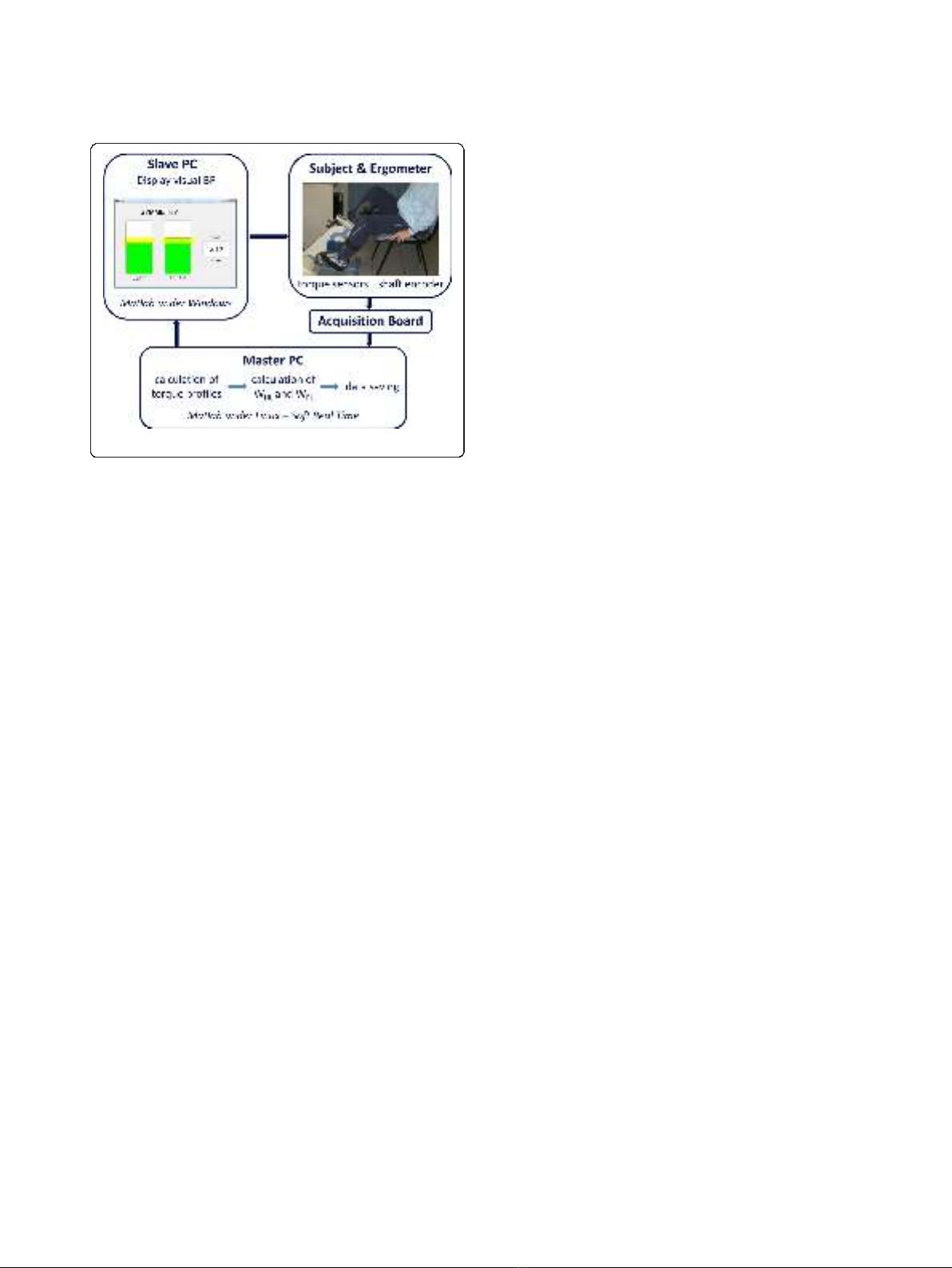
A master computer, called master PC, running
Matlab/Simulink
®
under Linux, acquired all signals
coming from the ergometer with a sampling frequency
of 200 Hz and calculated, at the end of each revolution,
the BF indices. Then, these indices were sent to a sec-
ond PC, called slave PC, which provided the visual bio-
feedback to the patients, displaying the values of the BF
indices through a graphical interface implemented in
Matlab. The communication between the PCs was
obtained through LAN connection according to the
UDP/IP protocol. The experimental setup is shown in
Figure 1.
Ferrante et al.Journal of NeuroEngineering and Rehabilitation 2011, 8:47
http://www.jneuroengrehab.com/content/8/1/47
Page 3 of 12
Intervention
The BF treatment was performed 3 days a week for two
weeks, obtaining a total of 6 sessions. Each session
lasted 14 minutes:
•1 minute of passive cycling;
•2 minutes of voluntary cycling without visual bio-
feedback (VOL1);
•8 minutes of voluntary cycling with visual biofeed-
back (BF phase);
•1 minute of passive cycling;
•2 minutes of voluntary cycling without visual bio-
feedback (VOL2).
Passive cycling was guaranteed by the ergometer’s
motor which maintained the speed at a constant value
of 30 rpm.
The communication between the two PCs, shown in
Figure 1, was active only during the BF phase. During
theotherphasesthedatawereonlyacquiredandsaved
by the master PC.
To compute the BF indices during the BF phase, the
active torque profiles for each leg as function of the
crank angle were obtained by subtracting the mean tor-
que computed during passive cycling from the torque
profile calculated during each revolution of voluntary
pedaling. In this way, the inertial and gravitational con-
tribution of the limbs were eliminated. Then, the BF
indices for each revolution consisted of the mechanical
work produced by the paretic (W
PL
) and healthy leg
(W
HL
) and were computed as follows:
WPL =360
◦
0
◦
TPL(θ)d
θ
(1)
WHL =360◦
0
◦
THL(θ)d
θ
(2)
where T
PL
and T
HL
are the active torque profiles pro-
duced by the paretic and healthy leg, respectively, while
θrepresents the crank angle.
The slave PC displayed in real-time, at the end of each
revolution, the values of work produced by the two legs,
through a graphical interface consisting of two bars with
a height proportional to the work values and a yellow
band indicating the target (see Figure 1). Patients were
asked to voluntary compensate a potential unbalance
producing with each leg a value of work within the tar-
get band (yellow bands on the two bars). When the two
work values were both within the yellow bands, the bars
becamegreen;otherwisetheywerered.Tomakethe
exercise more challenging, the target band increased the
valueofrequiredworkwhenthesubjectswereableto
fulfill the goal for at least 7 over 10 consecutive revolu-
tions. If the patients failed to maintain the increased tar-
get for 1 minute, the target decreased again not to
discourage the subjects. The target value was subject-
dependent and was fixed before the beginning of each
sessionbymeansofapreliminarytest.Thistestcon-
sisted of a 30-second period of passive cycling and a 30-
second period of voluntary cycling during which patients
were asked to pedal with maximal effort. At the end of
the test, the values of W
PL
and W
HL
for each revolution
were computed and the maximal value achieved by the
paretic leg (W
PLmax
)wasusedtosetthetargetinterval
used during the BF phase: the target could range
between 80% W
PLmax
and 120% W
PLmax
and the target
band was fixed at ± 10% W
PLmax
.
The proposed protocol was approved by the Ethical
Committee of the rehabilitation center and each partici-
pant signed an informed consent.
Assessment
Participants were tested before, after the intervention
and in a follow-up assessment one week after the end of
the treatment by means of the following assessment
tests:
1. a pedaling test, which comprised a 1-minute period
of passive cycling and a 2-minute period of voluntary
cycling. The same ergometer used for the BF treatment
was employed for this test. Thus, the crank angle and
the torque produced independently by the paretic and
healthy leg were measured and sampled at 200 Hz.
2. a walking test on a 10-meter walkway. Patients were
asked to walk without the shoes at a self selected speed.
No constraints were imposed to the subjects and neither
assistive devices were used during the test. Three-
dimensional kinematics of the subject’slowerlimbs
were recorded with the Elite clinic™(BTS, Milano,
Italy) motion analysis system (8 cameras, sample rate
100 Hz) using the SAFLo protocol [29]. Ground
Figure 1 Experimental setup used for the intervention.
Ferrante et al.Journal of NeuroEngineering and Rehabilitation 2011, 8:47
http://www.jneuroengrehab.com/content/8/1/47
Page 4 of 12


![Báo cáo seminar chuyên ngành Công nghệ hóa học và thực phẩm [Mới nhất]](https://cdn.tailieu.vn/images/document/thumbnail/2025/20250711/hienkelvinzoi@gmail.com/135x160/47051752458701.jpg)