
Some
architectural
aspects
of
tree
ageing
D.
Barthelemy,
C.
Edelin
F.
Hallé
Laboratoire
de
Botanique,
Institut
Botanique
(UA327
du
CNRS),
16’3,
rue
A.
Broussonet,
34000
Montpellier,
France
Introduction
Despite
the
numerous
investigations
on
tree
ageing,
among
which
the
work
of
Schaffalitzky
de
Muckadell
(1959)
is
cer-
tainly
the
most
famous,
we
are
still
far
from
being
able
to
give
a
definition
of
this
general
process.
This,
we
believe,
mainly
results
from
the
difficulty
to
identify
precise
markers
of
development
and
of
the
phy-
siological
state
of
an
old
tree.
Using
the
concepts
of
architectural
model
and
reit-
eration
(Halle
et
al.,
1978),
architectural
studies,
along
with
other
sectors
of
re-
search,
may
contribute
to
increasing
our
knowledge
of
tree
ageing,
by
analyzing
and
describing
the
successive
morphoge-
netic
processes
that
occur
between
crown
construction
and
the
death
of
woody
plants.
We
have
only
a
few
data
on
this
problem,
but
recent
observations
lead
us
to
distinguish
3
major
kinds
of
architec-
tural
events
during
this
period.
The
reversion
to
a
juvenile-like
archi-
tecture
Between
germination
and
crown
construc-
tion,
the
tree
shows
a
series
of
architec-
tures
that
arise
according
to
an
invariable
sequence
of
genetically
determined
events.
For
instance,
in
Virola
surinamen-
sis
(Roland.)
Warb.
(Myristicaceae),
a
South
American
tropical
tree
which
conforms
to
Massart’s
model,
the
first
phase
of
growth
consists
of
the
develop-
ment
of
tiers
of
plagiotropic
branches
on
the
orthotropic
trunk,
a
very
simple
archi-
tecture
which
corresponds
to
the
architec-
tural
unit
(Edelin,
1977)
of
this
species.
The
second
phase,
which
starts
when
the
organism
is
5-7
m
high,
is
marked
by
the
development
of
forks
at
the
extremity
of
the
branches;
each
axis
of
this
fork
is
a
partial
reiterated
complex.
The
third
phase
begins
when
the
tree
is
15-20
m
tall:
total
reiterated
complexes
grow
out
vertically
at
the
tip
of
the
branches.
These
reiterated
complexes
are
perennial
and,
together
with
the
branches
from
which
they
are
issued,
they
build
up
the
framework
of
the
crown.
Further,
we
observe
that
the
new
branches
growing
out
of
the
trunk
no
long-
er
support
total
reiterated
complexes,
but
they
still
produce
terminal
forks.
Higher
on
the
trunk,
before
it
stops
growing
defini-
tively,
the
last
branches
developed
do
not
bear
any
kind
of
reiterated
complex
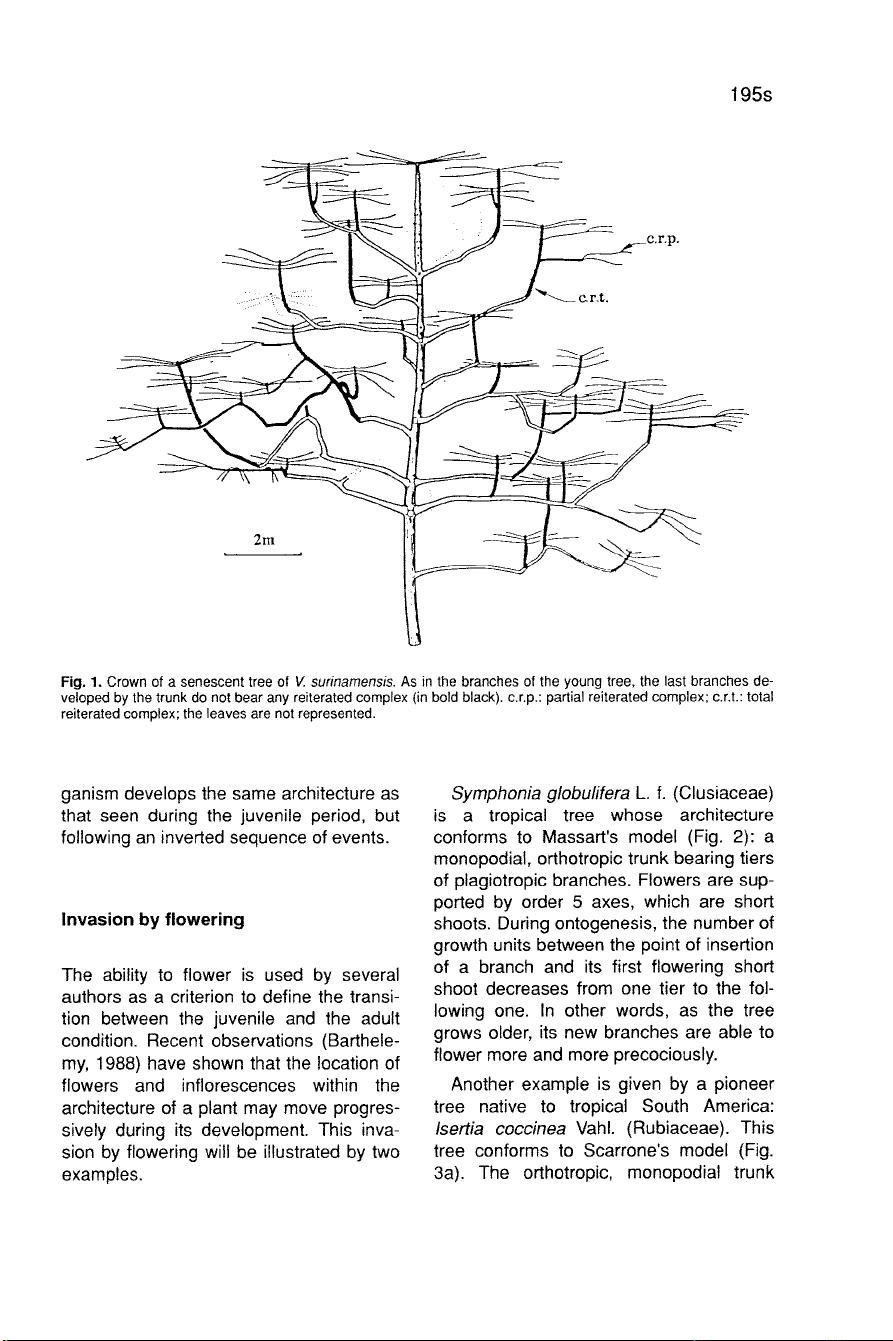
(Fig.
1
).
Thus,
reiteration
seems
to
characterize
a
momentary
and
relatively
short
phase
of
tree
development,
after
which,
the
or-
ganism
develops
the
same
architecture
as
that
seen
during
the
juvenile
period,
but
following
an
inverted
sequence
of
events.
Invasion
by
flowering
The
ability
to
flower
is
used
by
several
authors
as
a
criterion
to
define the
transi-
tion
between
the
juvenile
and
the
adult
condition.
Recent
observations
(Barthele-
my,
1988}
have
shown
that
the
location
of
flowers
and
inflorescences
within
the
architecture
of
a
plant
may
move
progres-
sively
during
its
development.
This
inva-
sion
by
flowering
will
be
illustrated
by
two
examples.
Symphonia
gtobulifera
L.
f.
(Clusiaceae)
is
a
tropical
tree
whose
architecture
conforms
to
Massart’s
model
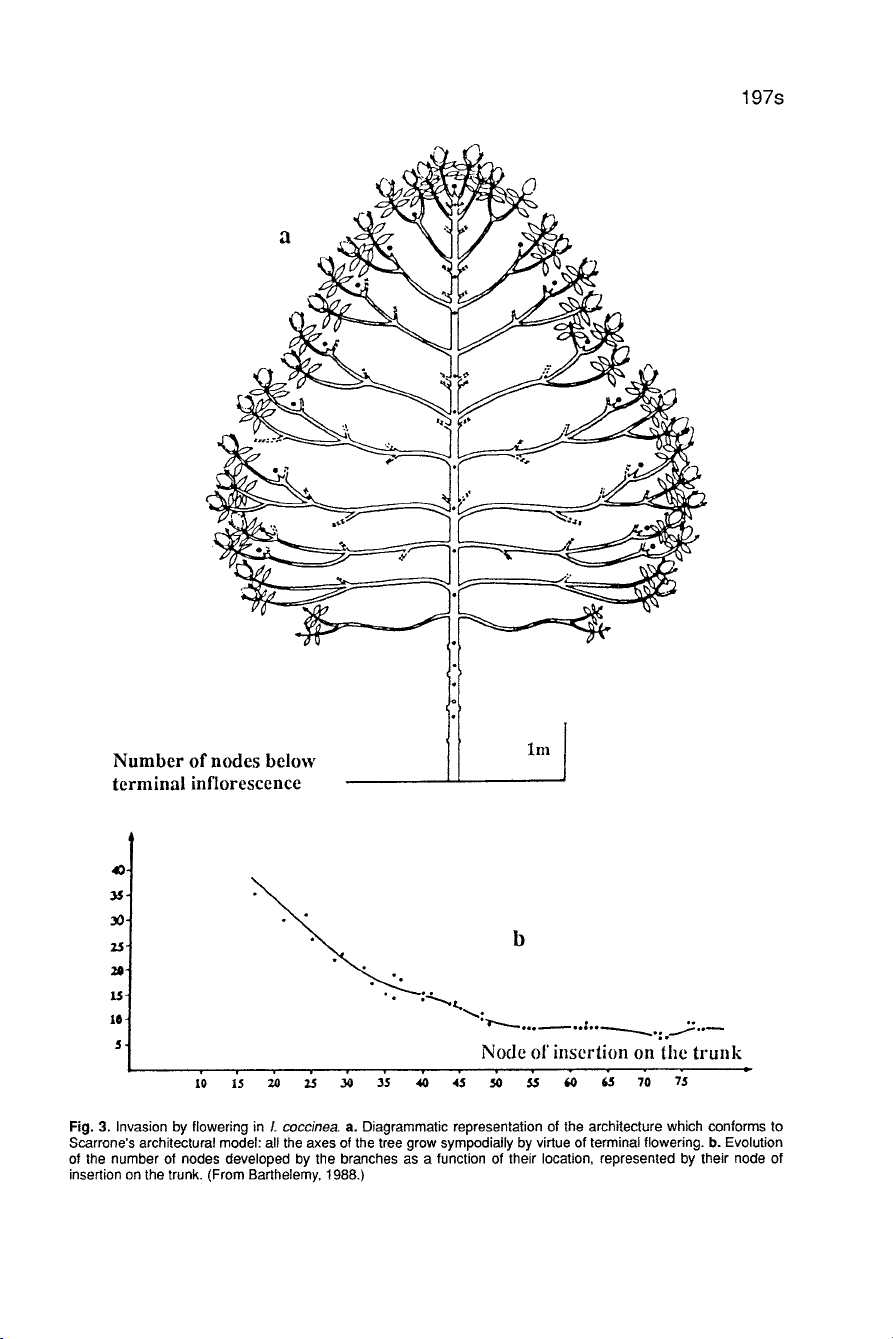
(Fig.
2):
a
monopodial,
orthotropic
trunk
bearing
tiers
of
plagiotropic
branches.
Flowers
are
sup-
ported
by
order
5
axes,
which
are
short
shoots.
During
ontogenesis,
the
number
of
growth
units
between
the
point
of
insertion
of
a
branch
and
its
first
flowering
short
shoot
decreases
from
one
tier
to
the
fol-
lowing
one.
In
other
words,
as
the
tree
grows
older,
its
new
branches
are
able
to
flower
more
and
more
precociously.
Another
example
is
given
by
a
pioneer
tree
native
to
tropical
South
America:
Isertia
coccinea
Vahl.
(Rubiaceae).
This
tree
conforms
to
Scarrone’s
model
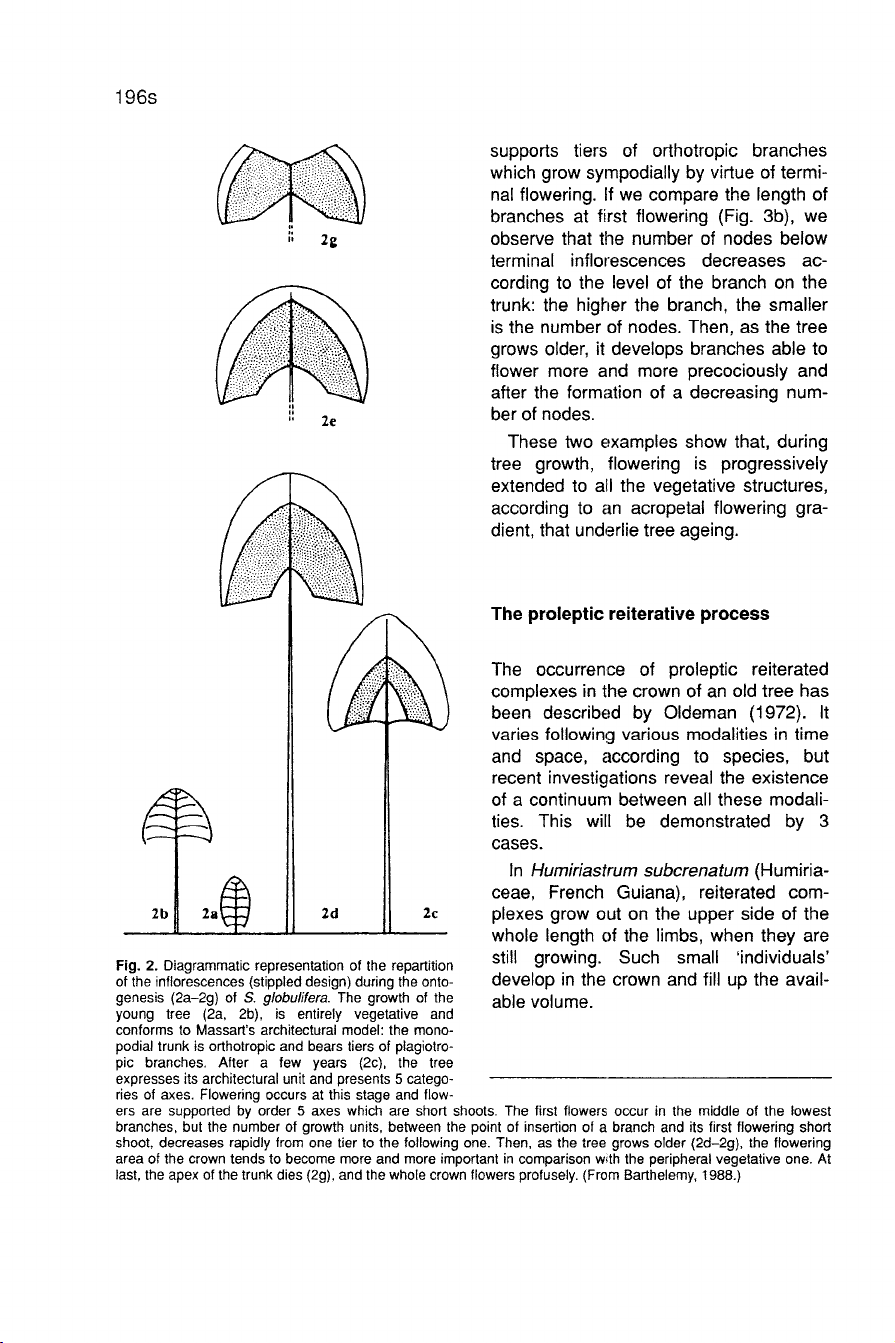
(Fig.
3a).
The
orthotropic,
monopodial
trunk
supports
tiers
of
orthotropic
branches
which
grow
sympodially
by
virtue
of
termi-
nal
flowering.
If
we
compare
the
length
of
branches
at
first
flowering
(Fig.
3b),
we
observe
that
the
number
of
nodes
below
terminal
inflorescences
decreases
ac-
cording
to
the
level
of
the
branch
on
the
trunk:
the
higher
the
branch,
the
smaller
is
the
number
of
nodes.
Then,
as
the
tree
grows
older,
it
develops
branches
able
to
flower
more
and
more
precociously
and
after
the
formation
of
a
decreasing
num-
ber
of
nodes.
These
two
examples
show
that,
during
tree
growth,
flowering
is
progressively
extended
to
all
the
vegetative
structures,
according
to
an
acropetal
flowering
gra-
dient,
that
underlie
tree
ageing.
The
proleptic
reiterative
process
The
occurrence
of
proleptic
reiterated
complexes
in
the
crown
of
an
old
tree
has
been
described
by
Oldeman
(1972).
It
varies
followin!g
various
modalities
in
time
and
space,
according
to
species,
but
recent
investigations
reveal
the
existence
of
a
continuum
between
all
these
modali-
ties.
This
will
be
demonstrated
by
3
cases.
In
Humiriastrum
subcrenatum
(Humiria-
ceae,
French
Guiana),
reiterated
com-
plexes
grow
out
on
the
upper
side
of
the
whole
length
of
the
limbs,
when
they
are
still
growing.
Such
small
’individuals’
develop
in
the
crown
and
fill
up
the
avail-
able
volume.
In
Qualea
rosea
Aubl.
(Vochysiaceae,
French
Guiana)
the
proleptic
reiterated
complexes
occur
only
at
the
base
of
the
limbs,
near
the
trunk,
when
the
crown
has
completed
its
development
and
is
going
to
die.
The
simultaneous
and
probably
coor-
dinated
development
of
the
reiterated
complexes
leads
to
the
building
up
of
a
new
homogeneous
crown
which
replaces
the
former
one.
In
Eperua
falcata
Aubl.
(Caesalpinia-
ceae,
French
Guiana),
the
reiterated
com-
plexes,
also
appear
at
the
base
of
the
main
branches
and
when
the
crown
begins
to
lose
its
limbs,
but
their
develop-
ment
is
very
delayed
in
space
and
time:
the
first
complexes
occur
at
the
top
of
the
crown,
the
following
ones
half-way
on
the
trunk,
and
the
last
ones,
some
years
be-
fore
the
tree
dies,
develop
near
the
base
of the bole.
Each
of
these
species
develops
nu-
merous
proleptic
reiterated
complexes
when
ageing,
but
it
is
clear
that
crown
architecture
of
the
old
tree
evolves
in
diffe-
rent
directions
according
to
complex
loca-
tion
and
the
mument
of
their
appearance:
it
can
lead
to
a
reinforcement
of
the
crown,
to
a
lowering
of
the
crown
or
to
its
complete
replacement.
Conclusion
The
reversion
to
a
juvenile-like
architec-
ture,
the
invasion
of
the
vegetative
struc-
tures
by
flowering
and
the
development
of
proleptic
reiterated
complexes
are
mor-
phogenetic
events
which
occur
simulta-
neously
and
progressively,
according
to
a
sequence
that
is
specific
to
each
species.
They
lead
us
to
distinguish
numerous
growth
stages
which
punctuate
tree
ageing.
In
return,
the
knowledge
of
these
stages
enables
us
to
determine
with
very
high
precision
the
true
physiological
states
reached
by
an
old
tree,
and
these
events
can
be
used
as
markers
of
tree
ageing
and
senescence.
Acknowledgments
This
research
has
been
financially
supported
by
the
CNRS
(ATP
’Physiologie
de
la
croissance
et
du
développement
des
v6g6taux
ligneux’).
References
Barthelemy
D.
(1 (88)
Architecture
et
sexualit6
chez
quelques
plantes
tropicales:
le
concept
de
floraison
automatique.
Ph.D.
Thesis,
Universite
Montpellier II,
France
Edelin
C.
(1977)
Images
de
I’architecture
des
conif6res.
Ph.D.
Thesis,
Université
Montpellier
II,
France
Halle
F.,
Oldeman
R.A.A.
&
Tomlinson
P.B.
(1978)
In:
Tropical’
Trees
and
Forests.
Springer-
Verlag,
Berlin,
pp.
441
Oldeman
R.A.A.
(1972)
L’architecture
de
la
foret
guyanaise.
Ph.D.
Thesis,
Université
Mont-
pellier
II,
France
Schaffalitzky
de
Muckadell
M.
(1959)
Investiga-
tions
on
ageing
of
apical
meristems
in
woody
plants
and
its
importance
in
sylviculture.
Forsti.
Forsoegsvaes.
Dan.
25,
310-455


%20--%3e%3cdefs%3e%3cstyle%3e%20.st0%20{%20fill:%20%23fff;%20}%20.st1%20{%20fill:%20%237800fa;%20}%20%3c/style%3e%3c/defs%3e%3cpath%20class='st1'%20d='M117.78,12.18H43.11c2.9,3.47,4.65,7.94,4.65,12.82,0,5.6-2.3,10.66-6.01,14.29h76.02l7.22-13.56-7.22-13.56Z'/%3e%3cg%3e%3cpath%20class='st0'%20d='M53.58,26.17h-.59v-1.46h.59v-4.96h2.83c1.78,0,2.67.94,2.67,2.82v5.76c0,1.87-.89,2.81-2.67,2.81h-2.83v-4.96ZM55.36,21.37v3.34h1.1v1.46h-1.1v3.34h1.01c.61,0,.91-.37.91-1.1v-5.93c0-.74-.3-1.1-.91-1.1h-1.01Z'/%3e%3cpath%20class='st0'%20d='M65.99,31.14h-1.8l-.31-2.07h-2.19l-.31,2.07h-1.64l1.82-11.39h2.62l1.82,11.39ZM65.28,18.04c-.25.46-.51.77-.75.94-.21.15-.47.22-.79.22-.26,0-.57-.07-.92-.22l-.38-.15c-.14-.05-.26-.07-.37-.07-.3,0-.53.18-.71.54l-.91-.68c.25-.46.51-.77.75-.94.21-.14.48-.21.79-.21.26,0,.57.07.92.21l.38.15c.14.05.26.07.37.07.3,0,.53-.18.71-.54l.91.68ZM61.91,27.52h1.73l-.87-5.76-.87,5.76Z'/%3e%3cpath%20class='st0'%20d='M74.53,26.89v1.52c0,1.91-.89,2.86-2.67,2.86s-2.67-.95-2.67-2.86v-5.93c0-1.91.89-2.86,2.67-2.86s2.67.95,2.67,2.86v1.11h-1.69v-1.22c0-.75-.31-1.12-.93-1.12s-.93.37-.93,1.12v6.15c0,.74.31,1.11.93,1.11s.93-.37.93-1.11v-1.63h1.69Z'/%3e%3cpath%20class='st0'%20d='M81.4,31.14h-1.8l-.31-2.07h-2.19l-.31,2.07h-1.64l1.82-11.39h2.62l1.82,11.39ZM75.9,19.2l1.52-1.91h1.71l1.51,1.91h-1.61l-.76-.95-.75.95h-1.61ZM77.32,27.52h1.73l-.87-5.76-.87,5.76ZM83.1,15.99l-1.76,1.91h-1.26l1.17-1.91h1.86Z'/%3e%3cpath%20class='st0'%20d='M84.86,19.75c1.78,0,2.67.94,2.67,2.82v1.48c0,1.87-.89,2.81-2.67,2.81h-.85v4.28h-1.79v-11.39h2.64ZM84.01,21.37v3.86h.85c.58,0,.87-.36.87-1.08v-1.71c0-.71-.29-1.07-.87-1.07h-.85Z'/%3e%3cpath%20class='st0'%20d='M93.51,19.75c1.78,0,2.67.94,2.67,2.82v1.48c0,1.87-.89,2.81-2.67,2.81h-.85v4.28h-1.79v-11.39h2.64ZM92.66,21.37v3.86h.85c.58,0,.87-.36.87-1.08v-1.71c0-.71-.29-1.07-.87-1.07h-.85Z'/%3e%3cpath%20class='st0'%20d='M98.8,31.14h-1.79v-11.39h1.79v4.88h2.03v-4.88h1.83v11.39h-1.83v-4.88h-2.03v4.88Z'/%3e%3cpath%20class='st0'%20d='M105.36,24.55h2.46v1.62h-2.46v3.34h3.09v1.63h-4.88v-11.39h4.88v1.63h-3.09v3.18ZM108.17,17.29l-1.76,1.91h-1.26l1.17-1.91h1.86Z'/%3e%3cpath%20class='st0'%20d='M112.2,19.75c1.78,0,2.67.94,2.67,2.82v1.48c0,1.87-.89,2.81-2.67,2.81h-.85v4.28h-1.79v-11.39h2.64ZM111.35,21.37v3.86h.85c.58,0,.87-.36.87-1.08v-1.71c0-.71-.29-1.07-.87-1.07h-.85Z'/%3e%3c/g%3e%3ccircle%20class='st1'%20cx='25'%20cy='25'%20r='20'/%3e%3cpath%20class='st0'%20d='M32.78,19.27c2.92,0,4.43,2.55,5.28,5.33l.71,2.17c.14.38-.33.75-.71.75h-5.61c.19-.33.24-.71.09-1.08l-.75-2.45c-.43-1.32-.99-2.64-1.79-3.77.75-.57,1.65-.94,2.78-.94h0ZM25,18.38c3.25,0,4.9,2.78,5.89,5.89l.76,2.45c.14.42-.33.8-.8.8h-11.69c-.42,0-.94-.38-.8-.8l.75-2.45c.99-3.11,2.64-5.89,5.89-5.89h0ZM25,11.35c1.74,0,3.11,1.37,3.11,3.11s-1.37,3.11-3.11,3.11-3.11-1.41-3.11-3.11,1.41-3.11,3.11-3.11h0ZM17.27,19.27c1.08,0,1.98.38,2.73.94-.8,1.13-1.37,2.45-1.74,3.77l-.8,2.45c-.14.38-.05.75.09,1.08h-5.56c-.42,0-.9-.38-.75-.75l.71-2.17c.9-2.78,2.41-5.33,5.33-5.33h0ZM17.27,12.91c1.51,0,2.78,1.27,2.78,2.83s-1.27,2.83-2.78,2.83-2.83-1.27-2.83-2.83,1.27-2.83,2.83-2.83h0ZM32.78,12.91c1.56,0,2.78,1.27,2.78,2.83s-1.23,2.83-2.78,2.83-2.83-1.27-2.83-2.83,1.27-2.83,2.83-2.83h0ZM27.07,28.56v.09c0,.57-.24,1.08-.61,1.46h0v.05c-.38.33-.9.57-1.46.57s-1.08-.24-1.46-.61h0c-.38-.38-.61-.9-.61-1.46v-.09h1.41v.09c0,.19.05.38.19.47v.05c.09.09.28.19.47.19s.38-.09.47-.19v-.05c.14-.09.24-.28.24-.47t-.05-.09h1.41ZM30.99,28.56v.09c0,1.65-.66,3.16-1.74,4.24-1.08,1.08-2.59,1.79-4.24,1.79s-3.16-.71-4.24-1.79l-.05-.05c-1.04-1.08-1.7-2.55-1.7-4.2v-.09h1.41v.09c0,1.27.47,2.4,1.27,3.25h.05c.85.85,1.98,1.37,3.25,1.37s2.4-.52,3.25-1.37c.85-.8,1.37-1.98,1.37-3.25v-.09h1.37ZM34.99,28.56v.09c0,2.78-1.13,5.28-2.92,7.07-1.79,1.79-4.29,2.92-7.07,2.92s-5.23-1.13-7.07-2.92c-1.79-1.79-2.92-4.29-2.92-7.07v-.09h1.41v.09c0,2.4.94,4.53,2.5,6.08,1.56,1.56,3.72,2.5,6.08,2.5s4.52-.94,6.08-2.5c1.56-1.56,2.5-3.68,2.5-6.08v-.09h1.41Z'/%3e%3c/svg%3e)