Open Access
Available online http://ccforum.com/content/9/4/R323
R323
Vol 9 No 4
Research
Time course of endothelial damage in septic shock: prediction of
outcome
Ortrud Vargas Hein, Klaudia Misterek, Jan-Peer Tessmann, Vera van Dossow, Michael Krimphove
and Claudia Spies
Department of Anesthesiology and Intensive Care, University Hospital Charité, Campus Mitte, Berlin, Germany
Corresponding author: Claudia Spies, claudia.spies@charite.de
Received: 7 Nov 2004 Revisions requested: 9 Jan 2005 Revisions received: 29 Mar 2005 Accepted: 7 Apr 2005 Published: 13 May 2005
Critical Care 2005, 9:R323-R330 (DOI 10.1186/cc3532)
This article is online at: http://ccforum.com/content/9/4/R323
© 2005 Vargas Hein et al, licensee BioMed Central Ltd.
This is an Open Access article distributed under the terms of the Creative Commons Attribution License (http://creativecommons.org/licenses/by/
2.0), which permits unrestricted use, distribution, and reproduction in any medium, provided the original work is cited.
Abstract
Introduction Endothelial damage accounts greatly for the high
mortality in septic shock. Higher expression of mediators (IL-6,
IL-8, soluble intercellular adhesion molecule 1 [sICAM-1],
soluble endothelial-linked adhesion molecule 1 [sELAM-1]) have
been described for non-survivors in comparison with survivors.
We investigated the predictive value of the mediators IL-6, IL-8,
sELAM-1 and sICAM-1 and their time course in intensive care
unit patients who developed septic shock with respect to
outcome.
Materials and methods We measured serum levels of IL-6, IL-
8, sELAM-1 and sICAM-1 in 40 intensive care unit patients who
developed septic shock. Measurements were performed until
death or until resolution of septic shock. Clinical and laboratory
data were also recorded.
Results After 48 hours the levels of sELAM-1 and sICAM-1
increased in non-survivors and decreased in survivors. sELAM-
1 was predictive for outcome on the third day (P = 0.02) and the
fourth day (P = 0.02) after diagnosis of septic shock. This
difference in the time course between survivors and non-
survivors occurred 7 days before death of the patients (median,
10 days). sICAM-1 levels increased significantly in non-survivors
over the study period (P < 0.001). sELAM-1 (P = 0.04), IL-6 (P
= 0.04) and IL-8 (P = 0.008) were significantly higher in non-
survivors over the whole study period. The age and
norepinephrine dose >0.5 µg/kg/min were significantly different
between the groups.
Conclusion sELAM-1 showed a markedly opposing course
after 48 hours of septic shock. This adhesion molecule may be
a useful early predictor of disease severity in the course of septic
shock after early initial treatment of the patients, and might
suggest considering endothelial-restoring therapy.
Introduction
Endothelial damage accounts for much of the pathology of
sepsis, resulting in capillary leak, hypotension, microvascular
thrombosis with consecutive tissue hypoxia and, finally, multi-
ple organ failure (MOF) and lethal outcome [1-3]. Endothelial
damage is worsened in septic shock [4]. The mortality of sep-
tic shock is higher than the mortality in sepsis (35–60% versus
20–40%) [4,5]. The release of cytokines (IL-6, IL-8) and adhe-
sion molecules (soluble endothelial-linked adhesion molecule
1 [sELAM-1], soluble intercellular adhesion molecule 1
[sICAM-1]) has been shown to correlate well with endothelial
damage in an experimental setting – especially for sELAM-I,
which is specific for endothelial tissue [2,6,7]. Although the
release of these mediators is not only sepsis related, the levels
are significantly higher in sepsis and in septic shock than after
trauma, postoperatively or after myocardial infarction [8-12]. In
addition, these mediators have higher levels in non-survivors
than in survivors, and the baseline levels have been correlated
with outcome [2,3,8,10-15].
The time of admission to the study and the onset of therapy are
of major relevance for outcome, however, as shown by Rivers
and colleagues in the early goal-directed therapy study in
severe sepsis and septic shock patients [16]. As early clinical
intervention improves outcome and as there are increasing lev-
els of cytokines in non-survivors, in comparison with a
AUC = area under the receiver operating characteristics curve; ECG = electrocardiogram; ICU = intensive care unit; IL = interleukin; MOF = multiple
organ failure; sELAM-1 = soluble endothelial-linked adhesion molecule 1; sICAM-1 = soluble intercellular adhesion molecule 1.

Critical Care Vol 9 No 4 Hein et al.
R324
decrease in survivors, differences in the mediator time course
between survivors and non-survivors after early onset of ther-
apy could be predictive for the outcome and for trend-setting
for further therapy measures [10,11,15,17-19].
We investigated the predictive value of the mediators IL-6, IL-
8, sELAM-1 and sICAM-1 and their time course, as primary
outcome measures, in intensive care unit (ICU) patients who
developed septic shock with respect to outcome. In addition,
IL-8 as an early chemoattractant cytokine and IL-6 as an
inflammatory tissue damage marker were investigated. Clinical
data, such as age, the use of hemodynamically active sub-
stances and myocardial ischemia, were investigated as sec-
ondary outcome measures.
Materials and methods
Patients
After ethical committee approval and written informed consent
from the legal representatives, 42 patients suffering from sep-
tic shock were enrolled in this observational study. Two
patients had to be excluded after enrollment because of immi-
nent surgery, so 40 patients completed the study. All patients
fulfilled the clinical and laboratory criteria of septic shock as
outlined in the 1992 Consensus Conference [20]. Exclusion
criteria were age <18 years, pregnancy, patients who have
had surgery within 48 hours before inclusion and patients who
have had cardiac surgery and neurosurgery. Patients with an
acute history of severe cardiac insufficiency (New York Heart
Association class III-IV) [21] and coronary artery disease
before the development of septic shock were also excluded
[22].
Monitoring and management
The study was initiated in the first 24 hours after septic shock
had been diagnosed. All patients were already admitted to the
ICU and were under ICU standard therapy and monitoring
[23]. All patients received analgesia, sedation and mechanical
ventilation. The patients were screened twice a day. The study
ended in the case of death or in resolution of septic shock.
A fiber optic pulmonary artery flotation catheter (Baxter Swan-
Ganz® Intelicath™ continuous cardiac output thermodilution
catheter 139H, 7.5 Fr; Baxter/Edwards Critical-Care, Irvine,
CA, USA) and a radial artery catheter were inserted as part of
the routine for continuous cardiovascular monitoring in septic
shock. Hemodynamic measurements were recorded at study
entry and every 8 hours during the study. Fluids were given to
achieve an optimal left atrial pressure. After adequate fluid
resuscitation, norepinephrine (maximum 4.0 µg/kg/min) was
titrated to maintain a mean arterial pressure >70 mmHg. Cat-
echolamine therapy in the case of low-output failure was per-
formed primarily with dobutamine (maximum 20 µg/kg/min) or
dopamine (maximum 10 µg/kg/min) at the discretion of the
physician on duty. Enoximone (maximum 10 µg/kg/min) was
added if low-output failure persisted, and then epinephrine
infusion (maximum 2.0 µg/kg/min) was initiated if low-output
failure remained. The target value was a cardiac index >3.0 l/
min/m2. The amount of different positive inotropic substances
was expressed as the number used in each group.
A 12-lead Holter electrocardiogram (ECG) was recorded
every 8 hours to determine possible myocardial ischemia,
defined by Spies and colleagues [22]. The oxygenation index
was calculated as the quotient of partial arterial oxygen pres-
sure and the inspired oxygen fraction (mmHg).
Group assignment
It was decided a priori to assign patients to the survivors group
when they were discharged from the ICU to a regular ward.
Those patients who died due to septic shock were assigned
to the non-survivors group. Patients who died from a cause
other than septic shock and consecutive MOF during their ICU
stay were excluded from the study.
Laboratory data
Blood gas analysis was performed every 8 hours to determine
the levels of hematrocrit and hemoglobin, and the arterial par-
tial oxygen pressure (ABL 500; Radiometer, Copenhagen,
Denmark).
Creatin kinase and the creatin kinase-myocardial bands were
determined every 8 hours (BM/Hitachi 717 analyser; Boe-
hringer Mannhein, Inc., Mannheim, Germany). The creatin
kinase/creatin kinase-myocardial band fraction was calculated
and a result >6% was recorded positive for myocardial
ischemia [22]. Blood samples for the determination of IL-6
concentrations (Enzymeimmunoassay [Milenia®]; DPC Bier-
mann GmbH, Bad Nauheim, Germany), of IL-8 concentrations
(Enzymeimmunoassay [Milenia®]; DPC Biermann GmbH), of
sICAM-1 concentrations (enzyme immunoassay kit BBE 1b;
R&D Systems, Minneapolis, MN, USA), of sELAM-1 concen-
trations (enzyme immunoassay kit BBE 2b; R&D Systems) and
of troponin T concentrations (enzyme-linked immunosorbent
assay Enzymun-Test™ batch ELISA ES 300 analyser; Boe-
hringer Mannheim Inc.) were withdrawn every 8 hours and
were centrifuged, and the plasma was stored at -80°C until
analysis.
Statistical analysis
Data are expressed as the median and range. Intergroup sta-
tistical analysis for determined time intervals was performed
using the Mann–Whitney U test for continuous variables and
using the Pearson chi-square test for dichotomous variables.
Intragroup statistical analysis for the determined time intervals
was performed with the Wilcoxon matched-pairs signed-rank
sum test. For intergroup and intragroup analysis over the
whole study period, the two-factorial non-parametric (analysis
of variance)-type rank variance analysis for longitudinal data
and small sample sizes using the SAS System software (SAS
Institute Inc., Cary, NC, USA) was used. Variables that were

Available online http://ccforum.com/content/9/4/R323
R325
significantly different between groups were analysed as pre-
dictors for outcome (group variable, survivor/non-survivor),
determining the area under the receiver operating characteris-
tics curve (AUC). The AUC, the P value and the 95% confi-
dence intervals are stated. P < 0.05 was considered
statistically significant.
Results
Forty patients were included in the study and 16 (40%)
patients were discharged from the ICU to a normal ward.
Twenty-four (60%) patients died due to septic shock. Patients
in the non-survivor group were significantly older and stayed a
significantly shorter time in the ICU than the survivors (Table
1). Survivors had a significantly higher rate of pneumonia as
the sepsis focus whereas non-survivors had a significantly
higher rate of peritonitis as the focus (Table 1). The Acute
Physiology and Chronic Health Evaluation III baseline score
and the Acute Physiology and Chronic Health Evaluation III
maximum score did not significantly differ between the groups
(Table 1). All patients required norepinephrine therapy but sig-
nificantly more non-survivors than survivors required nore-
phinephrine infusion >0.5 µg/kg/min (Table 2). The number of
positive inotropic agents necessary and the markers for myo-
cardial ischemia (monitored by ECG), for creatin kinase/crea-
tin kinase-myocardial band fraction >6% and for troponin T
were not significantly different between survivors and non-sur-
vivors (Table 2).
Intergroup analysis of variance between survivors and non-sur-
vivors showed significantly higher levels for IL-6 (P = 0.04), for
IL-8 (P = 0.008) and for sELAM-1 (P = 0.04) in the non-survi-
vors group. sICAM-1 (P = 0.25) was not significantly higher in
levels in the non-survivors group. The intragroup analysis for
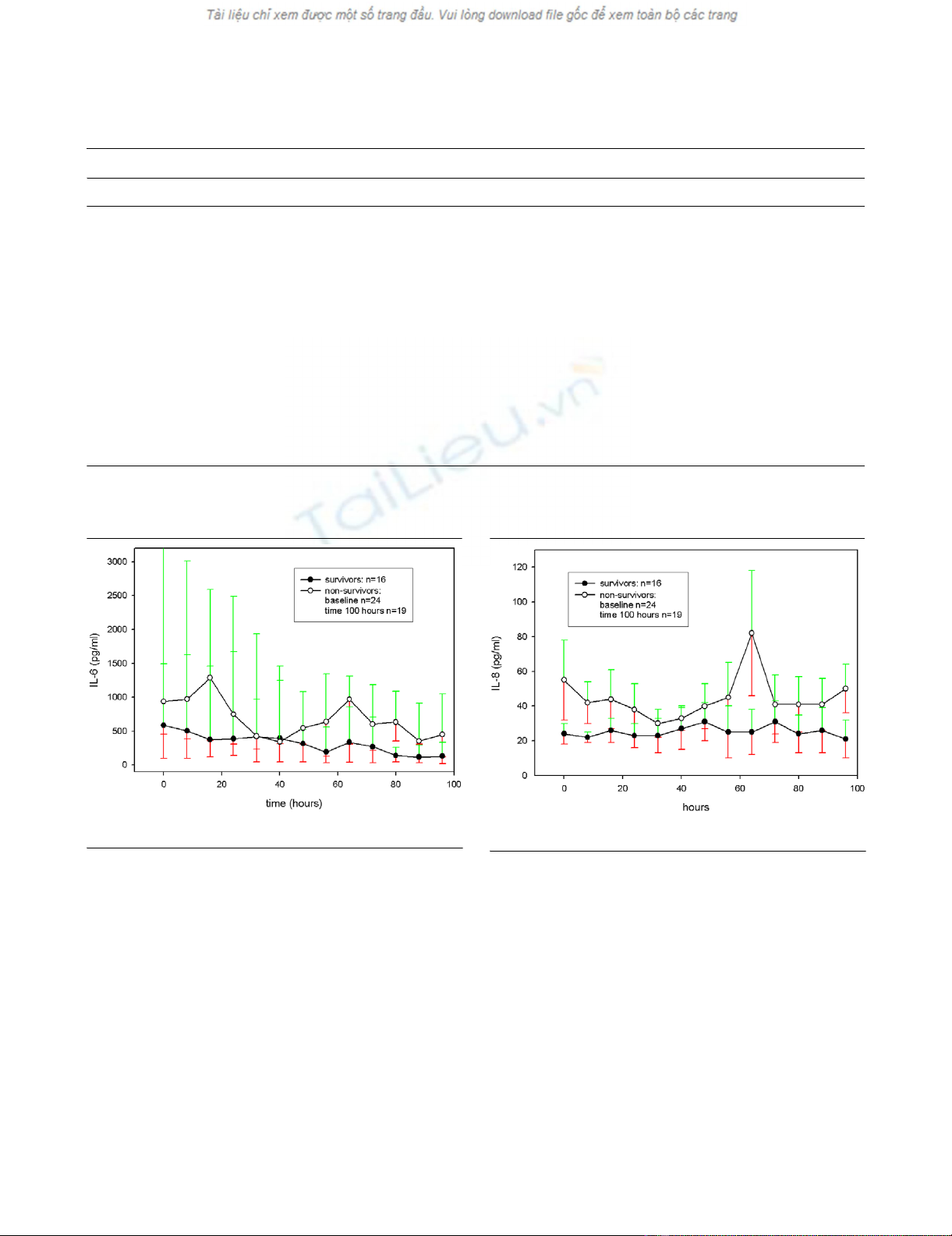
IL-6 showed a significant decline between the first value and
the last value (before discharge from the study or death) for
survivors (P = 0.002) and non-survivors (P = 0.04) (Fig. 1).
The intragroup analysis for IL-8 between the first value and the
last value (before discharge from the study or death) was not
significantly different in both groups (survivors, P = 0.17; non-
survivors, P = 0.78) (Fig. 2).
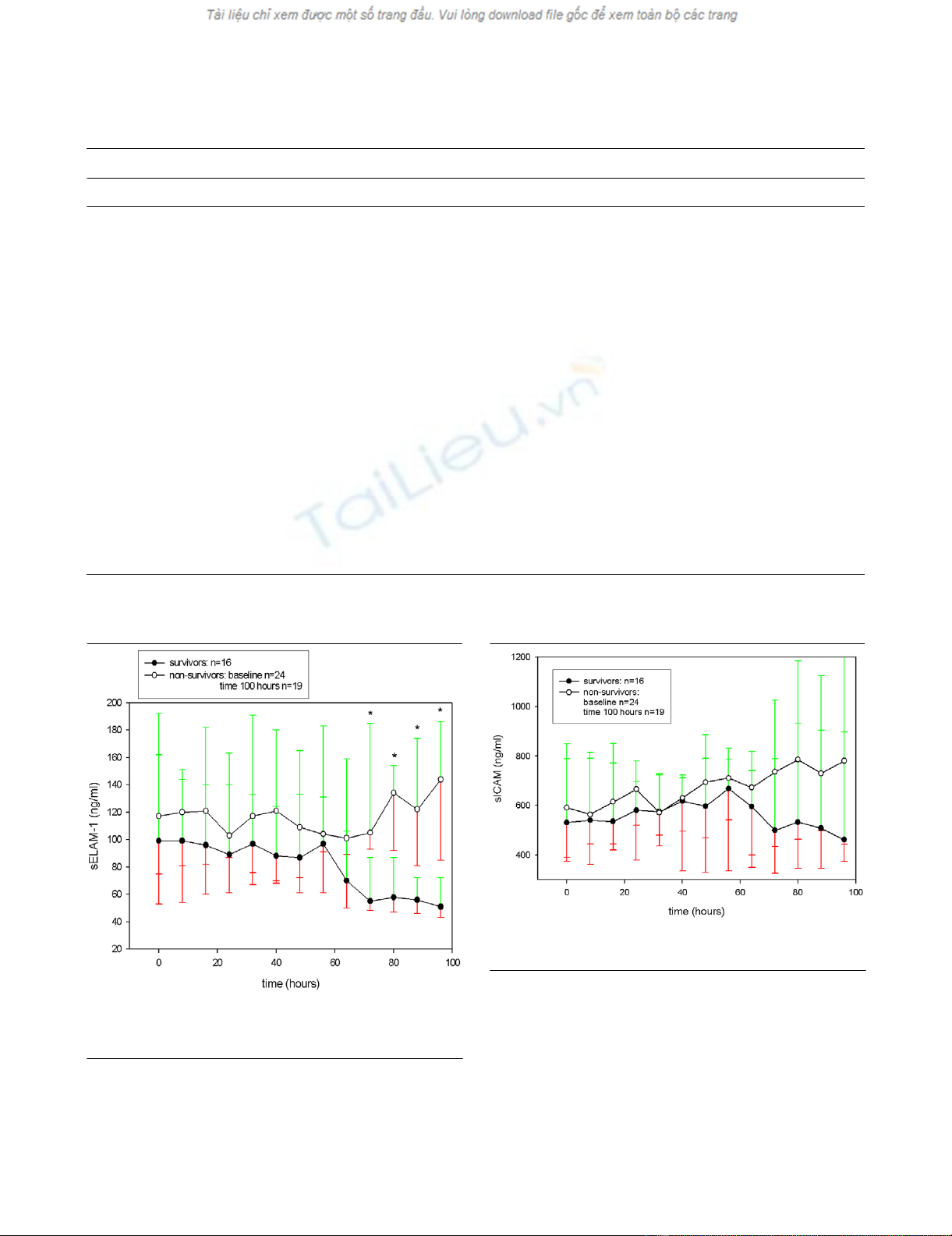
After a comparable course in the first 2 days, non-survivors
showed an increase in median values of sELAM-1 and sICAM-
1 whereas survivors' adhesion molecule levels decreased
markedly (Figs 3 and 4). This increase was significant for
sICAM-1 in the non-survivor group when comparing the first
value with last value before discharge from the study or death
of the patients (P < 0.001) (Fig. 4). The marked decline of
median values for sELAM-1 in the survivor group was signifi-
cant in the comparison of the first time point with the last time
point before discharge from the study or death (P = 0.04) (Fig.
3). When comparing survivors and non-survivors at single time
points, sELAM-1 was significantly higher in non-survivors from
the third day onwards (P = 0.02) (Fig. 3).
The AUC values for baseline, the third day and the fourth day
measurements of IL-6, IL-8, sELAM-1 and sICAM-1 are pre-
sented in Table 3. IL-8 was most predictive for outcome at
baseline, and sELAM-1 most predictive on the third and fourth
days (Table 3). The AUC for age (AUC, 0.761; P = 0.01; 95%
Table 1
Baseline and outcome data
Survivors (n = 16, 40%) Non-survivors (n = 24, 60%) P*
Age (years) 59 (28–82) 65 (33–86) 0.03
Sex (male/female) 11/5 11/13 0.15
Intensive care unit stay (days) 27 (11–48) 8 (2–57) <0.01
Sepsis focus (n)
Pneumonia 9 4 0.02
Peritonitis 2 13 0.04
Wound infection 3 4 >0.99
Abscess 2 3 >0.99
Hemoglobin (g/dl) 10 (7–14) 11 (7–13) 0.61
Oxygenation index (mmHg) 245 (114–421) 199 (89–384) 0.44
APACHE III baseline score 55 (23–88) 61 (12–100) 0.91
APACHE III maximum score 75 (52–108) 86 (52–117) 0.47
MODS baseline 6 (2–11) 7 (2–12) 0.36
MODS max 9 (5–15) 9 (4–14) 0.73
Data presented as median (range). APACHE, Acute Physiology and Chronic Health Evaluation; MODS, multiple organ dysfunction syndrome.
*P value for intergroup baseline and outcome data: Mann–Whitney U test, and Pearson chi-square and Fisher exact tests, respectively.
Critical Care Vol 9 No 4 Hein et al.
R326
confidence interval, 0.624–0.898) and that for median nore-
pinephrine dosage (AUC, 0.766; P = 0.001; 95% confidence
interval, 0.636–0.896) were also significantly predictive for
outcome.
Discussion
The most important finding in this study was the different time
courses of the markers of endothelial damage (sELAM-1 and
sICAM-1) after the second day in survivors and non-survivors
of septic shock. After a comparable course at different levels
in the first 2 days, non-survivors had an increase in adhesion
molecule concentrations whereas survivors' adhesion mole-
cule levels decreased markedly. SELAM-1 was predictive for
outcome on the third and fourth days after the diagnosis of
septic shock. This difference in time courses between survi-
vors and non-survivors was evident on the third day and, there-
fore, far before death of the patients (median, 10 days).
Endothelial damage accounts for much of the pathology of
septic shock, resulting finally in MOF and lethal outcome [1-3].
sELAM-1 is specific for endothelial tissue [2,7]. The latter
marker and sICAM-1 have been shown to be significantly ele-
vated at baseline and inconsistent in levels over the whole
study period in sepsis, in comparison with trauma patients or
critically ill patients without sepsis [2,3,8-12]. The levels of
adhesion molecules in septic shock patients have been
described as markedly elevated at baseline in comparison with
septic patients without shock [10,12,24]. In addition, sELAM-
1 and sICAM-1 have been shown to be markedly elevated at
Table 2
Clinical and laboratory data
Survivors (n = 16, 40%) Non-survivors (n = 24, 60%) P*
Norepinephrine (n) 16 (100%) 24 (100%)
Norepinephrine >0.5 µg/kg/min mean values (n)8 22 <0.01
Number of + inotropic medications (dobutamine or
dopamine, enoximone and epinephrine) (n)
0.79
036
1911
246
301
Myocardial ischemia signs in electrocardiogram (n)12 15 0.41
Troponin T >0.2 (ng/ml) 5 7 0.89
CK/CK-MB fraction >6% 1 0 0.22
Data presented as median (range). CK/CK-MB, creatin kinase/creatin kinase-myoglobin band.
*P value for intergroup data analysis: Pearson chi-square and Fisher exact tests.
Figure 1
IL-6 for survivors and non-survivors over timeIL-6 for survivors and non-survivors over time.
Figure 2
IL-8 for survivors and non-survivors over timeIL-8 for survivors and non-survivors over time.
Available online http://ccforum.com/content/9/4/R323
R327
baseline in non-survivors in comparison with survivors, as
shown in the present study [2,8,10-12,24].
In the present study, non-survivors (in comparison with survi-
vors) showed elevated adhesion molecule levels over the
whole study period. After a comparable time course at differ-
ent levels over the first 48 hours, the endothelial mediator lev-
els increased in non-survivors and decreased in survivors.
Table 3
Predictive parameters determined by the area under the receiver operating characteristics curve (AUC)
Time point AUC 95% confidence interval P
Baseline
IL-8 0.777 0.619–0.935 0.004
IL-6 0.648 0.462–0.834 0.14
sELAM-1 0.600 0.400–0.800 0.30
sICAM-1 0.548 0.360–0.735 0.622
Third day
IL-8 0.133 0.402–0.923 0.25
IL-6 0.727 0.501–0.953 0.087
sELAM-1 0.808 0.599–1.017 0.02
sICAM-1 0.677 0.427–0.927 0.18
Fourth day
IL-8 0.775 0.529–1.021 0.05
IL-6 0.737 0.504–0.971 0.09
sELAM-1 0.847 0.631–1.064 0.02
sICAM-1 0.694 0.433–0.956 0.18
sELAM-1, soluble endothelial-linked adhesion molecule 1; sICAM-1, soluble intercellular adhesion molecule 1.
Figure 3
Soluble endothelial-linked adhesion molecule 1 (sELAM-1) for survivors and non-survivors over timeSoluble endothelial-linked adhesion molecule 1 (sELAM-1) for survivors
and non-survivors over time. * Significant difference (P < 0.05) for
sELAM-1 between survivors and non-survivors.
Figure 4
Soluble intercellular adhesion molecule 1 (sICAM-1) for survivors and non-survivors over timeSoluble intercellular adhesion molecule 1 (sICAM-1) for survivors and
non-survivors over time.


![Báo cáo seminar chuyên ngành Công nghệ hóa học và thực phẩm [Mới nhất]](https://cdn.tailieu.vn/images/document/thumbnail/2025/20250711/hienkelvinzoi@gmail.com/135x160/47051752458701.jpg)