
Original
article
Daily
and
seasonal
variation
of
stem
radius
in
oak
Fedör
Tatarinov
a
Jan
&jadnr;ermák
b
a
Institute
of
Problems
of
Ecology
and
Evolution
of
Russian
Ac.Sci.,
Moscow,
Russia
b
Institute
of
Forest
Ecology,
Mendel
University
of
Agriculture
and
Forestry,
Brno,
Czech
Republic
(Received
10
February
1998 ;
accepted
21
June
1999)
Abstract -
Seasonal
and
diurnal
variation
of
stem
radius
and
sap
flow
in
large
pedunculate
oaks
(Quercus
robur
L.)
as
dependent
on
environmental
factors
was
studied
in
the
floodplain
forest
in
southern
Moravia
from
April
to
October
several
years
after
cessation
of
regular
natural
floods.
Two
main
processes
as
driving
variables
of
stem
radius
were
considered
separately:
growth
of
plant
tissues
and
their
hydration
(i.e.
shrinking
and
swelling).
Different
types
of
diurnal
dynamics
of
stem
radius
occurred
including
growth
with
and
without
shrinkage,
growth
at
night
and
shrinkage during
daytime
and
vice
versa.
A
simple
physiological
model
was
applied
to
describe
the
dynamics
of
stem
radius.
Data
on
sap
flow,
global
radiation
and
air
temperature
were
used
as
model
input.
Net
growth
was
simulated
by
means
of
photosynthesis
and
respiration,
calculated
for
real
meteorological
conditions
and
tissue
hydration
was
derived
from
the
difference
between
potential
and
real
transpiration
(sap
flow).
Simulation
showed
good
approximation
of
seasonal
dynamics
of
stem
radius
by
the
model
under
mild
weather
conditions
and
mostly
non-limiting
soil
moisture.
©
1999
Éditions
scien-
tifiques
et
médicales
Elsevier
SAS.
Quercus
robur
/
radial
growth
/
sap
flow
/
simulation
modelling
/
floodplain
forest
Résumé -
Variation
journalière
et
saisonnière
du
rayon
du
tronc
du
chêne
pédonculé.
La
variation
journalière
et
saisonnière
du
rayon
du
tronc
du
chêne
pédonculé
(Quercus
robur
L.)
a
été
étudiée
en
dépendance
des
facteurs
environnementaux
dans
une
forêt
marécageuse
en
Moravie
du
sud
d’avril
à
octobre,
plusieurs
années
après
le
fin
des
inondations
naturelles
régulières.
Les
deux
princi-
paux
processus
généraux
qui
contrôlent
le
rayon
du
tronc
ont
été
étudiés
séparément :
la
croissance
des
tissus
de
l’arbre
et
leur
hydratation
(contraction
et
gonflement).
Différents
types
de
dynamique
journalière
de
variation
de
dimension
du
rayon
du
tronc
ont
été
obtenus,
y
compris
la
croissance
avec
et
sans
contraction,
la
croissance
nocturne
et
la
contraction
diurne
et
vice
versa.
Un
modèle
physiologique
simple
a
été
utilisé
pour
décrire
la
dynamique
du
rayon
du
tronc.
Des
données
concernant
le
flux
transpiratoire,
le
ray-
onnement
global
et
la
température
de
l’air
ont
été
utilisées
comme
données
d’entrée.
La
croissance
a
été
simulée
à
partir
de
la
photo-
synthèse
et
de
la
respiration
calculées
pour
les
conditions
météorologiques
réelles
et
l’hydratation
des
tissus
a
été
déduite
de
la
dif-
férence
entre
la
transpiration
potentielle
et
réelle
(flux
transpiratoire).
La
simulation
à
partir
du
modèle
a
démontré
une
bonne
aproximation
de
la dynamique
saisonnière
de
variation
dimensionnelle
du
tronc
en
conditions
climatiques
modérées
et
humidité
non
limitante.
©
1999
Éditions
scientifiques
et
médicales
Elsevier
SAS.
chêne
pédonculé
/
croissance
radiale
/
flux
transpiratoire
/
modélisation
/
forêt
alluviale
1.
Introduction
Diurnal
and
seasonal
variation
in
stem
radii in
trees
in
connection
with
other
processes,
environmental
con-
ditions
and
tree
parameters
represents
an
important
characteristic
of
tree
physiology
and
was
studied
by
dif-
ferent
authors
([1,
15,
17, 25, 30, 35,
38]
among
oth-
ers).
Variation
of
stem
radius
(dr)
involves
two
compo-
nents:
variation
caused
by
growth
of
stem
tissues
and
* Correspondence
and
reprints
fjodor@mendelu.cz
Fedör
Tatarinov:
Institute
of
forest
ecology,
Mendel
University
of
agriculture
and
forestry,
Zemedelska
3, 61300
Brno,
Czech
Republic
variation
caused
by
changes
in
stem
tissue
water
content.
Growth
means
a
division
and
enlargement
of
cells,
in
which
the
seasonal
course
can
usually
be
distinguished.
In
contrast,
variation
caused
by
changes
in
tissue
water
content
of
stem
tissues
has
a
pronounced
diurnal
pattern.
Usually
shrinkage
occurs
during
the
daytime
when
high
transpiration
rate
exceeds
the
water
supply
capacity
of
the
root
systems
and
causes
dehydration
of
the
tissues.
Swelling
occurs
mostly
over
night
as a
result
of
rehy-
dratation
of
stem
tissues
under
low
transpiration
rates
[9,
12].
This
study
focused
on
modelling
of
both
the
diurnal
and
seasonal
variation
in
stem
radius
in
large
oaks
in
the
floodplain
forest
growing
in
the
plateau
of
the
Dyje
river
in
southern
Moravia.
In
this
site,
different
aspects
of
tree
physiology
[6, 7],
biometry
[42]
and
many
fields
of
ecol-
ogy
were
investigated
in
the
framework
of
extensive
ecosystem
studies
[28,
29].
A
simple
simulation
model
based
on
meteorological
data
and
sap
flow
measure-
ments
as
input
parameters
based
on
previous
experience
on
modelling
photosynthesis
and
trees
[24,
37]
was
applied
to
explain
the
stem
growth.
Data
characterize
the
period
shortly
after
cessation
of
regular
floods
in
the
region
when
the
diurnal
course
of
growth
was
measured
for
the
first
time
together
with
other
processes
[7,
33]
in
the
course
of
long-term
studies
of
forest
ecosystems.
Besides
modelling,
the
practical
aim
of
the
study
was
to
characterize
the
behaviour
of
trees
under
favourable
water
supply,
i.e.
in
conditions
typical
for
original,
regu-
larly
flooded
floodplain
forests.
General
features
of
tree
behaviour
were
compared
elsewhere
with
the
situation
in
these
forests
over
the
years
after
cessation
of
floods
in
the
region
and
over
20
years
later,
when
flooding
was
again
renewed
artificially
[2,
34].
2.
Materials
and
methods
2.1.
Field
study
2.1.1.
Site
characteristics
The
study
site
is
located
in
the
floodplain
forest
on
the
alluvium
of
the
Dyje
River
on
an
elevation
of
161-162
m.
The
site
is
in
the
forest
district
Horni
les,
no.
523
(lat-
itude
48°48’22,
longitude
16°46’32).
Phytocoenologically
it
is
an
Ulmeto-Fraxinetum
carpineum
according
to
the
Zlatnik
[44]
classification
or a
moist
ash
floodplain
for-
est
according
to
the
classification
of
the
National
Forest
Management
Institute
[32].
The
fully
developed
mixed
stand
with
prevailing
oak
(Quercus
robur
L.)
and
admix-
ture
of
ash
(Fraxinus
excelsior
L.
and
F.
angustifolia
Vahl.)
and
lime
(Tilia
cordata
Mill.)
was
planted
around
1880,
and
has
at
present
a
mean
upper
height
of
27
m.
The
stocking
density
was
90
%.
The
soil
profile
was
cre-
ated
by
a
heavy
alluvial
sediment
layer
and
is
classified
as
semigley
[27]
or
Fluvi-eutic
gleysols
(FAO
1970).
Climatically,
the
region
is
relatively
warm
(mean
annual
temperature
9.0
°C)
and
dry
(mean
precipitation
500
mm·year
-1
)
with
moderate
winters.
2.1.2.
Experimental
material
Seasonal
and
diurnal
variation
in
stem
radius
(dr),
sap
flow
rate
(Qwt
)
and
environmental
parameters
were mea-
sured
in
the
large
oak
tree
(Quercus
robur
L.).
The
set
of
17
trees
(in
some
of
them
the
sap
flow
rate
was
also
under
study)
was
measured
with
simple
band
dendrome-
ters
for
several
years.
However,
on
the
single
tree
the
continually
recording
radial
dendrometer
was
applied -
only
these
data
were
considered
in
the
present
study.
The
height
of
the
experimental
tree
was
33 m
and
diameter
at
breast
height
(with
bark)
(DBH)
was
61.8
cm
(the
initial
stem
xylem
radius,
equal
to
292
mm
measured
in
early
spring
was
taken
as
zero
for
dr
measurements).
Areas
characterizing
tree
crown
were
almost
equal:
projected
area
of
tree
crown
(S
P
=
86.9
m2
),
part
of
stand
area
(S
stand
=
10
000
m2)
occupied
by
the
tree
(S
tree
=
87.4
m2)
which
was
proportional
to
the
ratio
of
tree
basal
area
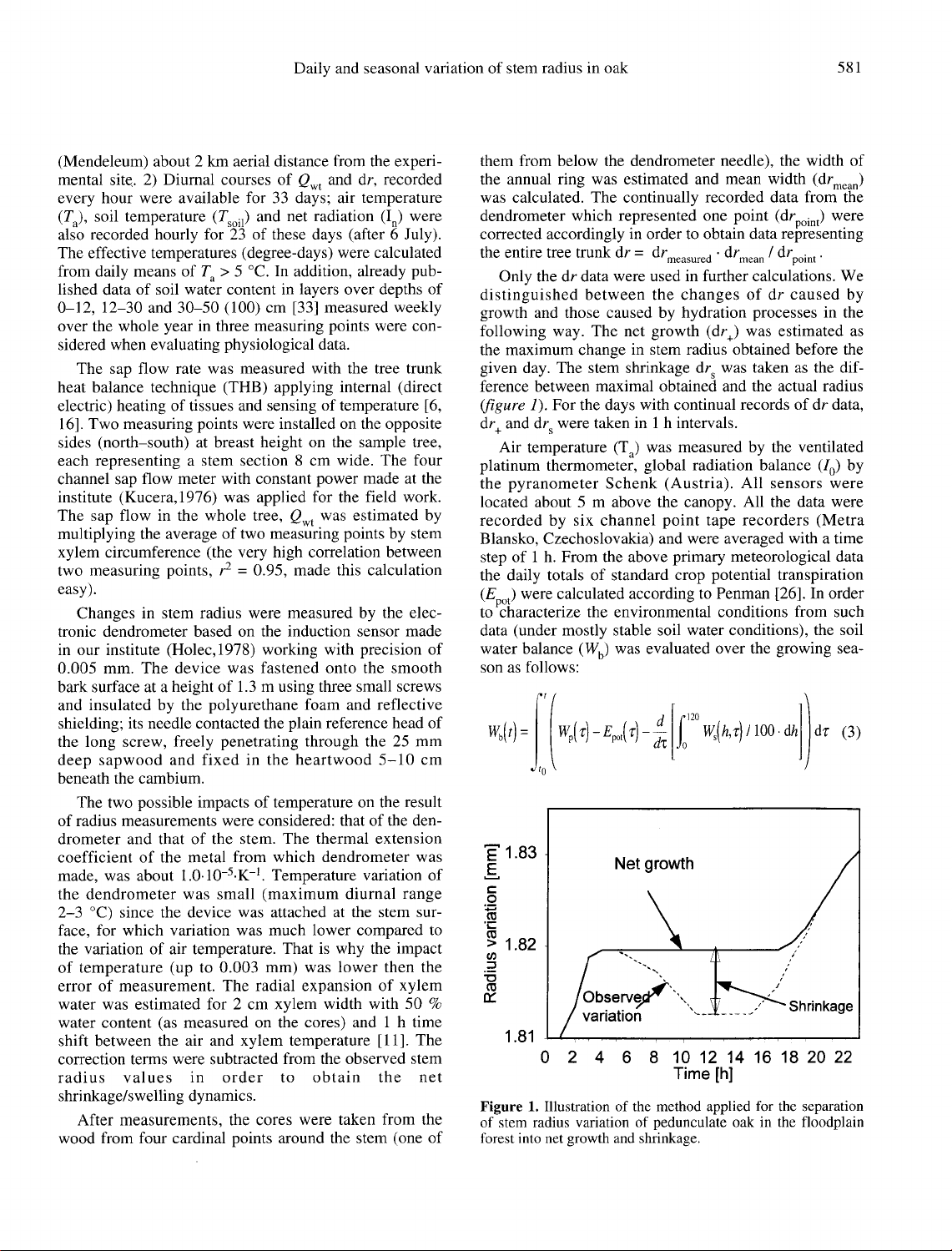
(S
bas.tree
)
and
stand
basal
area
(S
bas.stand
),
i.e.
very
close
to
Sp,
which
is
natural
for
the
closed
stand
canopy
under
consideration.
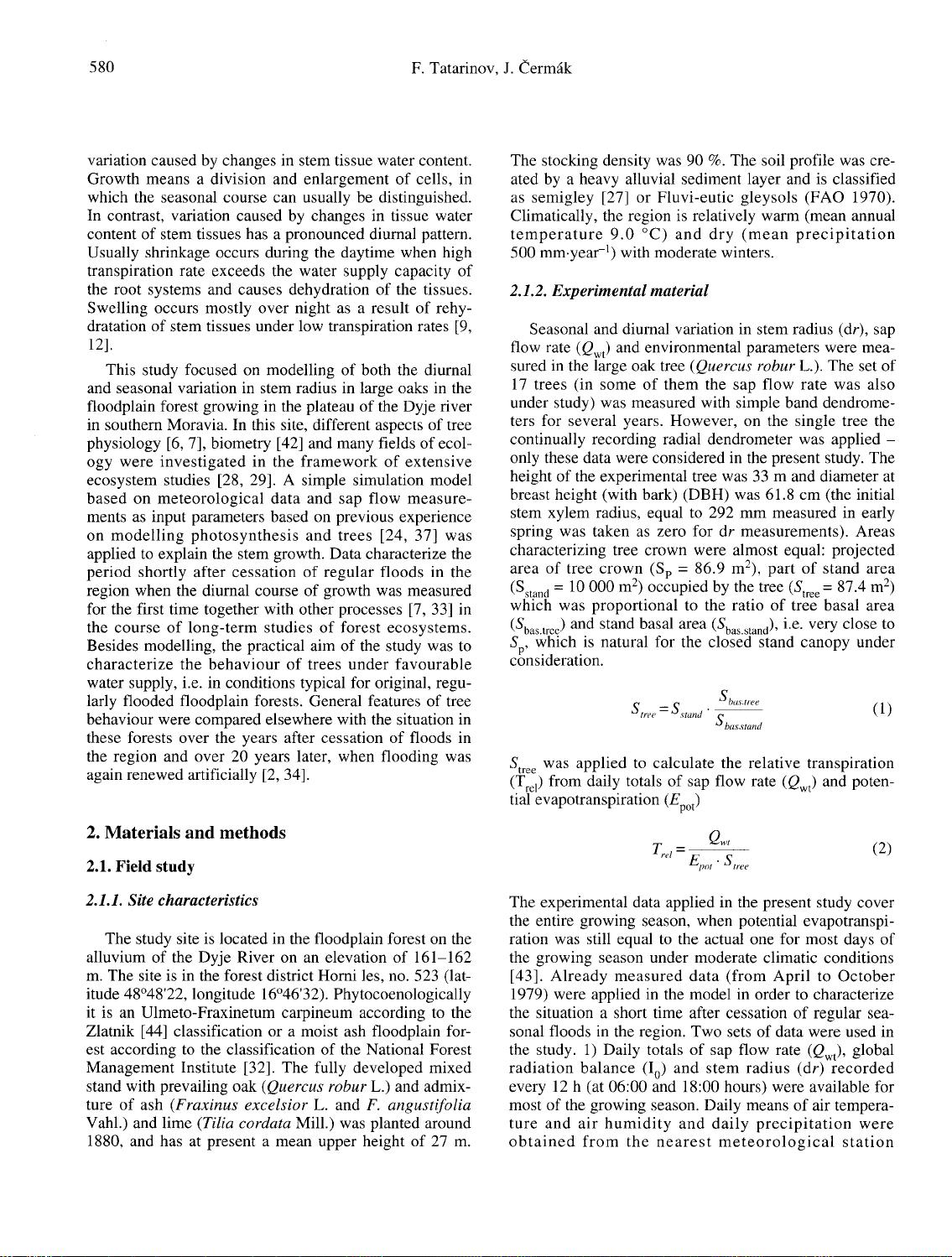
S
tree
was
applied
to
calculate
the
relative
transpiration
(T
rel
)
from
daily
totals
of
sap
flow
rate
(Qwt
)
and
poten-
tial
evapotranspiration
(E
pot
)
The
experimental
data
applied
in
the
present
study
cover
the
entire
growing
season,
when
potential
evapotranspi-
ration
was
still
equal
to
the
actual
one
for
most
days
of
the
growing
season
under
moderate
climatic
conditions
[43].
Already
measured
data
(from
April
to
October
1979)
were
applied
in
the
model
in
order
to
characterize
the
situation
a
short
time
after
cessation
of
regular
sea-
sonal floods
in
the
region.
Two
sets
of
data
were
used
in
the
study.
1)
Daily
totals
of
sap
flow
rate
(Qwt),
global
radiation
balance
(I
0)
and
stem
radius
(dr)
recorded
every
12
h
(at
06:00
and
18:00
hours)
were
available for
most
of
the
growing
season.
Daily
means
of
air
tempera-
ture
and
air
humidity
and
daily
precipitation
were
obtained
from
the
nearest
meteorological
station
(Mendeleum)
about
2
km
aerial
distance
from
the
experi-
mental
site.
2)
Diurnal
courses
of
Q
wt
and
dr,
recorded
every
hour
were
available
for
33
days;
air
temperature
(T
a
),
soil
temperature
(T
soil
)
and
net
radiation
(I
n)
were
also
recorded
hourly
for
23
of
these
days
(after
6
July).
The
effective
temperatures
(degree-days)
were
calculated
from
daily
means
of
Ta
>
5
°C.
In
addition,
already
pub-
lished
data
of
soil
water
content
in
layers
over
depths
of
0-12,
12-30
and
30-50
(100)
cm
[33]
measured
weekly
over
the
whole
year
in
three
measuring
points
were
con-
sidered
when
evaluating
physiological
data.
The
sap
flow
rate
was
measured
with
the
tree
trunk
heat
balance
technique
(THB)
applying
internal
(direct
electric)
heating
of
tissues
and
sensing
of
temperature
[6,
16].
Two
measuring
points
were
installed
on
the
opposite
sides
(north-south)
at
breast
height
on
the
sample
tree,
each
representing
a
stem
section
8
cm
wide.
The
four
channel
sap
flow
meter
with
constant
power
made
at
the
institute
(Kucera,1976)
was
applied
for
the
field
work.
The
sap
flow
in
the
whole
tree,
Q
wt
was
estimated
by
multiplying
the
average
of
two
measuring
points
by
stem
xylem
circumference
(the
very
high
correlation
between
two
measuring
points, r
2
=
0.95,
made
this
calculation
easy).
Changes
in
stem
radius
were
measured
by
the
elec-
tronic
dendrometer
based
on
the
induction
sensor
made
in
our
institute
(Holec,1978)
working
with
precision
of
0.005
mm.
The
device
was
fastened
onto
the
smooth
bark
surface
at
a
height
of
1.3
m
using
three
small
screws
and
insulated
by
the
polyurethane
foam
and
reflective
shielding;
its
needle
contacted
the
plain
reference
head
of
the
long
screw,
freely
penetrating
through
the
25
mm
deep
sapwood
and
fixed
in
the
heartwood
5-10
cm
beneath
the
cambium.
The
two
possible
impacts
of
temperature
on
the
result
of
radius
measurements
were
considered:
that
of
the
den-
drometer
and
that
of
the
stem.
The
thermal
extension
coefficient
of
the
metal
from
which
dendrometer
was
made,
was
about
1.0·10
-5·K-1
.
Temperature
variation
of
the
dendrometer
was
small
(maximum
diurnal
range
2-3
°C)
since
the
device
was
attached
at
the
stem
sur-
face,
for
which
variation
was
much
lower
compared
to
the
variation
of
air
temperature.
That
is
why
the
impact
of
temperature
(up
to
0.003
mm)
was
lower
then
the
error
of
measurement.
The
radial
expansion
of
xylem
water
was
estimated
for
2
cm
xylem
width
with
50
%
water
content
(as
measured
on
the
cores)
and
1
h
time
shift
between
the
air
and
xylem
temperature
[11].
The
correction
terms
were
subtracted
from
the
observed
stem
radius
values
in
order
to
obtain
the
net
shrinkage/swelling
dynamics.
After
measurements,
the
cores
were
taken
from
the
wood
from
four
cardinal
points
around
the
stem
(one
of
them
from
below
the
dendrometer
needle),
the
width
of
the
annual
ring
was
estimated
and
mean
width
(dr
mean
)
was
calculated.
The
continually
recorded
data
from
the
dendrometer
which
represented
one
point
(dr
point
)
were
corrected
accordingly
in
order
to
obtain data
representing
the
entire
tree
trunk
dr
=
dr
measured
.
dr
mean
/dr
point
.
Only
the
dr
data
were
used
in
further
calculations.
We
distinguished
between
the
changes
of
dr
caused
by
growth
and
those
caused
by
hydration
processes
in
the
following
way.
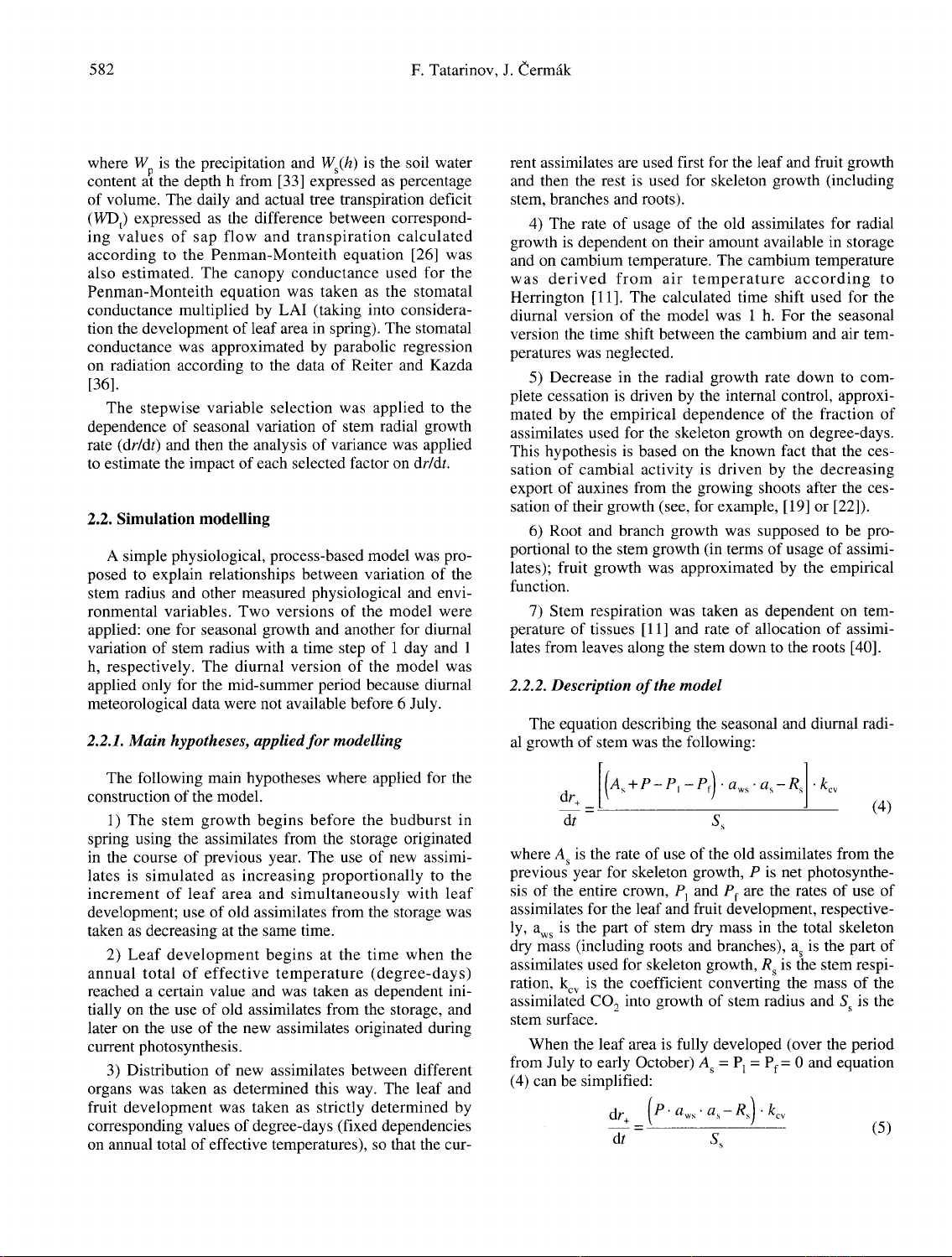
The
net
growth
(dr
+)
was
estimated
as
the
maximum
change
in
stem
radius
obtained
before
the
given
day.
The
stem
shrinkage
dr
s
was
taken
as
the
dif-
ference
between
maximal
obtained
and
the
actual
radius
(figure
1).
For
the
days
with
continual
records
of
dr
data,
dr
+
and
dr
s
were
taken
in
1
h
intervals.
Air
temperature
(T
a)
was
measured
by
the
ventilated
platinum
thermometer,
global
radiation
balance
(I
0)
by
the
pyranometer
Schenk
(Austria).
All
sensors
were
located
about
5
m
above
the
canopy.
All
the
data
were
recorded
by
six
channel
point
tape
recorders
(Metra
Blansko,
Czechoslovakia)
and
were
averaged
with
a
time
step
of
1
h.
From
the
above
primary
meteorological
data
the
daily
totals
of
standard
crop
potential
transpiration
(E
pot
)
were
calculated
according
to
Penman
[26].
In
order
to
characterize
the
environmental
conditions
from
such
data
(under
mostly
stable
soil
water
conditions),
the
soil
water
balance
(W
b)
was
evaluated
over
the
growing
sea-
son
as
follows:
where
W
is
the
precipitation
and
Ws
(h)
is
the
soil
water
content
at
the
depth
h
from
[33]
expressed
as
percentage
of
volume.
The
daily
and
actual
tree
transpiration
deficit
(WD
t)
expressed
as
the
difference
between
correspond-
ing
values
of
sap
flow
and
transpiration
calculated
according
to
the
Penman-Monteith
equation
[26]
was
also
estimated.
The
canopy
conductance
used
for
the
Penman-Monteith
equation
was
taken
as
the
stomatal
conductance
multiplied
by
LAI
(taking
into
considera-
tion
the
development
of
leaf
area
in
spring).
The
stomatal
conductance
was
approximated
by
parabolic
regression
on
radiation
according
to
the
data
of
Reiter
and
Kazda
[36].
The
stepwise
variable
selection
was
applied
to
the
dependence
of
seasonal
variation
of
stem
radial
growth
rate
(dr/dt)
and
then
the
analysis
of
variance
was
applied
to
estimate
the
impact
of
each
selected
factor
on
dr/dt.
2.2.
Simulation
modelling
A
simple
physiological,
process-based
model
was
pro-
posed
to
explain
relationships
between
variation
of
the
stem
radius
and
other
measured
physiological
and
envi-
ronmental
variables.
Two
versions
of
the
model
were
applied:
one
for
seasonal
growth
and
another
for
diurnal
variation
of
stem
radius
with
a
time
step
of
1
day
and
1
h,
respectively.
The
diurnal
version
of
the
model
was
applied
only
for
the
mid-summer
period
because
diurnal
meteorological
data
were
not
available
before
6
July.
2.2.1.
Main
hypotheses,
applied for
modelling
The
following
main
hypotheses
where
applied
for
the
construction
of
the
model.
1)
The
stem
growth
begins
before
the
budburst
in
spring
using
the
assimilates
from
the
storage
originated
in
the
course
of
previous
year.
The
use
of
new
assimi-
lates
is
simulated
as
increasing
proportionally
to
the
increment
of
leaf
area
and
simultaneously
with
leaf
development;
use
of
old
assimilates
from
the
storage
was
taken
as
decreasing
at
the
same
time.
2)
Leaf
development
begins
at
the
time
when
the
annual
total
of
effective
temperature
(degree-days)
reached
a
certain
value
and
was
taken
as
dependent
ini-
tially
on
the
use
of
old
assimilates
from
the
storage,
and
later
on
the
use
of
the
new
assimilates
originated
during
current
photosynthesis.
3)
Distribution
of
new
assimilates
between
different
organs
was
taken
as
determined
this
way.
The
leaf
and
fruit
development
was
taken
as
strictly
determined
by
corresponding
values
of
degree-days
(fixed
dependencies
on
annual
total
of
effective
temperatures),
so
that
the
cur-
rent
assimilates
are
used
first
for the
leaf
and
fruit
growth
and
then
the
rest
is
used
for
skeleton
growth
(including
stem,
branches
and
roots).
4)
The
rate
of
usage
of
the
old
assimilates
for
radial
growth
is
dependent
on
their
amount
available
in
storage
and
on
cambium
temperature.
The
cambium
temperature
was
derived
from
air
temperature
according
to
Herrington
[11].
The
calculated
time
shift
used
for
the
diurnal
version
of
the
model
was
1
h.
For
the
seasonal
version
the
time
shift
between
the
cambium
and
air
tem-
peratures
was
neglected.
5)
Decrease
in
the
radial
growth
rate
down
to
com-
plete
cessation
is
driven
by
the
internal
control,
approxi-
mated
by
the
empirical
dependence
of
the
fraction
of
assimilates
used
for
the
skeleton
growth
on
degree-days.
This
hypothesis
is
based
on
the
known
fact
that
the
ces-
sation
of
cambial
activity
is
driven
by
the
decreasing
export
of
auxines
from
the
growing
shoots
after
the
ces-
sation
of
their
growth
(see,
for
example,
[19]
or
[22]).
6)
Root
and
branch
growth
was
supposed
to
be
pro-
portional
to
the
stem
growth
(in
terms
of
usage
of
assimi-
lates);
fruit
growth
was
approximated
by
the
empirical
function.
7)
Stem
respiration
was
taken
as
dependent
on
tem-
perature
of
tissues
[11]
and
rate
of
allocation
of
assimi-
lates
from
leaves
along
the
stem
down
to
the
roots
[40].
2.2.2.
Description
of the
model
The
equation
describing
the
seasonal
and
diurnal
radi-
al
growth
of
stem
was
the
following:
where
As
is
the
rate
of
use
of
the
old
assimilates
from
the
previous
year
for
skeleton
growth,
P
is
net
photosynthe-
sis
of
the
entire
crown,
Pl
and
Pf
are
the
rates
of
use
of
assimilates
for
the
leaf
and
fruit
development,
respective-
ly,
a
ws
is
the
part
of
stem
dry
mass
in
the
total
skeleton
dry
mass
(including
roots
and
branches),
as
is
the
part
of
assimilates
used
for
skeleton
growth,
Rs
is
the
stem
respi-
ration,
k
cv
is
the
coefficient
converting
the
mass
of
the
assimilated
CO
2
into
growth
of
stem
radius
and S
s
is
the
stem
surface.
When
the
leaf
area
is
fully
developed
(over
the
period
from
July
to
early
October)
As
=
Pl
=
Pf=
0 and
equation
(4)
can
be
simplified:
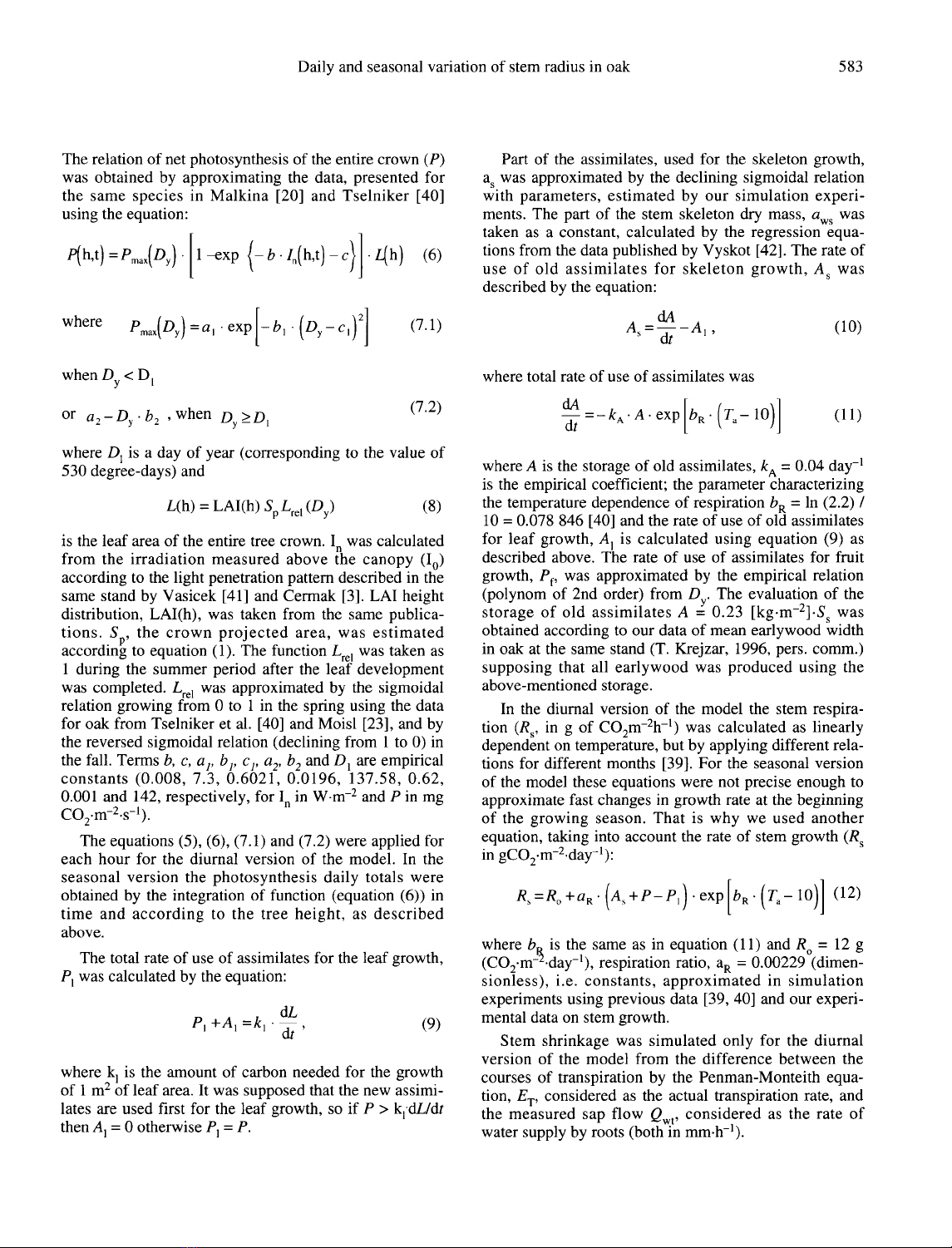
The
relation
of
net
photosynthesis
of
the
entire
crown
(P)
was
obtained
by
approximating
the
data,
presented
for
the
same
species
in
Malkina
[20]
and
Tselniker
[40]
using
the
equation:
where
D1
is
a
day
of
year
(corresponding
to
the
value
of
530
degree-days)
and
is
the
leaf
area
of
the
entire
tree
crown.
In
was
calculated
from
the
irradiation
measured
above
the
canopy
(I
0)
according
to
the
light
penetration
pattern
described
in
the
same
stand
by
Vasicek
[41]
and
Cermak
[3].
LAI
height
distribution,
LAI(h),
was
taken
from
the
same
publica-
tions.
Sp,
the
crown
projected
area,
was
estimated
according
to
equation
(1).
The
function
L
rel
was
taken
as
1
during
the
summer
period
after
the
leaf
development
was
completed.
L
rel
was
approximated
by
the
sigmoidal
relation
growing
from
0
to
1
in
the
spring
using
the
data
for
oak
from
Tselniker
et
al.
[40]
and Moisl
[23],
and
by
the
reversed
sigmoidal
relation
(declining
from
1
to
0)
in
the
fall.
Terms
b,
c,
a1,
b1,
c1,
a2,
b2
and
D1
are
empirical
constants
(0.008,
7.3,
0.6021,
0.0196,
137.58, 0.62,
0.001
and
142,
respectively,
for
In
in
W·m
-2
and
P
in
mg
CO
2
·m-2·s-1).
The
equations
(5), (6),
(7.1)
and
(7.2)
were
applied
for
each
hour
for
the
diurnal
version
of
the
model.
In
the
seasonal
version
the
photosynthesis
daily
totals
were
obtained
by
the
integration
of
function
(equation
(6))
in
time
and
according
to
the
tree
height,
as
described
above.
The
total
rate
of
use
of
assimilates
for
the
leaf
growth,
P1
was
calculated
by
the
equation:
where
k1
is
the
amount
of
carbon
needed
for
the
growth
of
1
m2
of
leaf
area.
It
was
supposed
that
the
new
assimi-
lates
are
used
first
for
the
leaf
growth,
so
if
P
>
k1
dL/dt
then
A1
=
0
otherwise
P1
=
P.
Part
of
the
assimilates,
used
for
the
skeleton
growth,
as
was
approximated
by
the
declining
sigmoidal
relation
with
parameters,
estimated
by
our
simulation
experi-
ments.
The
part
of
the
stem
skeleton
dry
mass,
a
ws
was
taken
as
a
constant,
calculated
by
the
regression
equa-
tions
from
the
data
published
by
Vyskot
[42].
The
rate
of
use
of
old
assimilates
for
skeleton
growth,
As
was
described
by
the
equation:
where
total
rate
of
use
of
assimilates
was
where
A
is
the
storage
of
old
assimilates,
kA
= 0.04
day
-1
is
the
empirical
coefficient;
the
parameter
characterizing
the
temperature
dependence
of
respiration
bR
=
In
(2.2)
/
10
=
0.078
846
[40]
and
the
rate
of
use
of
old
assimilates
for
leaf
growth,
A1
is
calculated
using
equation
(9)
as
described
above.
The
rate
of
use
of
assimilates
for
fruit
growth,
Pf,
was
approximated
by
the
empirical
relation
(polynom
of
2nd
order)
from
Dy.
The
evaluation
of
the
storage
of
old
assimilates A
=
0.23
[kg·m
-2
]·S
s
was
obtained
according
to
our
data
of
mean
earlywood
width
in
oak
at
the
same
stand
(T.
Krejzar,
1996,
pers.
comm.)
supposing
that
all
earlywood
was
produced
using
the
above-mentioned
storage.
In
the
diurnal
version
of
the
model
the
stem
respira-
tion
(R
s,
in
g
of
CO
2m
-2
h
-1
)
was
calculated
as
linearly
dependent
on
temperature,
but
by
applying
different
rela-
tions
for
different
months
[39].
For
the
seasonal
version
of
the
model
these
equations
were
not
precise
enough
to
approximate
fast
changes
in
growth
rate
at
the
beginning
of
the
growing
season.
That
is
why
we
used
another
equation,
taking
into
account
the
rate
of
stem
growth
(R
s
in
gCO
2
·m-2
·day
-1):
where
b
is
the
same
as
in
equation
(11)
and
Ro
=
12
g
(CO
2
·m-2
·day
-1),
respiration
ratio,
aR
=
0.00229
(dimen-
sionless),
i.e.
constants,
approximated
in
simulation
experiments
using
previous
data
[39,
40]
and
our
experi-
mental
data
on
stem
growth.
Stem
shrinkage
was
simulated
only
for
the
diurnal
version
of
the
model
from
the
difference
between
the
courses
of
transpiration
by
the
Penman-Monteith
equa-
tion,
ET,
considered
as
the
actual
transpiration
rate,
and
the
measured
sap
flow
Q
wt
,
considered
as
the
rate
of
water
supply
by
roots
(both
in
mm·h
-1).


%20--%3e%3cdefs%3e%3cstyle%3e%20.st0%20{%20fill:%20%23fff;%20}%20.st1%20{%20fill:%20%237800fa;%20}%20%3c/style%3e%3c/defs%3e%3cpath%20class='st1'%20d='M117.78,12.18H43.11c2.9,3.47,4.65,7.94,4.65,12.82,0,5.6-2.3,10.66-6.01,14.29h76.02l7.22-13.56-7.22-13.56Z'/%3e%3cg%3e%3cpath%20class='st0'%20d='M53.58,26.17h-.59v-1.46h.59v-4.96h2.83c1.78,0,2.67.94,2.67,2.82v5.76c0,1.87-.89,2.81-2.67,2.81h-2.83v-4.96ZM55.36,21.37v3.34h1.1v1.46h-1.1v3.34h1.01c.61,0,.91-.37.91-1.1v-5.93c0-.74-.3-1.1-.91-1.1h-1.01Z'/%3e%3cpath%20class='st0'%20d='M65.99,31.14h-1.8l-.31-2.07h-2.19l-.31,2.07h-1.64l1.82-11.39h2.62l1.82,11.39ZM65.28,18.04c-.25.46-.51.77-.75.94-.21.15-.47.22-.79.22-.26,0-.57-.07-.92-.22l-.38-.15c-.14-.05-.26-.07-.37-.07-.3,0-.53.18-.71.54l-.91-.68c.25-.46.51-.77.75-.94.21-.14.48-.21.79-.21.26,0,.57.07.92.21l.38.15c.14.05.26.07.37.07.3,0,.53-.18.71-.54l.91.68ZM61.91,27.52h1.73l-.87-5.76-.87,5.76Z'/%3e%3cpath%20class='st0'%20d='M74.53,26.89v1.52c0,1.91-.89,2.86-2.67,2.86s-2.67-.95-2.67-2.86v-5.93c0-1.91.89-2.86,2.67-2.86s2.67.95,2.67,2.86v1.11h-1.69v-1.22c0-.75-.31-1.12-.93-1.12s-.93.37-.93,1.12v6.15c0,.74.31,1.11.93,1.11s.93-.37.93-1.11v-1.63h1.69Z'/%3e%3cpath%20class='st0'%20d='M81.4,31.14h-1.8l-.31-2.07h-2.19l-.31,2.07h-1.64l1.82-11.39h2.62l1.82,11.39ZM75.9,19.2l1.52-1.91h1.71l1.51,1.91h-1.61l-.76-.95-.75.95h-1.61ZM77.32,27.52h1.73l-.87-5.76-.87,5.76ZM83.1,15.99l-1.76,1.91h-1.26l1.17-1.91h1.86Z'/%3e%3cpath%20class='st0'%20d='M84.86,19.75c1.78,0,2.67.94,2.67,2.82v1.48c0,1.87-.89,2.81-2.67,2.81h-.85v4.28h-1.79v-11.39h2.64ZM84.01,21.37v3.86h.85c.58,0,.87-.36.87-1.08v-1.71c0-.71-.29-1.07-.87-1.07h-.85Z'/%3e%3cpath%20class='st0'%20d='M93.51,19.75c1.78,0,2.67.94,2.67,2.82v1.48c0,1.87-.89,2.81-2.67,2.81h-.85v4.28h-1.79v-11.39h2.64ZM92.66,21.37v3.86h.85c.58,0,.87-.36.87-1.08v-1.71c0-.71-.29-1.07-.87-1.07h-.85Z'/%3e%3cpath%20class='st0'%20d='M98.8,31.14h-1.79v-11.39h1.79v4.88h2.03v-4.88h1.83v11.39h-1.83v-4.88h-2.03v4.88Z'/%3e%3cpath%20class='st0'%20d='M105.36,24.55h2.46v1.62h-2.46v3.34h3.09v1.63h-4.88v-11.39h4.88v1.63h-3.09v3.18ZM108.17,17.29l-1.76,1.91h-1.26l1.17-1.91h1.86Z'/%3e%3cpath%20class='st0'%20d='M112.2,19.75c1.78,0,2.67.94,2.67,2.82v1.48c0,1.87-.89,2.81-2.67,2.81h-.85v4.28h-1.79v-11.39h2.64ZM111.35,21.37v3.86h.85c.58,0,.87-.36.87-1.08v-1.71c0-.71-.29-1.07-.87-1.07h-.85Z'/%3e%3c/g%3e%3ccircle%20class='st1'%20cx='25'%20cy='25'%20r='20'/%3e%3cpath%20class='st0'%20d='M32.78,19.27c2.92,0,4.43,2.55,5.28,5.33l.71,2.17c.14.38-.33.75-.71.75h-5.61c.19-.33.24-.71.09-1.08l-.75-2.45c-.43-1.32-.99-2.64-1.79-3.77.75-.57,1.65-.94,2.78-.94h0ZM25,18.38c3.25,0,4.9,2.78,5.89,5.89l.76,2.45c.14.42-.33.8-.8.8h-11.69c-.42,0-.94-.38-.8-.8l.75-2.45c.99-3.11,2.64-5.89,5.89-5.89h0ZM25,11.35c1.74,0,3.11,1.37,3.11,3.11s-1.37,3.11-3.11,3.11-3.11-1.41-3.11-3.11,1.41-3.11,3.11-3.11h0ZM17.27,19.27c1.08,0,1.98.38,2.73.94-.8,1.13-1.37,2.45-1.74,3.77l-.8,2.45c-.14.38-.05.75.09,1.08h-5.56c-.42,0-.9-.38-.75-.75l.71-2.17c.9-2.78,2.41-5.33,5.33-5.33h0ZM17.27,12.91c1.51,0,2.78,1.27,2.78,2.83s-1.27,2.83-2.78,2.83-2.83-1.27-2.83-2.83,1.27-2.83,2.83-2.83h0ZM32.78,12.91c1.56,0,2.78,1.27,2.78,2.83s-1.23,2.83-2.78,2.83-2.83-1.27-2.83-2.83,1.27-2.83,2.83-2.83h0ZM27.07,28.56v.09c0,.57-.24,1.08-.61,1.46h0v.05c-.38.33-.9.57-1.46.57s-1.08-.24-1.46-.61h0c-.38-.38-.61-.9-.61-1.46v-.09h1.41v.09c0,.19.05.38.19.47v.05c.09.09.28.19.47.19s.38-.09.47-.19v-.05c.14-.09.24-.28.24-.47t-.05-.09h1.41ZM30.99,28.56v.09c0,1.65-.66,3.16-1.74,4.24-1.08,1.08-2.59,1.79-4.24,1.79s-3.16-.71-4.24-1.79l-.05-.05c-1.04-1.08-1.7-2.55-1.7-4.2v-.09h1.41v.09c0,1.27.47,2.4,1.27,3.25h.05c.85.85,1.98,1.37,3.25,1.37s2.4-.52,3.25-1.37c.85-.8,1.37-1.98,1.37-3.25v-.09h1.37ZM34.99,28.56v.09c0,2.78-1.13,5.28-2.92,7.07-1.79,1.79-4.29,2.92-7.07,2.92s-5.23-1.13-7.07-2.92c-1.79-1.79-2.92-4.29-2.92-7.07v-.09h1.41v.09c0,2.4.94,4.53,2.5,6.08,1.56,1.56,3.72,2.5,6.08,2.5s4.52-.94,6.08-2.5c1.56-1.56,2.5-3.68,2.5-6.08v-.09h1.41Z'/%3e%3c/svg%3e)