

Feasibility of diesel–biodiesel–ethanol/bioethanol blend as existing CI
engine fuel: An assessment of properties, material compatibility, safety
and combustion
S.A. Shahir
n
, H.H. Masjuki, M.A. Kalam, A. Imran, I.M. Rizwanul Fattah, A. Sanjid
Centre for Energy Sciences, Faculty of Engineering, University of Malaya, 50603 Kuala Lumpur, Malaysia
article info
Article history:
Received 1 April 2013
Received in revised form
1 December 2013
Accepted 4 January 2014
Available online 1 February 2014
Keywords:
Diesohol
Diesel–biodiesel–ethanol/bioethanol blend
CI engine
Miscibility
Stability
Combustion
abstract
The global fossil fuel crisis and emission problems lead to investigations on alternative fuels. In this quest, a
successful finding is the partial substitution of diesel with ethanol/bioethanol rather than completely replacing
it. These blends of diesel and ethanol/bioethanol can be used in the existing CI engines without any major
modifications and the most significant result of using this blend is the lower emission with almost the same
performance as of diesel fuel alone. Two major drawbacks of using this blend are low miscibility of ethanol/
bioethanol in diesel and low temperature instability of produced blend. However, biodiesel can be successfully
added to prevent the phase separation of diesel–ethanol/bioethanol blend. Thus, this blend becomes stable
even at lower temperatures and more amount of ethanol/bioethanol can be added to them. It is found that a
maximum of 25% biodiesel and 5% of ethanol/bioethanol can be added to the diesel fuel effectively. Adding
ethanol/bioethanol to diesel fuel alters the properties of the blend, which does not meet some of the standards.
Biodiesel addition to this blend helps in regaining the fuel properties to the standard values and thus the blend
can be efficiently used in the existing diesel engines. From thereview,itcanbesaidthat,theuseofdiesel–
biodiesel–ethanol/bioethanol blend can minimize the use of diesel fuel by approximately 25–30%.
&2014 Elsevier Ltd. All rights reserved.
Contents
1. Introduction. . . . . . . . . . . . . . . . . . . . . . . . . . . . . . . . . . . . . . . . . . . . . . . . . . . . . . . . . . . . . . . . . . . . . . . . . . . . . . . . . . . . . . . . . . . . . . . . . . . . . . . . 380
2. Diesel–biodiesel–ethanol blend as a diesel extender. . . . . . . . . . . . . . . . . . . . . . . . . . . . . . . . . . . . . . . . . . . . . . . . . . . . . . . . . . . . . . . . . . . . . . . . 380
3. Blend properties . . . . . . . . . . . . . . . . . . . . . . . . . . . . . . . . . . . . . . . . . . . . . . . . . . . . . . . . . . . . . . . . . . . . . . . . . . . . . . . . . . . . . . . . . . . . . . . . . . . . 381
3.1. Blend stability . . . . . . . . . . . . . . . . . . . . . . . . . . . . . . . . . . . . . . . . . . . . . . . . . . . . . . . . . . . . . . . . . . . . . . . . . . . . . . . . . . . . . . . . . . . . . . . . 381
3.2. Density . . . . . . . . . . . . . . . . . . . . . . . . . . . . . . . . . . . . . . . . . . . . . . . . . . . . . . . . . . . . . . . . . . . . . . . . . . . . . . . . . . . . . . . . . . . . . . . . . . . . . . 385
3.3. Calorificvalue ................................................................................................ 386
3.4. Viscosity and lubricity . . . . . . . . . . . . . . . . . . . . . . . . . . . . . . . . . . . . . . . . . . . . . . . . . . . . . . . . . . . . . . . . . . . . . . . . . . . . . . . . . . . . . . . . . . 386
3.5. Surface tension . . . . . . . . . . . . . . . . . . . . . . . . . . . . . . . . . . . . . . . . . . . . . . . . . . . . . . . . . . . . . . . . . . . . . . . . . . . . . . . . . . . . . . . . . . . . . . . 387
3.6. Fuel oxygen content . . . . . . . . . . . . . . . . . . . . . . . . . . . . . . . . . . . . . . . . . . . . . . . . . . . . . . . . . . . . . . . . . . . . . . . . . . . . . . . . . . . . . . . . . . . 387
3.7. Flash point . . . . . . . . . . . . . . . . . . . . . . . . . . . . . . . . . . . . . . . . . . . . . . . . . . . . . . . . . . . . . . . . . . . . . . . . . . . . . . . . . . . . . . . . . . . . . . . . . . . 387
3.8. Cold filter plugging point (CFPP) . . . . . . . . . . . . . . . . . . . . . . . . . . . . . . . . . . . . . . . . . . . . . . . . . . . . . . . . . . . . . . . . . . . . . . . . . . . . . . . . . 388
3.9. Cetane number . . . . . . . . . . . . . . . . . . . . . . . . . . . . . . . . . . . . . . . . . . . . . . . . . . . . . . . . . . . . . . . . . . . . . . . . . . . . . . . . . . . . . . . . . . . . . . . 388
3.10. Pour point . . . . . . . . . . . . . . . . . . . . . . . . . . . . . . . . . . . . . . . . . . . . . . . . . . . . . . . . . . . . . . . . . . . . . . . . . . . . . . . . . . . . . . . . . . . . . . . . . . . 389
4. Materials compatibility issue . . . . . . . . . . . . . . . . . . . . . . . . . . . . . . . . . . . . . . . . . . . . . . . . . . . . . . . . . . . . . . . . . . . . . . . . . . . . . . . . . . . . . . . . . . 389
5. Safety and biodegradability. . . . . . . . . . . . . . . . . . . . . . . . . . . . . . . . . . . . . . . . . . . . . . . . . . . . . . . . . . . . . . . . . . . . . . . . . . . . . . . . . . . . . . . . . . . . 390
6. Combustion characteristics . . . . . . . . . . . . . . . . . . . . . . . . . . . . . . . . . . . . . . . . . . . . . . . . . . . . . . . . . . . . . . . . . . . . . . . . . . . . . . . . . . . . . . . . . . . . 390
7. Conclusions . . . . . . . . . . . . . . . . . . . . . . . . . . . . . . . . . . . . . . . . . . . . . . . . . . . . . . . . . . . . . . . . . . . . . . . . . . . . . . . . . . . . . . . . . . . . . . . . . . . . . . . . 392
Acknowledgement. . . . . . . . . . . . . . . . . . . . . . . . . . . . . . . . . . . . . . . . . . . . . . . . . . . . . . . . . . . . . . . . . . . . . . . . . . . . . . . . . . . . . . . . . . . . . . . . . . . . . . . 393
References . . . . . . . . . . . . . . . . . . . . . . . . . . . . . . . . . . . . . . . . . . . . . . . . . . . . . . . . . . . . . . . . . . . . . . . . . . . . . . . . . . . . . . . . . . . . . . . . . . . . . . . . . . . . . 393
Contents lists available at ScienceDirect
journal homepage: www.elsevier.com/locate/rser
Renewable and Sustainable Energy Reviews
1364-0321/$ - see front matter &2014 Elsevier Ltd. All rights reserved.
http://dx.doi.org/10.1016/j.rser.2014.01.029
n
Correspondence to: Department of Mechanical Engineering, University of Malaya, 50603 Kuala Lumpur, Malaysia. Tel.: þ60 3 79674448, mobile: þ60 1 63490143;
fax: þ60 3 79675317.
E-mail address: shahirshawkat@gmail.com (S.A. Shahir).
Renewable and Sustainable Energy Reviews 32 (2014) 379–395

1. Introduction
The ever-increasing quest for alternative fuel has been started a
few decades back. The worldwide fuel crisis of the 1970s initiated
awareness about the vulnerability to oil embargoes and shortages
among many countries of the world. Significant attention was then
concentrated on the improvement of alternative fuel sources.
When the issue of using an alternative fuel in the diesel engines
comes into consideration, some important factors are needed to
be considered. These factors comprise of distribution and supply,
fuel delivery reliability to the engine, emissions and engine
stability [1]. Besides this attention towards the alternative fuel
sources, today another important concern for us is the gases
causing the greenhouse effect within the earth
0
s atmosphere and
local pollution.
The most significant way to assess an automotive fuel is to
judge its capability to decrease emissions, to increase the fuel
efficiency and the ability to lessen the dependency on the slowly
diminishing fossil oil stock [2]. Another very important factor to be
considered for assessment is the difference between the modern
state-of-the-art vehicles and the older technologies that repre-
sents the majority of our current vehicle fleet. Extreme environ-
mental conditions like very cold or very hot temperatures and
high elevations also play a vital role in assessing a fuel. Finally, the
fuel must provide the same drivability quality as the existing
conventional fuels do and the most important factor is its usability
in the typical engines. The vehicle and engine technology and
particularly the technology for the treatment of exhaust-gas are
the factors that usually affect our decision.
The efficient use of fuels sourcing from renewable sources is an
option to fulfill these challenges. Due to the availability in large
volume, among all the renewable fuel sources bioethanol can be a
good option especially because the second-generation production
process of bioethanol is going to be available very soon in the
coming years [3]. Bioethanol is produced from various feedstocks
like sugarcane, corn, beet, molasses, cassava root, barley sugar,
starch, cellulose, etc. In addition, ethanol can be produced from
reacting ethene and steam (As this process requires a lot of
energy, a major portion of the world
0
s ethanol is produced from
renewable sources through fermentation. Thus the bioethanol is
mostly named as simply ethanol.). Although it is regarded
primarily as a substitute fuel for SI or spark ignition engines
but it also has potential uses for CI engines. During the 1980s the
blendingofethanolwithfossildieselfuelwasatopicofresearch
and it was investigated that this ethanol–diesel blend, also
known as diesohol, is technically usable in the then existing
diesel engines without any major modifications [3].Themain
advantage of ethanol is its oxygen content which is about 34% by
weight [4]. Beside this oxygen content the use of ethanol with
diesel fuel has many more advantages as well as some major
disadvantages. Taking all these factors under consideration the
usage of ethanol with diesel fuel in the diesel engines seems
attractive.
The ongoing investigations and the already found analysis
about the fractional replacement of fossil diesel fuel with the
combination of biodiesel and ethanol in compression ignition
engines found to be successful as this blend has the similar fuel
properties like the commercial diesel fuel with high biofuel
content. Many scientists and investigators have studied this blend
with different proportions of diesel, biodiesel and ethanol to study
its suitability as a fuel in the existing CI engines. Thus the aim of
this review is to investigate different fuel properties of diesel–
biodiesel–ethanol/bioethanol blends by varying the biofuel por-
tions in the blends, investigated by many researchers. Finally
compare the properties with the classical diesel fuel to assess its
feasibility as a fuel for CI engine.
2. Diesel–biodiesel–ethanol blend as a diesel extender
The strategy of adding ethanol or bioethanol to diesel is quite
complex and requires dedicated solutions. The approaches are
quite multifaceted and require profound solutions. Several meth-
odologies are identified to overcome the described issues [3].
(i) Mixing of two fuels preceding injection [5–11] i.e. injecting
diesohol. The major weakness of this blend is its stability,
which is very poor. It depends on the chemical composition of
the diesel fuel used, the temperature at which the blend is
used and the percentage of ethanol present in the blend.
(ii) Diesel fuel can be fully substituted by ethanol (approximately
95% mass): technically this solution becomes very complex,
which requires major changes on the hardware of the engines
to overcome ethanol
0
s weak auto-ignition property [12]. Due
to major difference in physicochemical properties between
diesel and ethanol, this blend of 5% diesel and 95% ethanol
becomes very difficult to use in the existing CI engines.
(iii) Fumigation of ethanol i.e. ethanol addition to the intake air
charge [13,14].
(iv) Dual fuel injection; i.e. for each of the diesel and ethanol,
there is a separate injection system [15].
Amongst all of the above approaches, the first one can be
selected as the most feasible way to solve the baffling issues posed
by others. This approach has the following benefits:
(a) No need of major technical modifications on the engine [3].
(b) Ease of operation [3].
There are some very important advantages behind considering
this diesohol blend as a potential fuel for the existing CI engines.
They are
(a) The diesel–ethanol/bioethanol blend can significantly reduce
particulate matter (PM) emissions in the motor vehicles
[2,9,16–18] (approximately 15% [19]) when compared to low
sulfur diesel. Adding 10% of ethanol in the diesel fuel can
reduce 30–50% of this type of emission [2].
(b) Similar energy output can be attained compared to fossil
diesel fuel [20].
(c) By adding ethanol to the diesel fuel, the cold flow property is
improved compared to fossil diesel fuel [4].
(d) The diesohol blends have high heat of vaporization compared
to fossil diesel fuel [2].
But as suggested in some literatures [7,21–26], there are some
issues which hinder the utilization of diesohol blend in the
compression ignition engine.
(i) Cetane number of this blend becomes lower compared to
diesel fuel. The addition of 10 v/v% of ethanol decreases
cetane number by approximately 30%.
(ii) Ethanol is not completely miscible in diesel fuel. Very small
proportion (less than 5 vol%) of ethanol shows complete
miscibility in diesel fuel [3].
(iii) Minor variations in the fuel delivery system are required
while using diesohol as fuel [8,11,27].
(iv) The density, viscosity, lubricity, energy content and the flash
point of the fuel blend are affected [3]. Due to the addition of
ethanol in the diesel fuel the blend
0
s viscosity becomes lower.
The addition of 10 v/v% of bioethanol decreases viscosity
approximately by 10–25% [2].
(v) The swelling of T-valves fitted to Bosch-type feed pumps,
which results in jammed valve stems [19].
S.A. Shahir et al. / Renewable and Sustainable Energy Reviews 32 (2014) 379–395380

(vi) The calorific value of the diesohol blend is much lower than
the fossil diesel fuel [28].
(vii) The use of diesohol increases soot formulation [2].
To solve these problems and increase the ethanol portion in the
diesohol blend an emulsifier or a surfactant can be utilized
[1,9,29–34] and maintain the blend
0
s properties near to the fossil
diesel fuel.
Different types of biodiesel can be utilized as an emulsifier or a
surfactant or an amphiphile (a surface-active agent) for the long
term and low temperature stability of diesohol blends [1,30,35–44].
The density of biodiesel is between 860 and 894 kg/m³at 15 1C
[45–50] and viscosity at 40 1C is between 3.3 and 5.2 mm²/s
[46,47,51]. The main advantages of using biodiesel (rather than
using any artificial additive synthesized in the laboratory) are as
follows [52–60].
(i) The flash point of diesohol blend is very low. When biodiesel
is added to diesohol then the flash point of this ternary blend
becomes high enough to store it safely.
(ii) By using biodiesel, it will increase the supply of domestic
renewable energy supply [54].
(iii) When biodiesel is added to the diesohol, higher viscosity and
density of the biodiesel and the much lower viscosity and
density of the diesohol are compensated by each other and
these values come within the standard diesel fuel prescribed
limits.
(iv) By adding biodiesel the heating value of the ternary blend
comes nearer to the fossil diesel fuel [2].
(v) When biodiesel is added to the diesohol then the low
lubricating property of diesohol blends are improved and
becomes standard to use this ternary blend in the existing
CI engines [20].
(vi) The high cetane number of biodiesel compensates the dieso-
hol's low cetane number which is caused by the addition of
ethanol with the diesel [2].
According to Barabás and Todorut [61] the diesel–biodiesel–
ethanol blend is a great option as an alternative to diesel fuel for CI
engines. The idea comes from the findings that, when biodiesel
and ethanol/bioethanol are added to diesel fuel then the final fuel
properties of this ternary blend becomes almost similar to diesel
fuel alone except a few [2,62]. This ternary blend of diesel–
biodiesel–ethanol is found to be stable even below 0 1C and have
some identical or superior fuel properties to regular fossil diesel
fuel [35]. Thus the addition of biodiesel in the diesel–ethanol
blends or diesohol blends shows a favorable approach towards
the formulation of a novel form of biofuels and fossil diesel fuel
blend [4].
While conducting on-field tests Raslavicius and Bazaras [63]
found positive effect on dynamic and ecological characteristics of
the testing vehicle fueled with a blend of 70% of dieselþ30% of
biodiesel (hereinafter –B30) admixed with the dehydrated/
anhydrous ethanol additive (5 v/v%). He found no reduction of
power in the diesel engine, and within the boundary of the
experimental error, he found a tendency of 2% fuel economy
compared to pure B30. He found a dramatic decrease in PM (40%),
HC (25%) and CO (6%) emissions compared to fossil diesel fuel
while operating the vehicle at maximum power. NO
x
emission
from diesel–biodiesel–ethanol blends are less than (up to 4%) the
B30. However, NO
x
emission increases as compared to diesel fuel.
Considering all these details, he concluded that a blend of 80%
diesel, 15% biodiesel and 5% bioethanol is the most appropriate
ratio for diesel–biodiesel–ethanol blend production, as because of
the satisfactory fuel properties and reduction in emissions of the
ternary blends.
3. Blend properties
Proper operation of a diesel engine depends on a number of
fuel properties. When ethanol is added to the diesel fuel some of
the key fuel properties are affected with specific reference to
stability, density, viscosity, lubricity, energy content and cetane
number of the blend. Other important factors like materials
compatibility and corrosiveness are also essential to be considered
[1]. To make the selection other factors like surface tension, cold
filter plugging point, flash point, carbon content, hydrogen con-
tent, heating value and finally fuel biodegradability with respect to
ground water contamination etc. are also needed to be considered.
3.1. Blend stability
One of the main targets of using fuel blends in the diesel
engines is to keep the engine modification minimal. A solution is a
single-phase liquid system, homogeneous at the molecular level.
Some diesohol formulations may be a solution of ethanol/bio-
ethanol plus additives with diesel fuel. It was seen that such
blends are technically suitable to run existing diesel engines
without modifications. This ethanol-blended diesel blend yielded
substantial reductions in urban emissions of carbon monoxide
(CO), greenhouse gases (primarily CO
2
), sulfur oxides (SO
x
) and
particulate matter (PM). The major drawback of this diesel–
ethanol blend is that, ethanol is immiscible in regular diesel fuel
over a wide range of temperature. Its solubility in diesel changes
with the change of ambient temperature [17,63]. Its miscibility in
fossil diesel fuel is affected fundamentally by two factors, tem-
perature and the blend
0
s water content. The presence of water in
ethanol or diesel fuel can critically reduce solubility between the
two portions [10,63]. At normal ambient temperature anhydrous/
dry ethanol readily mixes with fossil diesel fuel. But below 10 1C
the two fuels become separate. In many regions of the world, for a
long period of time during the year this temperature limit is easily
surpassed. To prevent this parting of two fuels three possible ways
can be considered. They are
(i) Adding an emulsifier which performs to suspend small
droplets of ethanol within the diesel fuel.
(ii) Adding a co-solvent that performs as a linking agent through
molecular compatibility and bonding to yield a homogeneous
blend or
(iii) Adding iso-propanol [1,9,17,29–33,64].
To stabilize the ethanol and fossil diesel fuel blend, surface
active agent, i.e. an amphiphile, like Fatty Acid Methyl Ester
(FAME) can also be used [1,30,35–44]. To generate a blend through
the emulsification process usually heating and blending steps are
required where on the other hand using co-solvents simplifies the
blending method as it permits to be “splash blended”.
The solubility of ethanol in diesel fuel is affected by its aromatic
content [27]. The polar nature of ethanol induces a dipole in the
aromatic molecule permitting them to interact reasonably strongly,
while the aromatics stay compatible with other hydrocarbons
in diesel fuel. Hence, aromatics perform as bridging agents and
co-solvents to some degree. If the aromatic contents of the fossil
diesel fuel are compensated then it affects the miscibility of ethanol
in the diesel fuel. Thus the quantity of the additive necessary to gain
a stable blend, is affected [1,17,64].
Individually emulsifiers and co-solvents have been assessed
with diesel–ethanol blend. Among the appropriate co-solvents,
esters are used mostly because of their resemblance to diesel,
which allows the use of diesel–ester blends in any proportion. The
ester is used as a co-solvent, which permits the adding of more
ethanol to the fuel blend. This develops the tolerance of the fuel
S.A. Shahir et al. / Renewable and Sustainable Energy Reviews 32 (2014) 379–395 381
blend to water, and retains the blend stable, thus for a long period
the blend can be stored [32,65]. The percentage of required
additive is dominated by the lower limit of temperature at which
the blend is needed to be stable [66]. Accordingly, diesel–ethanol
blend requires fewer additives in summer conditions as compared
to winter. Pure Energy Corporation (PEC) of New York was the first
producer to improve an additive package that allowed ethanol to
be splash blended with diesel fuel using a 2–5% dosage with 15%
anhydrous ethanol and proportionately less for 10% blends [67].
PEC specified 5% additive for stability at temperatures well below
18 1C, making it suitable for winter fuel formulation. In summer,
the additive requirement drops to 2.35% with spring and fall
concentrations being 3.85% by volume [67]. The producer of
second additive was AAE Technologies of the United Kingdom,
which has been testing 7.7% and 10% diesel–ethanol blends
containing 1% and 1.25% AAE proprietary additive in different
states in the USA [67]. The third manufacturer was GE Betz, a
division of General Electric, Inc. They produced an exclusive
additive derived totally from petroleum products; compared to
the earlier two, which are made from renewable resources [67,68].
This additive has been utilized in many tests, exclusively with 10%
diesel–ethanol blends [67,68]. Apace Research Ltd. [19,69] of
Australia, has also declared the successful improvement of an
emulsification method by utilizing its pioneering emulsifier. Their
diesel–ethanol blend consists of 84.5 vol% regular diesel fuel,
15 vol% hydrated ethanol (5% water) and their emulsifier 0.5 vol
%. Tests were conducted by using diesohol on a truck and a bus
and the results were compared with the results found using
regular diesel fuel. It was investigated that larger amount of
ethanol in the diesohol minimizes the regulated exhaust emissions
(HC, CO, NO
x
, PM) [37].
This study attempts to analyze the use of biodiesel as a
potential amphiphile in this diesel–ethanol system. The study
looks into the phase behavior of the diesel–biodiesel–ethanol
ternary system in order to identify key areas within the phase
diagram that are stable isotropic micro-emulsions that could be
used as potential biofuels for compression–ignition engines. The
instantaneous phase behavior indicated that the system formu-
lates stable micro-emulsions over a large region of the phase
triangle, depending on the concentrations of different compo-
nents. The single-phase area of the three-component system was
widest at higher biodiesel concentrations. The phase diagram
indicated that at higher diesel concentrations, in order to formu-
late a stable micro-emulsion, the ratio of biodiesel to ethanol in
the system should be greater than 1:1. The results of the study
suggested that biodiesel could be effectively used as an amphi-
phile in a diesel–ethanol blend or the diesohol [36]. Pidol et al. [3]
used a Fatty Acid Methyl Ester (FAME) to stabilize the diesel and
ethanol blend. FAME stabilizes the blend by performing as a
surface active agent. The investigators used Rapeseed Methyl Ester
(RME) as biodiesel in this case. To raise its oxidative stability,
the biodiesel was additivated with 1000 mg kg
1
of anti-oxidant
(BHT –Butylated Hydroxytoluene). The miscibility of diesel–
FAME–ethanol blend was studied broadly which lead to phase
diagrams at different temperatures. As the water is harmful to the
blend stability, they used an anhydrous ethanol (water content is
less than 0.1%). The blends were prepared in two steps:
(1) First FAME was blended with the ethanol.
(2) Lastly, regular diesel was added to the blend.
This process was carried out as because it allows a better blend
stability.
Moses et al. [70] studied micro-emulsions by using a commer-
cial surfactant in the blend of hydrous ethanol (containing 5%
water) and fossil diesel fuel. They testified that the mixtures
formed impulsively and negligible stirring were needed. They also
appeared translucent signifying that the dispersion sizes were less
than a quarter of a wavelength of light and were observed as
“infinitely”stable, i.e. thermodynamically steady with no parting
even after some months. According to them roughly 2% surfactant
was needed for each 5% hydrous ethanol addition to the fossil
diesel fuel.
Boruff et al. [71] found formulations for two micro-emulsion
surfactants, one ionic and the other detergent-less. When these
surfactants were applied to the diesel–ethanol (hydrous) blends
then the blends were seen to be stable at low temperatures which
could reach 15 1C lowest value and the blends were also seen
transparent. Scientists in Sweden tried a blend of 15% hydrous
ethanol (containing 5% water) with fossil diesel fuel containing
DALCO, which is an emulsifying agent developed in Australia.
Letcher [66], Meiring et al. [71] and Letcher [31] found tetra-
hydrofuran as an effective co-solvent, which is gained at low price
from agricultural waste resources. They identified another effec-
tive co-solvent, which is named as ethyl acetate. This one can also
be produced cheaply from ethanol. The relative effects of the
temperature and the moisture contents on the stability of the
prepared fuel blends and the required amounts of co-solvents
against the increasing temperature and the moisture content of
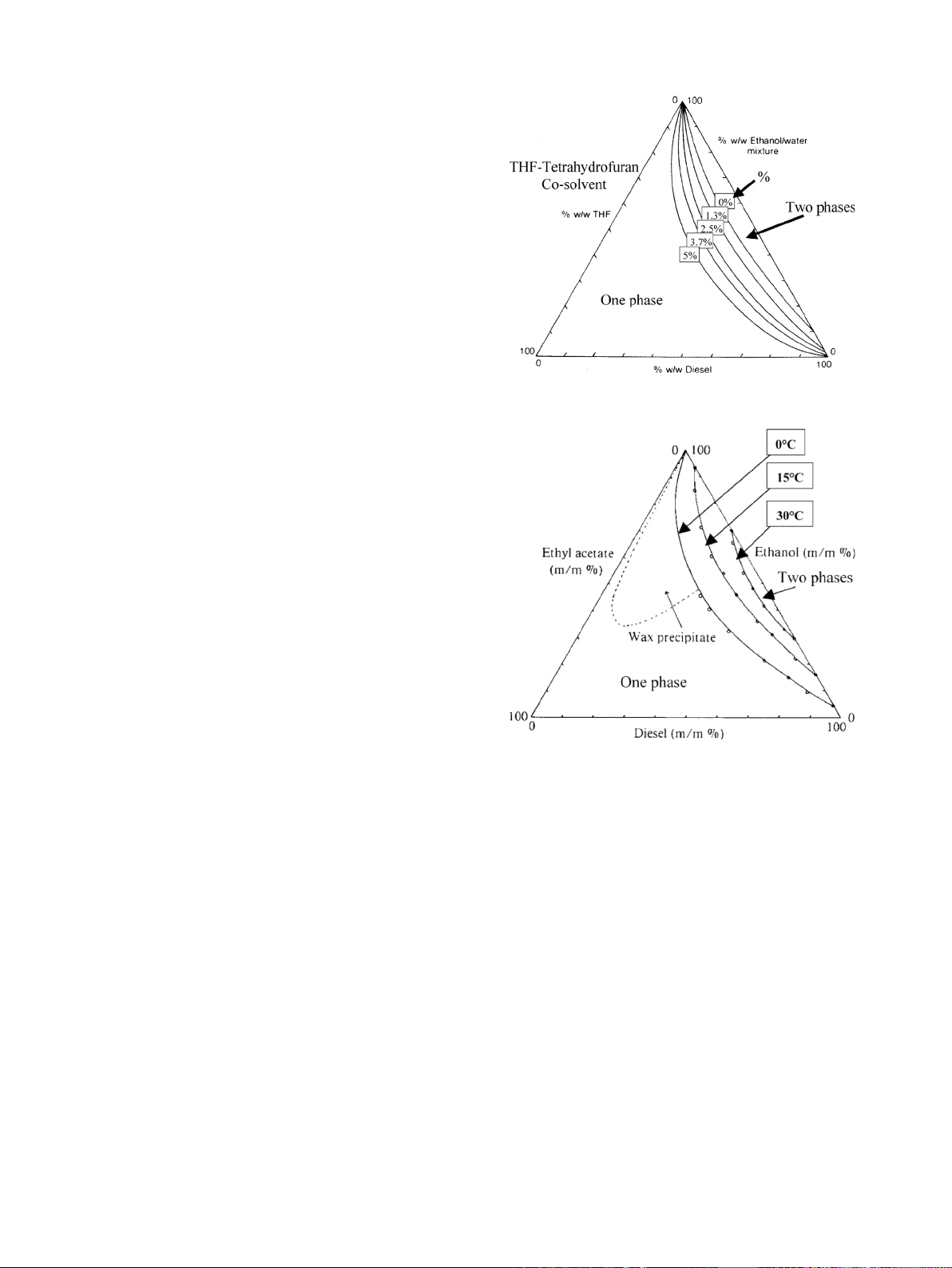
the fuel blend to sustain a homogenous blend can be illustrated in
Fig. 1. Liquid–liquid ternary phase diagram for diesel fuel, tetrahydrofuran and
ethanol or ethanol water mixtures with the temperature controlled at 0 1C[31].
Fig. 2. Liquid–liquid ternary phase diagram for diesel fuel, ethyl acetate and dry
(anhydrous) ethanol mixtures [31].
S.A. Shahir et al. / Renewable and Sustainable Energy Reviews 32 (2014) 379–395382
a ternary liquid–liquid phase diagram. Two such ternary liquid–
liquid phase diagrams are shown below under title Figs. 1 and 2.
Letcher [31] finally ended up with the conclusion that the
proportion of ethyl acetate to ethanol should be consistently 1:2
to guarantee a consistent homogenous fuel blend down to 0 1C.
Rahimi et al. [41] found that the temperature of phase separa-
tion up to 4–5% bioethanol in typical diesel fuel is identical to the
cloud point of the pure diesel fuel. Thus blending up to 4–5%
bioethanol places no additional temperature restrictions on these
fuels (if no water is present), for example, blending bioethanol
with a zero aromatic diesel increased cloud point by nearly 25 1C
at 5% bioethanol. Thus, it can be seen that the chemical properties
of diesel fuel have a large effect on bioethanol solubility. They
added sunflower methyl ester as biodiesel to increase the mis-
cibility of bioethanol in diesel. Experimental results showed that at
ambient temperature, 12% bioethanol could be dissolved in diesel.
But when they increased the share of bioethanol in the blend or
when the temperature decreased the observed phase separation.
By adding 8% biodiesel to the blend they found increased fuel
stability at low temperature close to the diesel fuel pour point
without any phase separation [41].
Kwanchareon et al. [37] studied the phase stability of the
ternary blend at room temperature by utilizing ethanol of three
different concentrations (95%, 99.5%, and 99.9%). This was impor-
tant because as the ethanol concentration affects the phase
stability directly. Their findings are presented below by using
ternary liquid–liquid phase diagrams of diesel, biodiesel and
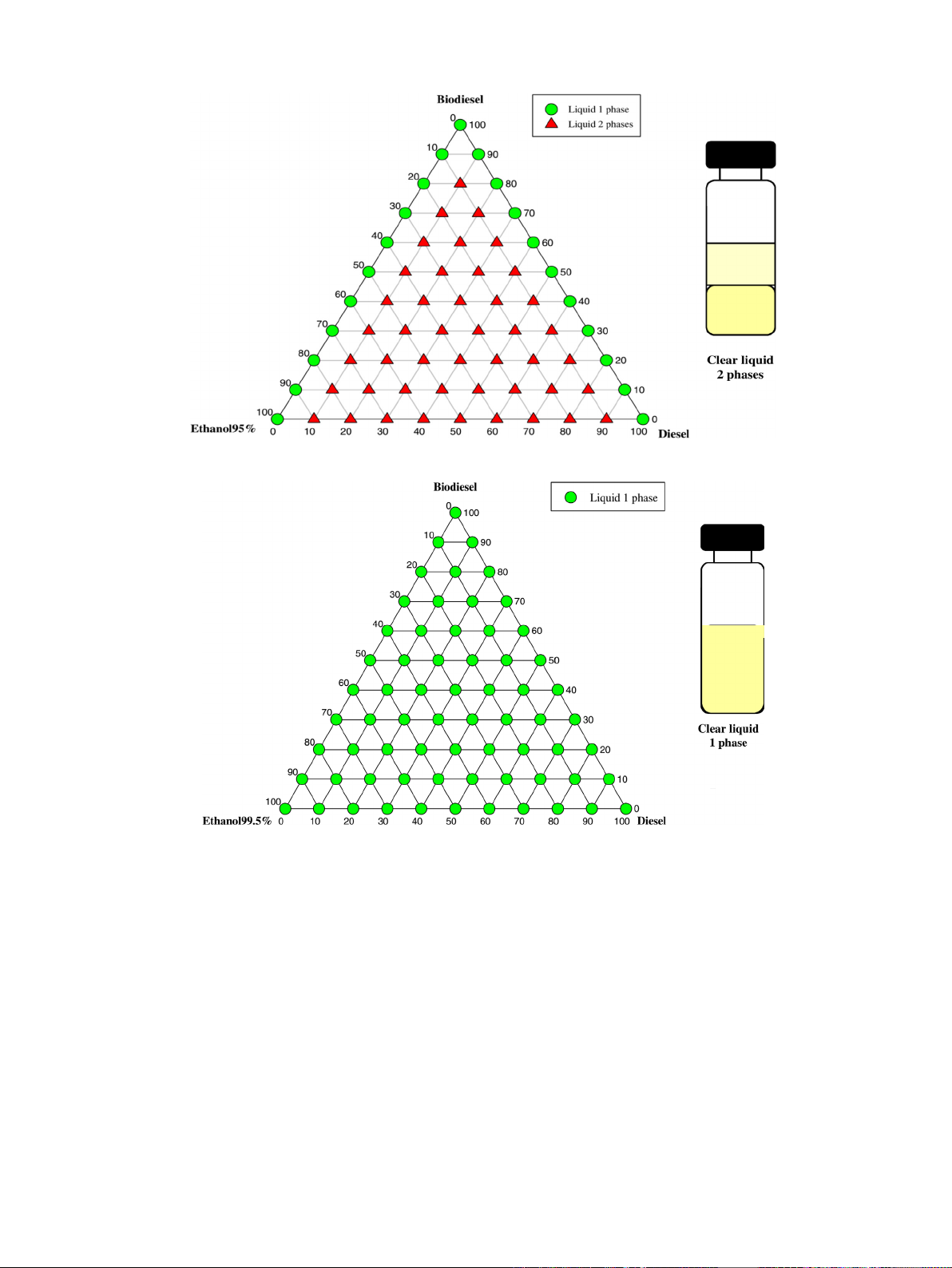
ethanol. The phase behavior of the diesel–biodiesel–ethanol
(95%) system is presented below in Fig. 3 at room temperature.
As 95% ethanol contains 5% water, the investigators found the
diesel and its blend insoluble. This happens because of the high
polarity of water. This large portion of water in the ethanol
enhances the polar part within an ethanol molecule. Thus diesel
fuel, which is a non-polar molecule, cannot be compatible with
95% pure ethanol. Biodiesel is completely soluble in 95% ethanol in
all proportions which is similar to its solubility in diesel fuel. But in
this case, they found that even adding biodiesel with this diesel–
ethanol (95%) blend did not increase the inter-solubility of the
Fig. 3. Diesel–biodiesel–ethanol 95% at room temperature [37].
Fig. 4. Diesel–biodiesel–ethanol 99.5% at room temperature [37].
S.A. Shahir et al. / Renewable and Sustainable Energy Reviews 32 (2014) 379–395 383






![Bài giảng Kỹ thuật điện - điện tử ô tô [chuẩn nhất]](https://cdn.tailieu.vn/images/document/thumbnail/2026/20260121/hoatrami2026/135x160/37681769069450.jpg)


![Câu hỏi ôn tập Truyền động điện [mới nhất]](https://cdn.tailieu.vn/images/document/thumbnail/2025/20250613/laphong0906/135x160/88301768293691.jpg)
![Giáo trình Kết cấu Động cơ đốt trong – Đoàn Duy Đồng (chủ biên) [Phần B]](https://cdn.tailieu.vn/images/document/thumbnail/2025/20251120/oursky02/135x160/71451768238417.jpg)


