
Original
article
Long-term
effects
of
culture
establishment
from
shoot-tip
explants
in
micropropagating
oak
(Quercus
robur
L)
B
Juncker,
JM
Favre
Université
de
Nancy
I,
Faculté
des
Sciences,
Laboratoire
de
Biologie
des
Ligneux,
BP
239,
54506
Vandœuvre
cedex,
France
(Received
11
December
1992;
accepted
2
February
1994)
Summary —
This
paper
describes
a
method
of
in
vitro
culture
establishment
from
shoot-tip
explants
taken
from
juvenile
and
mature
plant
material
for
oak
(table
I).
The
cultures
established
from
shoot-tips
were
then
compared
with
cultures
derived
from
nodal
explants
for
decontamination,
their
initial
reac-
tivity
and
their
potential
for
long-term
propagation.
For
the
decontamination,
the
results
showed
that
the
use
of
shoot-tip
explants
is
useful
only
when
culture
establishement
must
be
made
directly
from
source-plants
growing
in
situ
(table
II).
Otherwise,
the
use
of
nodal
explants
taken
from
source-plants
that
are
maintained
under
active
growth
and
controlled
sanitary
conditions
is
more
advisable
due
to
a
better
initial
reactivity.
As
regards
the
potential
for
long-term
propagation,
the
culture
establishment
from
shoot-tips
appeared
truly
interesting
only
in
the
case
of
recalcitrant
clones
and/or
insufficient
opti-
mization
of
the
culture
methods
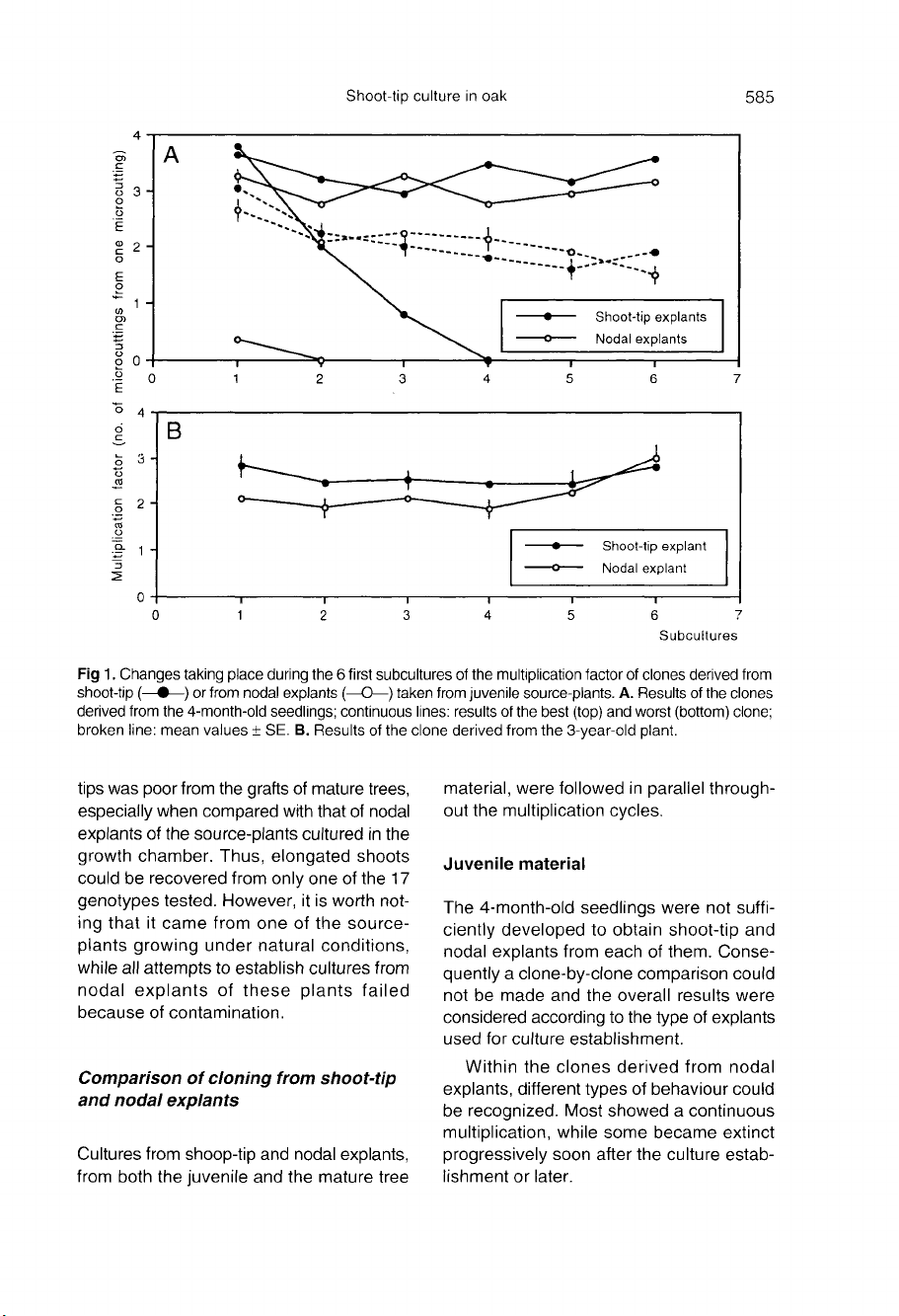
(fig
1).
However,
this
positive
effect
attenuated
after
a
6-7
month
cul-
ture
period,
and
the
clonal
effects
and
the
management
of
the
media
became
the
determining
factors
of
the
culture
behaviour
whatever
the
initial
explant
used
(fig
2).
shoop-tip
explant
/
decontamination
/
long-term
propagation
/
Quercus
robur
L
/
mature
plant
material
/ juvenile
plant
material
Résumé —
Effets
à
long
terme
de
l’introduction
in
vitro
à
partir
de
méristèmes
sur
la
micro-
propagation
du
chêne
(Quercus
robur L).
L’article
décrit
chez
le
chêne
les
conditions
d’obtention
d’un
clonage
in
vitro
à
partir
de
méristèmes
prélevés
sur
du
matériel
juvénile
et
sur
du
matériel
mature
(tableau
I).
Il
compare
ensuite,
sur
le
plan
de
la
décontamination,
de
la
réactivité
initiale
et
de
la
mul-
tiplication
à
long
terme,
le
comportement
de
cultures
issues
de
méristèmes
à
celui
de
cultures
issues
de
boutures
de
nœuds
Les
résultats
montrent
que,
sur
le
plan
de
la
décontamination,
l’utilisation
de
méristèmes
n’est
utile
que
lorsque
le
matériel
végétal
doit
être
prélevé
directement
in
situ
(tableau
II).
Dans
le
cas
contraire,
il
est
préférable
d’initier
les
cultures
à
partir
de
nœuds
prélevés
sur
des
pieds-
Abbreviations:
AC
=
activated
charcoal;
BA
=
6-benzylaminopurine;
2iP
=
2-isopentenyladenine;
Z
=
zeatine;
MS
=
Murashige
and
Skoog;
GD
=
Gresshoff
and
Doy.
*
Correspondence
and
reprints
mères
maintenus
en
croissance
active
dans
des
conditions
sanitaires
contrôlées,
en
raison
d’une
meilleure
réactivité
initiale.
Sur le
plan
multiplication
à
long
terme,
la
culture
de
méristèmes
ne
s’avère
réellement
intéressante
que
dans
le
cas
de
clones
récaltritrants,
ou
lorsque
les
protocoles
de
culture
sont
insuffisamment
optimisés
(fig
1).
Cet
effet
positif
n’est
cependant
que
transitoire.
Au-delà
des
6-7
pre-
miers
mois
qui
suivent
la
mise
en
culture,
il
s’atténue
et
ce
sont
les
effets
clonaux
ainsi
que
la
gestion
des
milieux
qui
déterminent
le
comportement
des
cultures,
quel
que
soit
le
type
d’explant
initial
(fig
2).
culture
de
méristèmes / décontamination / multiplication
à
long
terme/Quercus
robur
L/maté-
riel
mature / matériel juvénile
INTRODUCTION
In
vitro
culture
establishment
from
shoot-
tip
explants
potentially
offers
2
kinds
of
advantages
in
cloning
forest
trees.
Firstly,
in
vitro
propagation
of
forest
trees
and
other
woody
plants
is
often
limited
by
latent
inter-
nal
bacteria
or
fungi
(Bastiaens,
1983).
These
contaminants
make
the
initial
decon-
tamination
of
the
explants
difficult.
Even
in
apparently
healthy
cultures,
they
may
reap-
pear
after
several
transfers
causing
prob-
lems
in
the
cloning
(Cornu
and
Michel,
1987;
Fisse
et al,
1987;
McGranaham
et
al,
1988).
In
the
face
of
these
problems,
culture
establishment
from
shoot-tip
explants,
which
have
a
low
concentration
of
contaminants,
is
an
interesting
option
as
demonstrated
by
numerous
examples
of
recovering
virus-free
plants
(Morel
and
Mar-
tin,
1952;
Wang
and
Hu,
1980),
fungi-free
plants
(Baker
and
Phillips,
1962),
and
bac-
teria-free
plants
(Knauss,
1976;
Theiler,
1977;
Moncousin,
1980)
from
infected
stocks.
In
walnut,
data
showed
that
this
method
is
more
reliable
for
definitive
decon-
tamination
than
antibiotic
treatments
(Meynier
and
Arnould
1989).
Secondly,
physiological
aging
reduces
the
ability
to
propagate
vegetatively
(Mar-
tin,
1977;
Bonga,
1982;
Hackett,
1985).
Hence,
cloning
genetically
assessed
mature
trees
is
often
problematic.
Pretreatments
of
the
source-plants,
such
as
pruning,
hedg-
ing,
serial
graftings
(Franclet,
1981a,b;
Copes,
1983;
Saint-Clair
et al,
1985;
Bonga,
1987),
application
of
cytokinins
(Franclet,
1981 b;
Bouriquet
et al,
1985)
or fertilization
(Barnes
and
Bengston
1968,
Dumas
1987),
may
improve
the
physiological
state
of
the
explants
and
make
further
in
vitro
cloning
easier.
However,
these
treatments
are
awk-
ward
and
need
time.
So,
direct
culture
estab-
lishment
from
explants
with
high
organo-
genetic
potential,
such
as
meristems,
has
been
used
as
a
means
of
improving
the
reactivity
of
cultures
established
from
mature
source-plants
(Rodriguez,
1982;
Meynier,
1985;
Walker,
1986).
Indeed,
Monteuuis
(1991)
reported
that
culture
establishment
from
shoot-tip
explants
could
restore
active
growth,
rooting
ability
and
juvenile
leaf
mor-
phology
from
a
100-year-old
tree
of
Sequoiadendron
giganteum.
In
Quercus
robur,
in vitro
propagation
from
stem
explants
has
been
achieved
(Chalupa,
1984,
1988, 1993;
Vieitez
et al,
1985;
Favre
and
Juncker,
1987;
Meier-
Dinkel,
1987;
San-Jose
et al,
1988;
Meier-
Dinkel
et al,
1993).
However,
the
initial
decontamination
remains
a
barrier,
and
even
when
successful
cloning
is
obtained,
grad-
ual
or
sudden
extinction
may
occur
espe-
cially
in
the
case
of
adult
clones
(Juncker
and
Favre,
1989;
Slak
and
Favre,
1990).
We
therefore
tested
methods
of
shoot-
tip
culture
to
improve
the
initial
decontami-
nation
and
the
potential
for
long-term
prop-
agation.
We
compared
the
behaviour
of
several
clones
established
from
nodal
and
shoot-tip
explants
derived
from
both
juve-
nile
and
mature
plant
materials.
MATERIALS
AND
METHODS
Source-plants
Three
types
of
source-plants
were
used.
Actively
growing
4-month-old
seedlings
(28
genotypes)
were
obtained
from
acorns
collected
in
NE
France
and
cultured
at
26
±
1°C
under
con-
tinuous
lighting
in
a
peat/vermiculite
mixture
(2:1)
fertilized
once
a
month
with
the
Coic
and
Lesaint
solution
(1973).
They
were
periodically
sprayed
with
a
0.4
g.l
-1
benomyl
solution.
Nodal
explants
were
taken
from
all
the
genotypes,
and
shoot-tip
explants
from
only
14
of
them.
One
actively
growing
3-year-old
plant
was
obtained
from
seed
and
cultured
under
the
same
conditions
as
the
4-month-old
seedlings.
Both
nodal
and
shoot-tip
explants
were
prepared
from
this
plant.
Two-
to
6-year-old
grafts
of
mature
trees
(age
80-100
years)
were
obtained
from
one
site
in
the
Fontain
forest
(France),
and
were
grown
under
the
same
conditions
of
active
growth
as
the
seedlings
(8
genotypes),
or
in
the
nursery
under
natural
conditions
(12
genotypes).
Shoot-tip
explants
were
collected
from
5
out
of
the
8
genotypes
grown
in
the
growth
chamber
and
from
the
12
genotypes
grown
in
the
nursery.
Nodal
explants
were
prepared
from
all
the
geno-
types
grown
in
the
growth
chamber,
and
from
7
out
of
the
12
genotypes
grown
in
the
nursery.
In
vitro
culture
Five-centimetre-long
stem
explants
with
swelling
buds
were
cleaned
in
tap
water
containing
a
few
drops
of
a
commercial
disinfectant
(Mercryl lau-
rylé®),
and
then
dipped
into
ethanol
60%
for
10
sec.
Shoot-tip
explants
consisting
of
the
apical
dome
flanked
by
1-2
leaf
primordia
were
excised
under
a
stereomicroscope
and
planted
3
per
Petri
dish
(55
mm)
on
the
following
basic
medium
(BM):
-
half-strength
MS
macronutrients
(Murashige
and
Skoog,
1962)
with
1/4
NH
4
NO
3;
-
full
strength
MS
micronutrients
(Murashige
and
Skoog, 1962);
-
MS
vitamin
solution
(Murashige
and
Skoog,
1962)
complemented
with
10
mg•l
-1
glutamine
and
10
mg•l
-1
asparagine;
-
30
g•l
-1
sucrose;
-
agar
(Touzart
and
Matignon)
7
g•l
-1
.
Depending
on
the
experiment
BM
was
com-
plemented
with
either
AC
2
g•l
-1
(=
BM
AC)
or
cytokinins
(=
BM
Cyt):
0.1
mg•l
-1
,
2iP
0.1
mg•l
-1
,
Z,
0.1
and
0.25
mg•l
-1
BA.
The
cultures
were
grown
in
a
growth
chamber
at
26
+
1°C
under
a
16
h
long
photoperiod
(40
μE•m
-2
•s
-1).
Shoots
derived
from
nodal
explants
and
from
shoot-tip
explants
were
cloned
into
test
tubes
(25
x
200
mm),
either
on
a
BM
Cyt
medium
with
BA
0.1
mg•l
-1
in
a
continuous
manner
(Juncker
and
Favre,
1989),
or
alternately,
on
the
BM
Cyt
and
the
GD
medium
(macronutrients
according
to
Gresshoff
and
Doy,
1972)
with
the
same
con-
centration
of
BA.
The
duration
of
the
culture
cycles
was
6
weeks.
RESULTS
Shoot
growth
recovery
from
shoot-tip
explants
Shoot-tip
explants
were
established
on
BM,
BM
AC,
and
BM
Cyt.
On
BM
and
BM
AC
growth
recovery
did
not
occur.
All
explants
became
necrotic
within
3
weeks
of
culture,
whatever
the
type
of
source-plant.
On
BM
Cyt,
the
reactivity
was
better.
Shoot-tip
explants
enlarged
within
the
first
2
weeks
of
culture.
During
the
third
week,
the
1-2
initial
leaf
primordia
of
explants
expanded.
Rosette
formation
(new
formed
leaf
pieces)
occurred
during
the
fourth
week
and
2
weeks
later
the
rosettes
exhibited
swelling
axillary
buds.
Two
months
after
the
excision,
elongation
of
both
main
and
some
axillary
buds
occurred.
The
cloning
into
test
tubes
could
begin.
However,
the
results
varied
strongly
according
to
the
type
and/or
the
concen-
tration
of
the
cytokinin
used
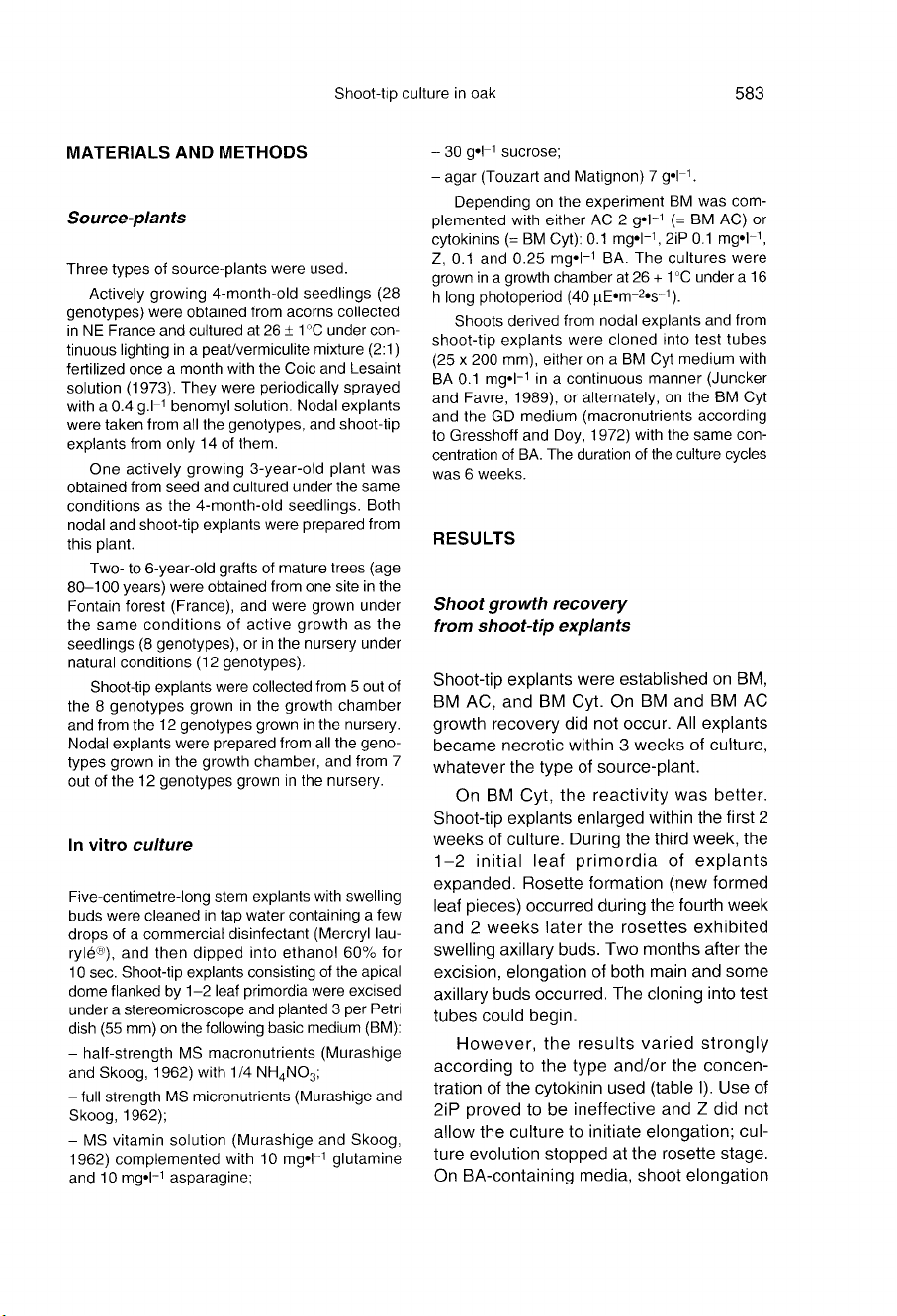
(table
I).
Use
of
2iP
proved
to
be
ineffective
and
Z
did
not
allow
the
culture
to
initiate
elongation;
cul-
ture
evolution
stopped
at
the
rosette
stage.
On
BA-containing
media,
shoot
elongation
could
be
recovered,
but
at
concentrations
exceeding
0.1
mg•l
-1
the
rosettes
exhib-
ited
high
levels
of
vitrification
and
basal
callogenesis
that
prevented
further
growth
and
cloning.
The
source-plant
also
influenced
the
cul-
ture
behaviour
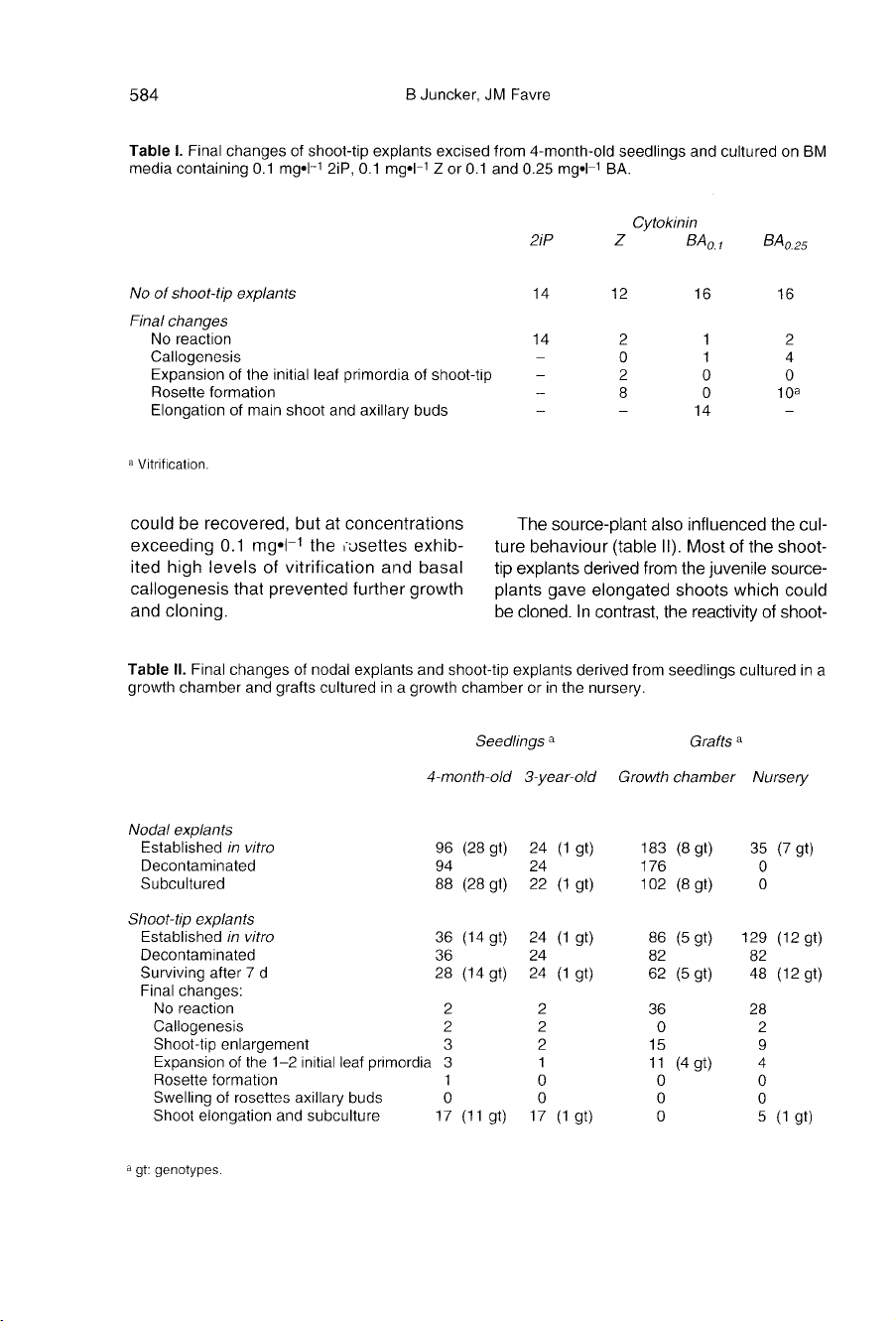
(table
II).
Most
of
the shoot-
tip
explants
derived
from
the
juvenile
source-
plants
gave
elongated
shoots
which
could
be
cloned.
In
contrast,
the
reactivity
of
shoot-
tips
was
poor
from
the
grafts
of
mature
trees,
especially
when
compared
with
that
of
nodal
explants
of
the
source-plants
cultured
in
the
growth
chamber.
Thus,
elongated
shoots
could
be
recovered
from
only
one
of
the
17
genotypes
tested.
However,
it
is
worth
not-
ing
that
it
came
from
one
of
the
source-
plants
growing
under
natural
conditions,
while
all
attempts
to
establish
cultures
from
nodal
explants
of
these
plants
failed
because
of
contamination.
Comparison
of
cloning
from
shoot-tip
and
nodal
explants
Cultures
from
shoop-tip
and
nodal
explants,
from
both
the
juvenile
and
the
mature
tree
material,
were
followed
in
parallel
through-
out
the
multiplication
cycles.
Juvenile
material
The
4-month-old
seedlings
were
not
suffi-
ciently
developed
to
obtain
shoot-tip
and
nodal
explants
from
each
of
them.
Conse-
quently
a clone-by-clone
comparison
could
not
be
made
and
the
overall
results
were
considered
according
to
the
type
of
explants
used
for
culture
establishment.
Within
the
clones
derived
from
nodal
explants,
different
types
of
behaviour
could
be
recognized.
Most
showed
a
continuous
multiplication,
while
some
became
extinct
progressively
soon
after
the
culture
estab-
lishment or
later.


%20--%3e%3cdefs%3e%3cstyle%3e%20.st0%20{%20fill:%20%23fff;%20}%20.st1%20{%20fill:%20%237800fa;%20}%20%3c/style%3e%3c/defs%3e%3cpath%20class='st1'%20d='M117.78,12.18H43.11c2.9,3.47,4.65,7.94,4.65,12.82,0,5.6-2.3,10.66-6.01,14.29h76.02l7.22-13.56-7.22-13.56Z'/%3e%3cg%3e%3cpath%20class='st0'%20d='M53.58,26.17h-.59v-1.46h.59v-4.96h2.83c1.78,0,2.67.94,2.67,2.82v5.76c0,1.87-.89,2.81-2.67,2.81h-2.83v-4.96ZM55.36,21.37v3.34h1.1v1.46h-1.1v3.34h1.01c.61,0,.91-.37.91-1.1v-5.93c0-.74-.3-1.1-.91-1.1h-1.01Z'/%3e%3cpath%20class='st0'%20d='M65.99,31.14h-1.8l-.31-2.07h-2.19l-.31,2.07h-1.64l1.82-11.39h2.62l1.82,11.39ZM65.28,18.04c-.25.46-.51.77-.75.94-.21.15-.47.22-.79.22-.26,0-.57-.07-.92-.22l-.38-.15c-.14-.05-.26-.07-.37-.07-.3,0-.53.18-.71.54l-.91-.68c.25-.46.51-.77.75-.94.21-.14.48-.21.79-.21.26,0,.57.07.92.21l.38.15c.14.05.26.07.37.07.3,0,.53-.18.71-.54l.91.68ZM61.91,27.52h1.73l-.87-5.76-.87,5.76Z'/%3e%3cpath%20class='st0'%20d='M74.53,26.89v1.52c0,1.91-.89,2.86-2.67,2.86s-2.67-.95-2.67-2.86v-5.93c0-1.91.89-2.86,2.67-2.86s2.67.95,2.67,2.86v1.11h-1.69v-1.22c0-.75-.31-1.12-.93-1.12s-.93.37-.93,1.12v6.15c0,.74.31,1.11.93,1.11s.93-.37.93-1.11v-1.63h1.69Z'/%3e%3cpath%20class='st0'%20d='M81.4,31.14h-1.8l-.31-2.07h-2.19l-.31,2.07h-1.64l1.82-11.39h2.62l1.82,11.39ZM75.9,19.2l1.52-1.91h1.71l1.51,1.91h-1.61l-.76-.95-.75.95h-1.61ZM77.32,27.52h1.73l-.87-5.76-.87,5.76ZM83.1,15.99l-1.76,1.91h-1.26l1.17-1.91h1.86Z'/%3e%3cpath%20class='st0'%20d='M84.86,19.75c1.78,0,2.67.94,2.67,2.82v1.48c0,1.87-.89,2.81-2.67,2.81h-.85v4.28h-1.79v-11.39h2.64ZM84.01,21.37v3.86h.85c.58,0,.87-.36.87-1.08v-1.71c0-.71-.29-1.07-.87-1.07h-.85Z'/%3e%3cpath%20class='st0'%20d='M93.51,19.75c1.78,0,2.67.94,2.67,2.82v1.48c0,1.87-.89,2.81-2.67,2.81h-.85v4.28h-1.79v-11.39h2.64ZM92.66,21.37v3.86h.85c.58,0,.87-.36.87-1.08v-1.71c0-.71-.29-1.07-.87-1.07h-.85Z'/%3e%3cpath%20class='st0'%20d='M98.8,31.14h-1.79v-11.39h1.79v4.88h2.03v-4.88h1.83v11.39h-1.83v-4.88h-2.03v4.88Z'/%3e%3cpath%20class='st0'%20d='M105.36,24.55h2.46v1.62h-2.46v3.34h3.09v1.63h-4.88v-11.39h4.88v1.63h-3.09v3.18ZM108.17,17.29l-1.76,1.91h-1.26l1.17-1.91h1.86Z'/%3e%3cpath%20class='st0'%20d='M112.2,19.75c1.78,0,2.67.94,2.67,2.82v1.48c0,1.87-.89,2.81-2.67,2.81h-.85v4.28h-1.79v-11.39h2.64ZM111.35,21.37v3.86h.85c.58,0,.87-.36.87-1.08v-1.71c0-.71-.29-1.07-.87-1.07h-.85Z'/%3e%3c/g%3e%3ccircle%20class='st1'%20cx='25'%20cy='25'%20r='20'/%3e%3cpath%20class='st0'%20d='M32.78,19.27c2.92,0,4.43,2.55,5.28,5.33l.71,2.17c.14.38-.33.75-.71.75h-5.61c.19-.33.24-.71.09-1.08l-.75-2.45c-.43-1.32-.99-2.64-1.79-3.77.75-.57,1.65-.94,2.78-.94h0ZM25,18.38c3.25,0,4.9,2.78,5.89,5.89l.76,2.45c.14.42-.33.8-.8.8h-11.69c-.42,0-.94-.38-.8-.8l.75-2.45c.99-3.11,2.64-5.89,5.89-5.89h0ZM25,11.35c1.74,0,3.11,1.37,3.11,3.11s-1.37,3.11-3.11,3.11-3.11-1.41-3.11-3.11,1.41-3.11,3.11-3.11h0ZM17.27,19.27c1.08,0,1.98.38,2.73.94-.8,1.13-1.37,2.45-1.74,3.77l-.8,2.45c-.14.38-.05.75.09,1.08h-5.56c-.42,0-.9-.38-.75-.75l.71-2.17c.9-2.78,2.41-5.33,5.33-5.33h0ZM17.27,12.91c1.51,0,2.78,1.27,2.78,2.83s-1.27,2.83-2.78,2.83-2.83-1.27-2.83-2.83,1.27-2.83,2.83-2.83h0ZM32.78,12.91c1.56,0,2.78,1.27,2.78,2.83s-1.23,2.83-2.78,2.83-2.83-1.27-2.83-2.83,1.27-2.83,2.83-2.83h0ZM27.07,28.56v.09c0,.57-.24,1.08-.61,1.46h0v.05c-.38.33-.9.57-1.46.57s-1.08-.24-1.46-.61h0c-.38-.38-.61-.9-.61-1.46v-.09h1.41v.09c0,.19.05.38.19.47v.05c.09.09.28.19.47.19s.38-.09.47-.19v-.05c.14-.09.24-.28.24-.47t-.05-.09h1.41ZM30.99,28.56v.09c0,1.65-.66,3.16-1.74,4.24-1.08,1.08-2.59,1.79-4.24,1.79s-3.16-.71-4.24-1.79l-.05-.05c-1.04-1.08-1.7-2.55-1.7-4.2v-.09h1.41v.09c0,1.27.47,2.4,1.27,3.25h.05c.85.85,1.98,1.37,3.25,1.37s2.4-.52,3.25-1.37c.85-.8,1.37-1.98,1.37-3.25v-.09h1.37ZM34.99,28.56v.09c0,2.78-1.13,5.28-2.92,7.07-1.79,1.79-4.29,2.92-7.07,2.92s-5.23-1.13-7.07-2.92c-1.79-1.79-2.92-4.29-2.92-7.07v-.09h1.41v.09c0,2.4.94,4.53,2.5,6.08,1.56,1.56,3.72,2.5,6.08,2.5s4.52-.94,6.08-2.5c1.56-1.56,2.5-3.68,2.5-6.08v-.09h1.41Z'/%3e%3c/svg%3e)