

* Corresponding author.
E-mail addresses: ehsanpb@yahoo.com (E.Pooladi)
© 2013 Growing Science Ltd. All rights reserved.
doi: 10.5267/j.esm.2014.1.003
Engineering Solid Mechanics 2 (2014) 131-138
Contents lists available at GrowingScience
Engineering Solid Mechanics
homepage: www.GrowingScience.com/esm
Residual strains around cold worked holes from statistical view
E. Pooladia* and Kh. Farhangdoosta
aDepartment of Mechanical Engineering, Ferdowsi University of Mashhad, Mashhad, Iran
A R T I C L E I N F O A B S T R A C T
Article history:
Received September 20, 2013
Received in Revised form
October, 14, 2013
Accepted 22 January 2014
Available online
2
4
January
201
4
Cold working a hole decreases tendency of fatigue crack initiation and growth near the hole. It
is due to creation of some compressive tangential residual stresses around the hole. But there
are many uncertainties which affect the residual strain and residual stress field. In fact these
uncertainties lead to have scatter in the test results and considering the residual strains and
residual stresses as random variables. In this paper strains recorded by strain gages mounted
around the hole during cold working process in seven pieces specimens, were analyzed by
statistical tests and stochastic properties of mentioned random variables were obtained using
SPSS software. The residual strains have been also distributed by normal probability
distribution function.
© 201
4
Growing Science Ltd. All rights reserved.
Keywords:
Cold work
Experimental study
Residual strain
Residual stress
Statistical distribution
1. Introduction
Cold working process, which increases fatigue life of components, consists of pushing a mandrel
with greater diameter into the hole with smaller size; named loading step, and then removing it;
which is called unloading step. During the loading step, an annular plastic zone is created around the
hole which is surrounded by the remaining elastic region and during the unloading step, the elastic
region compresses the plastic zone and some residual stresses will be remained around the hole. In
fact, compressive tangential residual stresses around the cold-worked hole is usefull for delaying
crack initiation or decreasing fatigue crack growth rate. Obtaining residual stress field is an important
object for design and predicting the main events in the component life such as maintenance time,
reliability and so on. Some researchers have performed analytical solutions and have compared the
results with finite element method (FEM), such as Stacy and Webster (1988), Walin (1993), Pavier et.
al. (1999), Jahed et al. (2000), Zhao et al.(2003), Pinho et al. (2005), Matos et al. (2005), Hojjati and

132
Hassani (2007), Nigrelli and Pasta (2008), Su et. al. (2008), Ayatollahi and Arian Nik (2009),
Maximov et al. (2009), Reese et al. (2009) and Yan et al. (2012). Gopalakrishna et al. (2010) have
considered the effect of two kinds of the cold working process at different expansion levels on the
fatigue life. They have used strain gages mounted around the hole. Others have also suggested
experimental procedure for measuring and obtaining the residual stress field.
It should be noted that most of the available studies have considered the residual stresses resulted
by cold working in deterministic state. However, there are many uncertainties that are affected the
residual stress and material behavior around the cold worked hole which lead to have scatter in results
in same conditions. Therefore, all of the analytical relations and even experimental results; such as
the X-ray diffraction, neutron diffraction, strain gages, etc., just introduced a mean and average of the
mentioned scatter in an optimistic manner. As Sobczyk and Trebicki (2004) underlined following
statement stated by Nelson (1982) before “An assessment of predictive ability of the superposition
approach must be done with caution, since its success or lake thereof depends on accurate knowledge
of the initial residual stress field, which is often a source of considerable uncertainty in itself”. Of
course few authors were considered residual stresses as random variables too, such as Millwater et al.
(2007) which introduced a normal distribution function for residual stress.
The most important parameters which lead to have scatter results in the residual stress field due
to the cold working are: i) material properties and metallurgical processing, ii) producing process and
iii) cold working process, which cannot be separated the contribution of each ones.
i) Variation of microstructure features such as size, number and arrangement, anisotropy
properties of grains, etc. lead to considering material properties as random variables, as
Farhangdoost and Rahnama (2011) have stated before.
ii) Producing processes are quality controlled with some engineering restrictions such as
tolerances and surface quality. In fact these restrictions are used for overcome to the
drawback of manufacturer for non-uniformity of their process. Since it is impossible to
manufacture quantities of machine parts with exactly the same dimensions, systems
have been devised to tolerate small dimensional variations of the mating parts without
sacrificing their proper functioning. When a component has been manufactured in a
special tolerance range, the concerned dimension is a random variable with normal
probability function with some special famous values, named mean, variance and
standard deviation. It should be noted that the tolerance range is equal to 6 times of
standard deviation, named six-sigma rule.
iii) Cold working process: In the loading step of the cold working process, the mandrel size
is greater than the hole size and interference creates due to shrink fit. When two
components mate together by shrink fit, the difference between the shaft and the hole
sizes; interference; is a probability function which obtained by subtracting the hole size
probability function and the shaft size probability function. The expansion level defined
in cold working process; which strictly depends on interference value; is one reason for
uncertainty. In fact cold working by an exact expansion value is impossible and should
be devised with caution. The mandrel has been suggested to be rigid than the hole, but
reality some elastic deformation of the mandrel which is disregarded in analytical
solution and depends on assembling condition, affects residual stress field. Also some
other parameters such as lateral surface quality of the hole are the other uncertainty
origins which are affected the residual stress field.
According to the above explanations, the residual stresses of cold working process, are random
variables and have probability function. Consequently, statistical consideration of residual stresses
E.Pooladi and Kh.Farhangdoost / Engineering Solid Mechanics 2 (2014)
133
plays an important role for taking all uncertainties into account, of course as stated before, it is
impossible to set apart the contribution of each of parameters affected on residual stress. Measuring
surface strains around the hole has been introduced as feature for residual stress filed, as
Gopalakrishna et al (2010), Garcia-Granada et al. (2003) and Pooladi and Farhangdoost (2013) stated
before.
In this research, an experimental study has been presented for obtaining the statistical properties
of the residual strain around the cold-worked hole. Seven pieces specimens have been prepared and
cold-worked, which some strain gages mounted on each one at a defined radius. During cold
working, the strains are measured. For validation of experimental results, the strain measured by gage
has been compared with finite element result.
Results showed scatter in measured strains which can be related to the residual stress filed. It
should be noted that the all samples are completely similar to each other and produced with a same
process and the mandrel prepared for cold working, is same for all holes as well. Also the condition
of cold working test is same for all specimens. Therefore the scatter of results can be related to
inherent statistical properties of residual stresses, explained above. Results showed that the residual
strains were distributed by normal probability function. For statistical analyzing of results, SPSS
software was used.
2. Experimental procedure
Specimens prepared from a rolled sheet material; 8mm thickness; made of Al2024-T351 (which
is used frequently in aerospace industries) all in the longitudinal direction. Chemical properties of
Al2024-T351 are listed in Table 1.
Table1. Chemical properties of Al2024-T351
Si
Fe
Cu
Mn
Mg
Zn
Ti
Cr
Ni
Pb
Sn
Ca
Sb
P
Al
0.054
0.202
4.176
0.539
1.405
0.081
0.012
0.009
0.009
0.002
0.006
0.002
0.001
0.009
Remained
Main mechanical properties are included of yielding (
y) at 367.88MPa, elastic moduless (E) of
77.5GPa and ultimate strength (
ult) of 457MPa. It is evident that the mentioned values are mean of a
distribution of random variables.
As stated before, seven specimens have been made of Al2024-T351 plate with 8mm thickness
and a radial hole, 5±0.01 mm in diameter, was created by drilling and then reaming. It should be
reminded that producing process such as production temperature, humidity, speed of drilling and
reaming and also quality of tools in machining are all the same and is not differed from one specimen
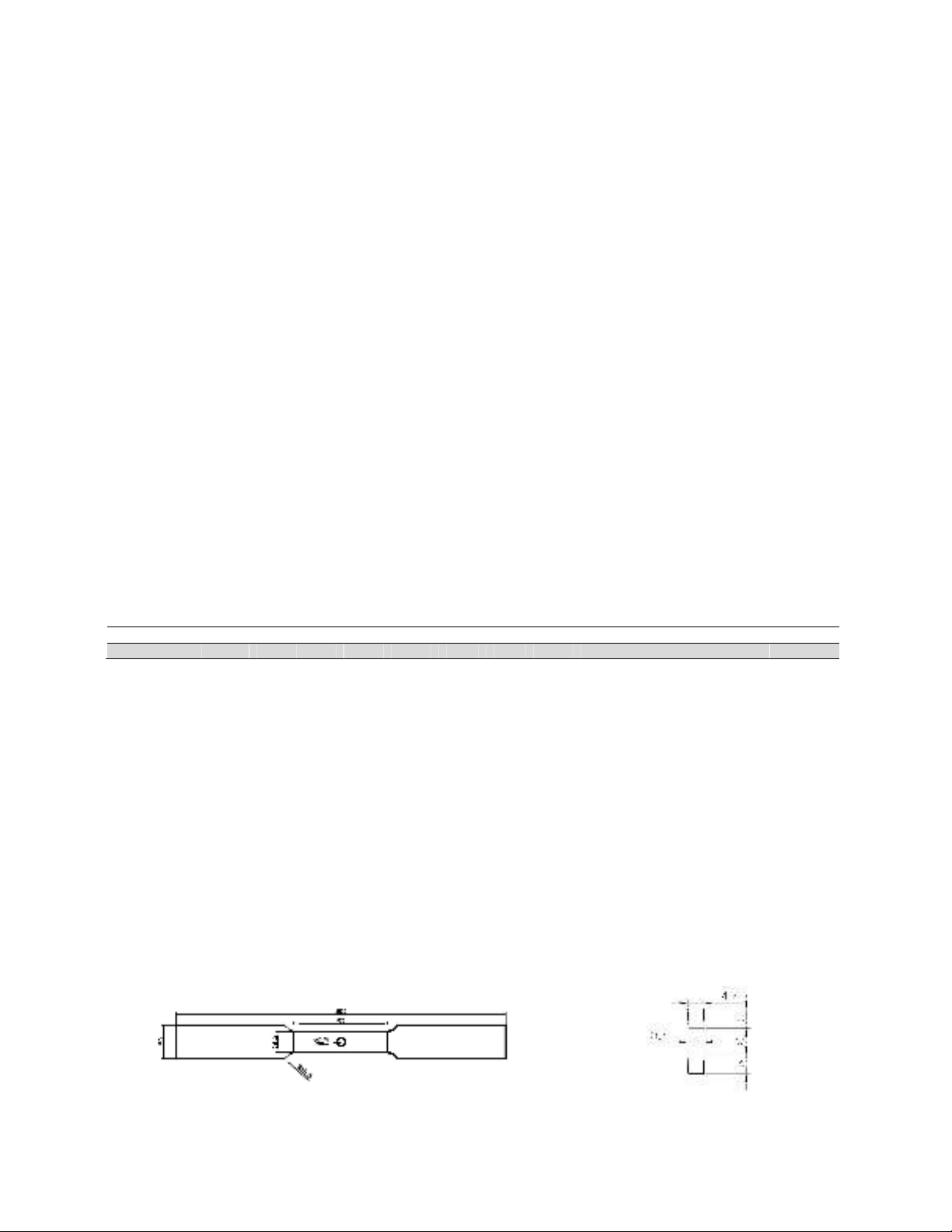
to another. The mandrel was made in tapered shape with maximum diameter 5.2±0.01 mm which
creates 4% nominal expansion. Figs.1 and 2 show the shop drawing of the plate and the mandrel. The
mandrel was made of SPK steel alloy (which is suitable for ramrod and piston, etc.) with E = 210GPa
and Poisson's ratio (
) equals to 0.3. On all specimens, a ±350Ω resistance strain gages was mounted
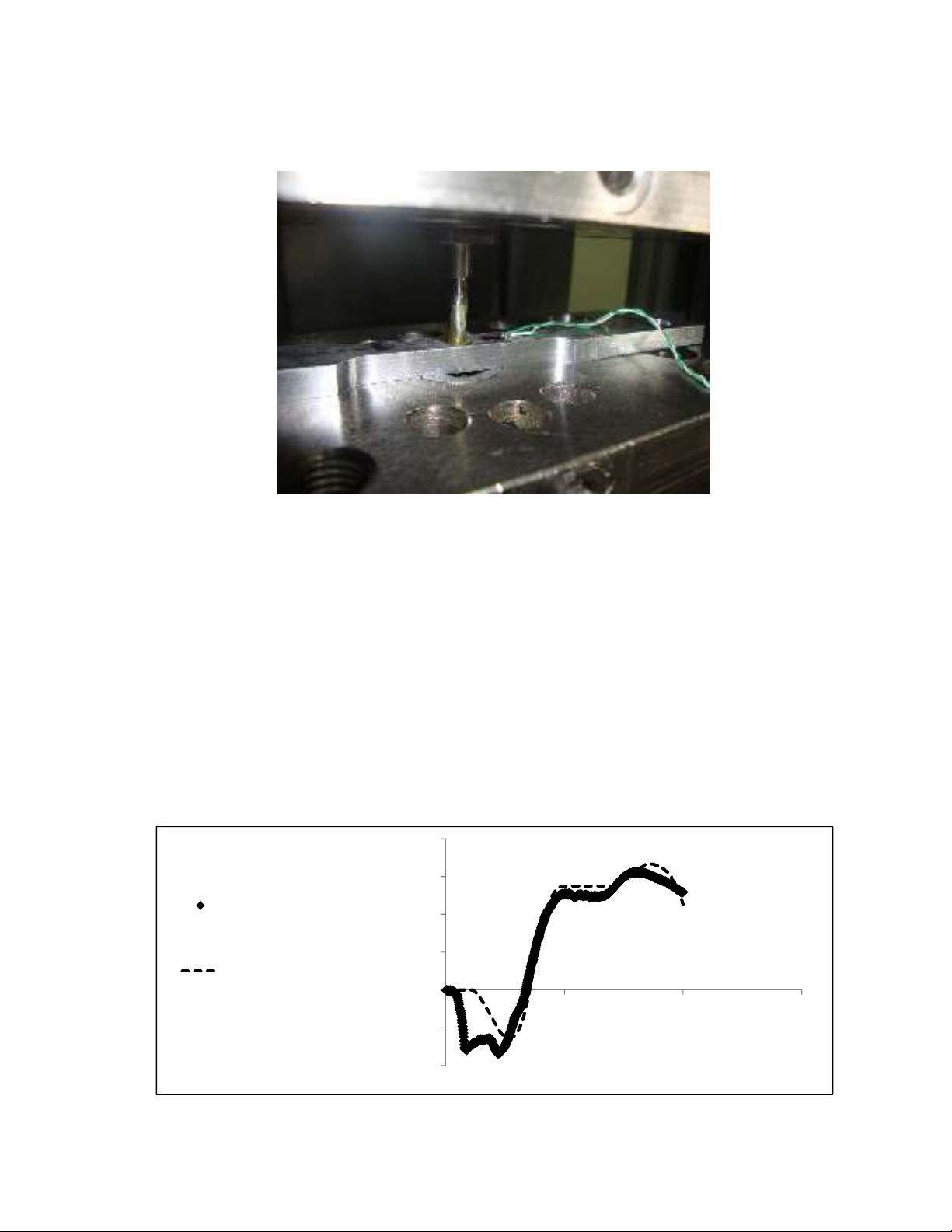
radially at r=10.5mm and θ=0° (from the center of hole). Fig.3 shows a specimen with gage mounted
on it, during cold working process. Lubrication between the mandrel and the hole was used for
minimizing friction effect.
Fig. 1. Shopping drawing of plate Fig. 2. Tapered mandrel
134
Cold working process was performed by universal ZWICK Z250. The mandrel pushed into the
hole with a constant speed (2mm/min). During the cold working process, the strains recorded by a
logger based on Wheatstone bridge. As stated before, using the strain values read by the gage and
substitution into one of the analytical relationship leads to drive residual stress field.
Fig. 3. Cold working process on specimen with mounted a gage at r=10.5mm
3. Results
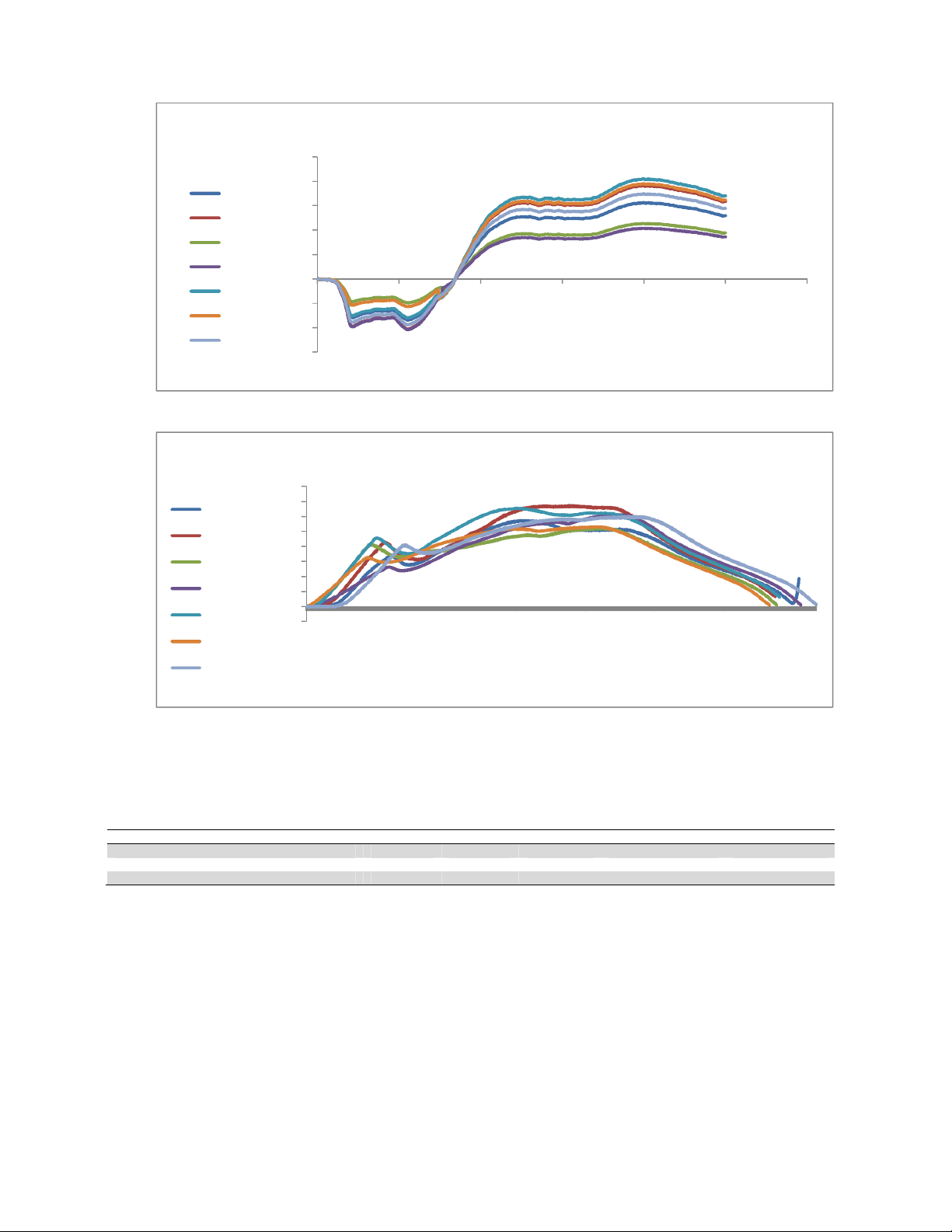
As stated before, surface strain around the hole at a defined radius, r=10.5mm; was measured by
the strain gage mounted on the specimens. Fig.4 shows variation of strain versus time of the cold
working in one sample and FEM result which is verified the experimental procedure for measuring
the strains.
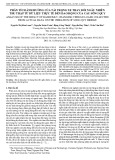
Scatter of the strains in all specimens has been shown in Fig. 5 and scatter of pushing force on the
mandrel during cold working has been shown in Fig .6. As predicted before, there is scatter in
experimental results which are related to the inherent nature and mentioned origins of residual
stresses. At the defined radius; r=10.5mm; and same conditions in all tests, strains are distributed as
random variables. Also the force acting on the mandrel for moving and removing into the hole is
distributed with a probability function. Statistical analysis of the two mentioned sets of random
variables has performed by SPSS15 software. Special points of process in all specimens have been
taken into consideration.
Fig. 4. Strain variations versus time change during cold working at r=10.5mm
-0.001
-0.0005
0
0.0005
0.001
0.0015
0.002
0 0.5 1 1.5
radial strain
time/total time
experimental
results
FEM
E.Pooladi and Kh.Farhangdoost / Engineering Solid Mechanics 2 (2014)
135
Fig. 5. Scatter of strain rate of various specimens during cold working for seven specimens (A to K) examined
Fig. 6. Scatter of pushing force on the mandrell in the tested specimens
The statistical properties of the strains at the end of loading and the end of unloading step (i.e.
residual strain; and the pushing force; at maximum stat) has been shown in Table2.
Table 2. Statistical descriptive of strain
Minimum maximum Mean variance Standard deviation
Loading strain 0.00082482 0.001628141 0.00129233 1.01837576e-007 0.00031912
Residual strain 0.000861534 0.001700623 0.001349859 1.11107611848e-007 0.00033333
Maximum Pushing force acting on the mandrel(N) 5231.99 6724.32 5953.117 322167.6285905 567.5981224339
The probability of the above random variables has been checked with P-P plot statistic test in
normal state. In the P-P plot test, the coincidence of normal probability distribution function (bisector
of 1st and 3rd zone in plane) with the test results is criterion for specifying whether test results
distributed in normal probability function or not.
Also some other statistic tests such as one-sample Kolmogorov-Sminrov can be used. The feature is
used for being true or not the hypothesis (characterization the normal distribution function) in
Kolmogorov-Sminrov test is named P-Value (2-tailed sig.) which should be greater than 0.05
(acceptable error level in statistical tests), as the greater P-value and the nearer to 1, the more strongly
our hypothesis (here, normal distribution of random variables) will be true. The P-P plots of strains
have been shown in Fig.7 and Fig. 8.
-0.0015
-0.001
-0.0005
0
0.0005
0.001
0.0015
0.002
0.0025
0 0.2 0.4 0.6 0.8 1 1.2
strain
time/total time
strain rate of cold working at r=10.5mm
A
B
D
H
I
J
K
-1000
0
1000
2000
3000
4000
5000
6000
7000
8000
0.00E+00
7.65E-01
1.54E+00
2.36E+00
3.19E+00
4.02E+00
4.85E+00
5.68E+00
6.51E+00
7.34E+00
8.17E+00
9.00E+00
9.83E+00
1.07E+01
1.15E+01
1.23E+01
1.31E+01
1.40E+01
1.48E+01
1.56E+01
1.65E+01
1.73E+01
1.81E+01
1.90E+01
1.98E+01
2.06E+01
2.14E+01
2.23E+01
pushing force(N)
the mandrel displacement(mm)
pushing force vs. the mandrel displacement
B
A
D
H
I
J
K





![Giáo trình Cấu trúc dữ liệu và giải thuật - Trường CĐ Cơ điện Hà Nội [Mới nhất]](https://cdn.tailieu.vn/images/document/thumbnail/2026/20260323/lionelmessi01/135x160/58171774381670.jpg)


![Giáo trình Tiện nâng cao (Nghề Cắt gọt kim loại, Trình độ Cao đẳng) - Trường Cao đẳng Cơ điện Hà Nội [Mới nhất]](https://cdn.tailieu.vn/images/document/thumbnail/2026/20260323/lionelmessi01/135x160/48101774403543.jpg)


