

www.elsevier.com/locate/atoures
Annals of Tourism Research, Vol. 31, No. 3, pp. 657–681, 2004
#2004 Elsevier Ltd. All rights reserved.
Printed in Great Britain
0160-7383/$30.00
doi:10.1016/j.annals.2004.01.010
FACTORS INFLUENCING
DESTINATION IMAGE
Asuncio
`n Beerli
Josefa D. Martı
´n
University of Las Palmas de Gran Canaria, Spain
Abstract: The aim of this paper is to develop and empirically validate a model which
explains the different factors which form the post-visit image of a destination. Based on a
literature review, this will involve analyzing the relationship between the different compo-
nents of the perceived image and the factors which influence its formation. These include
both sources of information (primary and secondary) and stimuli influencing the forming
of perceptions and evaluations of destinations pre- and post-visit, respectively, and motiv-
ation, accumulated touristic experiences and sociodemographic characteristics. Keywords:
marketing, destination image, process of destination image formation. #2004 Elsevier Ltd.
All rights reserved.
Re
´sume
´:Les facteurs qui influencent l’image des destinations. Le propos de cet article
est de de´velopper et de valider empiriquement un mode`le qui explique les diffe´rents fac-
teurs qui forment l’image d’une destination apre`s la visite. En se basant sur un bilan de la
lite´rature, on analyse la relation entre les diffe´rents e´le´ments de l’image perc¸ue et les fac-
teurs qui influencent sa formation. Ces facteurs comprennent les sources d’information
(de nature primaire ou secondaire) et les impulsions qui influencent la formation des per-
ceptions et de
˙se´valuations des destinations avant et apre`s la visite, respectivement, et les
caracte´ristiques sociode´mographiques et celles de la motivation et des experiences touris-
tiques accumule´es. Mots-cle
´s: marketing, image de destination, processus de formation de
l’image de destination. #2004 Elsevier Ltd. All rights reserved.
INTRODUCTION
The evaluation and analysis of destination image has been the sub-
ject of much attention in related academic literature, and has made a
significant contribution to a greater understanding of tourist beha-
vior. Hunt (1975) was among the first to demonstrate its importance
in increasing the number of tourists visiting destinations. Today there
exists a general consensus about the significance of the role played by
image in the process of decision making, and, by extension, choice
(Baloglu and McCleary 1999a; Chen and Kerstetter 1999; Goodrich
1978; Hunt 1975; Milman and Pizan 1995; Pearce 1982; Woodside
Asuncio
`n Beerli is Professor and Head of Marketing, University of Las Palmas de Gran
Canaria, (Campus Universitario de Tafira, C-106, 35017 Las Palmas, Spain. Email
<abeerli@dede.ulpgc.es>). She specializes in promotion, advertising, image of cities, and
tourism marketing and has published in these and related areas. Josefa Martı
´nis Professor
of Marketing at the same university and has conducted research in the same fields, resulting
in numerous journal articles.
657

and Lysonsky 1989). However, despite this increasing interest in desti-
nation image, many agree that the majority of studies carried out to
date are insufficiently theory-based, resulting in a lack of framework
or solid conceptualization.
Many studies frequently use the term ‘‘destination image’’ , but they
tend not to conceptualize this term precisely. Various authors point
out that while the concept is widely used in the empirical context, it
is loosely defined and lacks a solid conceptual structure (Fakeye and
Crompton 1991; Mazanec and Schweiger 1981). The study by Gallarza,
Gil Saura and Caldero´n Garcia (2002) featured an exhaustive review
of the literature dealing with this concept, proposing a theoretical
model defining image in terms of four characteristics: complex, mul-
tiple, relativistic, and dynamic.
The most recent studies (Baloglu and Brinberg 1997; Baloglu and
McCleary 1999a, 1999b; Gartner 1993; Walmsley and Young 1998)
tend to consider image as a concept formed by the consumer’s rea-
soned and emotional interpretation as the consequence of two closely
interrelated components: perceptive/cognitive evaluations referring
to the individual’s own knowledge and beliefs about the object (an
evaluation of the perceived attributes of the object), and affective
appraisals relating to an individual’s feelings towards the object.
From a theoretical point of view, there is general agreement that
the cognitive component is an antecedent of the affective component
and that the evaluative responses of consumers stem from their
knowledge of the objects (Anand, Holbrook and Stephens 1988;
Holbrook 1978; Russel and Pratt 1980; Stern and Krakover 1993). In
addition, the combination of these two factors produces an overall, or
compound, image relating to the positive, or negative, evaluation of
the product or brand. In the context of tourism, Baloglu and
McCleary (1999a, 1999b) and Stern and Krakover (1993) show
empirically that these perceptual/cognitive and affective evaluations
have a direct influence on the overall image, and also that the for-
mer, through the latter, has an indirect influence on that image.
Related professional and academic papers have proposed a number
of scales to determine the different attributes relevant to measuring
perceived image. An analysis of the principal scales (Baloglu and
McCleary 1999a, 1999b; Calantone, Di Benetton, Hakam and Bojanic
1989; Chon, Weaver and Kim 1991; Echtner and Ritchie 1993; Fakeye
and Crompton 1991; Gartner 1989; Gartner and Hunt 1987; Gartner
and Shen 1992; Goodrich 1978; Hu and Ritchie 1993; Hunt 1975;
Phelps 1986; Walmsley and Jenkins 1993) reveals a lack of homogen-
eity with respect to the attributes which define an individual’s percep-
tions. Similarly, it is evident that most studies have failed to establish
the validity and reliability of the scales, casting doubt on their psycho-
metric properties. Indeed, only three of the reviewed works, namely
that of Echtner and Ritchie (1993) and those of Baloglu and
McCleary (1999a, 1999b), had effectively determined the reliability of
the scales used.
This lack of a universally accepted, valid, and reliable scale for the
measurement of image led to the proposal of a frame incorporating
658 DESTINATION IMAGE

every aspect of a destination which could potentially be used as an
instrument of measurement. To that end, and following a review of
the attractions and attributes included in the existing scales, all fac-
tors influencing the image assessments made by individuals were
incorporated and classified into nine dimensions (Table 1). The
selection of the attributes used in designing a scale will depend lar-
gely on the attractions of each destination, on its positioning, and on
Table 1. Dimensions/Attributes Determining the Perceived Destination Image
Natural Resources General Infrastructure Tourist Infrastructure
Weather Development and quality of roads, Hotel and self-catering
Temperature airports and ports accommodation
Rainfall Private and public transport Number of beds
Humidity facilities Categories
Hours of sunshine Development of health services Quality
Beaches Development of Restaurants
Quality of seawater telecommunications Number
Sandy or rocky beaches Development of commercial Categories
Length of the beaches infrastructures Quality
Overcrowding of beaches Extent of building development Bars, discotheques and clubs
Wealth of countryside Ease of access to destination
Protected nature reserves Excursions at the destination
Lakes, mountains, deserts, etc. Tourist centers
Variety and uniqueness of flora
and fauna
Network of tourist information
Tourist Leisure and Recreation Culture, History and Art Political and Economic Factors
Theme parks Museums, historical buildings, Political stability
Entertainment and sports activities monuments, etc. Political tendencies
Golf, fishing, hunting, skiing, Festival, concerts, etc. Economic development
scuba diving, etc. Handicraft Safety
Water parks Gastronomy Crime rate
Zoos Folklore Terrorist attacks
Trekking Religion Prices
Adventure activities Customs and ways of life
Casinos
Night life
Shopping
Natural Environment Social Environment Atmosphere of the Place
Beauty of the scenery Hospitality and friendliness of the Luxurious
Attractiveness of the cities and local residents Fashionable
towns Underprivilege and poverty Place with a good reputation
Cleanliness Quality of life Family-oriented destination
Overcrowding Language barriers Exotic
Air and noise pollution Mystic
Traffic congestion Relaxing
Stressful
Fun, enjoyable
Pleasant
Boring
Attractive or interesting
BEERLI AND MARTI
´N659
the objectives of the assessment of perceived image, which will also
determine whether specific or more general attributes are chosen.
This research focuses on the process of destination image forma-
tion, one of the least studied areas in this field of research. As Baloglu
and McCleary (1999a) and Mackay and Fesenmaier (1997) point out,
there have been very few empirical studies aimed at analyzing which
forces influence an individual’s image of a given destination, and
there is a little research into those which influence the formation and
the structure of this image. In the absence of existing empirical
evidence analyzing the determinants of a destination’s perceived post-
visit image, this work proposes an empirical study aimed at develop-
ing and validating a model for defining such factors. To this end, and
based on the limited literature base, the starting point of this work is
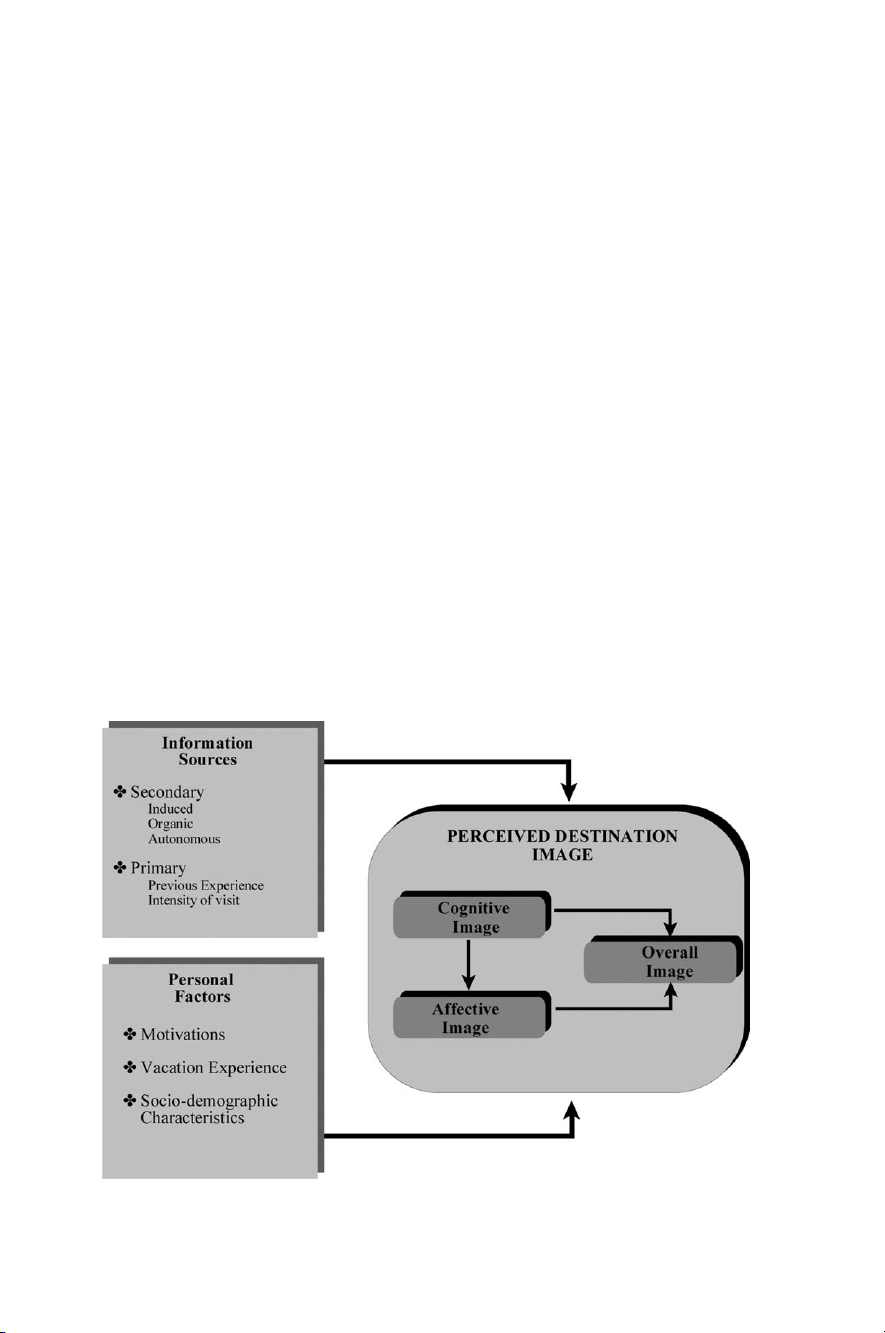
a conceptual model (Figure 1), to be validated using path models.
The model was developed in a way that differentiates between first-
time and repeat tourists for several reasons. One, certain differences
may exist between the image perceived by each group of individuals
that have an effect on the results. Two, the relationship between sec-
ondary information sources and perceived image can only be ana-
lyzed in the case of first-timers since repeat tourists could have
difficulty recalling the sources of information used before visiting the
place for the first time. Three, there may be differences between the
two groups in terms of their level of knowledge of the destination and
in their motivations, depending on whether they had previously vis-
Figure 1. Model of the Formation of Destination Image
660 DESTINATION IMAGE

ited the place or not. Four, it enabled a validation of the proposed
model to be made using two independent samples.
FACTORS INFLUENCING DESTINATION IMAGE FORMATION
A review of the literature reveals the existence of a set of factors
that influence image formation which, following the model proposed
by Stern and Krakover (1993), involve both information obtained
from different sources and the characteristics of the individual.
According to this model, the characteristics of both the information
and the individual have an effect on the system of interrelationships
governing the perceived stimuli of the environment, producing a
compound image. This system reflects the cognitive organization that
screens the perception. Baloglu and McCleary (1999a) propose a gen-
eral theoretical model of image-formation factors which differentiates
between stimulus factors (information sources, previous experience,
and distribution) and personal factors (psychological and social).
Information Sources
Information sources—also known as stimulus factors (Baloglu and
McCleary 1999a) or image forming agents (Gartner 1993)—are the
forces which influence the forming of perceptions and evaluations.
They refer to the amount and diverse nature of information sources
to which individuals are exposed, including destination information
acquired as a result of having visited the place. From the perspective
of behavior in the choice of a destination, various authors (Fakeye
and Crompton 1991; Gartner 1993; Mansfeld 1992; Um and Cromp-
ton 1990; Woodside and Lysonsky 1989) have proposed models that
attempt to explain this behavior. They establish that, together with a
number of other factors, the information sources to which the indivi-
duals are exposed determine that certain destinations are considered
possible alternative choices.
Gartner (1993) believes that the image forming process can be
regarded as a continuum of different agents or information sources
which act independently to form one single image in the mind of the
individual. He classifies the different agents as (a) overt induced,
found in conventional advertising in the mass media, from infor-
mation delivered by the relevant institutions in the destination or by
tour operators and wholesalers; (b) covert induced, using celebrities
in the destination’s promotion activities or destination reports or arti-
cles; (c) autonomous, including mass-media broadcasting news, doc-
umentaries, films, television programs, etc., about the place; (d)
organic, involving such people as friends and relatives, giving infor-
mation about places, based on their own knowledge or experience,
whether the information was requested or volunteered; and (e) a visit
to the destination, the end point of the continuum of the forming
process.
BEERLI AND MARTI
´N661
![Giáo trình Quản trị kinh doanh điểm đến du lịch [chuẩn nhất]](https://cdn.tailieu.vn/images/document/thumbnail/2026/20260122/lionelmessi01/135x160/19071769095813.jpg)









![Giáo trình Nhập môn ngành Du lịch [chuẩn nhất]](https://cdn.tailieu.vn/images/document/thumbnail/2026/20260212/hoatrami2026/135x160/23901771054739.jpg)


![Bài giảng Địa lí du lịch: Phần 1 [Mới nhất]](https://cdn.tailieu.vn/images/document/thumbnail/2026/20260212/hoatrami2026/135x160/73791771054746.jpg)


