

fer from quantitative types of tests in that their outcome is characterized by
a simple dichotomy into positive or negative cases.
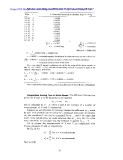
As an example, consider Table 4. 13, representing data on the alpha-feto-
protein (AFP) test for the diagnosis of hepatocellular carcinoma. 8 What do
these data tell us about the value of the AFP test for the diagnosis of this
disease?
Sensitivity an.d specificity
The statistical aspects of this type of problem are best understood by
introducing a number of concepts that have been specifically developed for
these problems. 8
Sensitivity is the proportion of positive results among the subjects af-
fected by the disease. Table 4. 13 provides as an estimate of sensitivity:
Sensitivity ==- == 0. 8411 == 84. 11%
Specificity is the proportion of negative results among the subjects who
are free of the disease. From Table 4. 13:
Specificity ==
~~~~
== 0. 9816 == 98. 16%
The concepts of sensitivity and specificity are useful descriptions of the
nature of a diagnostic test, but they are not, in themselves, sufficient for pro-
viding the physician with the information required for a rational medical deci-
sion.
For example, suppose that a particular subject has a positive AFP test.
What is the probability that this subject has hepatocarcinoma? From Table
13 we infer that among all subjects for whom the test is positive a propor-
tion of 90/129, or 69.77 percent, are affected by the disease. This proportion
is called the predictive value of a positive test, or PV + .
Predictive values-the concept of prevalence
Predictive value of a positive test. -(PV +) is d~fined as the proportion
of subjects affected by the qisease among those showing a positive test. The
(PV +) value cannot be derived merely from the sensitivity and the specifici...
ty of the test. To demonstrate this, consider Table 4. , which is fictitious
and was derived from Table 4. 13 by multiplying the values in the " Present
TABLE 4. 13. RESULTS OF ALPHA- FETOPROTEIN TESTS FOR DIAGNOSIS OF HEPATOCELLULAR
CARCINOMA
Hepatocarcinoma
Test result Present Absent Total
107
079
118
129
096
225
Total
Simpo PDF Merge and Split Unregistered Version - http://www.simpopdf.com

TABLE 4. 14. VALVES FOR ALPHA-FETOPROTEIN TESTS DERIVED FROM TABLE 4. I3
Hepatocarcinoma
Test Result Present Absent Total
900
170
070
079
118
939
249
118
Total
column by 10, and by leaving the values in the " Absent" column un-
changed. Table 4. 14 leads to the same sensitivity and specificity values as
Table 4. 13.. However , the (PV+) value is now 900/939 = 95. 85 percent.
It is seen that the (PV +) value depends not only on the sensitivity and
the specificity but also on the prevalence of the disease in the total popu-
lation. In Table 4. , this prevalence is 107/2225 = 4.809 percent, whereas
in Table 4. 14 it is 1O70/3118 = 34.32 percent.
A logical counterpart of the (PV +) value is the predictive value of a neg-
ative lest, or PV
- .
Predictive value of a negative test.----(PV ) is defined as the proportion
of subjects free of the disease among those showing a negative test. For the
data of Table 4. , the (PV - ) value is 2079/2096 = 99. 19 percent , whereas
for Table 4. , (PV - ) = 2079/2249= 92.44 percent. As is the case for
(PV +), the (PV - ) value depends on the prevalence of the disease.
The following formulas relate (PV +) and (PV - ) to sensitivity, specifici-
ty, and prevalence of the disease. We denote sensitivity by the symbol SE,
specificity by and prevalence by P; then:
(PV+) =
(1 SP) (1 -
1 +
SE
(PV -
) =
(1 - SE)
1 +
SP(1
(4.62)
(4. 63)
As an illustration, the data in Table 4. 13 yield:
(PV +) =
(1 - Q. 981~) (1 - 0. 04809) - 6978 = 69.78%
+ (0.8411) (0.04809)
(PV -
) = 1 + J~ 841J) (0.O480~ - 0. 9919 = 99. 19%
(0. 9816) (1 - 0. 04809)
Apart from rounding errors, these values agree with those found by direct
inspection of the table.
Interpretation of multiple tests
The practical usefulness of (PV +) and (PV - ) is now readily apparent.
Suppose that a patient' s result by the AFP test is positive and the prevalence
Simpo PDF Merge and Split Unregistered Version - http://www.simpopdf.com

of the disease is 4.809 percent. Then the probability that the patient suffers
from hepatocarcinoma is about 70 percent. On the basis of this result, the
patient now bel()ngs to a subgroup of the total population in which the preva-
lence of the disease is 70 percent rather than the 4.8 percent applying to the
total population. Let us assume that a second test is available for the diag-
nosis of hepatocarcinoma, and that this second test is independent of the
AFP test. The concept of independence of two diagnostic tests is crucial for
the correct statistical treatment of this type of problem, but it seems to have
received little attention in the literature. Essentially, it means that in the
class of patients affected by the disease, the proportion of patients showing a
positive result for test B is the same, whether test A was positive or nega-
tive. A similar situation must hold for the class of patients free of the dis-
ease.
In making inferences from this second test for the patient in question
we can start with a value of prevalence of the disease (P) of 70 percent, rath-
er than 4.8 percent , since we know from the result of the AFP test that the
patient belongs to the subgroup with this higher prevalence rate. As an illus-
tration, let us assume that the second test has a sensitivity of 65 percent and
a specificity of 90 percent and that the second test also is positive for this
patient. Then the new (PV +) value is .equal to
(PV+) =
(1 - 0. 90) (1 - 0. 70)
1 + (0.65) (0. 70)
938 = 93.
, on the other hand, the second test turned out to be negative, then the
probability that the patient is free of disease would be:
(PV -
) = -
(1 - 0. 65) (0.70) = 0. 524 = 52.4%
1 + (0.90) (1 - 0. 70)
In that, case, the two tests essentially would have contradicted each other
and no firm diagnosis could be made without further investigations.
A general formula for multiple independent tests
It can easily be shown that the order in which the independent tests are
carried out has no effect on the final (PV +) or (PV - ) value. In fact, the fol-
lowing general formula can be derived that covers any number of indepen-
dent tests and their possible outcomes.
Denote by (SE)i and (SP)i the sensitivity and the specificity of the
ith = test, where , 3
, . . . ,
N. Furthermore, define the symbols
and Bi as follows:
A.
(S E)i when the result of test is +
1 - (SE)i when the result of test is ~
B.
1 -:- (SP)i when the result of test is +
(SP)i when the result of test is -
Simpo PDF Merge and Split Unregistered Version - http://www.simpopdf.com

If is the prevalence rate of the disease before administration of any of
the tests , and
pi
is the probability that the subject has the disease after ad~
ministration of the tests, then:
P'
==
1 + 8t . 82, . . . )(1
(At ' A2.
. . .
It is important to keep in mind that Equation 4.64 is valid only if all tests
are mutually independent in the sense defined above.
(4.64)
Quality Control
The remainder of this chapter deals with the fundamental principles of a
quality control and quality assurance program for monitoring and assessing
the precision and accuracy of the data being processed within a laboratory.
The definitions of Quality, Quality Assurance, and Quality Control by
the American Society for Quality Control (ASQC)9 apply to either a product
or a service, and they are quoted here in their entirety.
1) Quality. The totality of features and characteristics of a product or
service that bear on its ability to satisfy a given need.
2) Quality assurance. " A system of activities whose purpose is to provide
assurance that the overall quality~control job is in fact being done effec-
tively. The system involves a continuing evaluation of the adequacy and
effectiveness of the overall quality-control program with a view of having
corrective measures initiated where necessary. For a specific product or
service, this involves verifications, audits, and the evaluation of the quali-
ty factors that affect the specification, production , inspection, and use of '
the product or service.
3) Quality control. The overall system of activities whose purpose is to
provide a quality of product or service that meets the needs of users; al~
, the use of such a system.
The aim of quality control is to provide .quality that is satisfactory,
adequate , dependable, and economic. The overall system involves inte-
grating the quality aspects of several related steps , including the proper
specification of what is wanted; production to meet the full intent of the
specification; inspection to determine whether the resulting product or
service is in accordance with the specification; and review of usage
provide for revision of specification.
The term quality control is often applied to specific phases in the
overall system of activities, as , for example, process quality control.
The Control Chart
According to the ASQC,9 the control chart is " a graphical chart with
control limits and plotted values of some statistical measure for a series of
samples or subgroups. A central line is commonly shown.
Simpo PDF Merge and Split Unregistered Version - http://www.simpopdf.com

The results of a laboratory test are plotted on the vertical axis, in units
of the test results, versus time, in hours, days, etc. , plotted on the horizontal
axis. Since each laboratory test should be checked at least once a day, the
horizontal scale should be wide enough to cover a minimum of one month of
data. The control chart should be considered as a tool to provide a " real-
time" analy~is and feedback for appropriate action. Thus, it should cover a
sufficient period of time to provide sufficient data to study trends, "runs
above and below the central line, and any other manifestation of lack of ran-
domness (see section on detection of lack of randomness).
Statistical basis for the control chart
General considerations
W. A. Shewhart, in his pioneering work in 1939 10 developed the prin-
ciples of the control chart. They can be summarized, as was done by E. I.
Grant 11 as follows: " The measured .quantity of a manufactured product is
always subject to a certain amount of variation as a result of chance. Some
stable ' System of Chance Causes ' is inherent in any particular scheme of pro-
duction and inspection. Variation within this stable pattern is inevitable. The
reasons for variation outside this stable pattern may be discovered and cor-
rected. " If the words " manufactured product" are changed to " laboratory
test " the above statement is directly applicable to the content of this
section.
We can think of the "measured quantity" as the concentration of a par-
ticular constituent in a patient' s sample (for example, the glucose content of
a patient' s serum). Under the "system of chance causes, " this concentra-
tion, when measured many times under the same conditions, will fluctuate in
such a way as to generate a statistical distribution that can be represented by
a mathematical expression. This expression could be the normal distribu-
tion, for those continuous variables that are symmetrically distributed about
the mean value, or it could be some other suitable mathematical function ap-
plicable to asymmetrically or discretely distributed variables (see section on
non-normal distributions). Then, applying the known principles ofprobabili-
ty, one can find lower and upper limits, known as control limits that will
define the limits of variation within "this stable pattern" for a given accept-
able tolerance probability..Values outside these control limits will be consid-
ered "unusual," and an investigation may be initiated to ascertain the rea-
sons for this occurrence.
Contrallimits
According to the ASQC,9 the control limits are the "limits on a control
chart that are used as criteria for action or for judging whether a set of data
does or does not indicate lack of control.
Probability limits. If the distribution of the measured quantity is
known, then lower and upper limits can be found so that, on the average, a
predetermined percentage of the values (e.g. , 95 percent, 99 percent) will fall
within these limits if the process is under control. The limits will depend on
the nature of the probability distribution. They will differ, depending on
Simpo PDF Merge and Split Unregistered Version - http://www.simpopdf.com
![Bảng tra dung sai lắp ghép Lê Hoàng Lâm: [Thêm từ mô tả phù hợp]](https://cdn.tailieu.vn/images/document/thumbnail/2022/20221205/camtucau205/135x160/9731670233749.jpg)



![Cẩm nang Gia công kim loại Việt Nam [mới nhất]](https://cdn.tailieu.vn/images/document/thumbnail/2026/20260513/baobinh_011/135x160/7971778670576.jpg)


%20--%3e%3cdefs%3e%3cstyle%3e%20.st0%20{%20fill:%20%23fff;%20}%20.st1%20{%20fill:%20%237800fa;%20}%20%3c/style%3e%3c/defs%3e%3cpath%20class='st1'%20d='M117.78,12.18H43.11c2.9,3.47,4.65,7.94,4.65,12.82,0,5.6-2.3,10.66-6.01,14.29h76.02l7.22-13.56-7.22-13.56Z'/%3e%3cg%3e%3cpath%20class='st0'%20d='M53.58,26.17h-.59v-1.46h.59v-4.96h2.83c1.78,0,2.67.94,2.67,2.82v5.76c0,1.87-.89,2.81-2.67,2.81h-2.83v-4.96ZM55.36,21.37v3.34h1.1v1.46h-1.1v3.34h1.01c.61,0,.91-.37.91-1.1v-5.93c0-.74-.3-1.1-.91-1.1h-1.01Z'/%3e%3cpath%20class='st0'%20d='M65.99,31.14h-1.8l-.31-2.07h-2.19l-.31,2.07h-1.64l1.82-11.39h2.62l1.82,11.39ZM65.28,18.04c-.25.46-.51.77-.75.94-.21.15-.47.22-.79.22-.26,0-.57-.07-.92-.22l-.38-.15c-.14-.05-.26-.07-.37-.07-.3,0-.53.18-.71.54l-.91-.68c.25-.46.51-.77.75-.94.21-.14.48-.21.79-.21.26,0,.57.07.92.21l.38.15c.14.05.26.07.37.07.3,0,.53-.18.71-.54l.91.68ZM61.91,27.52h1.73l-.87-5.76-.87,5.76Z'/%3e%3cpath%20class='st0'%20d='M74.53,26.89v1.52c0,1.91-.89,2.86-2.67,2.86s-2.67-.95-2.67-2.86v-5.93c0-1.91.89-2.86,2.67-2.86s2.67.95,2.67,2.86v1.11h-1.69v-1.22c0-.75-.31-1.12-.93-1.12s-.93.37-.93,1.12v6.15c0,.74.31,1.11.93,1.11s.93-.37.93-1.11v-1.63h1.69Z'/%3e%3cpath%20class='st0'%20d='M81.4,31.14h-1.8l-.31-2.07h-2.19l-.31,2.07h-1.64l1.82-11.39h2.62l1.82,11.39ZM75.9,19.2l1.52-1.91h1.71l1.51,1.91h-1.61l-.76-.95-.75.95h-1.61ZM77.32,27.52h1.73l-.87-5.76-.87,5.76ZM83.1,15.99l-1.76,1.91h-1.26l1.17-1.91h1.86Z'/%3e%3cpath%20class='st0'%20d='M84.86,19.75c1.78,0,2.67.94,2.67,2.82v1.48c0,1.87-.89,2.81-2.67,2.81h-.85v4.28h-1.79v-11.39h2.64ZM84.01,21.37v3.86h.85c.58,0,.87-.36.87-1.08v-1.71c0-.71-.29-1.07-.87-1.07h-.85Z'/%3e%3cpath%20class='st0'%20d='M93.51,19.75c1.78,0,2.67.94,2.67,2.82v1.48c0,1.87-.89,2.81-2.67,2.81h-.85v4.28h-1.79v-11.39h2.64ZM92.66,21.37v3.86h.85c.58,0,.87-.36.87-1.08v-1.71c0-.71-.29-1.07-.87-1.07h-.85Z'/%3e%3cpath%20class='st0'%20d='M98.8,31.14h-1.79v-11.39h1.79v4.88h2.03v-4.88h1.83v11.39h-1.83v-4.88h-2.03v4.88Z'/%3e%3cpath%20class='st0'%20d='M105.36,24.55h2.46v1.62h-2.46v3.34h3.09v1.63h-4.88v-11.39h4.88v1.63h-3.09v3.18ZM108.17,17.29l-1.76,1.91h-1.26l1.17-1.91h1.86Z'/%3e%3cpath%20class='st0'%20d='M112.2,19.75c1.78,0,2.67.94,2.67,2.82v1.48c0,1.87-.89,2.81-2.67,2.81h-.85v4.28h-1.79v-11.39h2.64ZM111.35,21.37v3.86h.85c.58,0,.87-.36.87-1.08v-1.71c0-.71-.29-1.07-.87-1.07h-.85Z'/%3e%3c/g%3e%3ccircle%20class='st1'%20cx='25'%20cy='25'%20r='20'/%3e%3cpath%20class='st0'%20d='M32.78,19.27c2.92,0,4.43,2.55,5.28,5.33l.71,2.17c.14.38-.33.75-.71.75h-5.61c.19-.33.24-.71.09-1.08l-.75-2.45c-.43-1.32-.99-2.64-1.79-3.77.75-.57,1.65-.94,2.78-.94h0ZM25,18.38c3.25,0,4.9,2.78,5.89,5.89l.76,2.45c.14.42-.33.8-.8.8h-11.69c-.42,0-.94-.38-.8-.8l.75-2.45c.99-3.11,2.64-5.89,5.89-5.89h0ZM25,11.35c1.74,0,3.11,1.37,3.11,3.11s-1.37,3.11-3.11,3.11-3.11-1.41-3.11-3.11,1.41-3.11,3.11-3.11h0ZM17.27,19.27c1.08,0,1.98.38,2.73.94-.8,1.13-1.37,2.45-1.74,3.77l-.8,2.45c-.14.38-.05.75.09,1.08h-5.56c-.42,0-.9-.38-.75-.75l.71-2.17c.9-2.78,2.41-5.33,5.33-5.33h0ZM17.27,12.91c1.51,0,2.78,1.27,2.78,2.83s-1.27,2.83-2.78,2.83-2.83-1.27-2.83-2.83,1.27-2.83,2.83-2.83h0ZM32.78,12.91c1.56,0,2.78,1.27,2.78,2.83s-1.23,2.83-2.78,2.83-2.83-1.27-2.83-2.83,1.27-2.83,2.83-2.83h0ZM27.07,28.56v.09c0,.57-.24,1.08-.61,1.46h0v.05c-.38.33-.9.57-1.46.57s-1.08-.24-1.46-.61h0c-.38-.38-.61-.9-.61-1.46v-.09h1.41v.09c0,.19.05.38.19.47v.05c.09.09.28.19.47.19s.38-.09.47-.19v-.05c.14-.09.24-.28.24-.47t-.05-.09h1.41ZM30.99,28.56v.09c0,1.65-.66,3.16-1.74,4.24-1.08,1.08-2.59,1.79-4.24,1.79s-3.16-.71-4.24-1.79l-.05-.05c-1.04-1.08-1.7-2.55-1.7-4.2v-.09h1.41v.09c0,1.27.47,2.4,1.27,3.25h.05c.85.85,1.98,1.37,3.25,1.37s2.4-.52,3.25-1.37c.85-.8,1.37-1.98,1.37-3.25v-.09h1.37ZM34.99,28.56v.09c0,2.78-1.13,5.28-2.92,7.07-1.79,1.79-4.29,2.92-7.07,2.92s-5.23-1.13-7.07-2.92c-1.79-1.79-2.92-4.29-2.92-7.07v-.09h1.41v.09c0,2.4.94,4.53,2.5,6.08,1.56,1.56,3.72,2.5,6.08,2.5s4.52-.94,6.08-2.5c1.56-1.56,2.5-3.68,2.5-6.08v-.09h1.41Z'/%3e%3c/svg%3e)