

RESEARC H ARTIC L E Open Access
Myocardial revascularization using on-pump
beating heart among patients with left
ventricular dysfunction
Ahmad K Darwazah
1*
, Vivian Bader
1
, Ismail Isleem
2
, Khalil Helwa
2
Abstract
Objectives: On-pump beating heart technique for myocardial revascularization has been used successfully among
both low and high risk patients. Its application among low ejection fraction patients is limited. The aim of our
study is to evaluate this technique among patients with low ejection fraction and to compare results with off-
pump bypass technique.
Methods: This retrospective study includes 137 patients with ejection fraction below 0.35 who underwent isolated
coronary artery bypass surgery. 39 patients underwent myocardial revascularization using on-pump beating heart
(ONCAB/BH), while 98 patients had off-pump beating heart (OPCAB). Different preoperative, operative and
postoperative variables were evaluated among both groups.
Results: Patients profiles and risk factors were similar among both groups, except for the number of patients
undergoing redo CABG which was significantly higher among ONCAB/BH (13% vs 3%; p = 0.025). Ejection fraction
(EF) varied from 10-34%. The mean EF for patients who underwent ONCAB/BH was 28 ± 6 in comparison to
26 ± 5 for OPCAB patients (P = 0.093). Predicted risk for surgery according to EuroSCORE was similar among both
groups (P = 0.443). The number of grafts performed per patient was significantly more among patients who
underwent ONCAB/BH (2.2 ± 0.7 Vs 1.7 ± 0.7; P = 0.002). Completeness of revascularization was significantly greater
in the ONCAB/BH patients (72% Vs 46%, P = 0.015). The incidence of hospital mortality and combined major
morbidity was more among ONCAB/BH in comparison to OPCAB, but the difference was not significant. However,
the incidence of blood loss, ventricular arrythmias, inotropic support, ICU, hospital stay and blood transfusion were
significantly greater among patients who underwent ONCAB/BH.
Conclusions: On-pump beating heart technique can be used in myocardial revascularization among patients with
left ventricular dysfunction. The technique was found to be associated with better myocardial revascularization
when compared with OPCAB technique. However, the incidence of morbidity and mortality was more than
OPCAB.
Introduction
Despite the presence of different pump techniques used
in surgical myocardial revascularization, the optimal
method used is still controversial. No technique was
found perfect to be applied to all patients. Nowadays we
are confronted with different categories of patients vary-
ing from straightforward low risk cases to complicated
ones due to the increase in number of elderly patients
with complicated coronary anatomy and impaired left
ventricular function.
The use of both conventional cardiopulmonary bypass
and OPCAB among patients with impaired LVF proved
its efficiency and safety [1,2]. Under certain circum-
stances, the application of both techniques could not be
possible and even harmful to the myocardium [3].
In our present work, ONCAB/BH technique was used
to revascularize the myocardium among patients with
impaired LVF. The results of such technique was com-
pared to those who underwent off-pump beating heart.
* Correspondence: darwaz30@hotmail.com
1
Department of Cardiac Surgery, Makassed Hospital, Jerusalem, Israel
Full list of author information is available at the end of the article
Darwazah et al.Journal of Cardiothoracic Surgery 2010, 5:109
http://www.cardiothoracicsurgery.org/content/5/1/109
© 2010 Darwazah et al; licensee BioMed Central Ltd. This is an Open Access article distributed under the terms of the Creative
Commons Attribution License (http://creativecommons.org/licenses/by/2.0), which permits unrestricted use, distribution, and
reproduction in any medium, provided the original work is properly cited.

Patients and Methods
This study was performed retrospectively among 137
patients with isolated coronary artery bypass surgery
during the period from 1999-2009. The selection of
patients was based initially on their ejection fraction.
Those with ejection fraction below 0.35 were included
only and divided into two groups according to the tech-
nique used during myocardial revascularization. Ninety
eight patients underwent OPCAB, while thirty nine
patients had ONCAB/BH technique. Patients with com-
bined procedure and those patients who initially under-
went off-pump and converted to on-pump beating heart
were excluded from the study. The decision to use
either technique was made intraoperatively based on
hemodynamic parameters.
Patients who could tolerate manipulation of the heart
without hemodynamic deterioration to visualise target
vessels underwent OPCAB revascularization. Those
patients who showed hemodynamic deterioration during
manipulation underwent ONCAB/BH.
Different preoperative, operative and postoperative
variables were evaluated among both groups. Analysis
was performed using statistical software version 13 SPSS
(Chicago, IL). Data are expressed as percentages and
compared using Fisher exact test. Variables are pre-
sented as mean ± standard error using student’sttest.
Statistical significance was assumed when P value was
less than 0.05.
Surgical Technique
Exposure of the heart was performed through median
sternotomy. Full heparinization was used in all patients
maintaining activated clotting time >400 s. In patients
undergoing ONCAB/BH a standard cannulation of the
aorta and right atrium was used. A full cardiopulmonary
bypass with normothermia was used. Anastomosis of
the grafts to coronary arteries was initially performed
distally among all patients. Proximal anastomosis to
ascending aorta was performed immediately after finish-
ing each distal anastomosis. The sequence by which cor-
onary vessels were grafted varied from one patient to
another. Grafting of the LAD by left internal mammary
artery was the first to be performed. However, in some
patients with huge hearts, grafting of diagonal followed
by RCA and circumflex arteries was usually performed
first, leaving the LAD at the end to avoid stretching and
kinking of LIMA during rotation of the heart.
Anastomosis was facilitated by the use of both
U-shaped stabilizer (Guidant, Indianapolis, IN) and suc-
tion stabilizers (Medtronic Octopus III). Revasculariza-
tion of circumflex or obtuse marginal arteries was
performed with the help of Starfish apical positioning
device(Medtronic,Inc,Minneapolis,MN).Intracoron-
ary shunts (Medtronic Inc.) were used when needed.
Results
Preoperative patients profile and risk factors are listed in
table 1. There was no differences among both groups,
except for the number of patients undergoing redo
CABG, which was significantly higher among ONCAB/
BH (13% Vs 3%, P = 0.025). Predicted risk for surgical
intervention according to EuroSCORE was similar
among both groups (P = 0.443).
Ejection fraction (EF) among all patients was below
0.35. It varied from 10-34. The mean EF for ONCAB/
BHwas28±6incomparisonto26±5forOPCAB
(P = 0.093). The incidence of main stem involvement
was more among ONCAB/BH patients, but the differ-
ence did not reach statistical significance (8% Vs 4%,
P = 0.765).
The extent of preoperative coronary artery disease was
similar among both groups regarding the involvement of
LAD, circumflex, second diagonal and obtuse marginal
coronary arteries. The extent of right coronary artery
disease was significantly higher among OPCAB (70% Vs
51% P = 0.025). On the other hand, involvement of first
diagonal coronary artery was significantly higher among
ONCAB/BH (33% Vs 17%, P = 0.035). There was no dif-
ferenceregardingthenumberofcoronaryvessels
affected whether single, double or triple vessel among
both groups (P = 0.396).
There was a significant difference regarding the num-
ber of grafts used per patient among both groups
(Table 2). ONCAB/BH patients received 2.2 ± 0.7 grafts,
while OPCAB had 1.7 ± 0.7 (P = 0.002). The difference
was due to more grafting of the right and circumflex
coronary arteries.
Hospital mortality was slightly more among ONCAB/
BH patients, but the difference was not significant 8%
Vs 6%, P = 0.712(Table 3). The incidence of total major
morbidity was more among ONCAB/BH patients, but
the difference did not reach statistical significance (P =
0.778). However, the incidence of blood loss, ventricular
arrythmias and inotropic support were significantly
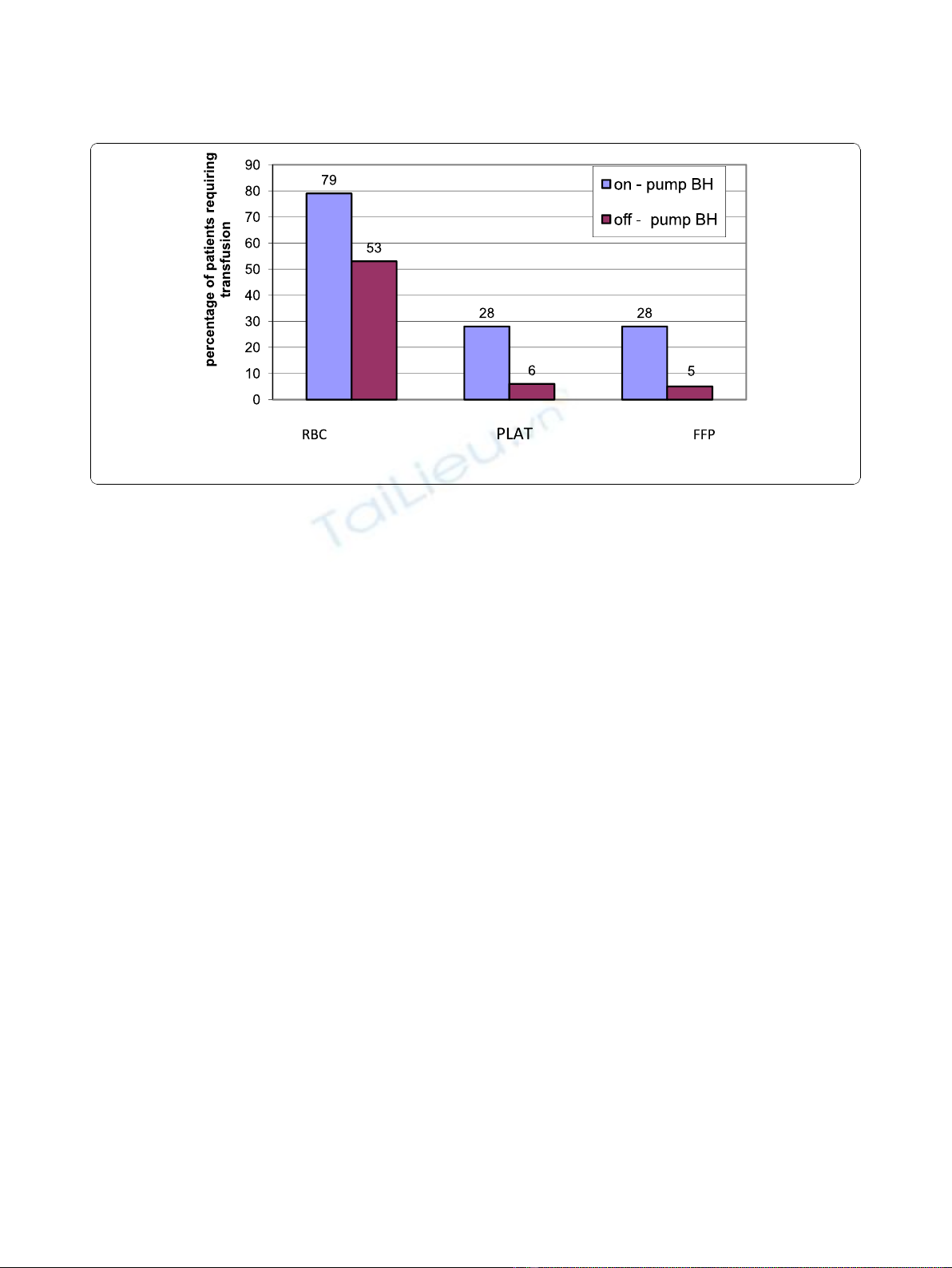
greater among ONCAB/BH group. Transfusion of red
blood cells and its products were significantly greater
among ONCAB/BH, P = 0.001 (Figure 1). Postoperative
intensive care unit length of stay was significantly higher
in the ONCAB/BH patients(35 ± 20 hours vs27 ± 14
hours for OPCAB, P = 0.019). Similarly, postoperative
hospital stay was significantly higher in the ONCAB/BH
patients (7.1 ± 2.9 days Vs 5.9 ± 2.3 days for OPCAB,
P = 0.015).
Discussion
Conventional non-beating heart on-pump is still the
standard technique used in coronary artery surgery.
Complications in relation to this technique are due to
the release of inflammatory mediators, the use of
Darwazah et al.Journal of Cardiothoracic Surgery 2010, 5:109
http://www.cardiothoracicsurgery.org/content/5/1/109
Page 2 of 6

cardioplegia, aortic cross clamping and hypothermia [4].
Off-pump technique was introduced to avoid such com-
plications. Despite its efficiency and safety over conven-
tional CPB, the technique was criticized by many
investigators regarding completeness of myocardial
revascularization, graft patency and long term results.
One of the important draw backs of this technique is
the hemodynamic deterioration which can occur during
manipulation of the heart during surgery, which entails
urgent transfer to conventional CPB. The results of such
surgery proved to be inferior [5].
From our previous study [1] using off-pump bypass
among low ejection fraction patients, we found that
such a technique is effective in reducing both mortality
and morbidity. Nevertheless, we agree with other
Table 1 Preoperative Demographics and Risk Factors
Variable On-pump BH (n = 39) Off-pump BH (n = 98) P value
Age 58 ± 8 57 ± 10 0.100
Female gender 7 (18%) 14 (14%) 0.826
BMI 27.6 ± 4.5 28.2 ± 4.5 0.564
Family History of CAD 19 (49%) 61 (62%) 0.128
Hypertension 17 (44%) 49 (50%) 0.354
Diabetes mellitus 18 (46%) 45 (46%) 0.929
Current smoker 22 (56%) 63 (64%) 0.362
Dyslipidemia 14 (36%) 41 (42%) 0.598
Obesity 12 (31%) 28 (27%) 0.778
Peripheral vascular disease 3 (8%) 8 (8%) 0.814
Carotid artery disease 5 (13%) 12 (12%) 0.387
Urgent operation 8 (21%) 28 (29%) 0.319
COPD 6 (15%) 15 (15%) 0.753
Redo CABG 5 (13%) 3 (3%) 0.025
Chronic Kidney Disease 6 (15%) 11 (11%) 0.126
Recent Angioplasty 6 (15%) 17 (17%) 0.884
Myocardial Infarction 26 (67%) 65 (66%) 0.600
Heart Failure 12 (31%) 52 (53%) 0.241
Unstable Angina 22 (56%) 43 (44%) 0.082
Stroke 5 (13%) 6 (6%) 0.381
Streptokinase 6 (15%) 5 (5%) 0.126
Clopidogrel 6 (15%) 8 (8%) 0.273
EuroSCORE 14.1 ± 11.0 12.2 ± 12.5 0.443
Table 2 Operative Data
Variable On-pump BH Off-pump BH P value
Use of LIMA 30(77%) 73(75%) 0.827
Use of RIMA 1(3%) 2(2%) 0.835
LAD Graft 37(95%) 95(97%) 0.544
RCA Graft 9(23%) 19(19%) 0.581
PDA Graft 4(10%) 4(5%) 0.019
D1 Graft 13(33%) 16(16%) 0.381
D2 graft 9(23%) 26(27%) 0.022
OM1 Graft 3(8%) 3(3%) 0.221
OM2 Graft 1(3%) 0(0%) 0.109
Cx Graft 7(18%) 4(4%) 0.182
Operation Time 4.0 ± 1.0 3.7 ± 1.0 0.033
Number of grafts 2.2 ± 0.7 1.7 ± 0.7 0.002
Complete revascularization 28(72%) 45(46%) 0.015
Table 3 Postoperative Morbidity and Mortality
Variable On-pump BH Off-pump BH P value
30-Day Mortality 3 (8%) 6 (6%) 0.712
Morbidity 12 (31%) 26 (27%) 0.778
Infection 4 (10%) 4 (4%) 0.765
Atrial Fibrillation 3 (8%) 8 (8%) 0.959
Ventricular Arrhythmias 9 (23%) 4 (4%) 0.002
Myocardial infarction 5 (13.15%) 8 (8%) 0.192
CVA 1 (3%) 1 (1%) 0.535
Respiratory Failure 3 (8%) 1 (1%) 0.133
Renal Failure 3 (8%) 3 (3%) 0.221
Intra Aortic Balloon pump 7 (18%) 10 (10%) 0.196
Inotropic Support 31 (79%) 29 (30%) 0.001
Estimated blood loss 974 ± 824 548 ± 337 0.001
Darwazah et al.Journal of Cardiothoracic Surgery 2010, 5:109
http://www.cardiothoracicsurgery.org/content/5/1/109
Page 3 of 6
investigators that the technique is not always associated
with complete revascularization. The main obstacle
which determines completeness of revascularization is
the hemodynamic deterioration which can occur during
such a procedure. To avoid such deterioration among
our patients, we advocated minimal manipulation during
surgery which obviously lead to less number of grafts
used and incomplete revascularization.
An intermediatory approach between conventional and
off-pump bypass was studied by Perrault and colleagues
[3]. They used on-pump beating heart (ONCAB/BH)
among their patients with low ejection fraction. They
found that using CPB without cross clamping and cardio-
plegic arrest with the heart beating is associated with less
myocardial oedema and ischemia. From their study, they
proved that such a technique is effective in preventing
myocardial injury and can be effectively used among high
risk patients who cannot tolerate cardioplegic arrest or
when the use of off-pump is not technically feasible.
Since the work of Perrault, various studies using
ONCAB/BH technique for myocardial revascularization
among both low and high risk patients was performed
[4,6-15].Thetechniqueprovedtobeareliableand
effective method and was associated with complete
revascularization.
The main idea of using ONCAB/BH technique among
high risk patients is to avoid the serious manipulation
which could be harmful to the myocardium and subse-
quently to perform complete revascularization. Surpris-
ingly, in our study, we found that the incidence of
myocardial infarction was more among patients who
underwent ONCAB/BH when compared to OPCAB,
which indicates that manipulation of the heart even
when supported by the bypass machine is still harmful.
In an interesting study performed by Rastan and co-
workers[4] using ONCAB/BH among patients with nor-
mal ejection fraction, they found an increase incidence
of myocardial injury when compared to off-pump.
Although, the effect was without any clinical significance
they believed that such a technique is not favourable to
off-pump bypass. Pegg and co-workers[12], confirmed
these findings, by reporting that that the incidence of
new irreversible myocardial injury among patients with
impaired LVF was significantly higher among ONCAB/
BH patients when compared with conventional bypass.
The other benefit of using ONCAB/BH is to achieve
complete revascularization. Previous studies showed that
this technique was associated with adequate number of
grafts performed among both low and high risk patients
[3,6,9,10,14,15]. Comparing the number of grafts per-
formed to other bypass techniques, conflicting results
were obtained. Some studies were in favour of off-pump
and conventional bypass over ONCAB/BH [4,7,14],
while others were in favour of ONCAB/BH when com-
pared to other techniques of bypass [9]. Prifti and col-
leagues in their study [11], found a similar number of
grafts performed among both conventional and
ONCAB/BH. We agree with previous studies that
ONCAB/BH technique is associated with adequate
number of grafts performed. In our present study, there
was a significant difference in the number of grafts per-
formed and complete revascularization was in favour of
ONCAB/BH. The main reason for such a difference was
due to difficulty in grafting of circumflex and posterior
descending coronary arteries among patients undergoing
off-pump bypass.
The mortality rate of patients with impaired LVF
undergoing ONCAB/BH varies from 2-8% [6,10,11,15].
Figure 1 Percentage of patients requiring blood transfusion and its products. RBC: Red blood cells, PLAT: Platelets, FFP: Fresh frozen
plasma.
Darwazah et al.Journal of Cardiothoracic Surgery 2010, 5:109
http://www.cardiothoracicsurgery.org/content/5/1/109
Page 4 of 6

The difference in mortality among various studies was
directly related to the difference in selection of patients.
Beside impaired LVF, other associated risk factors were
involved, as acute myocardial infarction, cardiogenic
shock and patients on dialysis [7,8,15]. In our study, the
mortality rate was 7.7%, which was high compared to
other studies. The high mortality among our group of
patients was related to the impaired left ventricular
function. Other factors contributing to the mortality of
patients were the preoperative association of heart fail-
ure and myocardial infarction, the failure to revascular-
ize both circumflex artery in 15% and RCA in 8% of
patients and lower percentage of patients who received
LIMA for grafting. Comparing our results with Folliguet
and colleagues study[6], they had the lowest mortality
among their group of patients despite a similar mean
ejection fraction to our patients, we found that the
mean EuroSCORE of their patients was 5.8 ± 2.7 in
comparison to 14.1 ± 11.0 among our patients. This
clearly shows the importance of associated other risk
factors affecting mortality beside impaired LVF.
There are limited studies evaluating the incidence of
mortality in relation to using either ONCAB/BH or off-
pump. Among low risk patients, the mortality rate
among patients who had ONCAB/BH was higher than
off-pump bypass [9]. On the contrary, in Rastan and
colleagues study [4] the mortality rate was more among
off-pump bypass patients. In high risk groups, Edgerton
and colleagues [8] found that mortality rate was signifi-
cantly higher among ONCAB/BH patients when com-
pared to off-pump. Similar findings were seen in our
study. However, the differences in mortality among our
two groups of patients was not significant.
From the above limited studies, it seems that
ONCAB/BH is associated with more mortality than
OPCAB despite the fact that these patients have ade-
quate myocardial revascularization. The explanation for
such unexpected results is related to the use of bypass
machine. Early work by Perrault and co-workers [3]
found that the release of inflammatory mediators inter-
leukin-6, interleukin-10 and elastase among patients
undergoing on-pump BH was not significantly different
from conventional bypass. A further study [13] found
that ONCAB/BH can trigger an intense inflammatory
response, they found that the levels of interleukin-6,
interleukin-8, interleukin-10 and tumour necrosis fac-
tor-alpha were significantly elevated when compared to
off-pump bypass.
It seems that ONCAB/BH technique does not amelio-
rate the complications encountered with the use of
bypass machine and its effect among high risk patients.
This is the basic difference from off-pump bypass tech-
nique. In our study, the number of patients who had
postoperative major morbiditywerehigheramong
ONCAB/BH patients when compared to OPCAB techni-
que. The percentage of patients who had postoperative
renal failure, infarction, use of inotropic support and
IABP were less among off-pump patients. The amount
of blood loss and ventricular arrythmias were signifi-
cantly higher among ONCAB/BH patients. This was
reflected on the significant amount of blood transfusion,
blood products and longer ventilation time, intensive
care and hospital stay.
The application of ONCAB/BH among patients with
impaired LVF resulted in conflicting data. Although,
patients had significantly better myocardial revasculari-
zation, the incidence of mortality and morbidity was
more than OPCAB. It seems that ONCAB/BH techni-
que gives a false sense of security believing that the use
of bypass machine can protect the heart during manipu-
lation to perform a better revascularization. This could
be true among low risk patients, but the scenario is dif-
ferent when the technique is applied to high risk group.
The present study is one of few studies comparing two
technique used in myocardial revascularization among
patients with impaired LVF. The study carries several lim-
itations, being a retrospective study among a small num-
ber of patients, which made the validity of the clinical
results limited. Further studies are needed in particular to
follow up these patients to find out the benefit which was
achieved by increasing myocardial revascularization
among patients who underwent on-pump beating heart.
In conclusion, we believe that ONCAB/BH can be
used in myocardial revascularization among patients
with left ventricular dysfunction. The technique was
found to be associated with better myocardial revascu-
larization, more morbidity and mortality when com-
pared to off-pump bypass.
Author details
1
Department of Cardiac Surgery, Makassed Hospital, Jerusalem, Israel.
2
Department of Cardiology, Makassed Hospital, Jerusalem, Israel.
Authors’contributions
AKD Performed operations, conception and study design. VB Assist in
surgical procedures and acquisition of data. II and KH investigations and
follow up of patients. All were involved in interpretation of data and
statistical analysis. All authors read and approved the final manuscript.
Competing interests
The authors declare that they have no competing interests.
Received: 13 July 2010 Accepted: 10 November 2010
Published: 10 November 2010
References
1. Darwazah AK, Abu Sham’a RA, Hussein E, Hawari MH, Ismail H: Myocardial
revascularization in patients with low ejection fraction < or = 35%:
effect of pump technique on early morbidity and mortality. J Card Surg
2006, 21:22-27.
2. Youn YN, Chang BC, Hong YS, Kwak YL, Yoo KL: Early and mid-term
impacts of cardiopulmonary bypass on coronary artery bypass grafting
Darwazah et al.Journal of Cardiothoracic Surgery 2010, 5:109
http://www.cardiothoracicsurgery.org/content/5/1/109
Page 5 of 6



![PET/CT trong ung thư phổi: Báo cáo [Năm]](https://cdn.tailieu.vn/images/document/thumbnail/2024/20240705/sanhobien01/135x160/8121720150427.jpg)







%20--%3e%3cdefs%3e%3cstyle%3e%20.st0%20{%20fill:%20%23fff;%20}%20.st1%20{%20fill:%20%237800fa;%20}%20%3c/style%3e%3c/defs%3e%3cpath%20class='st1'%20d='M117.78,12.18H43.11c2.9,3.47,4.65,7.94,4.65,12.82,0,5.6-2.3,10.66-6.01,14.29h76.02l7.22-13.56-7.22-13.56Z'/%3e%3cg%3e%3cpath%20class='st0'%20d='M53.58,26.17h-.59v-1.46h.59v-4.96h2.83c1.78,0,2.67.94,2.67,2.82v5.76c0,1.87-.89,2.81-2.67,2.81h-2.83v-4.96ZM55.36,21.37v3.34h1.1v1.46h-1.1v3.34h1.01c.61,0,.91-.37.91-1.1v-5.93c0-.74-.3-1.1-.91-1.1h-1.01Z'/%3e%3cpath%20class='st0'%20d='M65.99,31.14h-1.8l-.31-2.07h-2.19l-.31,2.07h-1.64l1.82-11.39h2.62l1.82,11.39ZM65.28,18.04c-.25.46-.51.77-.75.94-.21.15-.47.22-.79.22-.26,0-.57-.07-.92-.22l-.38-.15c-.14-.05-.26-.07-.37-.07-.3,0-.53.18-.71.54l-.91-.68c.25-.46.51-.77.75-.94.21-.14.48-.21.79-.21.26,0,.57.07.92.21l.38.15c.14.05.26.07.37.07.3,0,.53-.18.71-.54l.91.68ZM61.91,27.52h1.73l-.87-5.76-.87,5.76Z'/%3e%3cpath%20class='st0'%20d='M74.53,26.89v1.52c0,1.91-.89,2.86-2.67,2.86s-2.67-.95-2.67-2.86v-5.93c0-1.91.89-2.86,2.67-2.86s2.67.95,2.67,2.86v1.11h-1.69v-1.22c0-.75-.31-1.12-.93-1.12s-.93.37-.93,1.12v6.15c0,.74.31,1.11.93,1.11s.93-.37.93-1.11v-1.63h1.69Z'/%3e%3cpath%20class='st0'%20d='M81.4,31.14h-1.8l-.31-2.07h-2.19l-.31,2.07h-1.64l1.82-11.39h2.62l1.82,11.39ZM75.9,19.2l1.52-1.91h1.71l1.51,1.91h-1.61l-.76-.95-.75.95h-1.61ZM77.32,27.52h1.73l-.87-5.76-.87,5.76ZM83.1,15.99l-1.76,1.91h-1.26l1.17-1.91h1.86Z'/%3e%3cpath%20class='st0'%20d='M84.86,19.75c1.78,0,2.67.94,2.67,2.82v1.48c0,1.87-.89,2.81-2.67,2.81h-.85v4.28h-1.79v-11.39h2.64ZM84.01,21.37v3.86h.85c.58,0,.87-.36.87-1.08v-1.71c0-.71-.29-1.07-.87-1.07h-.85Z'/%3e%3cpath%20class='st0'%20d='M93.51,19.75c1.78,0,2.67.94,2.67,2.82v1.48c0,1.87-.89,2.81-2.67,2.81h-.85v4.28h-1.79v-11.39h2.64ZM92.66,21.37v3.86h.85c.58,0,.87-.36.87-1.08v-1.71c0-.71-.29-1.07-.87-1.07h-.85Z'/%3e%3cpath%20class='st0'%20d='M98.8,31.14h-1.79v-11.39h1.79v4.88h2.03v-4.88h1.83v11.39h-1.83v-4.88h-2.03v4.88Z'/%3e%3cpath%20class='st0'%20d='M105.36,24.55h2.46v1.62h-2.46v3.34h3.09v1.63h-4.88v-11.39h4.88v1.63h-3.09v3.18ZM108.17,17.29l-1.76,1.91h-1.26l1.17-1.91h1.86Z'/%3e%3cpath%20class='st0'%20d='M112.2,19.75c1.78,0,2.67.94,2.67,2.82v1.48c0,1.87-.89,2.81-2.67,2.81h-.85v4.28h-1.79v-11.39h2.64ZM111.35,21.37v3.86h.85c.58,0,.87-.36.87-1.08v-1.71c0-.71-.29-1.07-.87-1.07h-.85Z'/%3e%3c/g%3e%3ccircle%20class='st1'%20cx='25'%20cy='25'%20r='20'/%3e%3cpath%20class='st0'%20d='M32.78,19.27c2.92,0,4.43,2.55,5.28,5.33l.71,2.17c.14.38-.33.75-.71.75h-5.61c.19-.33.24-.71.09-1.08l-.75-2.45c-.43-1.32-.99-2.64-1.79-3.77.75-.57,1.65-.94,2.78-.94h0ZM25,18.38c3.25,0,4.9,2.78,5.89,5.89l.76,2.45c.14.42-.33.8-.8.8h-11.69c-.42,0-.94-.38-.8-.8l.75-2.45c.99-3.11,2.64-5.89,5.89-5.89h0ZM25,11.35c1.74,0,3.11,1.37,3.11,3.11s-1.37,3.11-3.11,3.11-3.11-1.41-3.11-3.11,1.41-3.11,3.11-3.11h0ZM17.27,19.27c1.08,0,1.98.38,2.73.94-.8,1.13-1.37,2.45-1.74,3.77l-.8,2.45c-.14.38-.05.75.09,1.08h-5.56c-.42,0-.9-.38-.75-.75l.71-2.17c.9-2.78,2.41-5.33,5.33-5.33h0ZM17.27,12.91c1.51,0,2.78,1.27,2.78,2.83s-1.27,2.83-2.78,2.83-2.83-1.27-2.83-2.83,1.27-2.83,2.83-2.83h0ZM32.78,12.91c1.56,0,2.78,1.27,2.78,2.83s-1.23,2.83-2.78,2.83-2.83-1.27-2.83-2.83,1.27-2.83,2.83-2.83h0ZM27.07,28.56v.09c0,.57-.24,1.08-.61,1.46h0v.05c-.38.33-.9.57-1.46.57s-1.08-.24-1.46-.61h0c-.38-.38-.61-.9-.61-1.46v-.09h1.41v.09c0,.19.05.38.19.47v.05c.09.09.28.19.47.19s.38-.09.47-.19v-.05c.14-.09.24-.28.24-.47t-.05-.09h1.41ZM30.99,28.56v.09c0,1.65-.66,3.16-1.74,4.24-1.08,1.08-2.59,1.79-4.24,1.79s-3.16-.71-4.24-1.79l-.05-.05c-1.04-1.08-1.7-2.55-1.7-4.2v-.09h1.41v.09c0,1.27.47,2.4,1.27,3.25h.05c.85.85,1.98,1.37,3.25,1.37s2.4-.52,3.25-1.37c.85-.8,1.37-1.98,1.37-3.25v-.09h1.37ZM34.99,28.56v.09c0,2.78-1.13,5.28-2.92,7.07-1.79,1.79-4.29,2.92-7.07,2.92s-5.23-1.13-7.07-2.92c-1.79-1.79-2.92-4.29-2.92-7.07v-.09h1.41v.09c0,2.4.94,4.53,2.5,6.08,1.56,1.56,3.72,2.5,6.08,2.5s4.52-.94,6.08-2.5c1.56-1.56,2.5-3.68,2.5-6.08v-.09h1.41Z'/%3e%3c/svg%3e)