
* Corresponding author. Tel.: +977 114 15100
E-mail address: rajendra.joshi@ku.edu.np (R. Joshi)
© 2020 Growing Science Ltd. All rights reserved.
doi: 10.5267/j.ccl.2020.4.001
Current Chemistry Letters 9 (2020) 199–204
Contents lists available at GrowingScience
Current Chemistry Letters
homepage: www.GrowingScience.com
Synthesis and characterization of some derivatives of 1,3-Diisopropyl-4,5-
dimethylimidazol-2-ylidene
Eyad Mallaha, Kamal Sweidanb, Luay Abu-Qatousehaa, Tawfiq Arafatc and Rajendra Joshid*
aFaculty of Pharmacy and Medical Sciences, University of Petra, Amman, Jordan
bDepartment of Chemistry, The University of Jordan, Amman, Jordan
cJordan Center for Pharmaceutical Research, Amman, Jordan
dDepartment of Chemical Science and Engineering, School of Engineering, Kathmandu University, Nepal
C H R O N I C L E A B S T R A C T
Article history:
Received February 28, 2020
Received in revised form
April 9, 2020
Accepted April 9, 2020
Available online
April 10, 2020
N-Heterocyclic carbenes are widely used in organic reactions and coordination chemistry. In
the present study, 2,3-dihydro-1,3-diisopropyl-4,5-dimethylimidazol-2-ylidene (1) is reacted
with diphenyl disulfide, methyl phenyl disulfide, and bis(methylsulfonyl)methane to yield
target compounds 5, 6, and 7 respectively. Structures of these compounds are well established
using nuclear magnetic resonance, mass spectrometry and elemental analysis. Possible reaction
mechanisms are proposed.
© 2020 Growin
g
Science Ltd. All ri
g
hts reserved.
Keywords:
N-Heterocyclic carbenes
NMR/MS data
Synthesis, 2,3-Dihydro-1,3-
diisopropyl-4,5-
dimethylimidazol-2-ylidene
1. Introduction
N-Heterocyclic carbenes (NHCs) have played an important role in various fields of chemistry,
including medicinal chemistry, transition metal catalysis, and material chemistry.1-3 More specifically,
NHCs have recently received significant attention for the development of materials and novel drugs.1,3
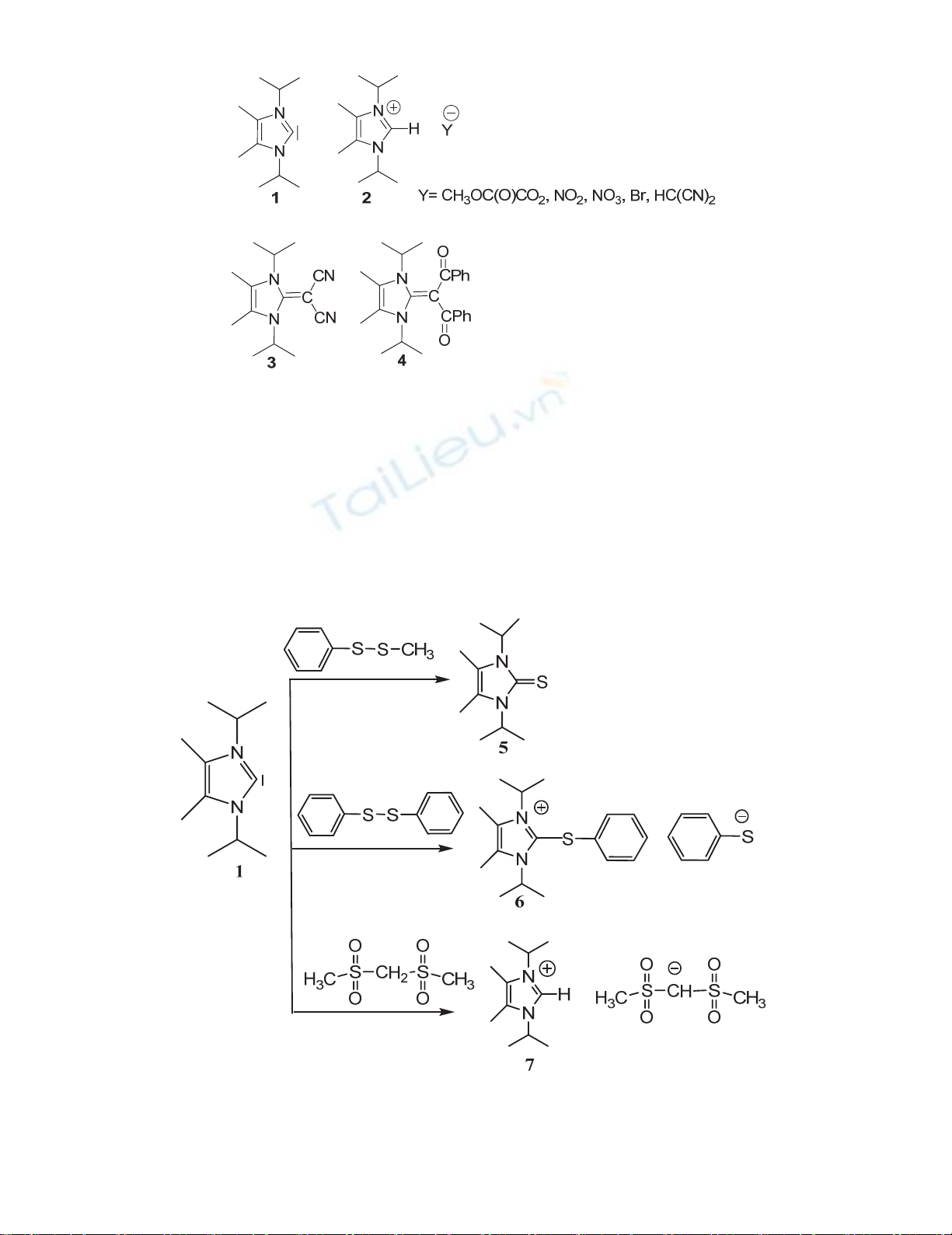
Further, NHCs are proven major ligand class.2 On the other hand, a 2,3-dihydro-1,3-diisopropyl-4,5-
dimethylimidazol-2-ylidene (1) has a strong basic character and consequently can form various
imidazolium salts (2) 4-6, and in parallel it poses a good nucleophilic property to form new derivatives
(3-4).7-8 There is a much interest in imidazolium salts based on their uses as ionic liquids.9-10
200
Expanding our systematic study on heterocyclic carbenes and continuing our investigations on the
chemistry of imidazol-2-ylidene, we report herein its reactions with diphenyl disulfide, methyl phenyl
disulfide and bis(methylsulfonyl)methane. To the best of our knowledge, none of these reactions have
been reported previously.
2. Results and Discussion
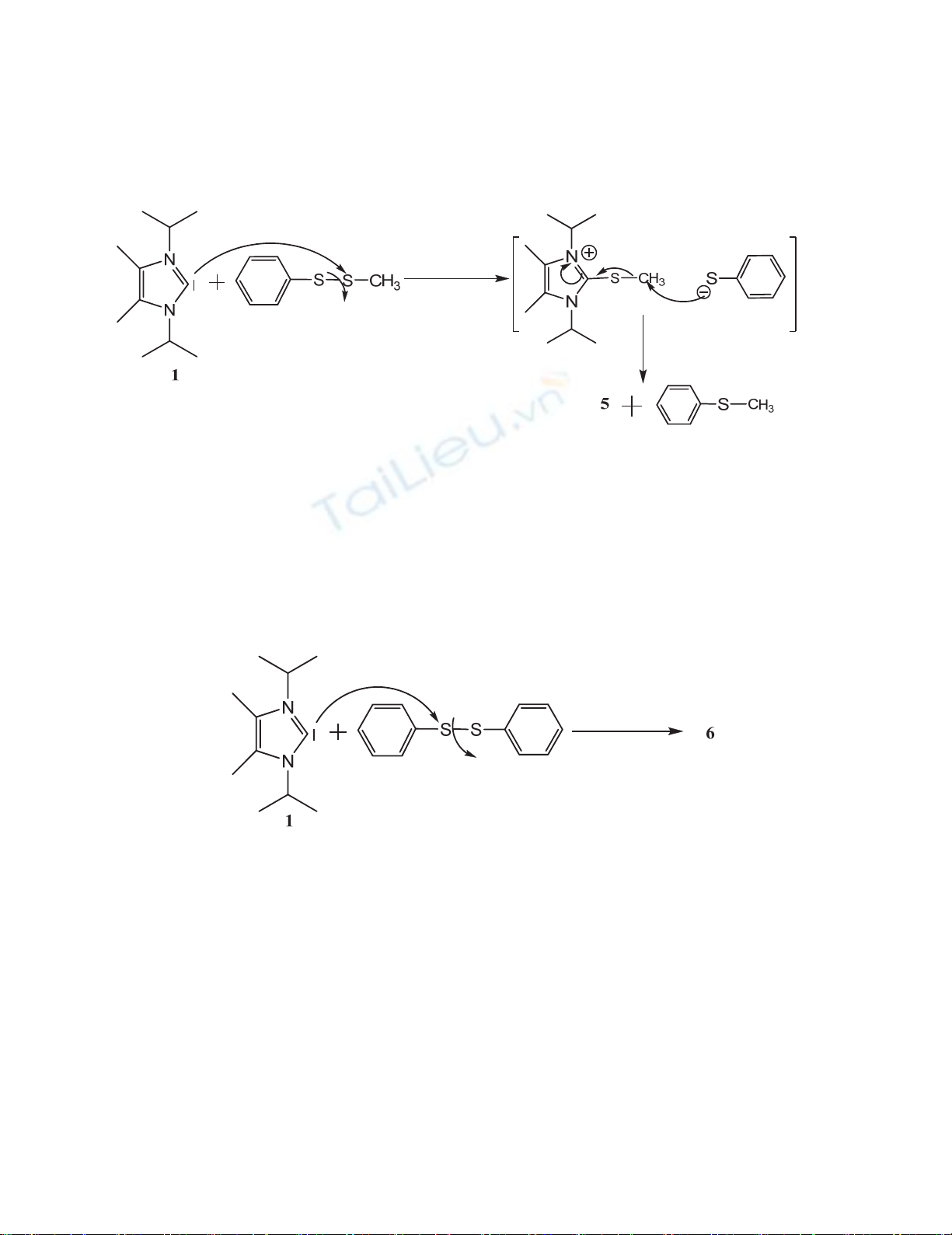
Compounds 5 and 6 were prepared in good yields from reactions of 1 with methyl phenyl disulfide
and diphenylsulfide respectively (Scheme 1). These reactions were performed based on the strong
nucleophilicity of 2,3-dihydro-1,3-diisopropyl-4,5-dimethylimidazol-2-ylidene (1).
Scheme 1. Synthesis of the target products 5, 6, and 7.
E. Mallah et al./ Current Chemistry Letters 9 (2020)
201
Compound 5 was characterized by NMR and IR spectroscopy, mass spectrometer and elemental
analysis. NMR and mass data are in good agreement with those published in the literature.11,12
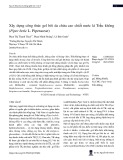
Mechanism of synthesis is proposed in Scheme 2. It seems that C2 of compound 1 attacks a sulfur atom
in methyl phenyl disulfide that is less-hindered followed by attacking the sulfur atom of thiophenolate
to the methyl group under SN2 mechanism to produce the target product 5. This sulfur-sulfur bond
cleavage mechanism was observed in selective desulfurization of trisulfides.13
Scheme 2. Proposed mechanism for synthesis of 5
The structure of compound 6 was assigned obviously from data of NMR and IR spectroscopy, mass
spectrometry and elemental analysis. Diphenyl disulfide shows only four signals in the 13C NMR
spectra due to the presence of symmetry between phenyl groups, while in 6 the symmetry between the
two phenyl rings have been disappeared due to the cleavage of S-S bond and formation of the salt. In
addition, all the imidazolium ion signals are existing in the expected range. 1H and 13C NMR data of 6
imply the presence of separated ions. A proposed mechanism for synthesis of compound 6 is shown in
Scheme 3; carbon atom (S-C) of the phenyl group in imidazolium cation cannot be attacked by sulfur
atom of thiophenolate anion due to the electronic and steric effects.
Scheme 3. Proposed mechanism for synthesis of 6
2,3-Dihydro-1,3-diisopropyl-4,5-dimethylimidazol-2-ylidene is considered a strong organic base,
and consequently can be employed as a deprotonation reagent14 to form imidazolium compounds which
have an important role in developing ionic liquids. These liquids were applied as pharmaceutical
solvents.15 In the present study, the reaction of compound 1 with bis(methylsulfonyl)methane
(Broenstedt acid) represents an acid-base reaction.
1H and 13C NMR spectra also exhibit all signals of the imidazolium ion. The structure of 7 can be
assigned obviously from the NMR spectroscopy. Concerning the 13C spectrum, the chemical shift of
methyl group for the anion is downfield (46.5 ppm), while the signal of methine group is upfield (63.0
ppm), with respect to those found in bis(methylsulfonyl)methane, 41.4 ppm and 70.3 ppm, respectively.
A similar chemical shift for methine group of the anion in 7 has been observed after deprotonation of
bis (phenylsulfonyl)methane with methyl lithium.16 On the other hand, the corresponding

202
imidazoliumacetylacetonate (acac) salt showed a significant downfield chemical shift in 13C spectrum
for the CHacac (δ = 101.7 ppm).17 Comparing with the present value (63.01 ppm), this difference might
be attributed to the electronegativity difference of sulfur and oxygen atoms. All attempts to get single
crystals from 7 were failed due to the very low stability of the salt and high sensitivity towards the
moisture.
3. Conclusion
Target compounds 5, 6, and 7 were prepared successfully in a reasonable yield from the reaction
of 2,3-dihydro-1,3-diisopropyl-4,5-dimethylimidazol-2-ylidene (1) with diphenyl disulfide, methyl
phenyl disulfide and bis(methylsulfonyl)methane respectively. Structures of these compounds were
fully characterized using various spectroscopic techniques. Compound 1 may act as good nucleophile
and strong base in various organic reactions under dry conditions.
Conflicts of Interest
The authors declare that there is no conflict of interest regarding the publication of this paper.
Acknowledgements
The authors gratefully acknowledge the financial support from the University of Jordan and
University of Petra, Deanships of Scientific Research. Also, the authors would like to thank Kathmandu
University for supporting this research.
4. Experimental
All experiments have been performed in purified solvents under argon. The following chemicals
were purchased and used without further purification: methyl phenyl disulfide, diphenyldisulfide and
bis(methylsulfonyl)methane from Sigma Aldrich. 1,3-Diisopropyl-4,5-dimethyl-4,5-
dimethylimidazol-2-ylidene was prepared according to the published work11. NMR analysis was done
using Bruker-Avance III 500 MHz spectrometers with TMS as the internal standard. Coupling constant
(J) values are given in Hertz (Hz). Thin Layer Chromatography (TLC) was performed using Merck
aluminum plates pre-coated with silica gel PF254; (20 x 20) cm x 0.25 mm, and detected by
visualization of the plate under UV lamp (ƛ = 254 nm). Elemental analysis was obtained using Euro
Vector Elemental analyzer model EUROEA3000 A, (Redavalle), Italy. Mass spectra were recorded on
a Finnigan Triple-Stage-Quadrupol spectrometer (TSQ-70) from Finnigan-Mat and the ionization
methods were electron-impact (EI) by 70 eV at 200°C or Fast-atom bombardment (FAB) by 70 eV in
Nitrobenzylalcohol-Matrix at 60°C.
Synthesis of 1,3-diisopropyl-4,5-dimethyl-1,3-dihydro-imidazole-2-thione (5). To a solution
containing 1,3-diisopropyl-4,5-dimethyl-4,5-dimethylimidazol-2-ylidene (1) (0.400 g, 2.22 mmol) in
30 mL Et2O, methyl phenyl disulphide (0.302 ml, 2.23 mmol) was added at room temperature. After
stirring overnight, the solution was kept to stand at -35 οC for 24 h, a white crystals was formed, filtered
off and dried in vacuo. Yield: 0.250 g (53%).
1H NMR (CDCl3): δ = 1.37 (d, 12H, 1,3-CHMe2, 3J = 6.65 Hz), 2.11 (s, 6H, 4,5-Me), 5.60 (sept, 2H,
1,3-CHMe2), 7.24 (m, 3 H, Ph), 8.16 (d, 2 H, Ph), 10.13 (s, 1 H, CIm2).
13C NMR (CDCl3): δ = 10.3 (4,5-Me), 20.7 (1,3-CHMe2), 49.3 (1,3-CHMe2), 159.8 (CS), 121.4 (CIm4,5).
Anal. Calcd. for C11H20N2S (212.20 g/mol): (C, 62.22; H, 9.49; N, 13.19; S, 15.10)%. Found for
C11H20N2S: (C, 62.56; H, 9.39; N, 12.99; S, 15.11) %.

E. Mallah et al./ Current Chemistry Letters 9 (2020)
203
MS (EI): m/z (%) = 212.2 [40].
Synthesis of 1,3-diisopropyl-4,5-dimethyl-2-phenylsulfanylimidazoium benzenethiol (6). To a
solution containing 1,3-diisopropyl-4,5-dimethyl-4,5-dimethylimidazol-2-ylidene (1) (0.240 g, 1.33
mmol) in 30 mL Et2O, diphenyldisulfide (0.290 g, 1.33 mmol) was added at -50 οC. After stirring
overnight at room temperature, the precipitate was filtered off, washed with Et2O and dried in vacuo.
Yield: 0.350 g (66%).
1H NMR (CDCl3): δ = 1.58 (d, 12H, 1,3-CHMe2, 3J = 6.80 Hz), 2.19 (s, 6H, 4,5-Me), 4.44 (sept, 2H,
1,3-CHMe2), 7.39 (m, 3 H, Ph), 7.70 (d, 2 H, Ph).
13C NMR (CDCl3): δ = 8.8 (4,5-Me), 22.8 (1,3-CHMe2), 51.1 (1,3-CHMe2), 125.5 (CPh4), 127.1 (CIm-
Ph2,6), 127.4 (CPh3,5), 128.4 (CSIm-Ph), 129.0 (CPh2,6), 129.2 (CIm-Ph3,5), 137.3 (CSPh), 132.8 (CIm2),131.70
(CIm4,5).
Anal. Calcd. for C23H30N2S2 (398.63 g/mol): (C, 68.35; H, 7.82; N, 7.25; S, 16.59)%. Found for
C23H30N2S2: (C, 68.56; H, 7.42; N, 6.91; S, 16.54) %.
MS (FAB pos.): m/z (%) = 289.1 [100].
MS (FAB neg.): m/z (%) = 108.8 [60].
Synthesis of 1,3-diisopropyl-4,5-dimethylimidazolium bis-methanesulfonyl-methane (7). To a
solution containing 1,3-diisopropyl-4,5-dimethyl-4,5-dimethylimidazol-2-ylidene (1) (0.320 g, 1.77
mmol) in 30 mL Et2O, bis(methylsulfonyl)methane (0.307 g, 1.78 mmol) was added at room
temperature. After stirring for about 48 h, the resulting precipitate was isolated, washed with Et2O and
dried in vacuo. Yield: 0.520 g (83%).
1H NMR (CD3CN): δ = 1.41 (d, 12H, 1,3-CHMe2, 3J = 6.72 Hz), 2.15 (s, 6H, 4,5-Me),
4.41 (sept, 2H, 1,3-CHMe2), 2.73 (CH3 sulfone), 3.41 (CH sulfone), 8.36 (s, 1 H, CIm2).
13C NMR (CD3CN): δ = 7.3 (4,5-Me), 21.4 (1,3-CHMe2), 49.9 (1,3-CHMe2), 46.5 (CH3 sulfone), 63.0
(CHsulfone), 126.3 (CIm2), 129.1 (CIm4,5).
Anal. Calcd. for C14H28N2O4S2 (352.51 g/mol): (C, 47.70; H, 8.01; N, 7.95; S, 18.19) %. Found: (C,
47.41; H, 7.88; N, 7.11; S, 17.81) %.
MS (FAB neg.): m/z (%) = 170.8 [100].
References
1. Ott, I. (2017) Medicinal chemistry of metal N-heterocyclic carbene (NHC) complexes. Inorganic
and Organometallic Transition Metal Complexes with Biological Molecules and Living Cells.
Academic Press, 147-179.
2. Bellemin-Laponnaz, S., Despagnet-Ayoub, E., Díez-González, S., Gade, L. H., Glorius, F., Louie, J.,
Nolan, S. P., Peris, E., Ritter, T., Rogers, M. M. and Stahl, S. S. (2004) N-Heterocyclic carbenes in
transition metal catalysis. Top. Organomet. Chem., 21.
3. Smith, C. A., Narouz, M. R., Lummis, P. A., Singh, I., Nazemi, A., Li, C. H. and Crudden, C. M.
(2019) N-Heterocyclic carbenes in materials chemistry. Chem. Rev., 119 (8), 4986-5056.
4. Dayyih, W. A., Mallah, E., Sweidan, K., Al-Sheikh, A. and Steimann, M. (2013) Crystal structure of
1, 3-diisopropyl-4, 5-dimethylimidazolium oxalic acid monomethyl ester, C14H24N2O4. Z. Krist.-
New Cryst. St., 228 (1), 55-56.
5. Kuhn, N., Richter, M., Steimann, M., Ströbele, M. and Sweidan, K. (2004) Hydrogen bonding in
imidazolium ntrates [1]. Z. Anorg. Allg. Chem., 630 (12), 2054-2058.
6. Kuhn, N., Steimann, M. and Sweidan, K. (2005) The crystal structure of 1, 3-dicyclohexyl-4, 5-










![Giáo trình Vi sinh vật học môi trường Phần 1: [Thêm thông tin chi tiết nếu có để tối ưu SEO]](https://cdn.tailieu.vn/images/document/thumbnail/2025/20251015/khanhchi0906/135x160/45461768548101.jpg)


![Bài giảng Sinh học đại cương: Sinh thái học [mới nhất]](https://cdn.tailieu.vn/images/document/thumbnail/2025/20250812/oursky02/135x160/99371768295754.jpg)


![Đề cương ôn tập cuối kì môn Sinh học tế bào [Năm học mới nhất]](https://cdn.tailieu.vn/images/document/thumbnail/2026/20260106/hoang52006/135x160/1251767755234.jpg)

![Cẩm Nang An Toàn Sinh Học Phòng Xét Nghiệm (Ấn Bản 4) [Mới Nhất]](https://cdn.tailieu.vn/images/document/thumbnail/2025/20251225/tangtuy08/135x160/61761766722917.jpg)