Open Access
Available online http://ccforum.com/content/10/6/R154
Page 1 of 13
(page number not for citation purposes)
Vol 10 No 6
Research
Causes of death and determinants of outcome in critically ill
patients
Viktoria D Mayr1, Martin W Dünser2, Veronika Greil3, Stefan Jochberger1, Günter Luckner1,
Hanno Ulmer4, Barbara E Friesenecker1, Jukka Takala2 and Walter R Hasibeder5
1Department of Anesthesiology and Critical Care Medicine, Innsbruck Medical University, Anichstrasse 35, 6020 Innsbruck, Austria
2Department of Intensive Care Medicine, University Hospital Bern, 3010 Bern, Switzerland
3Institute of Management and Quality Control, TILAK, Anichstrasse 35, 6020 Innsbruck, Austria
4Institute of Medical Biostatistics, Innsbruck Medical University, Anichstrasse 35, 6020 Innsbruck, Austria
5Department of Anesthesiology and Critical Care Medicine, Krankenhaus der Barmherzigen Schwestern, Ried im Innkreis, Austria
Corresponding author: Viktoria D Mayr, viktoria.mayr@uibk.ac.at
Received: 28 Jun 2006 Revisions requested: 3 Aug 2006 Revisions received: 13 Sep 2006 Accepted: 3 Nov 2006 Published: 3 Nov 2006
Critical Care 2006, 10:R154 (doi:10.1186/cc5086)
This article is online at: http://ccforum.com/content/10/6/R154
© 2006 Mayr et al.; licensee BioMed Central Ltd.
This is an open access article distributed under the terms of the Creative Commons Attribution License (http://creativecommons.org/licenses/by/2.0),
which permits unrestricted use, distribution, and reproduction in any medium, provided the original work is properly cited.
Abstract
Introduction Whereas most studies focus on laboratory and
clinical research, little is known about the causes of death and
risk factors for death in critically ill patients.
Methods Three thousand seven hundred patients admitted to
an adult intensive care unit (ICU) were prospectively evaluated.
Study endpoints were to evaluate causes of death and risk
factors for death in the ICU, in the hospital after discharge from
ICU, and within one year after ICU admission. Causes of death
in the ICU were defined according to standard ICU practice,
whereas deaths in the hospital and at one year were defined and
grouped according to the ICD-10 (International Statistical
Classification of Diseases and Related Health Problems) score.
Stepwise logistic regression analyses were separately
calculated to identify independent risk factors for death during
the given time periods.
Results Acute, refractory multiple organ dysfunction syndrome
was the most frequent cause of death in the ICU (47%), and
central nervous system failure (relative risk [RR] 16.07, 95%
confidence interval [CI] 8.3 to 31.4, p < 0.001) and
cardiovascular failure (RR 11.83, 95% CI 5.2 to 27.1, p <
0.001) were the two most important risk factors for death in the
ICU. Malignant tumour disease and exacerbation of chronic
cardiovascular disease were the most frequent causes of death
in the hospital (31.3% and 19.4%, respectively) and at one year
(33.2% and 16.1%, respectively).
Conclusion In this primarily surgical critically ill patient
population, acute or chronic multiple organ dysfunction
syndrome prevailed over single-organ failure or unexpected
cardiac arrest as a cause of death in the ICU. Malignant tumour
disease and chronic cardiovascular disease were the most
important causes of death after ICU discharge.
Introduction
In recent decades, intensive care medicine has developed into
a highly specialised discipline covering several fields of medi-
cine [1]. Whereas the total number of hospital beds in the
United States decreased by 26.4% from 1985 to 2000, inten-
sive care unit (ICU) beds increased by 26.2% during the same
period [1], underlining the high demand for intensive care
medicine. Mortality rates in the ICU strongly depend on the
severity of illness and the patient population analysed. Across
different ICUs, 6.4% to 40% of critically ill patients were
reported to die despite intensive care medicine [2,3].
Although pathophysiological processes and new treatment
approaches are extensively analysed in laboratory and clinical
research, comparably less data are available on the causes of
death, short- and long-term outcomes of critically ill patients,
and associated risk factors. Mostly, data on specific prognos-
tic criteria for single diseases have been published [4-11].
However, little is known of the exact causes of death and the
impact of general risk factors that may uniformly complicate
the course of critically ill patients irrespective of the underlying
disease. Knowledge of such general determinants of outcome
in a critically ill patient population would not only help improve
CI = confidence interval; ICD-10 = International Statistical Classification of Diseases and Related Health Problems; ICU = intensive care unit; MODS
= multiple organ dysfunction syndrome; RR = relative risk; SAPS = Simplified Acute Physiology Score.

Critical Care Vol 10 No 6 Mayr et al.
Page 2 of 13
(page number not for citation purposes)
prognostic evaluation of ICU patients, but also indicate what
therapy and research should focus on to improve the short and
long term outcomes of critically ill patients.
This prospective cohort study evaluates causes of death in a
critically ill patient population in the ICU, in the hospital after
ICU discharge, and within one year after ICU admission. Fur-
thermore, independent risk factors for death during these peri-
ods are identified.
Materials and methods
This prospective cohort study was conducted in a 12-bed
general and surgical ICU in a tertiary, university teaching hos-
pital with 1,595 beds. The ICU is one of six adult ICU facilities
in the university hospital and primarily receives patients after
elective or emergency surgery but also treats surgical and
non-surgical patients with internal medical diseases. All
patients admitted to this ICU between January 1, 1997, and
December 31, 2003, were included in the study protocol. The
study was approved by the institutional review board and the
ethics committee of the Innsbruck Medical University (Inns-
bruck, Austria).
Data collection and parameters
On admission to the ICU, pre-ICU data were documented in a
standardised study protocol by the intensivist in charge. Pre-
ICU data included the following: demographic variables (age
and gender), admission diagnosis, type of admission (emer-
gency or elective), referring unit (emergency department,
operating theatre, recovery room, ward, or other ICU), type of
disease (surgical or non-surgical), anatomical region of surgi-
cal intervention (cardiac, abdominal, traumatological, thoraco-
abdominal, extremity, thoracic, neuro-, or spinal surgery), pre-
operative American Society of Anesthesiologic classification
[12], specific data on cardiac surgery patients (preoperative
ejection fraction, time on cardiopulmonary bypass, aortic
cross-clamp time, and reperfusion time), history of pre-existent
chronic diseases (chronic obstructive pulmonary disease, cor-
onary heart disease, myocardial infarction within the preceding
six months, myocardial infarction longer than six months before
ICU admission, stable angina pectoris, unstable angina pec-
toris, congestive heart failure, treated chronic arterial hyperten-
sion, untreated chronic arterial hypertension, chronic renal
insufficiency, chronic renal insufficiency requiring haemodialy-
sis, liver cirrhosis, Child-Pugh classification of liver cirrhosis
[13], insulin-dependent diabetes mellitus, non-insulin-depend-
ent diabetes mellitus, healed tumour disease, malignant
tumour disease, gastroduodenal ulcer disease, cerebrovascu-
lar insufficiency, status post-transient ischemic attack, pro-
longed ischemic neurological deficit or apoplectic insult, tetra-
or paraplegia, other neurological pathology, psychiatric dis-
ease, immunosuppression, chemotherapy or radiation therapy
during the preceding six months, chronic therapy with corti-
costeroids, and obesity), and the number of pre-existent
chronic diseases. Presence or absence of pre-existent chronic
diseases was documented in a binary fashion (0 = absent, 1
= present).
Any new complication or additional diagnosis that arose dur-
ing the ICU stay was documented on a daily basis by one of
three senior intensivists. Data included need for re-operation,
massive transfusion, continuous veno-venous haemofiltration,
or extracorporeal membrane oxygenation, as well as new-
onset arrhythmias, SIRS (systemic inflammatory response syn-
drome), infection, sepsis, septic shock, acute respiratory dis-
tress syndrome, partial or global respiratory insufficiency,
acute delirium, or critical illness polyneuropathy.
After discharge of the patient, data documentation was com-
pleted by one of the senior intensivists. Data documented at
patient discharge included the Therapeutic Intervention Sever-
ity Score [14] and Simplified Acute Physiology Score (SAPS)
II [15], which were both calculated from the worst physiologi-
cal and laboratory parameters during the first 24 hours after
ICU admission; highest multiple organ dysfunction syndrome
(MODS) score (Appendix) during the ICU stay; worst PaO2/
FiO2 ratio; creatinine, aspartate, alanine aminotransferase, and
bilirubin serum concentrations during the ICU stay; duration of
ICU stay in days; patient mortality; and type of unit the patient
was transferred to (ward, cardiac surgical intermediate care
unit, surgical intermediate care unit, other ICU, or other hospi-
tal). For all patients who died in the ICU, the cause of death
was documented.
In January 2005, the demographic data of the study population
were transferred to the Institute of Management and Quality
Control of the university hospital, which documented the fol-
lowing data from all study patients: number of admissions to
the ICU, hospital mortality, institution the patient was dis-
charged to from hospital (home, other hospital, or rehabilita-
tion unit), and causes of in-hospital death of critically ill
patients after discharge from the ICU. At the same time, mor-
tality data (death rate and cause of death according to the
International Statistical Classification of Diseases and Related
Health Problems [ICD-10] code [16]) were delivered by the
'Austrian Statistical Institution' as well as the 'Tumour Register'
of South Tyrol. Using these data, mortality within one year after
ICU admission and days of survival after ICU discharge were
calculated for each study patient.
Before entry into the computer database, each case report
was reviewed by a member of the study committee (senior
intensivist or coworker). At the end of the electronic documen-
tation of all study patients, plausibility tests were performed for
each study variable to detect and correct typing mistakes that
occurred during data entry or processing.
Definitions and patient management
All codes and definitions of study variables were established
before the beginning of the study and were uniformly docu-

Available online http://ccforum.com/content/10/6/R154
Page 3 of 13
(page number not for citation purposes)
mented as standard operating procedures for study data doc-
umentation. Study-related definitions are summarised in Table
1[16-21]. Cause of death was defined as the primary pathol-
ogy (irrespective of its duration) leading to death of the patient
or to the decision to withhold or withdraw intensive care ther-
apy. Thus, cause of death did not necessarily have to be iden-
tical to admission diagnosis. To reduce inter-investigator
variability to a minimum, all study-relevant decisions on cause
of death, occurrence of new complications in the ICU, as well
as any decision to withhold or withdraw intensive care treat-
ment were made exclusively by one of three senior intensivists
heading the ICU and in charge of the study.
Patient management
In all study patients, discharge from the ICU was initiated by
senior intensivists only. According to institutional practice, car-
diac surgery patients were routinely discharged to a cardiac
surgical intermediate care unit. Only if no bed was available in
this unit were cardiac surgery patients transferred directly from
the ICU to the normal cardiac surgery ward. In all other
patients, the decision to transfer the patient to other ICUs,
intermediate care units, or normal wards was made on a
patient-to-patient basis according to the condition and
requirements of the patient.
Decision to withhold or withdraw life-sustaining therapy
The decision to withhold or withdraw life-sustaining therapy in
a critically ill patient was made exclusively by two or more sen-
ior intensivists in agreement with the patient or the next-of-kin,
as well as physicians from consulting departments other than
the ICU. Aside from the extent of therapeutic support and the
degree of organ dysfunction, decisions to withhold or with-
draw life-sustaining therapy were based on the patient's will
and, if the patient was not able to communicate, on the per-
ceptions of the next-of-kin and physicians concerning the
patient's preference about the use of ongoing life support, as
well as predictions on the likelihood of survival in the ICU and
future quality of life. Withdrawal of life-sustaining therapy in
most cases included cessation of cardiovascular support and/
or extracorporeal therapies (for example, continuous veno-
venous haemofiltration or extracorporeal membrane oxygena-
tion). All patients in whom life-sustaining therapy was with-
drawn received intravenous benzodiazepines and opioids,
fluid therapy, as well as mechanical ventilation, if necessary. In
no patient was extubation or active termination of mechanical
ventilation or tube feeding performed. Moreover, patients were
not discharged to a ward when death was expected. With-
holding of life-sustaining treatment included limitation of ongo-
ing organ support (for example, limitation of the extent of
cardiovascular support) or limitation of therapeutic support if
organ failure occurred (for example, no continuous veno-
venous haemofiltration if acute renal failure occurred). Thus,
the decision to withhold life-sustaining treatments was also
implemented in patients in whom the limiting organ failure had
not yet been present.
Table 1
Study definitions
Obesity Body mass index >30 kg/m2 [17]
Massive transfusion Replacement of one blood mass within 24 hours or need for transfusion of four red cell concentrates within
one hour [18]
SIRS, sepsis, and septic shock Definitions according to standard recommendations [19]
ARDS Acute deterioration of gas exchange (PaO2/FiO2 ratio <200), bilateral infiltrates on the chest x-ray, pulmonary
capillary wedge pressure <18 mmHg [20]
Partial respiratory insufficiency PaO2 <60 mmHg in the extubated spontaneously breathing patient with or without oxygen
Global respiratory insufficiency PaO2 <60 mmHg and PaCO2 >60 mmHg in the extubated spontaneously breathing patient with or without
oxygen
Causes of deatha
Cardiovascular failure According to the MODS score given in the Appendix
Irreversible cardiovascular failure Death in pharmacologically uncontrollable hypotension (MAP <60 mmHg)
Acute, refractory MODS Death from severe MODS (>four failing organs), MAP >60 mmHg, metabolic derangement (for example, lactic
acidosis with arterial lactate concentrations >100 mg/dl)
Chronic, refractory MODS Death from a secondary complication leading to MODS in the state of chronic critical illness
Chronic critical illness Period after tracheotomy has been performed on the ICU because of long-term ventilation (>7 to 12 days) [21]
a Any other cause of death in the ICU, in the hospital after discharge from the ICU, and within one year after admission to the ICU was defined and
grouped according to the ICD-10 code [16]. ARDS, acute respiratory distress syndrome; FiO2, inspiratory oxygen concentration; ICD-10,
International Statistical Classification of Diseases and Related Health Problems; ICU, intensive care unit; MAP, mean arterial blood pressure;
MODS, multiple organ dysfunction syndrome; PaCO2, partial arterial carbon dioxide pressure; PaO2, partial arterial oxygen pressure; SIRS,
systemic inflammatory response syndrome.

Critical Care Vol 10 No 6 Mayr et al.
Page 4 of 13
(page number not for citation purposes)
Outcome variables and study endpoints
The primary study endpoint was to evaluate the causes of
death of critically ill patients in the ICU, in the hospital after dis-
charge from the ICU, and within one year after admission to
the ICU. The secondary study endpoint was to define risk fac-
tors for death in the ICU, in the hospital after discharge from
the ICU, and within one year after admission to the ICU.
Statistical analysis
Descriptive statistical methods were used to analyse demo-
graphic and clinical data of the study population, as well as
causes of death. Three separate logistic regression analyses
applying forward conditioning variables only were used to
examine the association between study variables and ICU
mortality (first analysis, denominator: death in the ICU), in-hos-
pital mortality (second analysis, denominator: death in the hos-
pital after discharge from the ICU), and mortality within one
year after admission to the ICU (third analysis, denominator:
death after hospital discharge and within one year after ICU
admission). Variable selection for the three models was sepa-
rately based on univariate comparisons. In each analysis, vari-
ables that were statistically significant at α = 0.05 in univariate
comparisons were introduced into a multivariate model; cov-
ariates significant at <0.05 were retained in the model. To
evaluate associations between single-organ functions and out-
come variables, MODS score was not directly entered into the
statistical model but was divided into its seven components
(lungs, kidney, cardiovascular system, liver, coagulation, gas-
trointestinal tract, and central nervous system). According to
the score (Appendix), these components were again subdi-
vided into unaffected organ function (0 points), organ dysfunc-
tion (1 point), and organ failure (2 points). In both models, the
MODS score was tested as contrasts of failure versus unaf-
fected organ function, as well as organ dysfunction versus
unaffected organ function. Tests for differences between
study subgroups were performed using the unpaired Student
t, χ2 , or Mann-Whitney U-rank sum tests, as appropriate. Kap-
lan-Meier curves together with the log-rank sum test were
used to illustrate cumulative survival rates for patients with and
without central nervous system failure or cardiovascular failure
in the ICU. A standard statistical program was used for all anal-
yses of this study (SPSS 12.0 for Windows; SPSS Inc., Chi-
cago, IL, USA). Data are given as mean values ± standard
deviation unless stated otherwise.
Results
Study population and patient characteristics
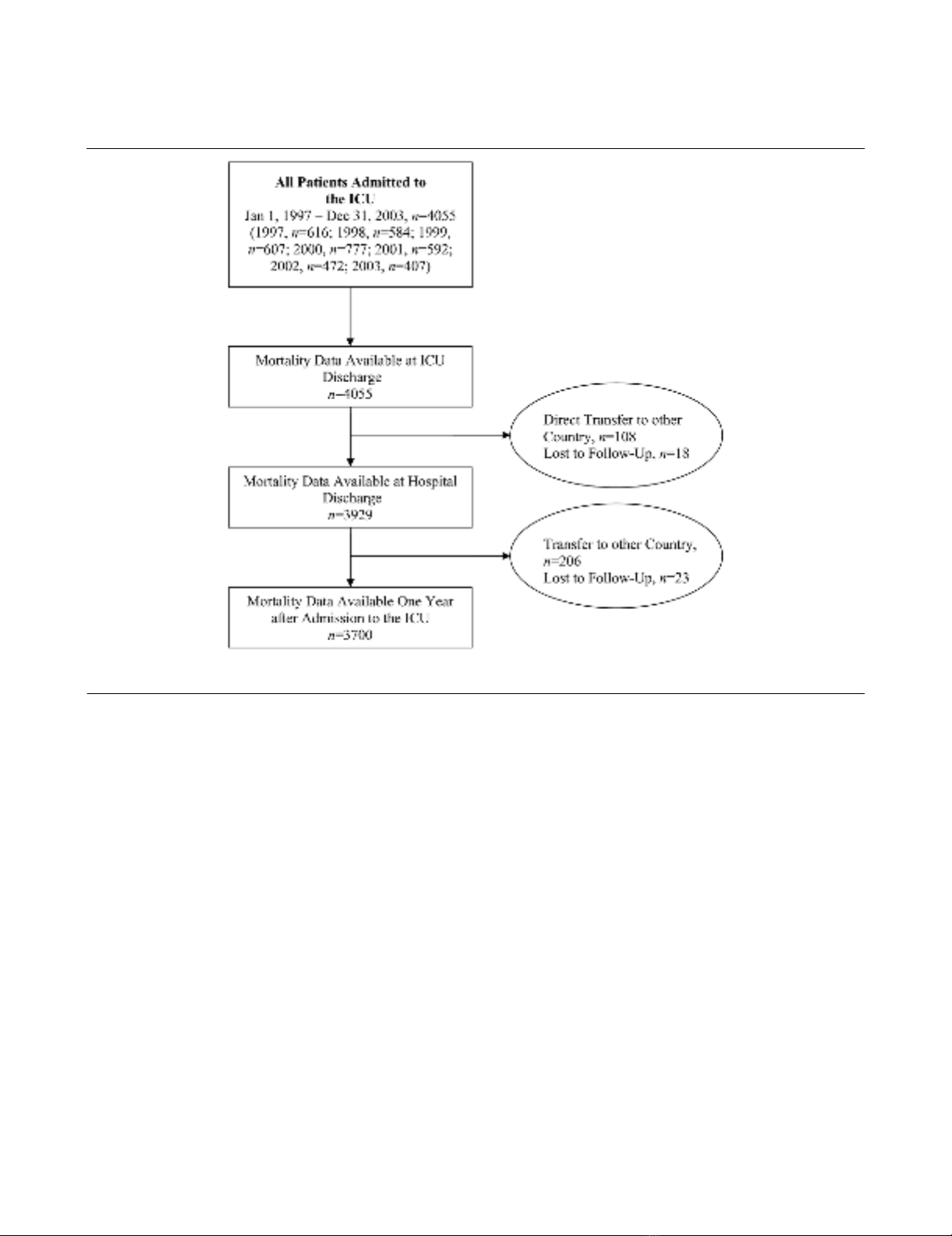
During the observation period, a total of 4,055 critically ill
patients were admitted to the ICU, of whom 3,700 were
included in the statistical analysis (Figure 1). Tables 2 to 4 give
characteristics of the study population.
ICU outcome
ICU mortality was 9.5% (353/3,700) for the study population
for which full data sets were available one year after ICU
admission and 8.7% (353/4,055) for all patients treated in the
ICU during the given period. ICU mortality in patients admitted
to the ICU because of infection, sepsis, or septic shock was
10.1%, 17.5%, and 53.3%, respectively.
ICU survivors had a significantly shorter ICU stay than did non-
survivors (7.6 ± 9.5 versus 11.7 ± 11.5 days, p < 0.001). No
study patient died within the first day of ICU therapy. Twelve
percent of non-survivors died within the first 3 days in the ICU,
and 52.7% died within the first week after ICU admission. In
end-of-life-decisions, treatment was withdrawn in 54.7%
(193/353) of patients who died in the ICU. Table 5 summa-
rises the causes of death of critically ill patients in the ICU.
Acute, refractory MODS was the most frequent cause of
death. Figure 2 presents the relationship between the number
of failing organs and mortality at ICU discharge, hospital dis-
charge, and one year after ICU admission. When the MODS
score reached 14 points (failure of all seven evaluated organ
systems) (n = 6), ICU mortality was 100%.
Independent risk factors for death in the ICU are shown in
Table 6. Central nervous system failure and cardiovascular fail-
ure were the two most important risk factors for death in the
ICU. Figure 3 displays Kaplan-Meier curves with the log-rank
sum test for ICU patients with and without central nervous sys-
tem failure (a) or cardiovascular failure (b). Patients with cen-
tral nervous system or cardiovascular failure had a significantly
higher ICU mortality rate than did patients without central nerv-
ous system failure (7.7% versus 54.2%, p < 0.001) or cardio-
vascular failure (1.4% versus 40.5%, p < 0.001). When
compared with patients who were admitted from the operating
theatre, emergency department, normal ward, or other ICUs,
patients who were admitted to the ICU from the recovery room
were older (61.9 ± 19 versus 59 ± 19 years, p = .002), had
more pre-existent diseases (2.8 ± 1.9 versus 2.4 ± 1.6, p <
0.001), a higher American Society of Anesthesiologists classi-
fication (3.4 ± 0.9 versus 3.2 ± 0.9, p < 0.001), and a higher
SAPS II (39.7 ± 17.9 versus 35.6 ± 14.8, p < 0.001).
In-hospital outcome
In-hospital mortality after discharge from the ICU was 4.3%
(144/3,347). Overall mortality of critically ill patients in the
hospital was 13.5% (497/3,700). In-hospital mortality of
patients admitted to the ICU because of infection, sepsis, or
septic shock was 18.1%, 27.8%, and 57.2%, respectively.
The mean duration of stay in the hospital after ICU discharge
was significantly longer in patients who died in the hospital
than in those who were discharged home or to another hospi-
tal (50.1 ± 62.8 versus 37.3 ± 53.3 days, p = 0.021); 101
patients discharged from the ICU (3%) had to be re-admitted
to the ICU.
Table 5 summarises the most frequent causes of death of crit-
ically ill patients who died in the hospital after discharge from
the ICU. Malignant tumour disease was the most frequent
Available online http://ccforum.com/content/10/6/R154
Page 5 of 13
(page number not for citation purposes)
cause of in-hospital death of critically ill patients after dis-
charge from the ICU. Table 6 presents independent risk fac-
tors for death of critically ill patients in the hospital.
One year outcome
After discharge from the hospital, mortality within one year
after admission to the ICU was 8.9% (286/3,203). Overall
mortality of critically ill patients within one year after admission
to the ICU was 21.2% (783/3,700). One-year mortality of
patients admitted to the ICU because of infection, sepsis, or
septic shock was 33.6%, 42.3%, and 66.9%, respectively.
In patients who died within one year after admission to the
ICU, the mean time after discharge from the hospital to death
was 133 ± 108 days. Table 5 displays the most frequent
causes of death of critically ill patients who died within one
year after ICU admission. Tumour disease was the most fre-
quent cause of death. Fifty-five percent of the non-survivors
died from the same condition that prompted admission to the
ICU.
Table 6 shows independent risk factors for death of critically ill
patients within one year after admission to the ICU. The
number of ICU admissions was the most important risk factor
for death. Patients who were treated more than once in the
ICU were significantly more likely to die within the first year
after ICU admission than patients who required only one
admission to the ICU (30.7% versus 21%, p = 0.026).
Discussion
When taking the high degree of physiologic derangement
(SAPS II, 37.6 ± 16 points) and the associated predicted mor-
tality (19.7%) into account, the observed ICU mortality of
9.5% in this patient population is low. An important explana-
tion for this observation may be the high proportion of postop-
erative patients, in particular postoperative cardiac surgery
patients, in this study population. In contrast to earlier reports
[22,23], ICU non-survivors did not die early in the course of the
disease but primarily in the period of prolonged critical illness
(11.7 ± 11.5 days). This finding is in accordance with recent
studies [24] and underlines the emerging phenomenon of
chronic critical illness [21,25]. The rate of withdrawal of life-
Figure 1
Overview of data inclusionOverview of data inclusion. ICU, intensive care unit.



![Liệu pháp nội tiết trong mãn kinh: Báo cáo [Mới nhất]](https://cdn.tailieu.vn/images/document/thumbnail/2024/20240705/sanhobien01/135x160/4731720150416.jpg)