
369
AT = anaerobic threshold; CPX = cardiopulmonary exercise testing; ICU = intensive care unit.
Available online http://ccforum.com/content/8/5/369
Introduction
Once upon a time, a small village in the mountains of
Switzerland was troubled by the number of tourists involved
in accidents coming down the steep hill into the village. The
tourists were apparently more interested in the scenery than
in the road. The problem facing the village elders, with what
little money they had, was the choice between building more
beds in the hospital or building safety barriers at the roadside
to prevent the accidents.
Do you believe prevention is better than cure? Do you believe
in identifying your high-risk patients before they identify
themselves by the need for yet another intensive care unit
(ICU) bed? The concept of admitting patients to the ICU
postoperatively when they have deteriorated on the ward
results in poor outcomes due to the high severity of illness at
the time of ICU admission. The issues in identifying high-risk
patients are, specifically, what to look for and what tests to
perform. We present our case for a new safety barrier.
Recent myocardial infarction [1] and congestive cardiac
failure [2] were known historically to be associated with high
mortality. The Confidential Enquiry into Perioperative Deaths,
a series of more than 500,000 patients, in 1987 showed that
the majority of postoperative deaths occurred in elderly
patients, with pre-existing cardiac or pulmonary disease,
undergoing major surgery [3]. A later report from Finland in
1995 showed the same findings, this time in more than
325,000 patients [4]. These articles verified the work of
Goldman and colleagues, who published the first index of
cardiac risk in noncardiac surgery in 1977 [2]. Clowes and
Del Guercio had, in 1960, related operative mortality specifically
to the inability to increase cardiac output postoperatively [5].
Defining the problem
There are two main components in identification of high risk
for surgery. The first relates to the type of surgery and the
second to the cardiopulmonary functional capacity of the
patient. These components must be assessed independently.
Postoperative management may influence the final outcome;
identification of high-risk patients will thus only be of value if
there is a change in the management prompted by abnormal
findings. This is important for the effective use of ICU beds
for postsurgical patients.
Review
Clinical review: How to identify high-risk surgical patients
Paul Older1and Adrian Hall2
1Director (Emeritus), Intensive Care Unit and Director, CPX Laboratory, Western Hospital, Footscray, Victoria, Australia
2Deputy Director, Intensive Care Unit, Western Hospital, Footscray, Victoria, Australia
Corresponding author: Paul Older, paul.older@wh.org.au
Published online: 31 March 2004 Critical Care 2004, 8:369-372 (DOI 10.1186/cc2848)
This article is online at http://ccforum.com/content/8/5/369
© 2004 BioMed Central Ltd
Abstract
Postoperative outcome is mainly influenced by ventricular function. Tests designed to identify
myocardial ischemia alone will fail to detect cardiac failure and are thus inadequate as a screening test
for identification of cardiac risk in noncardiac surgical patients. We find that the degree of cardiac
failure is the most important predictor of morbidity and mortality. We use cardiopulmonary exercise
testing to establish the anaerobic threshold as the sole measure of cardiopulmonary function as well as
to detect myocardial ischemia. Patients with an anaerobic threshold <11 ml/min/kg are at risk for major
surgery, and perioperative management must be planned accordingly. Myocardial ischemia combined
with moderate to severe cardiac failure (anaerobic threshold <11 ml/min/kg) is predictive of the
highest morbidity and mortality.
Keywords anaerobic threshold, exercise test, postoperative complications

370
Critical Care October 2004 Vol 8 No 5 Older and Hall
Surgical risk also has two components: the extent and, to a
lesser degree, the duration of the procedure both cause an
increase in postoperative oxygen demand [6]. We, and other
workers, have shown that major intra-abdominal surgery is
associated with an increase in oxygen demand of 40% or
more [7]. This must be met by an increase in cardiac output
or an increase in oxygen extraction. The latter is limited, in the
postoperative setting, to an absolute value of 35–40%.
Patients having surgery such as abdominoperineal resection
of the rectum, oesophagectomy or repair of an abdominal
aortic aneurysm should thus be managed in the ICU because
the oxygen demand of the patient will be high and their
postoperative care will be complicated. It has been shown
that patients with poor ventricular function who are unable to
increase cardiac output to meet the postsurgical demand
have much higher mortality [8]. For lesser surgery, such as an
inguinal hernia repair, there is little or no measurable increase
in oxygen demand and postoperative cardiovascular
complications would not be expected even in a patient with
poor ventricular function. The concept of ‘surgery-specific
risk’ has been well described in the American College of
Cardiology/American Heart Association guidelines [9].
The functional capacity of the patient determines their ability
to support the postoperative demand of increased oxygen
consumption and therefore of cardiac output. We have
shown that myocardial ischemia only becomes part of this
equation if the ischemia limits ventricular function and cardiac
output. The presence or absence of this limitation is the
pivotal issue, not the diagnosis of ischemia per se.
How should we assess functional capacity?
Del Guercio and Cohn showed that standard clinical pre-
operative assessment of the elderly for surgery was inadequate.
Hemodynamic monitoring revealed serious abnormalities in
23% of patients; all in this group who underwent surgery
despite a warning died [10]. This was the first work to identify
risk on the basis of physiologic measurement. In a similar
study, Older and Smith found that up to 13% of elderly
patients had serious cardiopulmonary abnormalities that
made them a high risk for surgery, undetected on prior clinical
examination [7].
In a study of operative mortality, Greenburg and colleagues
found that physiologic senescence is a real phenomenon and
that age was less of a mortality factor than physiologic status
— an effect of aging. They also found that survivors from
geriatric surgery did not have congestive cardiac failure [11].
Although aging is associated with a decline in organ system
function, Wasserman has pointed out that we all age
physiologically at different rates. Chronologic age is thus a
poor discriminator of individual surgical risk [12].
There are many commonly performed investigations for
cardiac disease and, while they are sensitive in detecting or
delineating the extent of ischemic heart disease, none were
designed specifically as preoperative screening tests. Because
the incidence of adverse cardiac events following major
surgery is less than 10%, the positive predictive value of the
special investigations ranges from only 10% to 20% [13].
Sadly, many or most of the current clinical ‘risk indices’ still
highlight issues such as age, risk factors for coronary artery
disease, valvular heart disease, arrhythmias and findings on
physical examination.
There is a current conviction that transthoracic echocardio-
graphy or radionuclide ventriculography assess functional
capacity. Transthoracic echocardiography is noninvasive and
easy to perform, which may be the reason for its ready
acceptance. It assesses systolic wall motion and diastolic
wall motion but, as may be suspected, there is a poor
correlation between transthoracic echocardiography findings
and functional capacity; ventricular dysfunction on echo-
cardiography may well be associated with moderate to good
functional capacity. A study performed by the Study of
Perioperative Ischaemia Research Group did not support the
use of transthoracic echocardiography in the assessment of
cardiac risk prior to noncardiac surgery [14].
It is now accepted that the ejection fraction assessed by
radionuclide ventriculography correlates poorly with the
exercise capacity and the peak oxygen uptake. Froelicher
showed a poor correlation between the ejection fraction and
the maximal oxygen uptake in patients with coronary artery
disease not limited by angina [15]. In a study by Dunselman
and colleagues of New York Health Association class II and
class III patients with an ejection fraction <40%, only oxygen-
derived data were able to show differences between groups.
Their article further states that objective determination of
exercise capacity is the only way to select patients for studies
on heart failure [16].
Dobutamine stress echocardiography is used for evaluation
of myocardial ischemia. While wall motion abnormalities may
be detected, no objective measurement of functional capacity
can be obtained. The sensitivity and specificity for the
detection of myocardial ischemia is high and, as such,
dobutamine stress echocardiography is a useful adjunct in
evaluating coronary artery disease. However, dobutamine
stress echocardiography is not appropriate for preoperative
screening.
A study carried out by the Study of Perioperative Ischemia
Research Group showed that dipyridamole-thallium scinti-
graphy was not a valid screening test for prediction of post-
operative cardiac events [17]. Following these results, single-
photon emission computed tomography was developed. The
combination of this technique with radionuclide angiography
was used as a screening test in 457 patients scheduled for
abdominal aortic reconstructive surgery. The authors
concluded that dipyridamole-thallium single-photon emission
371
computed tomography was not an accurate screening test of
cardiac risk for abdominal aortic surgery [18].
The alternative paradigm
Having elucidated the shortcomings of the traditional (and
existing) approach, what are the alternatives?
Evidence for a new paradigm came from work performed in
the 1980s. Gerson and colleagues compared history and
clinical examination, laboratory data and radionuclide data
with exercise testing. They found that an inability to perform
2 min of supine bicycle exercise to raise the heart rate above
99 beats/min was the only independent predictor of peri-
operative complications [19].
In discussing the aforementioned study by Greenburg and
colleagues [11] regarding operative mortality and the physio-
logic effects of aging, Schrock commented that “a missing
ingredient in the study is some measure of physiologic
reserve. Functional reserve is critical in determining response
to minor and major problems” [11]. Schrock then asked the
crucial question: “Is there some way to quantitate this
particular factor?” [11].
Greenburg and colleagues replied “Measurement of physio-
logic reserve becomes more difficult when one evaluates the
number of pre-existing illnesses the patient has” [11].
Goldman stated in 1987 at the London Sepsis Conference
that “exercise testing using a bicycle could identify patients at
risk that were not identified by the cardiac risk index”
(personal communication).
The requirement is for a screening test that quantifies
functional reserve independently of other factors. We
postulated in 1993 at the Washington Colo-Rectal Meeting
that such a test should be objective, should be specific and
sensitive for detection of cardiac failure and myocardial
ischemia at subclinical levels, should be noninvasive, should
be able to be performed at short notice on inpatients or on
outpatients, and should be quick and inexpensive to perform.
This virtually defines cardiopulmonary exercise testing (CPX).
CPX measures oxygen uptake at increasing levels of work
and objectively determines cardiopulmonary performance
under conditions of stress. This test is normally performed on
a bicycle ergometer using respiratory gas analysis and an
electrocardiogram. Oxygen consumption and carbon dioxide
production are measured during a ‘ramp’ exercise protocol.
Oxygen consumption is a function of oxygen delivery and thus
of total cardiopulmonary performance. Under exercise
conditions, oxygen consumption becomes a linear function of
cardiac output. The measurement of aerobic capacity thus
becomes a surrogate for the measurement of ventricular
function. The test takes less than 1 hour and the cost is
limited to the cost of consumables once the metabolic cart
has been purchased.
The most repeatable and relevant measurement on CPX
testing is the anaerobic threshold (AT). This is the point at
which aerobic metabolism is inadequate for maintenance of
high-energy phosphate production in the exercising muscles,
thus forcing the anaerobic metabolism to make up the deficit.
This point is nonvolitional and is readily determined with high
accuracy. The AT is expressed as a value of oxygen consump-
Available online http://ccforum.com/content/8/5/369
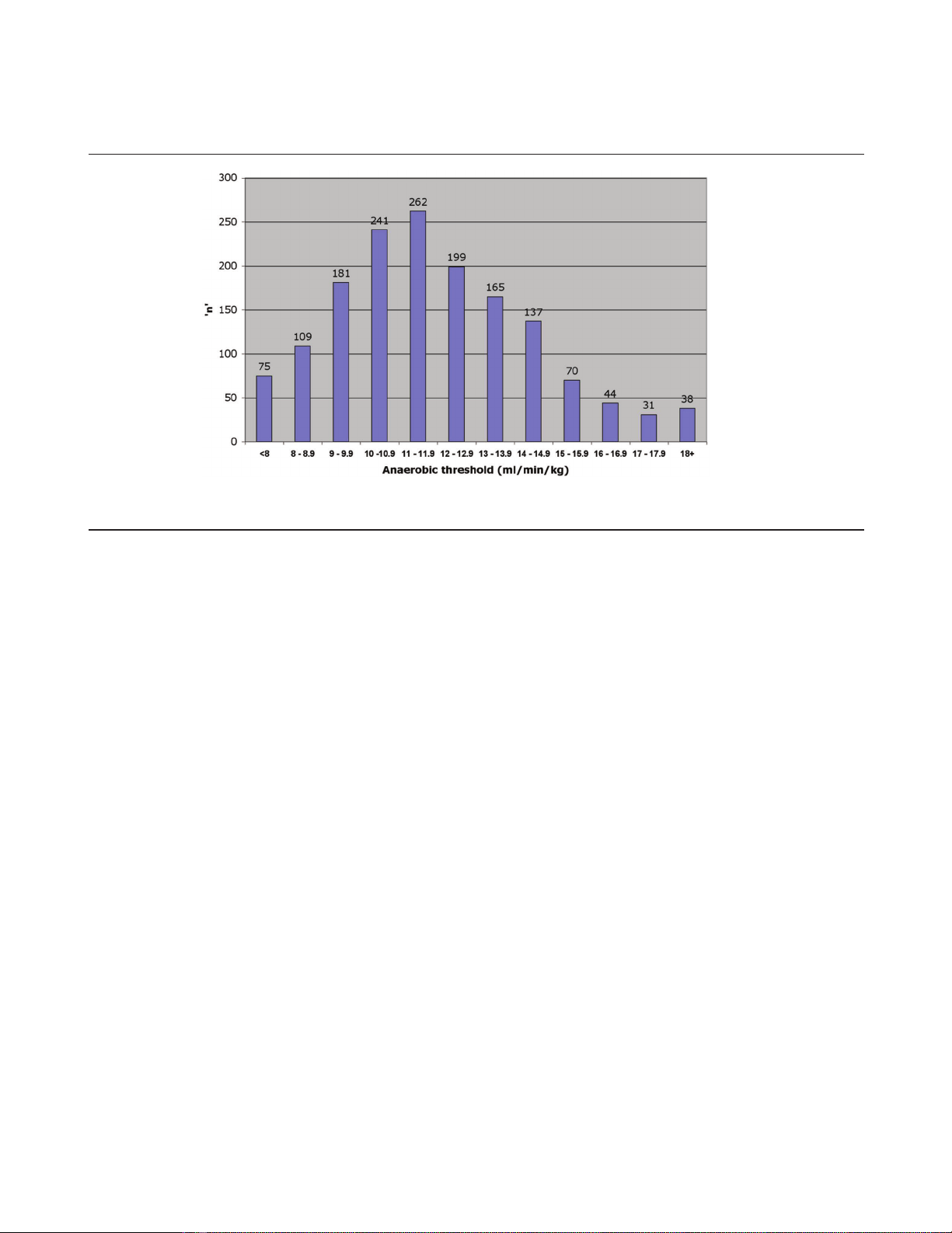
Figure 1
Frequency distribution of the anaerobic threshold for 1645 patients (mean, 12.1 ml/min/kg).

372
tion indexed to body mass (ml/min/kg). Anaerobic metabolism
occurs in any tissue where oxygen delivery is inadequate to
meet energy requirement. This leads to our concepts of a
‘surgical anaerobic threshold’ and ‘postoperative cardiac
failure’; the inability of the heart to meet the demand of
postoperative stress.
In our database of over 1600 patients we have established a
range of average values for the AT of 12.2 ± 2.7 ml/min/kg in
an elderly population (Fig. 1). We do not believe it possible to
make a clinical differentiation between patients with an AT in
the range 10–14 ml/min/kg. Such differentiation is vital in
preoperative assessment and perioperative management and
can only be made by CPX testing.
We have used CPX testing for preoperative risk stratification
since 1988. We have demonstrated that an exercise
anaerobic threshold >11 ml/min/kg predicts postoperative
survival with high sensitivity and specificity [20,21].
Cardiovascular deaths in all our studies are virtually confined
to patients with AT <11 ml/min/kg (i.e. there are very few
false negatives). Current mortality figures show a cardio-
vascular mortality rate of 0.9% in 750 patients, all in patients
with AT <11 ml/min/kg.
It is interesting and very relevant that in a recent study of
medical patients with cardiac failure, unrelated to surgery, AT
<11 ml/min/kg was associated with poor prognosis [22].
Our work suggests that cardiac failure is responsible for more
deaths than myocardial ischemia. The presence or absence
of myocardial ischemia per se does not influence outcome;
however, the temporal relationship of ischemia to AT is
important. We have found that in patients in whom myocardial
ischemia develops at reduced work rates, the anaerobic
threshold is usually reduced, implying that ischemia is limiting
the cardiac performance of the patient. Our hypothesis is that
those patients in whom ischemia develops early in exercise
are at higher risk of postoperative ventricular dysfunction than
those in whom ischemia develops late [23].
Competing interests
The authors declare that they have no competing interests.
References
1. Rao TL, Jacobs KH, El-Etr AA: Reinfarction following anesthe-
sia in patients with myocardial infarction. Anesthesiology 1983,
59:499-505.
2. Goldman L, Caldera DL, Nussbaum SR, Southwick FS, Krogstad
D, Murray B, Burke DS, O’Malley TA, Goroll AH, Caplan CH,
Nolan J, Carabello B, Slater EE: Multifactorial index of cardiac
risk in noncardiac surgical procedures. N Engl J Med 1977,
297:845-850.
3. Buck N, Devlin HB, Lunn JN: The Report of a Confidential Enquiry
into Perioperioperative Deaths. London: King’s Fund Publishing
Office; 1987.
4. Tikkanen J, Hovi-Viander M: Death associated with anaesthesia
and surgery in Finland in 1986 compared to 1975. Acta Anaes-
thesiol Scand 1995, 39:262-267.
5. Clowes GH Jr, Del Guercio LR: Circulatory response to trauma
of surgical operations. Metabolism 1960, 9:67-81.
6. Waxman K, Shoemaker WC: Management of postoperative and
posttraumatic respiratory failure in the intensive care unit.
Surg Clin N Am 1980, 60:1413-1428.
7. Older P, Smith R: Experience with the preoperative invasive
measurement of haemodynamic, respiratory and renal func-
tion in 100 elderly patients scheduled for major abdominal
surgery. Anaesth Intensive Care 1988, 16:389-395.
8. Shoemaker WC, Appel PL, Kram HB, Waxman K, Lee TS:
Prospective trial of supranormal values of survivors as thera-
peutic goals in high-risk surgical patients. Chest 1988, 94:
1176-1186.
9. Eagle K, Brunage B, Chaitman B: Guidelines for perioperative
cardiovascular evaluation for noncardiac surgery. Report of
the American College of Cardiology/American Heart Associa-
tion Task Force on Practise Guidelines. Committee on Periop-
erative Cardiovascular Evaluation for Non-cardiac Surgery.
Circulation 1996, 93:1278-1317.
10. Del Guercio LR, Cohn JD: Monitoring operative risk in the
elderly. JAMA 1980, 243:1350-1355.
11. Greenburg AG, Saik RP, Pridham D: Influence of age on mortal-
ity of colon surgery. Am J Surg 1985, 150:65-70.
12. Wasserman K: Preoperative evaluation of cardiovascular
reserve in the elderly. Chest 1993, 104:663-664.
13. Bodenheimer MM: Noncardiac surgery in the cardiac patient:
what is the question? Ann Intern Med 1996, 124:763-766.
14. Halm EA, Browner WS, Tubau JF, Tateo IM, Mangano DT:
Echocardiography for assessing cardiac risk in patients
having noncardiac surgery. Study of Perioperative Ischemia
Research Group. Ann Intern Med 1996, 125:433-441.
15. Froelicher V: Interpretation of specific exercise test responses.
In Exercise and the Heart, 2nd edition. Edited by Froelicher V.
Chicago, IL: Year Book Medical Publishers; 1987:83-145.
16. Dunselman PH, Kuntze CE, van Bruggen A, Beekhuis H, Piers B,
Scaf AH, Wesseling H, Lie KI: Value of New York Heart Associ-
ation classification, radionuclide ventriculography, and car-
diopulmonary exercise tests for selection of patients for
congestive heart failure studies. Am Heart J 1988, 116:1475-
1482.
17. Mangano DT, London MJ, Tubau JF, Browner WS, Hollenberg M,
Krupski W, Layug EL, Massie B: Dipyridamole thallium-201
scintigraphy as a preoperative screening test. A reexamina-
tion of its predictive potential. Study of Perioperative
Ischemia Research Group. Circulation 1991, 84:493-502.
18. Baron JF, Mundler O, Bertrand M, Vicaut E, Barre E, Godet G,
Samama CM, Coriat P, Kieffer E, Viars P: Dipyridamole-thallium
scintigraphy and gated radionuclide angiography to assess
cardiac risk before abdominal aortic surgery. N Engl J Med
1994, 330:663-669.
19. Gerson MC, Hurst JM, Hertzberg VS, Doogan PA, Cochran MB,
Lim SP, McCall N, Adolph RJ: Cardiac prognosis in noncardiac
geriatric surgery. Ann Intern Med 1985, 103:832-837.
20. Older P, Smith R, Courtney P, Hone R: Preoperative evaluation
of cardiac failure and ischemia in elderly patients by car-
diopulmonary exercise testing. Chest 1993, 104:701-704.
21. Older P, Hall A, Hader R: Cardiopulmonary exercise testing as
a screening test for perioperative management of major
surgery in the elderly. Chest 1999, 116:355-362.
22. Gitt AK, Wasserman K, Kilkowski C, Kleemann T, Kilkowski A,
Bangert M, Schneider S, Schwarz A, Senges J: Exercise anaero-
bic threshold and ventilatory efficiency identify heart failure
patients for high risk of early death. Circulation 2002, 106:
3079-3084.
23. Older P, Hall A: Myocardial ischaemia or cardiac failure: which
constitutes the major perioperative risk? In 2003 Year Book of
Critical Care and Emergency Medicine. Edited by Vincent J. New
York: Springer-Verlag; 2003.
Critical Care October 2004 Vol 8 No 5 Older and Hall

![PET/CT trong ung thư phổi: Báo cáo [Năm]](https://cdn.tailieu.vn/images/document/thumbnail/2024/20240705/sanhobien01/135x160/8121720150427.jpg)