
Review
article
Tree
improvement
programs
for
European
oaks:
goals
and
strategies
PS
Savill,
PJ
Kanowski
Oxford
Forestry
Institute,
Department
of
Plant
Sciences,
University
of
Oxford,
South
Parks
Road,
Oxford
OX1
3RB,
UK
Summary —
Most
work concerned
with
the
improvement
of
European
oaks
is
concentrated
on
Quercus
robur
and
Q
petraea.
Improvement
is
constrained
by
limited
knowledge
of
the extent
and
pattern
of
genetic
variation,
the
long
period
to
reproductive
maturity,
levels
of
seed
production
rela-
tive
to
demand
and
difficulties
in
vegetative
multiplication.
The
goals
of
improvement
activities
have
focused
on
straightness,
vigor
and
desirable
branching;
on
wood
anatomy,
shrinkage,
density
and
color,
and
susceptibility
to
problems
such
as
frost
cracks,
shakes
and
defoliation.
Three
aspects
of
breeding
are
currently
receiving
attention:
1)
in
vitro
methods
for
regeneration,
flower
induction
and
genetic
manipulation;
2)
technologies
for
clonal
multiplication,
and
3)
elements
of
classical
breeding
programs.
Recent
conceptual
and
technological
advances
and
greatly
increased
research
activity
have
raised
expectations
of
genetic
progress,
which
will
need
to
be
accompanied
by
developments
in
associated
topics
such
as
silviculture,
pathology
and
wood
science.
oak
/
Quercus
/
breeding
/
genetic
conservation
/ improvement
Résumé —
Programmes
d’amélioration
des
chênes
européens :
objectifs
et
stratégies.
La
plu-
part
des
travaux
concernant
l’amélioration
des
chênes
européens
est
concentrée
sur
Quercus
robur
et
Q
petraea.
L’amélioration
est
rendue
difficile
du
fait
de
la
connaissance
limitée
des
variations
gé-
nétiques,
de
la
longue
période
pour
atteindre
la
maturité
reproductive,
de
la
quantité
de
graines
pro-
duites
par
rapport
à
la
demande
et
des
problèmes
rencontrés
concernant
la
multiplication
végéta-
tive.
Les
buts
de
l’amélioration
ont
été
concentrés
sur
la
rectitude,
la
vigueur
et
la
ramification
ainsi
que
l’anatomie
du
bois,
le
retrait,
la
densité,
la
couleur
et
la
sensibilité
à
des
problèmes
tels
que
les
gélivures,
les
fissures
et
la
défoliation.
Trois
aspects
de
l’amélioration
génétique
sont
actuellement
abordés : 1)
les
méthodes
de
régénération
in
vitro,
d’induction
florale
et
de
manipulations
généti-
ques; 2)
les
techniques
de
multiplication
clonale;
et
3)
les
éléments
de
programmes
d’amélioration
classique.
De
récentes
avancées
technologiques
et
conceptuelles
ainsi
qu’une
activité
accrue
de
la
recherche,
ont
apporté
de
nouveaux
espoirs
d’amélioration
génétique
qui
devront
s’accompagner
de
progrès
en
sylviculture,
pathologie
et
science
du
bois.
chêne
/ Quercus
/ reproduction
/
conservation
génétique
/ amélioration
INTRODUCTION
Of
the
27
European
species
of
oak,
only
3
are
of
major
economic
significance:
Quer-
cus
petraea,
Q
robur
and
Q
suber.
The
first
2
are
important
components
of
the
for-
ests
of
Europe
north
of
the
Mediterranean
region,
and
their
timber
is
highly
valued.
We
concentrate
on
them
in
this
paper.
The
third
species,
Q
suber,
produces
most
of
the
world’s
commercial
cork
and
is
the ba-
sis
of
an
important
industry,
especially
in
Portugal.
Despite
their
economic
importance,
a
comprehensive
set
of
constraints
—
the
long
rotations,
the
delay
in
the
onset
of
flowering,
uncertainty
as
to
the
timing
of
heavy
fruiting
(good
seed
years
occur
at
2-10-yr
intervals
in
most
regions),
impossi-
bility
of
storing
seed
for
extended
periods,
and
difficulties
in
vegetative
propagation
—
have
made
oaks
relatively
difficult
sub-
jects
for
geneticists
and
tree
breeders,
par-
ticularly
in
comparison
to
shorter-rotation,
more
promiscuous
and
more
easily
propa-
gated
species,
such
as
poplars,
eucalypts
and
many
conifers.
At
present,
there
are
no
large-scale
oak
improvement
programs
in
Europe,
due
partly
to
the
limited
financial
support
for
breeding
long-rotation
hardwoods.
Conse-
quently,
the
many
seed
stands
which
do
exist
will
continue
to
provide
the
main
source
of
reproductive
material
both
for
nursery
production
and
direct
sowing.
They
are
considered
by
many
to
represent
a
considerable
improvement
over
the
pre-
vious
situation
when
none
existed
be-
cause
seeds
are
now
harvested
from
well-
adapted,
phenotypically
superior
stands
and,
in
France
at
least,
seed
transfers
be-
tween
regions
are
restricted.
Even
when
seed
orchards
have
been
established,
their
contribution
is
limited
under
current
silvicultural
practice:
a
1-ha
seed
stand
or
orchard
will
produce
enough
seed
for
the
establishment
of
only
between
2
and
7.5
ha/year
of
plantations
at
the
typical
Ger-
man
stocking
of
10
000
trees/ha
(Kleinsch-
mit,
1986).
Goals:
breeding
objectives
and
selection
criteria
Breeding
objectives
describe
the
goals
of
genetic
improvement
and
selection
criteria
as
the
traits
by
which
this
improvement
will
be
realized
(Cotterill
and
Dean,
1990).
In
theory,
breeding
goals
include
all
traits
of
economic
importance;
selection
criteria
usually
comprise
a
more
restricted
set,
chosen
for
their
genetic
control
and
rela-
tionship
with
the
breeding
objective.
Typi-
cally
traits
which
influence
size
and
quality
at
harvest
are
included
as
breeding
objec-
tives
and
weighted
according
to
their
rela-
tive
economic
importance.
Selection
crite-
ria
are
likely
to
include
those
juvenile
growth,
quality
and
resistance
traits
which
can
easily
be
assessed,
and
are
known
or
expected
to
correlate
well
with
mature
per-
formance.
We
have
assumed
that
quality
timber
production
for
veneer
and
sawn
wood
will
continue
to
be
the
primary
goal
of
breeding
Quercus
robur
and
Q
petraea.
Selection
criteria
are
therefore
likely
to
include
fast
growth,
especially
during
the
early
stages
of
development,
straightness
and
lack
of
forking
in
the
stem,
self-pruning,
disease
resistance
and
wood
quality
traits.
The
latter
are
probably
the
most
difficult
to
nominate
and
include
shrinkage
and
aes-
thetic
appeal.
Available
genetic
parameter
estimates
for
oak
are
summarized
in
table
I.
They
are
generally
consistent
with
ex-
pectations
from
more
comprehensive
studies
in
other
species;
specific
results
are
discussed
below
and
are
dealt
with
more
comprehensively
elsewhere
in
this
volume.
Vigor,
form
and
branching
Growth
rate
is
usually
under
weaker
ge-
netic
control
than
stem
straightness,
which
is
typically
moderately
heritable
(see,
for
example,
Zobel
and
Talbert,
1984).
Both
are
usually
sufficiently
variable
and
geneti-
cally
determined
to
allow
substantial
progress;
the
relationship
between
them
has
usually
been
of
more
concern
to
breeders.
In
some
species,
eg
Pinus
cari-
baea,
adverse
correlations
between
vigor
and
form
have
constrained
simultaneous
progress
in
both
traits
(Dean
et
al,
1986).
However,
it
may
be
possible
to
achieve
sufficient
gains
in
straightness
in
the
first
generations
of
breeding
to
relax
selection
for
this
trait
in
subsequent
generations,
as
with
P
caribaea
(Kanowski
and
Nikles,
1989).
Data
for
oak
are
quite
limited.
Sig-
nificant
improvement
in
stem
form
was
re-
ported
by
Irgens-Moller
(1955)
for
Q
robur
selected
in
The
Netherlands.
Clonal
vari-
ability
in
terms
of
vigor
and
form
has
been
estimated
in
1-year-old
plants
from
cop-
pice
shoots
(Nepveu,
1982)
and
is
sum-
marized
in
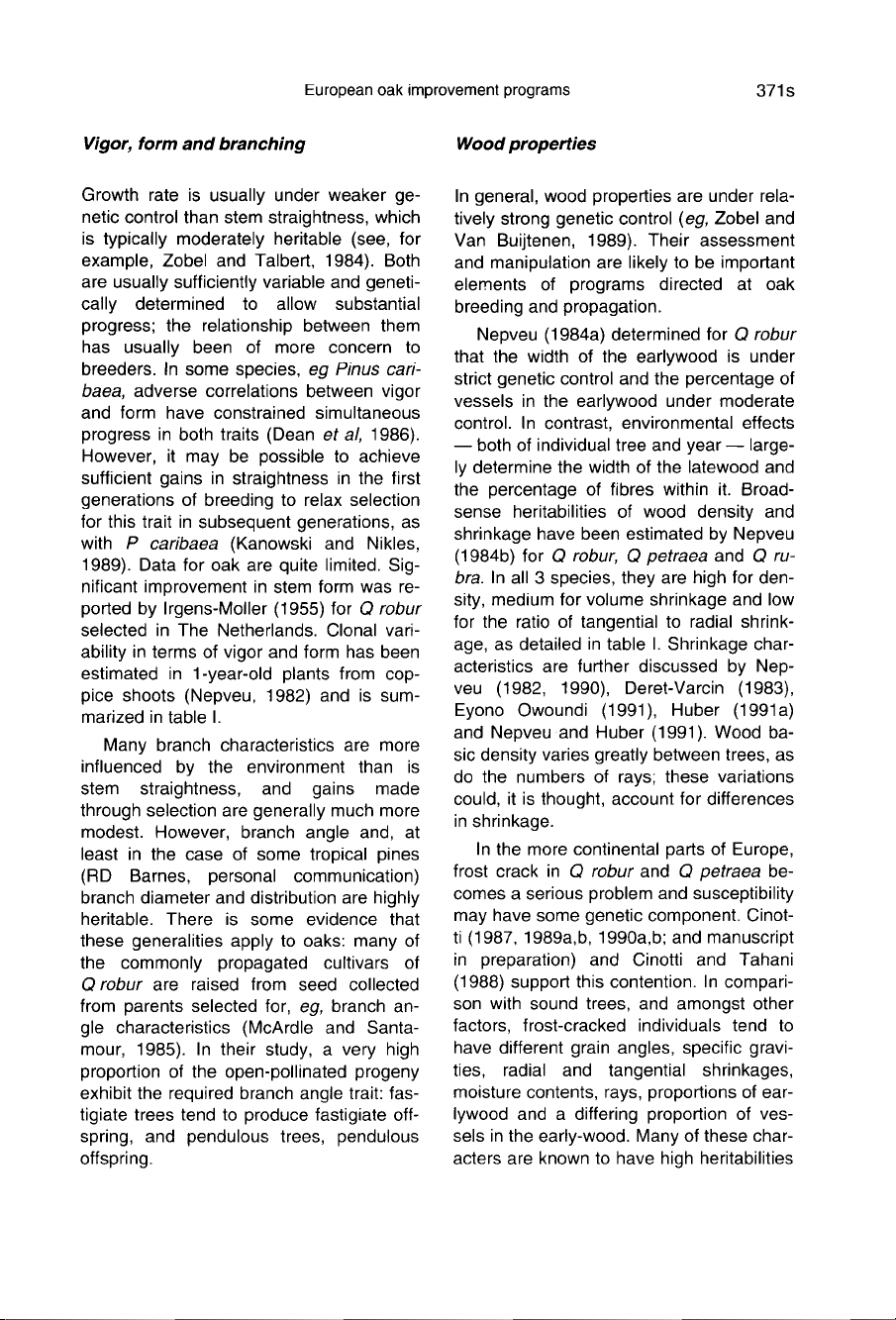
table
I.
Many
branch
characteristics
are
more
influenced
by
the
environment
than
is
stem
straightness,
and
gains
made
through
selection
are
generally
much
more
modest.
However,
branch
angle
and,
at
least
in
the
case
of
some
tropical
pines
(RD
Barnes,
personal
communication)
branch
diameter
and
distribution
are
highly
heritable.
There
is
some
evidence
that
these
generalities
apply
to
oaks:
many
of
the
commonly
propagated
cultivars of
Q
robur
are
raised
from
seed
collected
from
parents
selected
for,
eg,
branch
an-
gle
characteristics
(McArdle
and
Santa-
mour,
1985).
In
their
study,
a
very
high
proportion
of
the
open-pollinated
progeny
exhibit
the
required
branch
angle
trait:
fas-
tigiate
trees
tend
to
produce
fastigiate
off-
spring,
and
pendulous
trees,
pendulous
offspring.
Wood
properties
In
general,
wood
properties
are
under
rela-
tively
strong
genetic
control
(eg,
Zobel
and
Van
Buijtenen,
1989).
Their
assessment
and
manipulation
are
likely
to
be
important
elements
of
programs
directed
at
oak
breeding
and
propagation.
Nepveu
(1984a)
determined
for
Q
robur
that
the
width
of
the
earlywood
is
under
strict
genetic
control
and
the
percentage
of
vessels
in
the
earlywood
under
moderate
control.
In
contrast,
environmental
effects
—
both
of
individual
tree
and
year
—
large-
ly
determine
the
width
of
the
latewood
and
the
percentage
of
fibres
within
it.
Broad-
sense
heritabilities
of
wood
density
and
shrinkage
have
been
estimated
by
Nepveu
(1984b)
for
Q
robur,
Q
petraea
and
Q
ru-
bra.
In
all
3
species,
they
are
high
for
den-
sity,
medium
for
volume
shrinkage
and
low
for
the
ratio
of
tangential
to
radial
shrink-
age,
as
detailed
in
table
I.
Shrinkage
char-
acteristics
are
further
discussed
by
Nep-
veu
(1982,
1990),
Deret-Varcin
(1983),
Eyono
Owoundi
(1991),
Huber
(1991a)
and
Nepveu and
Huber
(1991).
Wood
ba-
sic
density
varies
greatly
between
trees,
as
do
the
numbers
of
rays;
these
variations
could,
it
is
thought,
account
for
differences
in
shrinkage.
In
the
more
continental
parts
of
Europe,
frost
crack
in
Q
robur
and
Q
petraea
be-
comes
a
serious
problem
and
susceptibility
may
have
some
genetic
component.
Cinot-
ti
(1987,
1989a,b,
1990a,b;
and
manuscript
in
preparation)
and
Cinotti
and
Tahani
(1988)
support
this
contention.
In
compari-
son
with
sound
trees,
and
amongst
other
factors,
frost-cracked
individuals
tend
to
have
different
grain
angles,
specific
gravi-
ties,
radial
and
tangential
shrinkages,
moisture
contents,
rays,
proportions
of
ear-
lywood
and
a
differing
proportion
of
ves-
sels
in
the
early-wood.
Many
of
these
char-
acters
are
known
to
have
high
heritabilities
and
so
might
eventually
be
used
as
selec-
tion
criteria,
but
correlations
with
other
ma-
ture
traits
are
not
yet
sufficiently
deter-
mined
to
make
their
immediate
application
possible.
Another
defect
to
which
Q
petraea
and
Q
robur
are
peculiarly
susceptible
is
ring
and
star
shake.
This
has
been
investigated
by
Henman
(1984)
and
at
the
University
of
Oxford
where
Savill
(1986)
found
that
trees
with
large
vessel
cross-sectional
areas
are
particularly
predisposed
to
shake;
Kanow-
ski
et
al
(1991)
reported
vessel
size
to
be
under
relatively
strong
genetic
control
and
therefore
amenable
to
genetic
improve-
ment;
and
Savill
and
Mather
(1990)
discov-
ered
that
large
vessels
are
often
associat-
ed
with
late
flushing
trees,
providing
a
relatively
easy
way
of
determining
shake-
prone
trees
at
the
time
of
leaf
emergence
in
the
spring.
The
prospects
for
breeding
against
shake
therefore
seem
reasonable.
To
those
less
skilled
than
the
French
and
Germans
at
growing
clean
stems
of
oak,
the
problem
of
controlling
epicormic
shoot
growth
can
be
serious.
This
charac-
teristic
has
been
found
by
Mather
(person-
al
communication)
to
be
under
reasonably
strong
genetic
control
(table
I),
and
there-
fore
amenable
to
selective
breeding.
The
significance
of
wood
aesthetics
has
been
investigated
by
Flot
(1988),
Mazet
(1988),
Janin
et
al
(1989,
1990a,b),
Fra-
mond
(1990),
Klumpers
(1990),
Mazet
and
Janin
(1990)
and
Janin
and
Eyono
Owoun-
di
(1991).
Studies
by
several
of
these
au-
thors
and
others
such
as
that
by
Scalbert
et
al
(1989),
provide
more
basic
informa-
tion
on
wood
chemistry.
Early
studies
es-
tablished
that
light-colored
oak
is
particu-
larly
valued
by
most
professional
users.
Investigations
of
the
wood
itself
indicated
that
there
are
significant
correlations
be-
tween
color,
basic
density
and
volumetric
shrinkage.
Results
suggest
that
color
char-
acteristics
might
be used
as
indicators
of
basic
and
technological
properties
of
the
wood
of
oak,
and
the
work
now
underway
to
address
this
topic
should
be
most
use-
ful.
The
breeder’s
interest
in
juvenile-
mature
correlations,
in
terms
of
the
rela-
tionship
between
selection
criteria
and
breeding
objective,
is
complicated
in
the
case
of
wood
properties
by
their
changes
from
juvenility
to
maturity.
Studies
to
inves-
tigate
the
feasibility
of
juvenile
selection
for
specific
wood
characteristics
in
mature
trees
by
F
Huber
(1991 b;
and
manuscript
in
preparation)
and
Nepveu
and
Huber
(1991)
suggest
a
high
level
of
variability
between
trees
for
several
characteristics,
eg,
vessel
diameter,
superimposed
on a
substantial
increase
with
age
for
about
the
first
20
years.
The
amount
of
earlywood
changes
with
age;
fiber
percentages
de-
crease
with
age
and,
in
adult
wood,
seem
to
be
affected
by
climate.
The
proportion
of
rays
is
relatively
constant
within
a
tree,
but
varies
greatly
between
trees.
The
authors
stress
the
preliminary
nature
of
these
re-
sults,
and
note
that
further
work
will
be
necessary
before
any
strategies
for
juve-
nile
selection
can
be
formulated.
Gebhardt
et
al
(1989)
have
suggested
that
it
should
be
possible
to
screen
aseptic
shoot
cultures
for
resistance
to
various
pests
and
diseases;
however,
to
our
knowledge,
no
successful
applications
of
such
work have
yet
been
demonstrated.
Toscano
Underwood
and
Pearce
used
tis-
sue
explants
to
screen
for
fungal
invasions
in
Picea
sitchensis
and
their
results
sug-
gested
genetic
differences
in
resistance
(Toscano
Underwood
and
Pearce,
submit-
ted);
although
the
screening
was
empirical
without
presupposing
any
mechanisms,
it
may
serve
as a
model
for
work
with
oak.
In
an
attempt
to
reduce
defoliation
of
Q robur
by
insect
larvae,
Roest
et
al
(1991)
have
attempted
to
develop
an
Agro-
bacterium-mediated
transformation
proce-


%20--%3e%3cdefs%3e%3cstyle%3e%20.st0%20{%20fill:%20%23fff;%20}%20.st1%20{%20fill:%20%237800fa;%20}%20%3c/style%3e%3c/defs%3e%3cpath%20class='st1'%20d='M117.78,12.18H43.11c2.9,3.47,4.65,7.94,4.65,12.82,0,5.6-2.3,10.66-6.01,14.29h76.02l7.22-13.56-7.22-13.56Z'/%3e%3cg%3e%3cpath%20class='st0'%20d='M53.58,26.17h-.59v-1.46h.59v-4.96h2.83c1.78,0,2.67.94,2.67,2.82v5.76c0,1.87-.89,2.81-2.67,2.81h-2.83v-4.96ZM55.36,21.37v3.34h1.1v1.46h-1.1v3.34h1.01c.61,0,.91-.37.91-1.1v-5.93c0-.74-.3-1.1-.91-1.1h-1.01Z'/%3e%3cpath%20class='st0'%20d='M65.99,31.14h-1.8l-.31-2.07h-2.19l-.31,2.07h-1.64l1.82-11.39h2.62l1.82,11.39ZM65.28,18.04c-.25.46-.51.77-.75.94-.21.15-.47.22-.79.22-.26,0-.57-.07-.92-.22l-.38-.15c-.14-.05-.26-.07-.37-.07-.3,0-.53.18-.71.54l-.91-.68c.25-.46.51-.77.75-.94.21-.14.48-.21.79-.21.26,0,.57.07.92.21l.38.15c.14.05.26.07.37.07.3,0,.53-.18.71-.54l.91.68ZM61.91,27.52h1.73l-.87-5.76-.87,5.76Z'/%3e%3cpath%20class='st0'%20d='M74.53,26.89v1.52c0,1.91-.89,2.86-2.67,2.86s-2.67-.95-2.67-2.86v-5.93c0-1.91.89-2.86,2.67-2.86s2.67.95,2.67,2.86v1.11h-1.69v-1.22c0-.75-.31-1.12-.93-1.12s-.93.37-.93,1.12v6.15c0,.74.31,1.11.93,1.11s.93-.37.93-1.11v-1.63h1.69Z'/%3e%3cpath%20class='st0'%20d='M81.4,31.14h-1.8l-.31-2.07h-2.19l-.31,2.07h-1.64l1.82-11.39h2.62l1.82,11.39ZM75.9,19.2l1.52-1.91h1.71l1.51,1.91h-1.61l-.76-.95-.75.95h-1.61ZM77.32,27.52h1.73l-.87-5.76-.87,5.76ZM83.1,15.99l-1.76,1.91h-1.26l1.17-1.91h1.86Z'/%3e%3cpath%20class='st0'%20d='M84.86,19.75c1.78,0,2.67.94,2.67,2.82v1.48c0,1.87-.89,2.81-2.67,2.81h-.85v4.28h-1.79v-11.39h2.64ZM84.01,21.37v3.86h.85c.58,0,.87-.36.87-1.08v-1.71c0-.71-.29-1.07-.87-1.07h-.85Z'/%3e%3cpath%20class='st0'%20d='M93.51,19.75c1.78,0,2.67.94,2.67,2.82v1.48c0,1.87-.89,2.81-2.67,2.81h-.85v4.28h-1.79v-11.39h2.64ZM92.66,21.37v3.86h.85c.58,0,.87-.36.87-1.08v-1.71c0-.71-.29-1.07-.87-1.07h-.85Z'/%3e%3cpath%20class='st0'%20d='M98.8,31.14h-1.79v-11.39h1.79v4.88h2.03v-4.88h1.83v11.39h-1.83v-4.88h-2.03v4.88Z'/%3e%3cpath%20class='st0'%20d='M105.36,24.55h2.46v1.62h-2.46v3.34h3.09v1.63h-4.88v-11.39h4.88v1.63h-3.09v3.18ZM108.17,17.29l-1.76,1.91h-1.26l1.17-1.91h1.86Z'/%3e%3cpath%20class='st0'%20d='M112.2,19.75c1.78,0,2.67.94,2.67,2.82v1.48c0,1.87-.89,2.81-2.67,2.81h-.85v4.28h-1.79v-11.39h2.64ZM111.35,21.37v3.86h.85c.58,0,.87-.36.87-1.08v-1.71c0-.71-.29-1.07-.87-1.07h-.85Z'/%3e%3c/g%3e%3ccircle%20class='st1'%20cx='25'%20cy='25'%20r='20'/%3e%3cpath%20class='st0'%20d='M32.78,19.27c2.92,0,4.43,2.55,5.28,5.33l.71,2.17c.14.38-.33.75-.71.75h-5.61c.19-.33.24-.71.09-1.08l-.75-2.45c-.43-1.32-.99-2.64-1.79-3.77.75-.57,1.65-.94,2.78-.94h0ZM25,18.38c3.25,0,4.9,2.78,5.89,5.89l.76,2.45c.14.42-.33.8-.8.8h-11.69c-.42,0-.94-.38-.8-.8l.75-2.45c.99-3.11,2.64-5.89,5.89-5.89h0ZM25,11.35c1.74,0,3.11,1.37,3.11,3.11s-1.37,3.11-3.11,3.11-3.11-1.41-3.11-3.11,1.41-3.11,3.11-3.11h0ZM17.27,19.27c1.08,0,1.98.38,2.73.94-.8,1.13-1.37,2.45-1.74,3.77l-.8,2.45c-.14.38-.05.75.09,1.08h-5.56c-.42,0-.9-.38-.75-.75l.71-2.17c.9-2.78,2.41-5.33,5.33-5.33h0ZM17.27,12.91c1.51,0,2.78,1.27,2.78,2.83s-1.27,2.83-2.78,2.83-2.83-1.27-2.83-2.83,1.27-2.83,2.83-2.83h0ZM32.78,12.91c1.56,0,2.78,1.27,2.78,2.83s-1.23,2.83-2.78,2.83-2.83-1.27-2.83-2.83,1.27-2.83,2.83-2.83h0ZM27.07,28.56v.09c0,.57-.24,1.08-.61,1.46h0v.05c-.38.33-.9.57-1.46.57s-1.08-.24-1.46-.61h0c-.38-.38-.61-.9-.61-1.46v-.09h1.41v.09c0,.19.05.38.19.47v.05c.09.09.28.19.47.19s.38-.09.47-.19v-.05c.14-.09.24-.28.24-.47t-.05-.09h1.41ZM30.99,28.56v.09c0,1.65-.66,3.16-1.74,4.24-1.08,1.08-2.59,1.79-4.24,1.79s-3.16-.71-4.24-1.79l-.05-.05c-1.04-1.08-1.7-2.55-1.7-4.2v-.09h1.41v.09c0,1.27.47,2.4,1.27,3.25h.05c.85.85,1.98,1.37,3.25,1.37s2.4-.52,3.25-1.37c.85-.8,1.37-1.98,1.37-3.25v-.09h1.37ZM34.99,28.56v.09c0,2.78-1.13,5.28-2.92,7.07-1.79,1.79-4.29,2.92-7.07,2.92s-5.23-1.13-7.07-2.92c-1.79-1.79-2.92-4.29-2.92-7.07v-.09h1.41v.09c0,2.4.94,4.53,2.5,6.08,1.56,1.56,3.72,2.5,6.08,2.5s4.52-.94,6.08-2.5c1.56-1.56,2.5-3.68,2.5-6.08v-.09h1.41Z'/%3e%3c/svg%3e)