Genet. Sel. Evol. 36 (2004) 123–137 123
c
INRA, EDP Sciences, 2004
DOI: 10.1051/gse:2003055
Original article
Estimation of the proportion of genetically
unbalanced spermatozoa in the semen
of boars carrying chromosomal
rearrangements using FISH on sperm nuclei
Alain Pa, Alain Da∗, Martine Yb
aUMR INRA-ENVT Cytog´en´etique des populations animales, ´
Ecole nationale v´et´erinaire de
Toulouse, 23, chemin des Capelles, 31076 Toulouse Cedex 3, France
bLaboratoire de g´en´etique cellulaire, Institut national de la recherche agronomique,
Auzeville BP 27, 31326 Castanet-Tolosan Cedex, France
(Received 12 March 2003; accepted 23 May 2003)
Abstract – Many chromosomal rearrangements are detected each year in France on young
boars candidates for reproduction. The possible use of these animals requires a good knowl-
edge of the potential effect of the rearrangements on the prolificacy of their mates. This effect
can be estimated by an accurate determination of the rate of unbalanced spermatozoa in the
semen of boars which carry the rearrangements. Indeed, these spermatozoa exhibiting normal
fertilizing ability are responsible for an early embryonic mortality, and then, for a decrease
of the litter sizes. The “spermFISH” technique, i.e. fluorescent in situ hybridization on decon-
densed sperm heads, has been used on several occasions in Man, in this perspective. In livestock
species, this method was formerly used mainly for semen sexing purposes. We used it, for the
first time, to estimate the rates of imbalance in the semen of four boars carrying chromosomal
rearrangements: two reciprocal translocations, rcp(3;15)(q27;q13) and rcp(12;14)(q13;q21), as
well as two independent cases of trisomy 18 mosaicism. The rates of unbalanced gametes were
relatively high for the two reciprocal translocations (47.83% and 24.33%, respectively). These
values differed from the apparent effects of the rearrangements estimated using a limited num-
ber of litters: a decrease in prolificacy of 23% (estimation obtained using the results of 6 litters)
and 39% (57 litters), respectively for the 3/15 and 12/14 translocations. The imbalance rates
were much lower for the trisomy mosaics (0.58% and 1.13%), suggesting a very moderate effect
of this special kind of chromosomal rearrangement.
reciprocal translocation /trisomy mosaic /gamete /fluorescent in situ hybridization /
chromosome
∗Corresponding author: a.ducos@envt.fr

124 A. Pinton et al.
1. INTRODUCTION
Constitutional chromosomal rearrangements are relatively common genetic
abnormalities in most animal species. In man, they are responsible for re-
productive disorders and important congenital abnormalities. The estimated
frequency in live born infants is about 0.7% [3]. Recently, a similar frequency
(0.4%) was estimated in pigs, in a sample of 3500 young purebred boars con-
trolled before reproduction in artificial insemination centres [12]. In livestock
species, constitutional chromosomal abnormalities affect the reproductive per-
formance of animals which carry the rearrangements, or the reproductive
performance of their mates. The reason is the production of genetically un-
balanced gametes responsible for an early embryonic mortality. The numer-
ous chromosomal analyses carried out in hypoprolific boars has allowed for
the identification of many chromosomal rearrangements [27]. The economical
consequences of such abnormalities can be very important if the animals which
carry the rearrangements have a high number of mates, as is generally the case
for reproducers used in artificial insemination centres [30]. These economical
considerations result in the establishment of systematic control programs of
young purebred animal candidates for reproduction in several selected porcine
populations [9, 11]. The analyses carried out have allowed the discovery of
various chromosomal rearrangements carried by young animals controlled be-
fore reproduction, including reciprocal translocations, peri- and paracentric
inversions, as well as trisomy mosaics. In some cases, familial analyses have
allowed us to find the rearrangement on numerous relatives. The frequency
of some abnormalities has turned out to be important in certain populations:
up to 10% of the animals carried the anomaly. Since these chromosomal rear-
rangements have potentially harmful effects for breeders, their eradication has,
up to now, been systematically advised. However, on several occasions, this
recommendation is difficult to apply. Indeed, in some small-sized populations,
the eradication implies the elimination of numerous animals having high ad-
ditive genetic values, thus decreasing the efficiency of the selection schemes.
In such situations, eradication is relevant only if the rearrangements are effec-
tively responsible for an important alteration of the reproductive performance.
Therefore, a precise knowledge of the potential effect of the rearrangements
is needed to adjust the selection decisions. Test matings can be carried out
to estimate this effect, but this strategy is long and costly. Since the unbal-
anced gametes responsible for embryonic loss (and the subsequent litter size
reduction) have normal fertilizing abilities [10, 29], an alternative strategy is
the direct in vitro estimation of the proportion of unbalanced gametes in the
semen of animals carrying the rearrangements. Different technical approaches
initially developed in Man can be used in this perspective. One is based on

Chromosomal imbalance in the semen of boars 125
the in vitro penetration of hamster oocytes by the spermatozoa of the animal of
interest, followed by the fixation and analysis of pronuclei chromosomes [35].
This approach is burdensome and allows only the analysis of a limited num-
ber of gametes. Moreover, it is potentially biased since only the spermato-
zoa that effectively fecundate the hamster oocytes are studied. Since 1997,
two molecular cytogenetics procedures applied on decondensed sperm heads
have been generally preferred: fluorescent in situ hybridization of DNA probes
(spermFISH), and primed in situ DNA labeling (PRINS). Theoretically, the so-
called “spermFISH” technique allows the distinction between normal/balanced
and unbalanced spermatozoa in the semen of individuals carrying chromoso-
mal rearrangements. In reciprocal translocations for instance, the first ones
are mainly produced by alternate segregation mechanisms, whereas the oth-
ers mainly result from adjacent-1 or -2 and 3:1 segregations [3, 8]. The si-
multaneous hybridization of three probes on decondensed sperm heads allows
the distinction between the different segregation products. Two probes must
be chosen in the centromeric regions of both chromosomes involved in the
translocation, whereas the third one must be located on one translocated frag-
ment. Each probe is revealed using a specific fluorochrome combination, e.g.
red, green, and red+green =yellow. Whatever the segregation mechanisms in-
volved, only one fluorescent phenotype corresponds to balanced spermatozoa
(YRG or Yellow/Red/Green phenotype, i.e. one signal for each probe). YRG
spermatozoa are normal ones or balanced spermatozoa carrying translocated
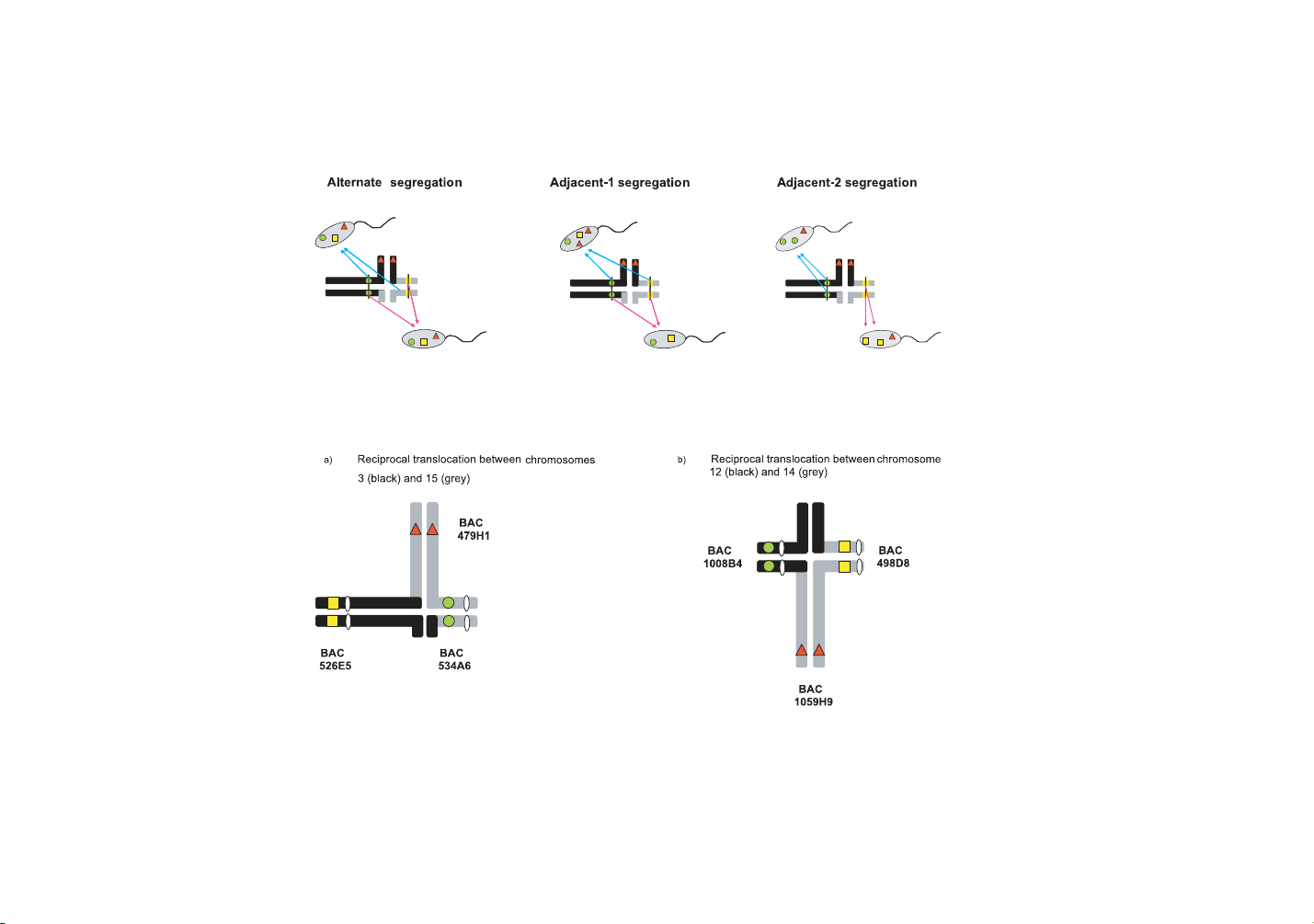
chromosomes (Fig. 1; see also [19] for more details).
This approach has been used successfully on many occasions in Man to
study the segregation products of various chromosomal rearrangements [1, 4,
5, 7, 20, 21, 40]. In livestock species, the spermFISH technique was formerly
used to quantify X- and Y-bearing sperm in cattle [17,28,31,36] and pigs [23],
as well as for the estimation of aneuploidy rates in pigs [34]. We used it for
the first time to estimate the proportion of unbalanced gametes in the semen
of boars carrying different chromosomal rearrangements, and to predict their
effects on reproduction.
2. MATERIALS AND METHODS
2.1. Animals and chromosomal rearrangements studied
Three chromosomal rearrangements were considered.
Two of them were reciprocal translocations. The first one, rcp(3;15)
(q27;q13), was identified in a 10 month-old purebred Large White boar con-
trolled before reproduction in an artificial insemination (AI) centre. Six litters
were sired by this boar before culling, for experimental purposes. The average
size of these litters (9.2 piglets born) was 23% lower than those obtained from

126 A. Pinton et al.
Table I. Description of the probes used in the “spermFISH” applications.
Rearrangement Chromosomes BACs Marker/Gene Location Labeling (*) Color
t(3/15) 3 526E5 STAG3 3p16 B+D Yellow
15(1) 534A6 SW2072 15q12 D Green
15(2) 479H1 S1001 15q25 B Red
t(12/14) 12 1008B4 SW943 12p13 D Green
14(1) 498D8 PER V 14q11 B+D Yellow
14(2) 1059H9 FGFA2 14q28 B Red
trisomy 18 Control : 3 526E5 STAG3 3p16 B Red
18 344H5 WAP 18q24 D Green
(*) B: biotin; D: digoxigenin; B+D: biotin+digoxygenin.
the contemporary boars of the herd (12 piglets born, on average). The sec-
ond one, rcp(12;14)(q13;q21), was identified in a 15 month-old boar selected
from a composite line based on Duroc and Large White breeds, and used in a
multiplication herd. The litters sired by this boar (n=57) had a reduced size
(6.7 piglets born) as compared with those obtained from the contemporary
boars of the herd (10.98, i.e. a decrease in prolificacy of 39%).
The third anomaly was a trisomy 18 mosaic. It was found independently in
two 9 month-old boar candidates for reproduction in AI centres. One was of
the French Landrace breed, the other one of the Pi´etrain breed. In both cases,
trisomic cells were found in various tissues (skin, blood, lung). The average
proportion of trisomic cells was 23% and 50%, respectively for the two boars.
These two animals were culled by the breeders before reproduction.
2.2. Preparation of the probes
Probes were prepared using BAC clones isolated from the Inra swine BAC
library [33]. These clones contained genes or microsatellite markers previ-
ously located on the porcine cytogenetic (http://www.toulouse.inra.fr/lgc/pig/
cyto/cyto.htm) and RH maps [18] (Tab. I). Biotin or/and digoxigenin labeling
of the probes was carried out using random priming.
The specificity of all probes was previously tested on metaphases obtained
from lymphocyte cultures.
For each reciprocal translocation, three probes were hybridized simultane-
ously on decondensed sperm heads: probe 1 labeled with biotin, probe 2 la-
beled with digoxigenin, and probe 3 labeled with both biotin and digoxygenin
(Tab.I,Fig.2).
For the two trisomy 18 mosaic cases plus one control (boar with a normal
karyotype), two probes were hybridized simultaneously on decondensed sperm
head preparations. One probe was specific for chromosome 18, the other one
for chromosome 3 (the same as the one used for the 3/15 translocation) (Tab. I).
Chromosomal imbalance in the semen of boars 127
Figure 1. Examples of gametes produced by 2:2 segregation mechanisms, and the corresponding fluorescent phenotypes (interstitial
crossing-overs were not considered).
Figure 2. Quadrivalent figures at meiosis I - Location of the probes used.



![Liệu pháp nội tiết trong mãn kinh: Báo cáo [Mới nhất]](https://cdn.tailieu.vn/images/document/thumbnail/2024/20240705/sanhobien01/135x160/4731720150416.jpg)