RESEARC H Open Access
Insulin-treated diabetes is not associated with
increased mortality in critically ill patients
Jean-Louis Vincent
1*
, Jean-Charles Preiser
2
, Charles L Sprung
3
, Rui Moreno
4
, Yasser Sakr
5
Abstract
Introduction: This was a planned substudy from the European observational Sepsis Occurrence in Acutely ill
Patients (SOAP) study to investigate the possible impact of insulin-treated diabetes on morbidity and mortality in
ICU patients.
Methods: The SOAP study was a cohort, multicenter, observational study which included data from all adult
patients admitted to one of 198 participating ICUs from 24 European countries during the study period. For this
substudy, patients were classified according to whether or not they had a known diagnosis of insulin-treated
diabetes mellitus. Outcome measures included the degree of organ dysfunction/failure as assessed by the
sequential organ failure assessment (SOFA) score, the occurrence of sepsis syndromes and organ failure in the ICU,
hospital and ICU length of stay, and all cause hospital and ICU mortality.
Results: Of the 3147 patients included in the SOAP study, 226 (7.2%) had previously diagnosed insulin-treated
diabetes mellitus. On admission, patients with insulin-treated diabetes were older, sicker, as reflected by higher
simplified acute physiology system II (SAPS II) and SOFA scores, and more likely to be receiving hemodialysis than
the other patients. During the ICU stay, more patients with insulin-treated diabetes required renal replacement
therapy (hemodialysis or hemofiltration) than other patients. There were no significant differences in ICU or
hospital lengths of stay or in ICU or hospital mortality between patients with or without insulin-treated diabetes.
Using a Cox proportional hazards regression analysis with hospital mortality censored at 28-days as the dependent
factor, insulin-treated diabetes was not an independent predictor of mortality.
Conclusions: Even though patients with a history of insulin-treated diabetes are more severely ill and more likely
to have renal failure, insulin-treated diabetes is not associated with increased mortality in ICU patients.
Introduction
Diabetes mellitus is an increasingly common condition,
and is estimated to affect approximately 246 million
adults worldwide [1]. Although diabetes is occasionally
the reason for admission to an intensive care unit (ICU),
it is more commonly present as a comorbid condition.
Although hyperglycemia can induce a number of immu-
nological alterations [2-5], whether patients with dia-
betes who are admitted to the ICU are more likely to
develop infectious complications remains a controversial
issue with studies yielding conflicting results [6-12].
Similarly, some studies [11,13,14], but not all [10,15],
have indicated increased mortality in ICU patients with
diabetes.
In view of the relative lack of data on patients in the
ICU with diabetes and the conflicting results from the
available data, we investigated the potential impact of
insulin-treated diabetes on morbidity and mortality in
ICU patients included in a large European epidemiologi-
cal study, the Sepsis Occurrence in Acutely ill Patients
(SOAP) study [16].
Materials and methods
The SOAP study was a prospective, multicenter, observa-
tional study designed to evaluate the epidemiology of
sepsis, as well as other characteristics, of ICU patients in
European countries. Details of recruitment, data collec-
tion, and management have been published previously
[16]. Briefly, all patients older than 15 years admitted to
the 198 participating centers [see the list of participating
countries and centers in Additional data file 1] between 1
* Correspondence: jlvincen@ulb.ac.be
1
Department of Intensive Care, Erasme Hospital, Université libre de Bruxelles,
route de Lennik 808, 1070 Bruxelles, Belgium
Vincent et al.Critical Care 2010, 14:R12
http://ccforum.com/content/14/1/R12
© 2010 Vincent et al.; licensee BioMed Central Ltd. This is an open access article distributed under the terms of the Creative Commons
Attribution License (http://creativecommons.org/licenses/by/2.0), which permits unrestricted use, distribution, and reproduction in
any medium, provided the original work is properly cited.

and 15 May, 2002, were included, except patients who
stayed in the ICU for less than 24 hours for routine post-
operative observation. Patients were followed until death,
hospital discharge, or for 60 days. Due to the observa-
tional nature of the study, institutional review board
approval was either waived or expedited in participating
institutions and informed consent was not required.
Data were collected prospectively using pre-printed
case report forms. Data collection on admission
included demographic data and comorbidities, including
diabetes requiring insulin administration. Clinical and
laboratory data for the simplified acute physiology score
(SAPS) II [17] were reported as the worst value within
24 hours after admission. Microbiologic and clinical
infections were reported daily as well as the antibiotics
administered. A daily evaluation of organ function
according to the sequential organ failure assessment
(SOFA) score [18], was performed, with the most abnor-
mal value for each of the six organ systems (respiratory,
renal, cardiovascular, hepatic, coagulation, and neurolo-
gical) collected on admission and every 24 hours there-
after. Infection was defined as the presence of a
pathogenic microorganism in a sterile milieu (such as
blood, abscess fluid, cerebrospinal fluid or ascitic fluid),
and/or clinically documented infection, plus the admin-
istration of antibiotics. Sepsis was defined according to
consensus conference definitions as infection plus two
systemic inflammatory response syndrome (SIRS) cri-
teria [19]. Organ failure was defined as a SOFA score
abovetwofortheorganinquestion[20].Severesepsis
was defined as sepsis with at least one organ failure.
For the purposes of this study, patients were separated
into two groups according to whether or not they had a
history of insulin-treated diabetes prior to ICU admis-
sion. The a priori defined outcome parameters for this
analysis included the degree of organ dysfunction/failure
as assessed by the SOFA score, the occurrence of sepsis
syndromes and organ failure in the ICU, hospital and
ICU lengths of stay, and all-cause hospital and ICU
mortality.
Statistical methods
Data were analyzed using SPSS 13.0 for Windows (SPSS
Inc., Chicago, IL, USA). Descriptive statistics were com-
puted for all study variables. A Kolmogorov-Smirnov
test was used, and histograms and normal-quantile plots
were examined to verify the normality of distribution of
continuous variables. Discrete variables are expressed as
counts (percentage) and continuous variables as means
± standard deviation or median (25th to 75th percen-
tiles). For demographic and clinical characteristics of the
study groups, differences between groups were assessed
using a chi-squared, Fisher’s exact test, Student’st-test
or Mann-Whitney U test, as appropriate.
We performed a Cox proportional hazards regression
analysis to examine whether the presence of diabetes was
associated with mortality. To correct for differences in
patient characteristics, we simultaneously included age,
gender, SAPS II score on admission, co-morbidities, type
of admission (medical or surgical), infection on admission,
mechanical ventilation on admission, renal replacement
therapy on admission (hemofiltration or hemodialysis),
renal failure on admission, and creatinine level on admis-
sion. Variables were introduced in the model if signifi-
cantly associated with a higher risk of 28-day in-hospital
death on a univariate basis at a Pvalue less than 0.2. Coli-
nearity between variables was excluded prior to modelling.
Extended Cox models were constructed adding interaction
terms. The most parsimonious model was fitted and
retained as the final model. We tested the assumption of
proportionality of hazards and found no evidence of viola-
tion. We also tested the qualitative goodness of fit of the
model. All statistics were two-tailed and a Pless than 0.05
was considered to be statistically significant.
Results
Of the 3147 patients included in the SOAP study, 226
(7.2%) had a prior diagnosis of insulin-treated diabetes
mellitus. Table 1 presents the characteristics of the study
group on admission to the ICU. Patients with a history of
insulin-treated diabetes were older (66 (range 55 to 75)
versus 64 (49 to 74) years, P< 0.01) and more severely ill
on admission, as reflected by the higher SAPS II and
SOFA scores, than were patients without a history of insu-
lin-treated diabetes. On admission, more patients with a
history of insulin-treated diabetes had renal failure and
were undergoing hemodialysis than did patients with no
history of insulin-treated diabetes. On admission and dur-
ing the ICU stay, there were no differences in the occur-
rence of sepsis or septic shock among ICU patients with
and those without a history of insulin-treated diabetes
(Tables 1 and 2). During the ICU stay, more patients with
a history of insulin-treated diabetes developed renal failure
and underwent hemodialysis than did those without a his-
tory of insulin-treated diabetes (Table 2).
There were no differences in ICU or hospital lengths
of stay in patients with or without a history of insulin-
treated diabetes and ICU and hospital mortality rates
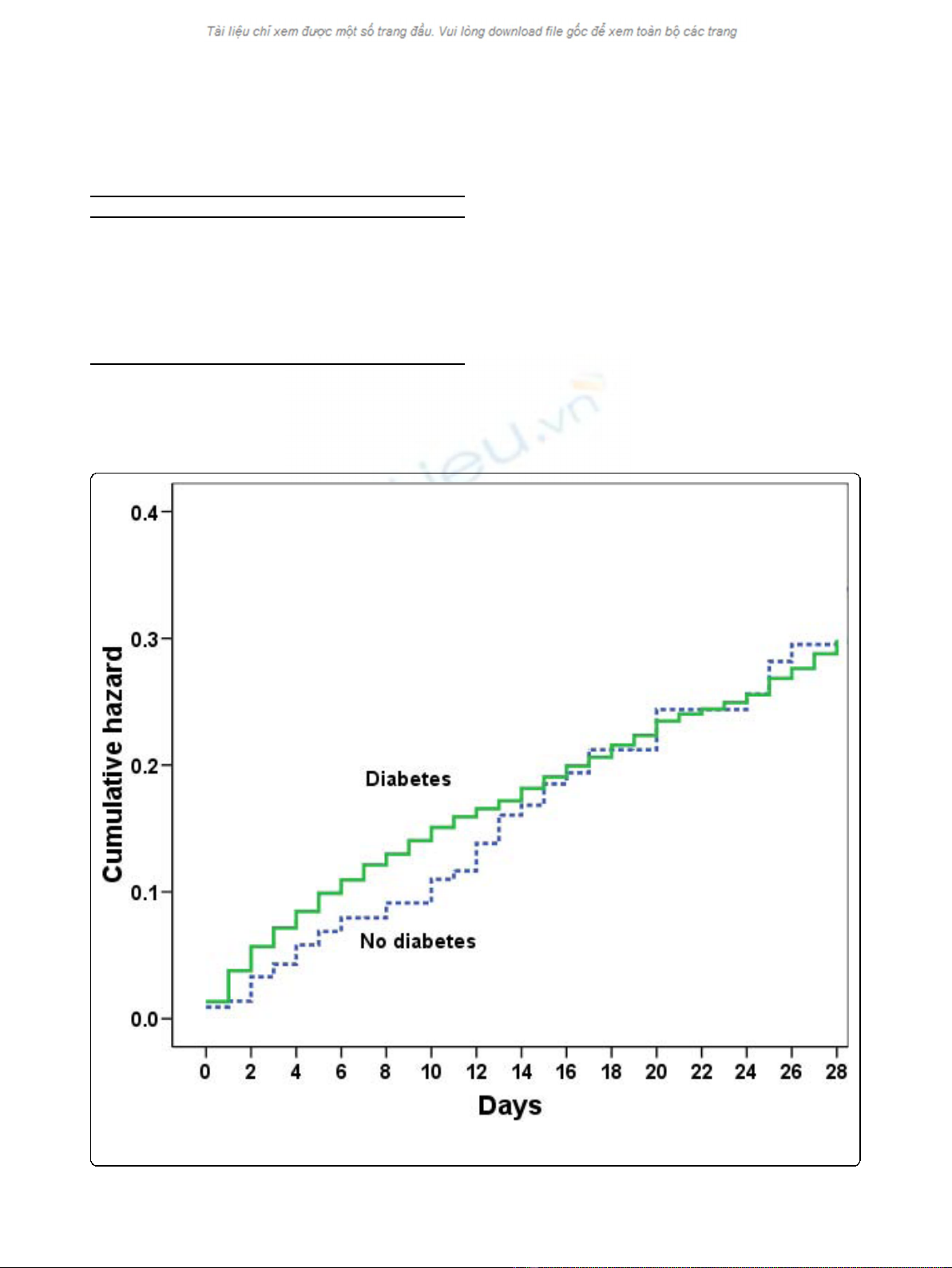
were also similar (Table 2). In the Cox regression
model, medical admission, higher SAPS II score, older
age comorbid liver cirrhosis, and mechanical ventilation
on admission, but not a history of insulin-treated dia-
betes, were associated with an increased risk of death at
28 days (Table 3 and Figure 1).
Discussion
The present results demonstrate that in this heteroge-
neous population of critically ill patients in Western
Vincent et al.Critical Care 2010, 14:R12
http://ccforum.com/content/14/1/R12
Page 2 of 8

Europe, patients with a history of insulin-treated dia-
betes had similar mortality rates to those without, even
though patients with a history of insulin-treated diabetes
were more severely ill on admission to the ICU and
were more likely to have or to develop renal failure and
to require hemodialysis than patients with no history of
insulin-treated diabetes. Importantly, these results refer
to patients who were receiving insulin on admission and
do not reflect the effects of insulin treatment during the
hospital stay. The development of renal failure in ICU
patients is generally associated with an increase in mor-
tality [21,22]; however, this was not the case in our
patients, perhaps because in the majority of the patients
renal failure was already present on admission, making
it a less important prognostic factor than renal failure
that develops later during the ICU admission.
Although diabetes is a relatively common comorbidity
in critically ill patients - in our study 7% of patients had
a history of insulin-treated diabetes - its effects on out-
comes have not been extensively studied. In the litera-
ture, there seems to be considerable variation regarding
the effect of diabetes on outcomes in different groups of
critically ill patients. In an analysis of a database of
15,408 individuals, Slynkova and colleagues [14]
reported that patients with a history of diabetes mellitus
were three times more likely to develop acute organ fail-
ure and had a threefold risk of dying when hospitalized
for that organ failure. In patients with community-
Table 1 Characteristics of the study group on admission to the intensive care unit in patients with and without a
history of insulin-treated diabetes.
No history of insulin-treated diabetes
(n = 2921)
History of insulin-treated diabetes
(n = 226)
Pvalue
Age, years, median (IQR) 64 (49-74) 66 (55-75) < 0.01
Sex, male n (%) 1790 (62) 130 (58) 0.2
Medical admission, n (%) 1301 (45) 87 (39) 0.08
Reason for admission
Digestive/liver 312 (11.3) 21 (10.1) 0.35
Respiratory 519 (18.8) 41 (19.7) 0.71
Cardiovascular 878 (31.8) 71 (34.1) 0.49
Hematological 26 (0.9) 1 (0.5) 0.99
Neurological 455 (16.5) 30 (14.4) 0.5
Renal 86 (3.1) 18 (8.7) < 0.01
Metabolic 56 (2) 15 (7.2) < 0.01
Trauma 178 (6.4) 3 (1.4) < 0.01
Comorbid conditions
Cancer, n (%) 390 (13) 25 (11) 0.36
Hematological cancer 67 (2.3) 2 (0.9) 0.34
COPD 317 (10.9) 23 (10.2) 0.82
HIV infection 24 (0.8) 2 (0.9) 0.84
Liver cirrhosis 110 (3.8) 11 (4.9) 0.37
Heart failure 259 (8.9) 48 (21.2) < 0.001
Presence of sepsis, n (%)
Sepsis 717 (25) 60 (27) 0.52
Severe sepsis 503 (17) 49 (22) 0.10
Septic shock 227 (7.8) 16 (7.1) 0.80
Renal failure on admission 519 (17.8) 56 (24.8) 0.01
With hemodialysis 27 (0.9) 10 (4.4) < 0.001
Without hemodialysis 492 (16.8) 46 (20.4) 0.20
Interventions, n (%)
Mechanical ventilation 1720 (59) 130 (58) 0.73
Hemofiltration 65 (2) 8 (4) 0.24
Hemodialysis 36 (1) 13 (6) < 0.001
Creatinine, mg/dL 1.42 ± 1.40 1.93 ± 1.90 < 0.001
SAPS II, median (IQR) 34 (24-46) 36 (26-49) 0.02
SOFA score, median (IQR) 6 (4-9) 8 (4-10) < 0.01
COPD = chronic obstructive pulmonary disease; IQR = interquartile range; SAPS = simplified acute physiology score; SOFA = sequential organ failure assessment.
Vincent et al.Critical Care 2010, 14:R12
http://ccforum.com/content/14/1/R12
Page 3 of 8

acquired pneumonia, diabetes was an independent pre-
dictor of mortality in a multivariate analysis in one
study [23], but it was not associated with increased mor-
tality in patients with community-acquired bacteremia
in another study [24]. In patients with acute myocardial
infarction, diabetes has been associated with increased
short-term [25] and long-term [26] mortality; however,
in trauma patients, Ahmad and colleagues reported that
although patients with diabetes had more complications
and longer hospital stays, they did not have higher mor-
tality rates than non-diabetic patients [10]. Also in
trauma patients, Kao and colleaguesreportedthatdia-
betes was associated with increased infectious complica-
tions but not with increased mortality [27]. Similar
findings have been reported in burn patients [9] and in
patients with acute heart failure [28]. In patients under-
going hepatic resection, patients with a history of
diabetes had higher rates of postoperative renal failure,
but diabetes was not an independent risk factor for mor-
tality [29]. In patients with severe sepsis or septic shock
enrolled in a large multicenter trial, Stegenga and collea-
gues recently reported that patients with a history of dia-
betes had similar 28-day and 90-day mortality rates to
the other patients [30]. In the present study, the inci-
dence of infections acquired during the ICU stay was not
higher in patients with a history of insulin-treated dia-
betes; however, this does not exclude the possibility that
some specific subgroups (e.g., cardiac surgery) of diabetic
patients may more frequently experience postoperative
infections as suggested in other studies [11].
Much has been written in recent years about the
potential role of hyperglycemia on admission [31] and
during the ICU stay [32,33] on outcomes in ICU
patients and the need for tight control of glucose
Table 2 Procedures, organ failures, and presence of infection during the ICU stay, and ICU and hospital outcomes in
patients with and without a history of insulin-treated diabetes
No history of insulin-treated diabetes
(n = 2921)
History of insulin-treated diabetes
(n = 226)
Pvalue
Infection, n (%)
Before 48 hours 825 (28) 73 (32) 0.19
After 48 hours (ICU acquired) 263 (9) 16 (7) 0.33
Sepsis, n (%) 1088 (37) 89 (39) 0.52
Severe sepsis, n (%) 855 (29) 75 (33) 0.23
Septic shock, n (%) 423 (15) 39 (17) 0.28
Procedures, n (%)
Mechanical ventilation, at least once 1886 (65) 139 (62) 0.35
Hemofiltration, at least once 187 (6) 24 (11) 0.02
Hemodialysis, at least once 111 (4) 30 (13) < 0.001
Organ dysfunction (any time), n (%)
Renal failure 1015 (35) 105 (47) < 0.01
with hemodialysis on admission 32 (1.1) 11 (4.9) < 0.001
without hemodialysis on admission 983 (34) 94 (42) 0.02
Respiratory failure 1202 (41) 99 (44) 0.44
Coagulation failure 289 (10) 20 (9) 0.73
Hepatic failure 154 (5.3) 14 (6) 0.54
CNS failure 782 (27) 57 (25) 0.64
Cardiovascular failure 971 (33) 81 (36) 0.42
Organ dysfunction (after 48 hours), n (%)
Renal failure 248 (9) 23 (10) 0.38
Respiratory failure 208 (7) 18 (8) 0.64
Coagulation failure 75 (3) 6 (3) 0.73
Hepatic failure 51 (2) 4 (2) 0.98
CNS failure 76 (3) 5 (2) 0.72
Cardiovascular failure 93 (3) 10 (4) 0.31
ICU LOS, days, median (IQR) 3 (2-7) 3 (2-8) 0.49
Hospital stay, days, median (IQR) 15 (7-32) 17 (9-35) 0.15
ICU mortality, n (%) 540 (19) 43 (19) 0.86
Hospital mortality, n (%) 684 (24) 63 (28) 0.15
CNS = central nervous system; ICU = intensive care unit; IQR = interquartile range; LOS = length of stay.
Vincent et al.Critical Care 2010, 14:R12
http://ccforum.com/content/14/1/R12
Page 4 of 8
concentrations using insulin [34-38]. Hyperglycemia has
been associated with impaired neutrophil chemotaxis,
oxidative burst, and phagocytosis and increased neutro-
phil adherence [2-5]. Using intravital microscopy, Booth
and colleagues demonstrated that hyperglycemia was
able to initiate an inflammatory response in the micro-
circulation [39], and correction of hyperglycemia in cri-
tically ill patients has been associated with improved
outcomes [34,40]. Our present study was not focused on
hyperglycemia. Whether or not blood glucose should be
strictly controlled is a different issue, which requires
prospective, controlled, randomized studies as in the
study by Van den Berghe and colleagues in which surgi-
cal ICU patients who were managed with a strict proto-
col to maintain blood glucose concentrations between
80 and 110 mg/dl (4.4 and 6.1 mmol/l) had less
Figure 1 Cumulative hazard of death during the first 28 days in the intensive care unit in patients with and without a history of
insulin-treated diabetes.
Table 3 Summary of Cox proportional hazards model
analysis with time to hospital death right-censored at 28
days as the dependent factor.
B SE HR 95% CI P
Medical admission 0.71 0.094 2.04 1.70 - 2.45 < 0.001
Age, year 0.01 0.003 1.01 1.00 - 1.02 0.001
SAPS II score (per point) 0.04 0.002 1.05 1.04 - 1.05 < 0.001
Mechanical ventilation, on
admission
0.30 0.111 1.35 1.09 - 1.68 0.007
Liver cirrhosis on
admission
0.79 0.160 2.19 1.60 –3.00 < 0.001
Insulin-treated diabetes -0.24 0.157 0.78 0.58 - 1.07 0.120
B = coefficient estimate; CI = confidence interval; HR = hazard ratio; SAPS =
simplified acute physiology score; SE = standard error of the estimate.
Vincent et al.Critical Care 2010, 14:R12
http://ccforum.com/content/14/1/R12
Page 5 of 8



![Liệu pháp nội tiết trong mãn kinh: Báo cáo [Mới nhất]](https://cdn.tailieu.vn/images/document/thumbnail/2024/20240705/sanhobien01/135x160/4731720150416.jpg)