

Chapter 10
Externalities
TRUE/FALSE
1. Markets sometimes fail to allocate resources efficiently.
ANS: T DIF: 2 REF: 10-0
NAT: Analytic LOC: Markets, market failure, and externalities
TOP: Market failure MSC: Interpretive
2. When a transaction between a buyer and seller directly affects a third party, the effect is called an externality.
ANS: T DIF: 1 REF: 10-0
NAT: Analytic LOC: Markets, market failure, and externalities
TOP: Externalities MSC: Definitional
3. Buyers and sellers neglect the external effects of their actions when deciding how much to demand or supply.
ANS: T DIF: 2 REF: 10-0
NAT: Analytic LOC: Markets, market failure, and externalities
TOP: Externalities MSC: Interpretive
4. In a market characterized by externalities, the market equilibrium fails to maximize the total benefit to society
as a whole.
ANS: T DIF: 1 REF: 10-0
NAT: Analytic LOC: Markets, market failure, and externalities
TOP: Externalities MSC: Definitional
5. In a market with positive externalities, the market equilibrium quantity maximizes the welfare of society as a
whole.
ANS: F DIF: 1 REF: 10-0
NAT: Analytic LOC: Markets, market failure, and externalities
TOP: Externalities MSC: Interpretive
6. Barking dogs cannot be considered an externality because externalities must be associated with some form of
market exchange.
ANS: F DIF: 1 REF: 10-0
NAT: Analytic LOC: Markets, market failure, and externalities
TOP: Externalities MSC: Applicative
7. The social cost of pollution includes the private costs of the producers plus the costs to those bystanders
adversely affected by the pollution.
ANS: T DIF: 1 REF: 10-1
NAT: Analytic LOC: Markets, market failure, and externalities
TOP: Externalities MSC: Definitional
8. Organizers of an outdoor concert in a park surrounded by residential neighborhoods are likely to consider the
noise and traffic cost to residential neighborhoods when they assess the financial viability of the concert
venture.
ANS: F DIF: 1 REF: 10-1
NAT: Analytic LOC: Markets, market failure, and externalities
TOP: Negative externalities MSC: Applicative
9. When a driver enters a crowded highway he increases the travel times of all other drivers on the highway.
This is an example of a negative externality.
ANS: T DIF: 1 REF: 10-0
NAT: Analytic LOC: Markets, market failure, and externalities
TOP: Externalities MSC: Interpretive
151

152 Chapter 10/Externalities
10. When firms internalize a negative externality, the market supply curve shifts to the left.
ANS: T DIF: 2 REF: 10-1
NAT: Analytic LOC: Markets, market failure, and externalities
TOP: Negative externalities MSC: Analytical
11. Government subsidized scholarships are an example of a government policy aimed at correcting negative
externalities associated with education.
ANS: F DIF: 1 REF: 10-1
NAT: Analytic LOC: Markets, market failure, and externalities
TOP: Positive externalities MSC: Applicative
12. A congestion toll imposed on a highway driver to force the driver to take into account the increase in travel
time she imposes on all other drivers is an example of internalizing the externality.
ANS: T DIF: 2 REF: 10-1
NAT: Analytic LOC: Markets, market failure, and externalities
TOP: Corrective taxes MSC: Interpretive
13. Negative externalities lead markets to produce a smaller quantity of a good than is socially desirable, while
positive externalities lead markets to produce a larger quantity of a good than is socially desirable.
ANS: F DIF: 2 REF: 10-1
NAT: Analytic LOC: Markets, market failure, and externalities
TOP: Negative externalities | Positive externalities MSC: Interpretive
14. The government can internalize externalities by taxing goods that have negative externalities and subsidizing
goods that have positive externalities.
ANS: T DIF: 2 REF: 10-1
NAT: Analytic LOC: Markets, market failure, and externalities
TOP: Negative externalities | Positive externalities MSC: Applicative
15. If the social value of producing robots is greater than the private value of producing robots, the private market
produces too few robots.
ANS: T DIF: 2 REF: 10-1
NAT: Analytic LOC: Markets, market failure, and externalities
TOP: Positive externalities | Technology spillovers MSC: Analytical
16. The patent system gives firms greater incentive to engage in research and other activities that advance
technology.
ANS: T DIF: 2 REF: 10-1
NAT: Analytic LOC: Markets, market failure, and externalities
TOP: Technology spillovers MSC: Applicative
17. Government intervention in the economy with the goal of promoting technology-producing industries is
known as patent policy.
ANS: F DIF: 1 REF: 10-1
NAT: Analytic LOC: Markets, market failure, and externalities
TOP: Industrial policy MSC: Definitional
18. A technology spillover is a type of negative externality.
ANS: F DIF: 2 REF: 10-1
NAT: Analytic LOC: Markets, market failure, and externalities
TOP: Technology spillovers MSC: Interpretive
19. Even if possible, it would be inefficient to prohibit all polluting activity.
ANS: T DIF: 2 REF: 10-2
NAT: Analytic LOC: Markets, market failure, and externalities
TOP: Externalities MSC: Applicative

Chapter 10/Externalities 153
20. When correcting for an externality, command-and-control policies are always preferable to market-based
policies.
ANS: F DIF: 2 REF: 10-2
NAT: Analytic LOC: Markets, market failure, and externalities
TOP: Command-and-control policies | Corrective taxes MSC: Interpretive
21. Corrective taxes enhance efficiency, but the cost to administer them exceeds the revenue they raise for the
government.
ANS: F DIF: 1 REF: 10-2
NAT: Analytic LOC: Markets, market failure, and externalities
TOP: Corrective taxes MSC: Interpretive
22. Corrective taxes cause deadweight losses, reducing economic efficiency.
ANS: F DIF: 2 REF: 10-2
NAT: Analytic LOC: Markets, market failure, and externalities
TOP: Corrective taxes MSC: Interpretive
23. Most economists prefer regulation to taxation because regulation corrects market inefficiencies at a lower cost
than taxation does.
ANS: F DIF: 2 REF: 10-2
NAT: Analytic LOC: Markets, market failure, and externalities
TOP: Corrective taxes MSC: Applicative
24. A corrective tax places a price on the right to pollute.
ANS: T DIF: 2 REF: 10-2
NAT: Analytic LOC: Markets, market failure, and externalities
TOP: Corrective taxes MSC: Interpretive
25. According to recent research, the gas tax in the United States is lower than the optimal level.
ANS: T DIF: 2 REF: 10-2
NAT: Analytic LOC: Markets, market failure, and externalities
KEY: Corrective taxes MSC: Applicative
26. The least expensive way to clean up the environment is for all firms to reduce pollution by an equal
percentage.
ANS: F DIF: 2 REF: 10-2
NAT: Analytic LOC: Markets, market failure, and externalities
TOP: Corrective taxes MSC: Interpretive
27. Corrective taxes are more efficient than regulations for keeping the environment clean.
ANS: T DIF: 1 REF: 10-2
NAT: Analytic LOC: Markets, market failure, and externalities
TOP: Corrective taxes | Tradable pollution permits MSC: Applicative
28. A market for pollution permits can efficiently allocate the right to pollute by using the forces of supply and
demand.
ANS: T DIF: 1 REF: 10-2
NAT: Analytic LOC: Markets, market failure, and externalities
TOP: Tradable pollution permits MSC: Applicative
29. Economists believe that the optimal level of pollution is zero.
ANS: F DIF: 2 REF: 10-2
NAT: Analytic LOC: Markets, market failure, and externalities
TOP: Tradable pollution permits MSC: Interpretive

154 Chapter 10/Externalities
30. The Environmental Protection Agency (EPA) cannot reach a target level of pollution through the use of
pollution permits.
ANS: F DIF: 1 REF: 10-2
NAT: Analytic LOC: Markets, market failure, and externalities
TOP: Tradable pollution permits MSC: Applicative
31. Social welfare can be enhanced by allowing firms to trade their rights to pollute.
ANS: T DIF: 2 REF: 10-2
NAT: Analytic LOC: Markets, market failure, and externalities
TOP: Tradable pollution permits MSC: Applicative
32. Firms that can reduce pollution easily would be willing to sell their pollution permits.
ANS: T DIF: 2 REF: 10-2
NAT: Analytic LOC: Markets, market failure, and externalities
TOP: Tradable pollution permits MSC: Applicative
33. One example of a real-world market for tradable pollution permits is the market for carbon permits in Europe.
ANS: T DIF: 1 REF: 10-2
NAT: Analytic LOC: Markets, market failure, and externalities
TOP: Tradable pollution permits MSC: Applicative
34. Government can be used to solve externality problems that are too costly for private parties to solve.
ANS: T DIF: 1 REF: 10-3
NAT: Analytic LOC: Markets, market failure, and externalities
TOP: Externalities MSC: Interpretive
35. Government intervention is necessary to correct all externalities.
ANS: F DIF: 2 REF: 10-3
NAT: Analytic LOC: Markets, market failure, and externalities
TOP: Externalities MSC: Applicative
36. According to the Coase theorem, if private parties can bargain without cost, then the private market will solve
the problem of externalities.
ANS: T DIF: 1 REF: 10-3
NAT: Analytic LOC: Markets, market failure, and externalities
TOP: Coase theorem MSC: Definitional
37. According to the Coase theorem, the private market will need government intervention in order to reach an
efficient outcome.
ANS: F DIF: 1 REF: 10-3
NAT: Analytic LOC: Markets, market failure, and externalities
TOP: Coase theorem MSC: Definitional
38. Despite the appealing logic of the Coase theorem, private actors often fail to resolve on their own the problems
caused by externalities.
ANS: T DIF: 1 REF: 10-3
NAT: Analytic LOC: Markets, market failure, and externalities
TOP: Coase theorem MSC: Applicative
39. According to the Coase Theorem, individuals can always work out a mutually beneficial agreement to solve
the problems of externalities even when high transaction costs are involved.
ANS: F DIF: 2 REF: 10-3
NAT: Analytic LOC: Markets, market failure, and externalities
TOP: Coase Theorem MSC: Interpretive
Chapter 10/Externalities 155
40. According to the Coase theorem, whatever the initial distribution of rights, the interested parties can bargain to
an efficient outcome.
ANS: T DIF: 1 REF: 10-3
NAT: Analytic LOC: Markets, market failure, and externalities
TOP: Coase theorem MSC: Definitional
41. Private parties may choose not to solve an externality problem if the transaction costs are large enough.
ANS: T DIF: 2 REF: 10-3
NAT: Analytic LOC: Markets, market failure, and externalities
TOP: Coase theorem MSC: Interpretive
42. Many charities like the Sierra Club are established to deal with externalities.
ANS: T DIF: 2 REF: 10-3
NAT: Analytic LOC: Markets, market failure, and externalities
TOP: Coase Theorem MSC: Interpretive
SHORT ANSWER
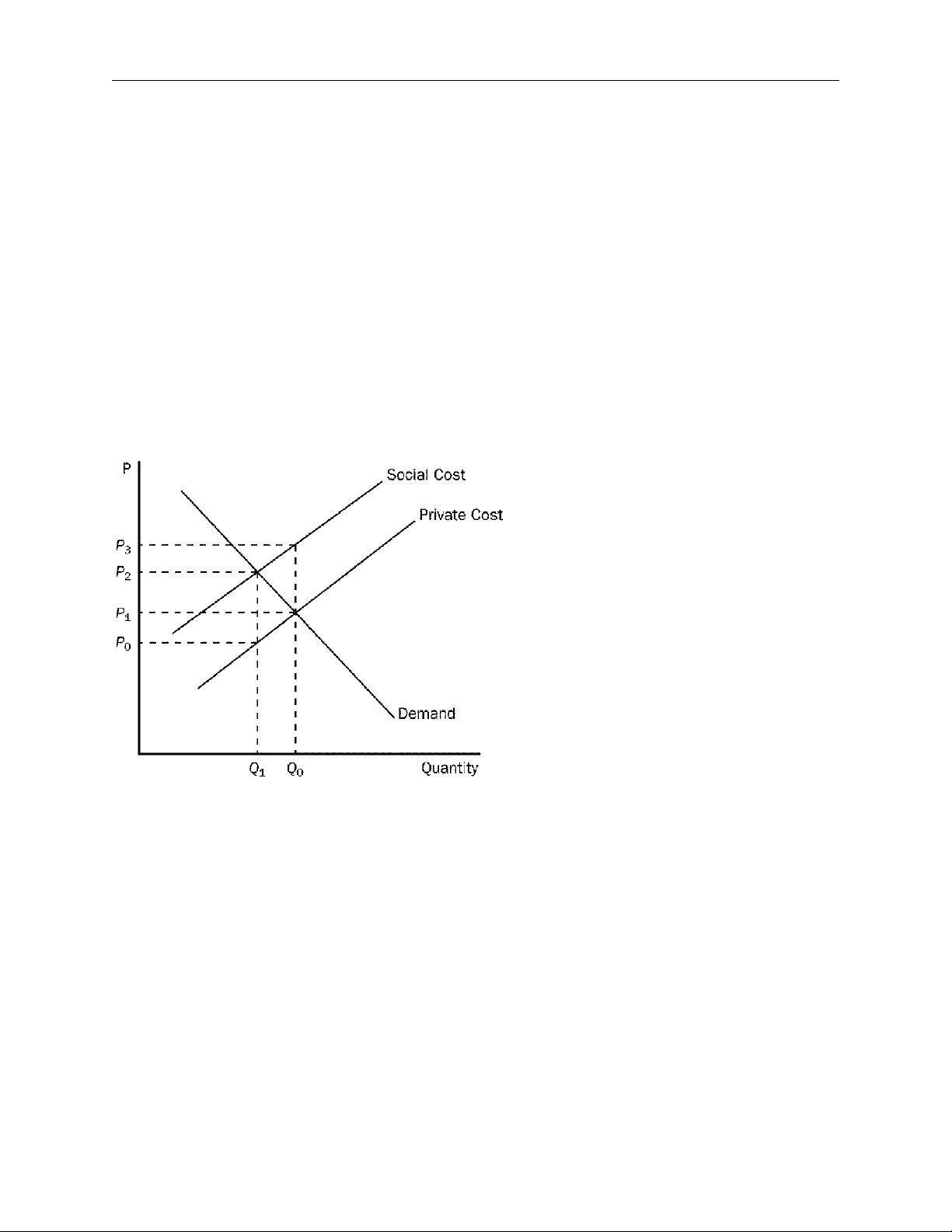
1. Using a supply and demand diagram, demonstrate how a negative externality leads to market inefficiency.
How might the government help to eliminate this inefficiency?
ANS:
When a negative externality exists, the private cost (or supply curve) is less than the social cost. The market
equilibrium quantity of Q0 will be greater than the socially optimal quantity of Q1. The government could help
eliminate this inefficiency by taxing the product. In this example, the size of the per-unit tax would be P3 - P1 (or P2 -
P0).
DIF: 2 REF: 10-1 NAT: Analytic
LOC: Markets, market failure, and externalities TOP: Negative externalities
MSC: Analytical









![Đề cương ôn tập Khoa học quản lý [năm học] chi tiết, chuẩn nhất](https://cdn.tailieu.vn/images/document/thumbnail/2026/20260506/camtucau2026/135x160/62691778123105.jpg)


%20--%3e%3cdefs%3e%3cstyle%3e%20.st0%20{%20fill:%20%23fff;%20}%20.st1%20{%20fill:%20%237800fa;%20}%20%3c/style%3e%3c/defs%3e%3cpath%20class='st1'%20d='M117.78,12.18H43.11c2.9,3.47,4.65,7.94,4.65,12.82,0,5.6-2.3,10.66-6.01,14.29h76.02l7.22-13.56-7.22-13.56Z'/%3e%3cg%3e%3cpath%20class='st0'%20d='M53.58,26.17h-.59v-1.46h.59v-4.96h2.83c1.78,0,2.67.94,2.67,2.82v5.76c0,1.87-.89,2.81-2.67,2.81h-2.83v-4.96ZM55.36,21.37v3.34h1.1v1.46h-1.1v3.34h1.01c.61,0,.91-.37.91-1.1v-5.93c0-.74-.3-1.1-.91-1.1h-1.01Z'/%3e%3cpath%20class='st0'%20d='M65.99,31.14h-1.8l-.31-2.07h-2.19l-.31,2.07h-1.64l1.82-11.39h2.62l1.82,11.39ZM65.28,18.04c-.25.46-.51.77-.75.94-.21.15-.47.22-.79.22-.26,0-.57-.07-.92-.22l-.38-.15c-.14-.05-.26-.07-.37-.07-.3,0-.53.18-.71.54l-.91-.68c.25-.46.51-.77.75-.94.21-.14.48-.21.79-.21.26,0,.57.07.92.21l.38.15c.14.05.26.07.37.07.3,0,.53-.18.71-.54l.91.68ZM61.91,27.52h1.73l-.87-5.76-.87,5.76Z'/%3e%3cpath%20class='st0'%20d='M74.53,26.89v1.52c0,1.91-.89,2.86-2.67,2.86s-2.67-.95-2.67-2.86v-5.93c0-1.91.89-2.86,2.67-2.86s2.67.95,2.67,2.86v1.11h-1.69v-1.22c0-.75-.31-1.12-.93-1.12s-.93.37-.93,1.12v6.15c0,.74.31,1.11.93,1.11s.93-.37.93-1.11v-1.63h1.69Z'/%3e%3cpath%20class='st0'%20d='M81.4,31.14h-1.8l-.31-2.07h-2.19l-.31,2.07h-1.64l1.82-11.39h2.62l1.82,11.39ZM75.9,19.2l1.52-1.91h1.71l1.51,1.91h-1.61l-.76-.95-.75.95h-1.61ZM77.32,27.52h1.73l-.87-5.76-.87,5.76ZM83.1,15.99l-1.76,1.91h-1.26l1.17-1.91h1.86Z'/%3e%3cpath%20class='st0'%20d='M84.86,19.75c1.78,0,2.67.94,2.67,2.82v1.48c0,1.87-.89,2.81-2.67,2.81h-.85v4.28h-1.79v-11.39h2.64ZM84.01,21.37v3.86h.85c.58,0,.87-.36.87-1.08v-1.71c0-.71-.29-1.07-.87-1.07h-.85Z'/%3e%3cpath%20class='st0'%20d='M93.51,19.75c1.78,0,2.67.94,2.67,2.82v1.48c0,1.87-.89,2.81-2.67,2.81h-.85v4.28h-1.79v-11.39h2.64ZM92.66,21.37v3.86h.85c.58,0,.87-.36.87-1.08v-1.71c0-.71-.29-1.07-.87-1.07h-.85Z'/%3e%3cpath%20class='st0'%20d='M98.8,31.14h-1.79v-11.39h1.79v4.88h2.03v-4.88h1.83v11.39h-1.83v-4.88h-2.03v4.88Z'/%3e%3cpath%20class='st0'%20d='M105.36,24.55h2.46v1.62h-2.46v3.34h3.09v1.63h-4.88v-11.39h4.88v1.63h-3.09v3.18ZM108.17,17.29l-1.76,1.91h-1.26l1.17-1.91h1.86Z'/%3e%3cpath%20class='st0'%20d='M112.2,19.75c1.78,0,2.67.94,2.67,2.82v1.48c0,1.87-.89,2.81-2.67,2.81h-.85v4.28h-1.79v-11.39h2.64ZM111.35,21.37v3.86h.85c.58,0,.87-.36.87-1.08v-1.71c0-.71-.29-1.07-.87-1.07h-.85Z'/%3e%3c/g%3e%3ccircle%20class='st1'%20cx='25'%20cy='25'%20r='20'/%3e%3cpath%20class='st0'%20d='M32.78,19.27c2.92,0,4.43,2.55,5.28,5.33l.71,2.17c.14.38-.33.75-.71.75h-5.61c.19-.33.24-.71.09-1.08l-.75-2.45c-.43-1.32-.99-2.64-1.79-3.77.75-.57,1.65-.94,2.78-.94h0ZM25,18.38c3.25,0,4.9,2.78,5.89,5.89l.76,2.45c.14.42-.33.8-.8.8h-11.69c-.42,0-.94-.38-.8-.8l.75-2.45c.99-3.11,2.64-5.89,5.89-5.89h0ZM25,11.35c1.74,0,3.11,1.37,3.11,3.11s-1.37,3.11-3.11,3.11-3.11-1.41-3.11-3.11,1.41-3.11,3.11-3.11h0ZM17.27,19.27c1.08,0,1.98.38,2.73.94-.8,1.13-1.37,2.45-1.74,3.77l-.8,2.45c-.14.38-.05.75.09,1.08h-5.56c-.42,0-.9-.38-.75-.75l.71-2.17c.9-2.78,2.41-5.33,5.33-5.33h0ZM17.27,12.91c1.51,0,2.78,1.27,2.78,2.83s-1.27,2.83-2.78,2.83-2.83-1.27-2.83-2.83,1.27-2.83,2.83-2.83h0ZM32.78,12.91c1.56,0,2.78,1.27,2.78,2.83s-1.23,2.83-2.78,2.83-2.83-1.27-2.83-2.83,1.27-2.83,2.83-2.83h0ZM27.07,28.56v.09c0,.57-.24,1.08-.61,1.46h0v.05c-.38.33-.9.57-1.46.57s-1.08-.24-1.46-.61h0c-.38-.38-.61-.9-.61-1.46v-.09h1.41v.09c0,.19.05.38.19.47v.05c.09.09.28.19.47.19s.38-.09.47-.19v-.05c.14-.09.24-.28.24-.47t-.05-.09h1.41ZM30.99,28.56v.09c0,1.65-.66,3.16-1.74,4.24-1.08,1.08-2.59,1.79-4.24,1.79s-3.16-.71-4.24-1.79l-.05-.05c-1.04-1.08-1.7-2.55-1.7-4.2v-.09h1.41v.09c0,1.27.47,2.4,1.27,3.25h.05c.85.85,1.98,1.37,3.25,1.37s2.4-.52,3.25-1.37c.85-.8,1.37-1.98,1.37-3.25v-.09h1.37ZM34.99,28.56v.09c0,2.78-1.13,5.28-2.92,7.07-1.79,1.79-4.29,2.92-7.07,2.92s-5.23-1.13-7.07-2.92c-1.79-1.79-2.92-4.29-2.92-7.07v-.09h1.41v.09c0,2.4.94,4.53,2.5,6.08,1.56,1.56,3.72,2.5,6.08,2.5s4.52-.94,6.08-2.5c1.56-1.56,2.5-3.68,2.5-6.08v-.09h1.41Z'/%3e%3c/svg%3e)