FTU Working Paper Series, Vol. 2 No. 3 (09/2021) | 101
CÁC NHÂN TỐ ẢNH HƯỞNG ĐẾN Ý ĐỊNH ỨNG DỤNG KẾ TOÁN TINH
GỌN TRONG CÁC CÔNG TY FINTECH TẠI VIỆT NAM
Trần Nguyên Hạnh1
Sinh viên K56 CLC Kế toán kiểm toán định hướng ACCA - Khoa Kế toán Kiểm toán
Trường Đại học Ngoại thương, Hà Nội, Việt Nam
Nguyễn Quang Huy
Giảng viên Khoa Kế toán Kiểm toán
Trường Đại học Ngoại thương, Hà Nội, Việt Nam
Tóm tắt
Nghiên cứu được thực hiện nhằm xác minh các nhân tố ảnh hưởng đến ý định ứng dụng kế toán
tinh gọn trong các công ty Fintech tại Việt Nam. Nghiên cứu đã tích hợp ba mô hình lý thuyết: Mô
hình hành vi có hoạch định, mô hình khuyếch tán đổi mới đổi mới và mô hình chấp nhận công
nghệ. Kết quả phân tích từ 108 kế toán viên phần lớn đang công tác tại Hà Nội cho thấy ý định ứng
dụng kế toán tinh gọn chịu ảnh hưởng bởi (1) tính dễ sử dụng được cảm nhận và (2) khả năng dùng
thử. Trong khi đó, lợi thế tương đối, thái độ và khả năng quan sát được giữ vai trò không đáng kể.
Kết quả nghiên cứu là tài liệu tham khảo cho các chủ doanh nghiệp và kế toán viên hiểu đúng về
quy trình kế toán nội bộ tinh gọn. Từ đó, các nhà quản lý có thể phát triển một hệ thống tinh gọn,
hướng tới mục tiêu cải thiện hiệu suất công việc và tối đa hóa giá trị cho khách hàng.
Từ khóa: kế toán tinh gọn, công ty fintech, ý định sử dụng, hoạt động tinh gọn.
FACTORS AFFECTING INTENTION TO USE LEAN ACCOUNTING AT
FINTECH COMPANIES IN VIETNAM
Abstract
The aim of this study is to verify the factors affecting the intention to use lean accounting at Fintech
companies in Vietnam. To investigate this phenomenon, the theory of planned behavior, the
innovation diffusion theory, and the technology acceptance model had been integrated. An online
survey was distributed to accountants, mainly accountants in Hanoi, collecting a total of 108
respondents. From five proposed research factors, the findings show that the perceived ease of use
and trialability had a positive and significant relationship with the intention to use lean accounting.
Whereas, the relative advantage, attitude and observability were found to be insignificant. The
results of this study will serve as a reference for business owners and acscountants to understand
1 Tác giả liên hệ, Email: k56.1718820028@ftu.edu.vn
Working Paper 2021.2.3.08
- Vol 2, No 3

FTU Working Paper Series, Vol. 2 No. 3 (09/2021) | 102
internal lean accounting processes with the right awareness and to develop a lean system while
improving work performance and maximizing values for customers.
Keywords: lean accounting, fintech companies, intention to use, lean operation.
1. Introduction
The development of the Fintech companies in Vietnam is on the rise. In 2015, the number of
startups in the Fintech sector was 44, by 2020, this number climbed more than 2.7 times, reaching
123 startups. This is fueled by the explosion of e-commerce as people are increasingly in favor of
online consumption and payment. Along with that is strong support from Vietnamese State’s
policies, especially for high-tech services industries2.
Fintech company is considered to be a lean organization. According to Sheahan (2017), lean
organizations are “firms that have adopted the lean methodology into their business model”. Its
ultimate goal is “to provide perfect value to the customer through a perfect value creation process
that has zero waste.” (Lean Enterprise Institute, 2018). There is hardly any definition that can help
readers instantly understand and clearly visualize a lean organization. However, it can be said that
most lean organizations are clearly expressed through lean operation and management, which
emphasizes the process speed and quality improvement through reduction of waste.
Moreover, lean accounting is strictly integrated in these lean operation and management.
Without a lean accounting system, there is no alignment between lean practices and the
information company management will be receiving to understand how well the lean business is
performing (Katko & Luca, 2020). A lean accounting process is expected to transform Fintech
companies into true lean models, with the most modern and optimal technology applications. In
fact, lean accounting has brought numerous benefits to Fintech companies, from receiving orders,
billing, instant payments, bookkeepping and tax-filling, all are automated on the cloud-based
software. This enabled fintech companies to cut manually administrative costs, reduce the
receivable turnover cycle, and allow them to make pre-emptive decisions or to react instantly to
evolving financial situations thanks to the ability to access real-time financial information analysis,
forecasting, budgeting, and resource management.
In the world, research on lean accounting mainly focuses on manufacturing enterprises. In
addition, currently in the world and in Vietnam, there is no research on accounting systems in
Fintech companies. Considering this as a research gap, as a primitive study, the author chooses the
topic "Factors affecting intention to use lean accounting at Fintech companies in Vietnam" for the
papper.
2 Nation Agency for Technology Entrepreneurship and Commercialization Development is established in 2016 to
incubate businesses and provide financial support to tech startups; Corporate income tax reduction for companies working in the
high-tech sector or high tech zones is set at the preferential tax rate of 10% for 15 years or of 17% for 10 years compared to the
normal tax rate of 20% (Government, 2016); Regulatory Fintech sandbox on Project "Plan on restructuring the service industry to
2020, with an orientation to 2025" is on the process (Government, 2017).

FTU Working Paper Series, Vol. 2 No. 3 (09/2021) | 103
2. Theoretical framework of lean accounting
2.1. Definition and characteristics of lean accounting
Introbooks (2015, pp.65) perceived lean accounting as the common term used for the changes
necessary to a company’s accounting, organizing, measurement and executive process to maintain
lean manufacturing and lean thinking. Aligning financial management with company’s Lean
strategies, lean accounting improves not only the accounting affairs but the entire economics of
your business.
According to Katko (2020), lean accounting is defined as “the management accounting system
for a lean organization. It provides the relevant financial and nonfinancial information necessary
to execute the lean strategy and drive financial success.” With the same view, an article on
Kanbantool website (2020) pointed out that lean accounting “describes the financial reporting
practices used by a company that embraces Lean thinking: focusing on the value delivered to the
client and on waste elimination, through better workflow and material management”.
Among the preceding definitions, lean accounting definition mentioned by Katko and
Kanbantool (2020) is compatible with the author's viewpoint and is used in this study. There are
three key characteristics in it:
Firstly, lean accounting provides both financial and non-financial information. The financial
statements used in lean accounting are concise summaries of financial transactions over an
accounting period, which helps analyzing company's operations, financial position and cash flows.
(Fernado, 2021). Futhermore, lean accounting could provide a knowledge base for effectively
making decisions about the future, which is the main feature of management accounting.
Secondly, lean accounting focuses an organization on customer value. The deployment of lean
tools and techniques, for example: value stream costing and visual management, that create flow
and eliminate waste will bring in improved cost management and revenue growth. These are the
economics of lean.
Last but not least, lean accounting primarily focus on continuous learning. Through the use of
various lean tools and methods, employees could learn to master their work. Each employee also
possesses ideas and abilities that many leaders may not have. Therefore, their perspectives and
methods to implement their duties should also be considered and discussed.

FTU Working Paper Series, Vol. 2 No. 3 (09/2021) | 104
2.2. Lean accouting tools
Table 2.1. Comparison of the three main lean accounting tools
Tool Criteria
Value Stream
costing
Visual management
Continuous
improvement
Definition
Value stream costing
is an accounting
system for tracking
revenues and costs
for an entire value
stream as opposed to
individual products
as with standard
costing (Aaron, L.,
2020).
Visual Management is a
method designed to create a
visual workplace with
controls communicating
without words and
interruptions in process
(Chris, A, O., Murry, P.,
2010).
Continuous
improvement seeks to
improve every process
by enhancing the
activities that generate
value for customer
while removing as
many waste activities
as possible
(Kabanize).
Advantages
Improves cross-
functional
collaboration
Reduces costs by
eliminating waste and
bottlenecks
Allows employees to
synthesize and visualize the
information (signals,
instructions, processes,
measurements)
Requires little or no prior
training to interpret
The business will
always put systems in
place to analyze and
enhance its operations
on a regular basis.
Disadvantages
Cannot be used for
products with no
identical material
flow maps
Unable to show the
impact on WIP, order
throughput and
operating expenses of
inefficient material
flows
Can easily become
overwhelming and too
difficult to maintain
Requires virtual systems
with alerts and notifications
to keep tasks moving and
provide real-time
information
It's possible that goals
aren't being conveyed
properly, or that
managers aren't
motivated enough to
make changes.
Source: Syntherized by the author
FTU Working Paper Series, Vol. 2 No. 3 (09/2021) | 105
Value Stream Costing
Value Streams represent “the series of steps that an organization uses to
implement solutions that provide a continuous flow of value to a customer”. A business may
contain one or more value streams, which is dedicated to build and support a set of solutions
delivered to the customer (SAFe, 2020). When put into lean context, value stream costing is
directly related to lean accounting system. Following that, costs, revenues and profit or loss
reporting are also developed (Maskell, B., H., and Kennedy, F., A., 2007).
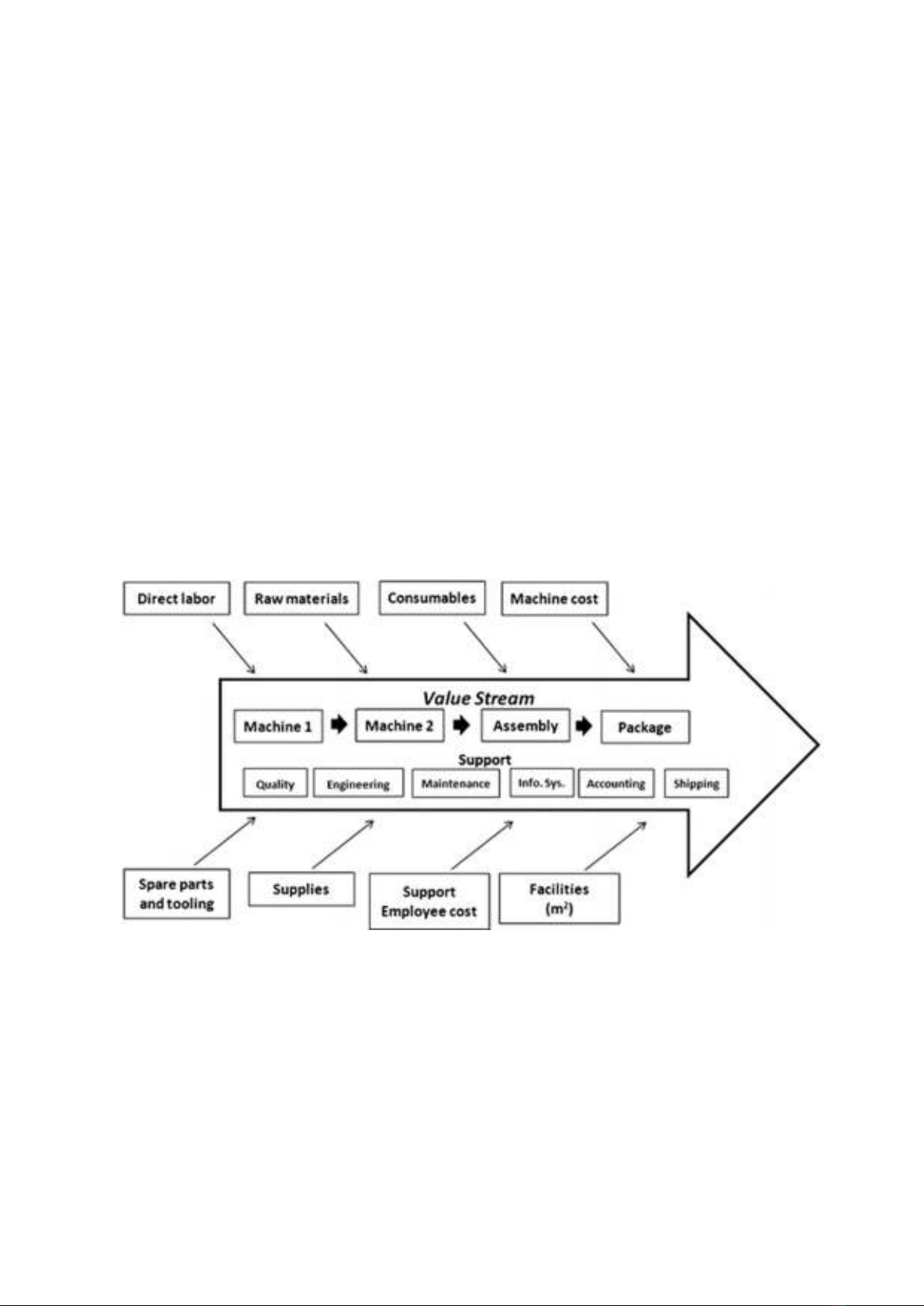
Instead of controlling cost of each individual products, value stream costing aims to calculate
total cost in each value stream. There are many different ways to categorize value stream, for
example: (1) By product; (2) By process; (3) By customer. Once value stream to be defined, it is
important to identify costs. Below is an example of 02 different value stream by product groups:
product family A and product family B (Figure 2.1).
Costs charged to a value stream can be divided into 3 categories: (1) purchase costs of raw
materials and other inputs; (2) processing costs or conversion costs; (3) facility costs. Indirect cost
could be allocated on the basis of meter square occopied by each value stream. When indirect costs
cannot be directly allocated to value stream but are high, they can be allocated by using simplified
version of activity-based costing. When the indirect costs’ value is low, indirect costs are simply
recorded in the company’ income statement.
Figure 2.1. Value Stream Costing in an auto-parts factory
Source: Ruiz de Arbulo P., Fortuny J., García J., Díaz de Basurto P., Zarrabeitia E. (2012)