

* Corresponding author.
E-mail addresses: mita8@tpu.ru (D. P. Il’yaschenko)
© 2020 Growing Science Ltd. All rights reserved.
doi: 10.5267/j.esm.2019.8.006
Engineering Solid Mechanics 8 (2020) 41-48
Contents lists available at GrowingScience
Engineering Solid Mechanics
homepage: www.GrowingScience.com/
esm
Effect of ultra-disperse powder in electrode coating on properties of welds in MMA welding
Dmitry P. Il’yaschenkoa*, Dmitry A. Chinakhova, Sergey V. Makarova, Vladimir I. Danilovb,
Andrey A. Galinskyc and Elena V. Verkhoturovad
aYurga Institute of Technology National Research Tomsk Polytechnic University, Yurga, Russian Federation
bInstitute of Strength Physics and Material Science, Siberian Branch, Russian Academy of Sciences, Tomsk, Russian Federation
cTyumen Industrial University, Tyumen, Russian Federation
dIrkutsk National Reseach Techniical University, Irkutsk, Russian Federation
A R T I C L EI N F O A B S T R A C T
Article history:
Received 9 July, 2019
Accepted 28 August 2019
Available online
2
8
August
201
9
Growth of the volumes of dangerous and critical welded metal structures constructed under low
temperatures imposes additional requirements on the mechanical properties of the weld joints,
particularly, on the impact resistance of the weld joint and on the stability of its values. It can be
achieved by using coated electrodes with ultradisperse powders of alloying elements in the coating.
To develop new improved welding materials we need to optimize the systems of weld metal
alloying to meet the increasingly stringent requirements to the welding-operational characteristics.
Introduction of a complex ultradisperse powder (Al2O3, SiO2, TiO2, Ni) into the electrode coating
applied for manual metal-arc welding ensures more stable process of electrode metal fusing and
its transfer into the welding bath, improves the performance characteristics of the welded metal.
© 2020 Growing Science Ltd. All rights reserved.
Keywords:
Nano-dispersed powders
Welding electrodes
Mechanical properties
Crystallization
Modification
M
icrostructure
1. Introduction
Today, expanding manufacturing of important and critical welded constructions in low temperature
conditions has posed additional requirements in respect of mechanical characteristics of welds, in
particular, notch toughness of a weld and its stability. Traditionally, these characteristics have been
controlled via alloying and modifying. The point of these methods is to ensure certain operational
properties with the help of a structure formed in the material by means of introducing chemical elements.
Data provided by Analytical Agency (Electronic resource 2019) demonstrate that in 2018 the output
of coated electrodes for manual metal arc (MMA) welding amounted to 90254.2 ton in Russia. The study
on materials for welding (Mazur et al, 2014; Lozovoi et al., 2007; Votinova, 2016), available on the
market in Russia, first of all, coated electrodes manufactured by domestic and foreign producers, has
revealed a basic trend in this industry – improvement of tolerance to failure and operational properties of
metal constructions welded in MMA welding, with the cost price kept stable. As a rule, different
modifiers, e.g. nano-powders are used for this purpose (Chekanova, 2015; Il'yashenko & Makarov,
2016). Different methods to introduce modifying powders into a weld metal are suggested (Krushenko
& Fil'kov, 2007; Wang et al., 2008; Sapozhkov & Burakova, 2016; Sokolov et al., 2011) – spraying in a
42
shielding gas (Kuznetsov & Zernin, 2012), in a fluxing agent via dipping an electrode into a mixture of
ultra-disperse materials etc. Introduction of ultra-disperse powder into liquid glass when manufacturing
electrodes is the most efficient method. Its efficiency can be attributed to
minimal losses of a modifying powder;
stable sanitary and hygienic characteristics of welding process;
uniform distribution of a modifying powder along the length of an electrode;
manufacturing technology of electrodes doesn’t tend to become more difficult and complicated
because of adding technological processes.
We believe that there is currently no integrated approach to determine an appropriate amount of
modifying powders to be introduced into an electrode and predict properties of a joint welded in MMA
welding with coated electrodes. The study aims at research on the effect of ultra-disperse powder with
a complex chemical composition Al2O3, SiO2, TiO2, Ni introduced into cellulose and rutile coating of
electrode on operational properties of a joint weld.
2. Methods of Research
For experiments electrodes MR-3E (GOST 9466-75) with a diameter of 4 mm were fabricated
according to industrial standards. In the process of fabrication ultra-disperse powders Al2O3, SiO2, TiO2,
Ni were introduced into liquid glass (Krushenko & Fil'kov, 2007). To compare and assess welding and
operational properties of experimental electrodes and their industrial analogues МР-3 weld beds were
built up on plate surfaces (09Г2С, 300х276х20 mm). A weld bed was deposited using a welding rectifier
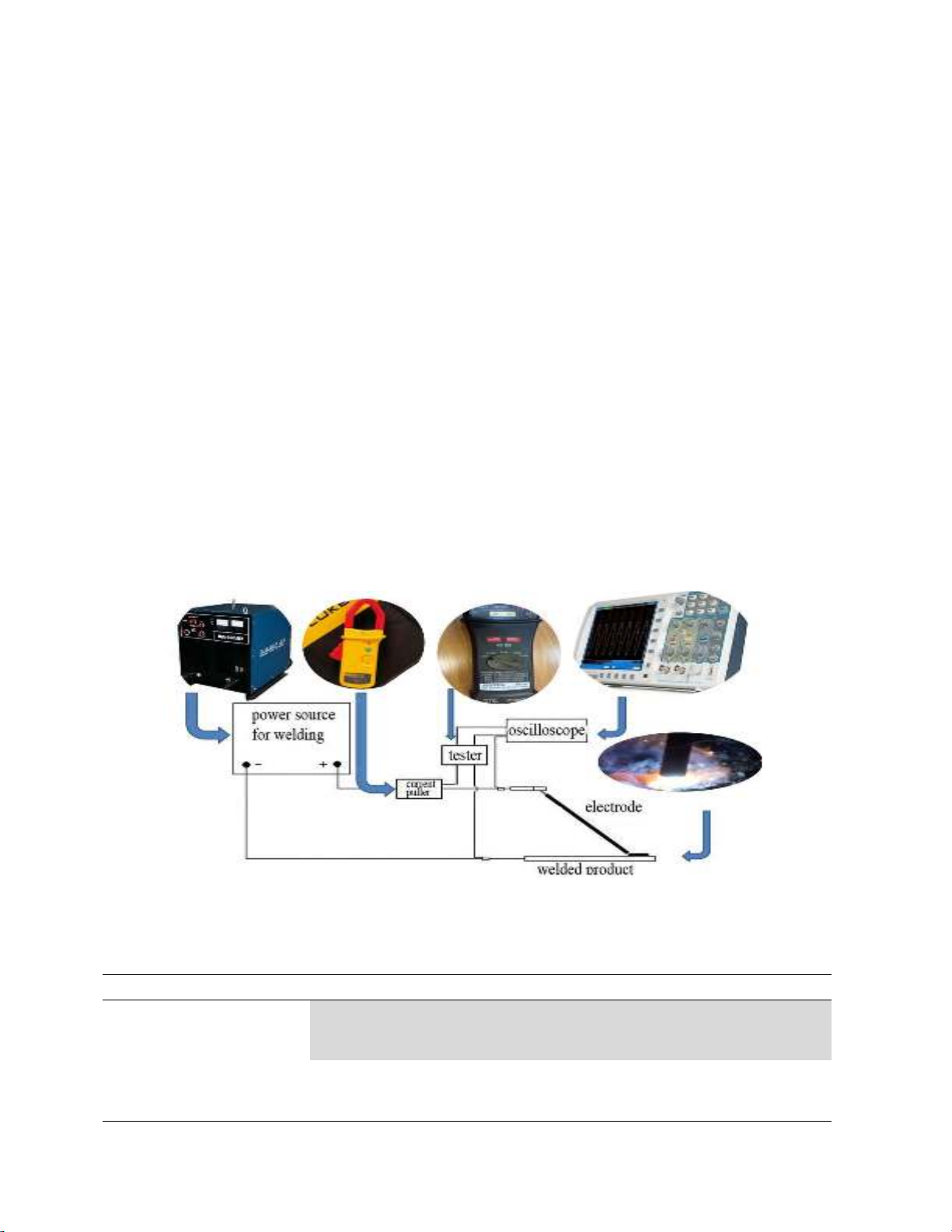
VD-306. Current oscillograms in a welding circuit and voltage of electrode and work piece were
registered as energy parameters of weld deposition (Table 1) started changing (Fig. 1).
Fig. 1. Experimental procedure to determine stability criteria for MMA welding.
Table 1. Welding conditions for different electrodes and power sources
Power source Electrode Average values of parameters
Diode rectifier VD-306
MR-3
Current 113.1±2.7 А
Voltage 243±0.6 V
Welding velocity 0.25 m/min
Experimental MR-3E
Current 110А±2.7
Voltage 24.9±0.6 В
Welding velocity 0.25 m/min
D. P. Il’yaschenko et al. / Engineering Solid Mechanics 8 (2020)
43
Arc burning stability of the electrodes under consideration was analyzed via comparing current and
voltage oscillograms traced by digital recording oscillograph «АКИП-4122/22»; differential tester
«Pintek Electronics «DP-50»; current clamps «Fluke i1010»; software tool «OWON_Oscilloscope».
Cross-sections were made on all samples to examine their micro-structure. Cross-sections were made via
mechanical smoothing, mechanical polishing with diamond paste АСМ 10/7 НВЛ and chemical etching
in concentrated «75% HCl + 25% HNO3». Tests were carried out in optic metallography using a
microscope Neophot-21, images recorded with a digital camera Genius VileaCam. Mechanical properties
of welded metal were assessed according to GOST 6996-66 with the help of universal tension tester
ЦДМУ-30, industrial № 2271/55/1 (measurement error 1%); impact testing machine МК, industrial
№ 32, (measurement error 3%). Fractography of welded metal fractures was carried out by an optic
microscope Neophot-21, images recorded with a digital camera Genius VileaCam.
3. Results and Discussion
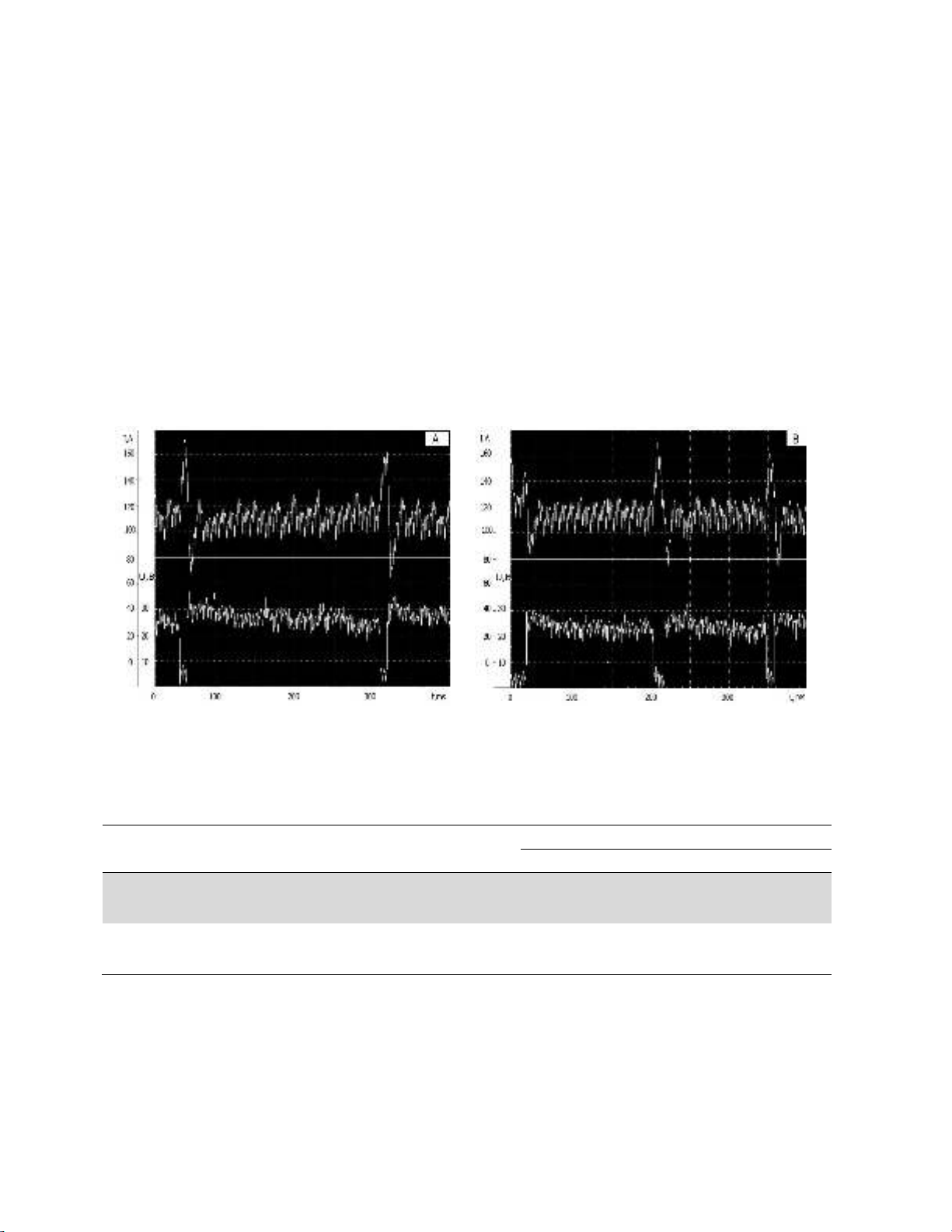
Current and voltage oscillograms in MMA welding with different electrodes are shown in
Fig. 2. Experimental data on droplet transfer parameters of electrode metal are given in Table 2.
Fig. 2. Current and voltage oscillograms in MMA welding with coated electrodes:
а) MR-3; b) MR-3E
Table 2. Statistical data on parameters of electrode metals droplet transfer
Parameter Electrode
МR-3 МR-3E
Arc gap period shortcut τsc, мs± mean root square
deviation of period shortcut, στsc, ms 14.9±4.6 13.19±3.9
Period of cycle Tsc, мs± mean root square deviation
of period of cycle σTsc, ms 200±79 177±64.8
Data in Table 2 point at decreasing time of droplet transfer and increasing number of shortcuts when
using experimental electrodes МР-3 in comparison with standard electrodes МР-3; so, fine-droplet
transfer of electrode metal (Makarov et al., 2017; Erohin, 1973) is possible due to modifying powders
in electrode coating, which support stability of arc burning (Vaz, Bracarense, 2015; Varnauskas et al.,
2004; Lazić et al., 2010).
44
Studies (Makarenko et al., 2001; Saraev et al., 2017) suggest that refinement of transferred electrode metal
droplets furthers formation of a fine grained weld structure, improves plasticity and notch toughness.
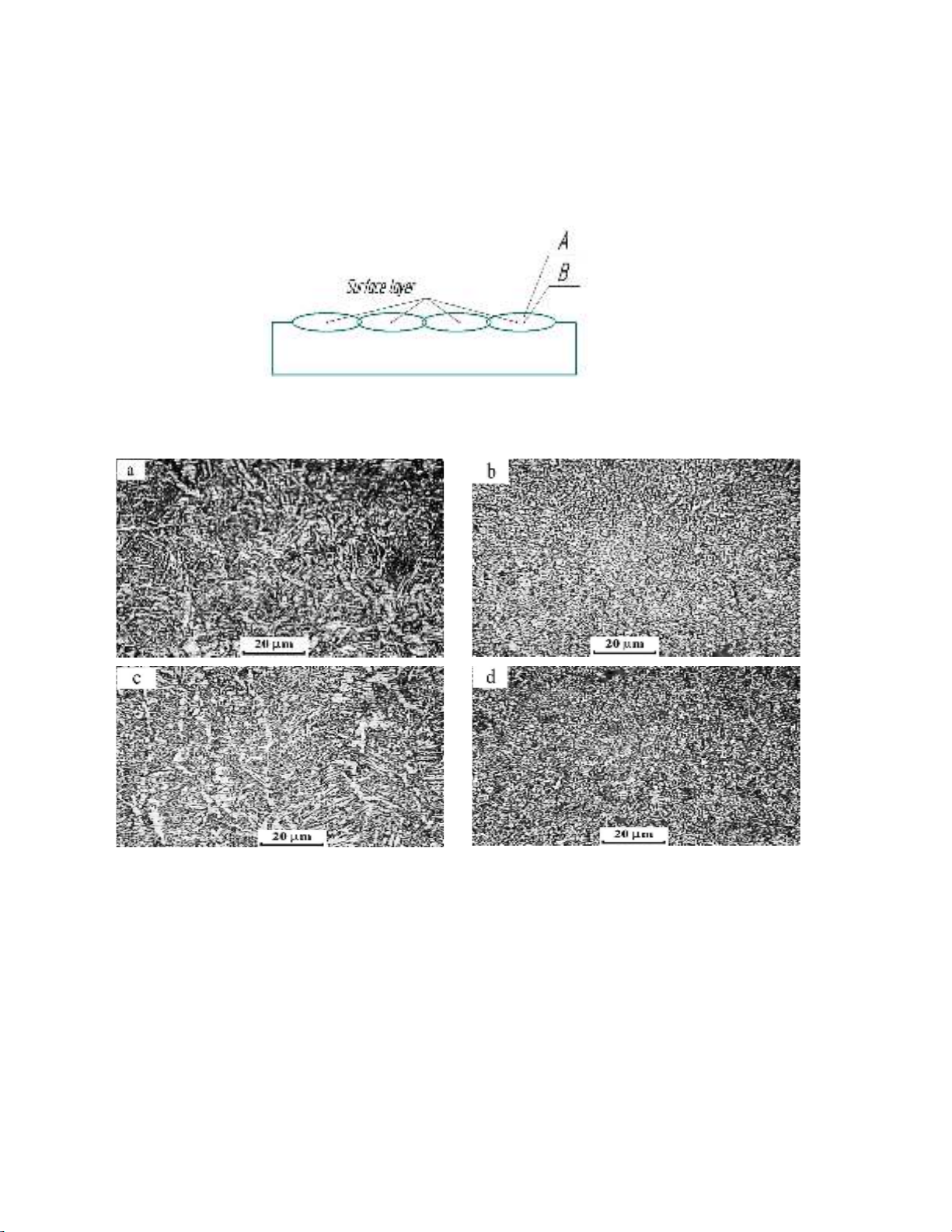
Comparative microstructural research on metal welded with different electrodes was carried out as shown in
Fig. 3.
Fig. 4. Images of micro-structure in welded metal: а, b – upper layer (Fig. 3) standard МR-3
and experimental МR-3E, respectively; c, d – lower layer (Fig. 3)
Micro-structural analysis (Fig. 4) has determined
а) layer depth ≈ 1500 µm. Needle-shaped structure. Mean width and length of needles ≈ 1.8 ±0.06 µm
and 9.0 ±0.28 µm.
b) layer depth ≈ 875 µm. Ultrafine-grained structure. Average dimension ≈ 1.2±0.08 µm.
c) layer depth ≈ 2875 µm. Branch-shaped structure. «Stem» – a primary ferrite, average cross
dimension ≈ 2.8 ±0.08 µm. Average distance between «branches» ≈ 16.0±0.62 µm.
d) layer depth ≈ 3125 µm. Fine-grained structure. Average dimension ≈ 2.4±0.07 µm.
Fig. 3. Study on the surface layer micro-structure: А - upper sub-layer,
B - lower sub-layer
D. P. Il’yaschenko et al. / Engineering Solid Mechanics 8 (2020)
45
Micro-structures presented demonstrate that introduction of a modifying powder with a complex
chemical composition improves micro-structure of welded metal and causes refinement of grains due to
ultra-disperse powders in coatings (Kobernik et al., 2015; Boldyrev et al., 2014a; Golovko et al., 2015;
Kuznecov, Stepanov, 2015; Boldyrev et al., 2014b; Boldyrev et al., 2012).
Table 3. Mechanical properties of welded metal
Parameter Standard electrodes МR-3 Experimental electrodes on
a component base МR-3E
σв, MPa
461
464...458
490
510...480
δ,% 5,18
20...17
32
35...29
KCU at + 20º С, J/cm²
(notch in the center of a weld)
80
85...75
100
110...90
Differences found when investigating arc burning stability and analyzing micro-structure of welded
metal are important for operational properties of a joint weld. In terms of methods above mechanical
properties of welded metal were studied, their findings are given in Table 3. Data obtained (Table 3)
show that introduction of ultra-disperse powder with a complex chemical composition into coating of
electrode MP-3 results in 10% increase of ultimate stress limit, 43 % increase of relative elongation, and
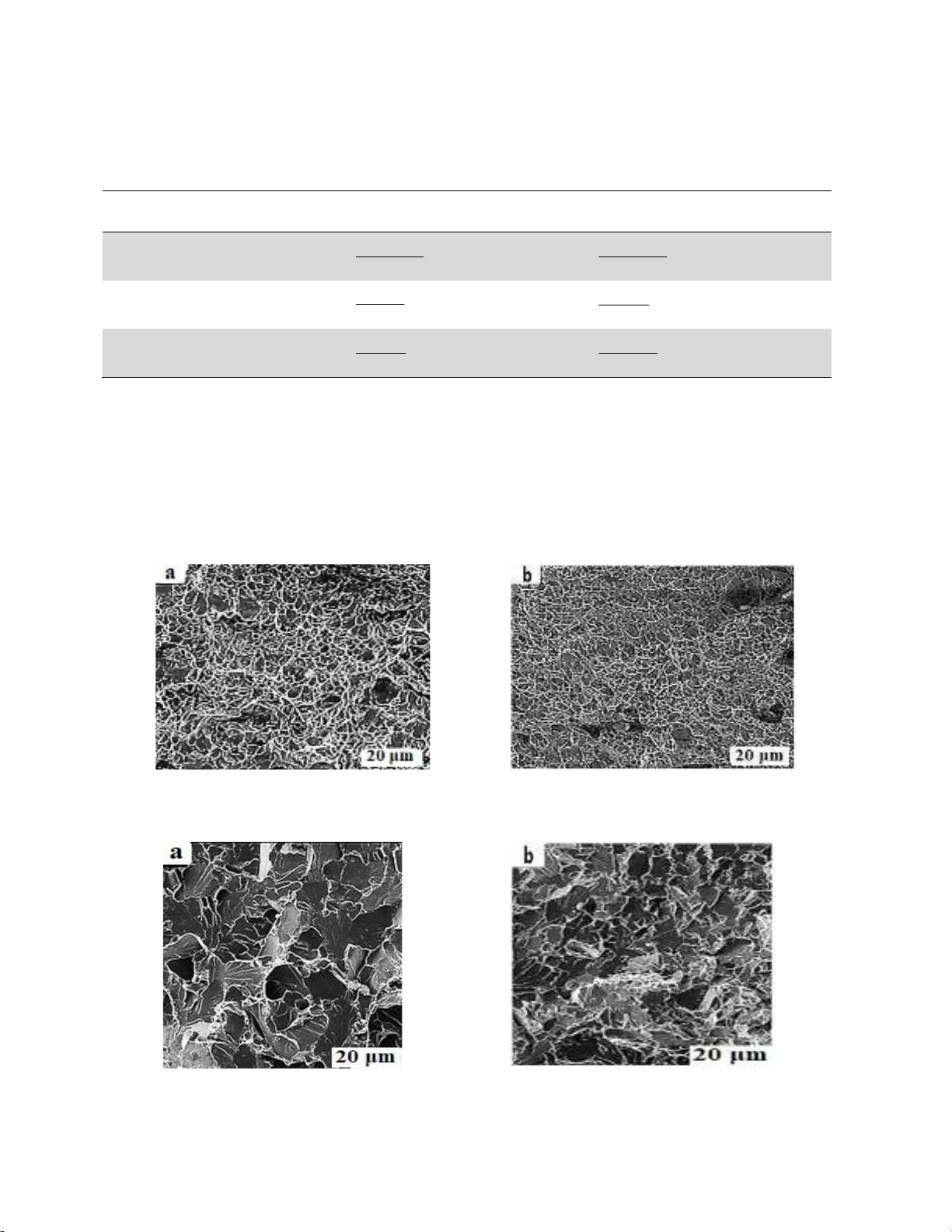
20 % rise of notch toughness in comparison with characteristics of standard electrodes. Fractography of
samples tested mechanically demonstrate brittle fractures (Fig. 5, 6).
Fig. 5. Micro-photography of soft fracture on the sample surface when viscosity testing:
(a) standard electrode МР-3; (b) experimental МР-3.
Fig. 6. Micro-photography of brittle fracture on the sample surface when notch toughness
testing: (a) standard electrode МR-3; (b) МR-3E.



![Thép cán kết cấu hàn: [Thông tin chi tiết/Báo giá/Hướng dẫn lựa chọn]](https://cdn.tailieu.vn/images/document/thumbnail/2020/20201014/maryland93/135x160/2381602661478.jpg)


![Giáo trình Cấu trúc dữ liệu và giải thuật - Trường CĐ Cơ điện Hà Nội [Mới nhất]](https://cdn.tailieu.vn/images/document/thumbnail/2026/20260323/lionelmessi01/135x160/58171774381670.jpg)


![Giáo trình Tiện nâng cao (Nghề Cắt gọt kim loại, Trình độ Cao đẳng) - Trường Cao đẳng Cơ điện Hà Nội [Mới nhất]](https://cdn.tailieu.vn/images/document/thumbnail/2026/20260323/lionelmessi01/135x160/48101774403543.jpg)


