© 2010 Kelly et al; licensee BioMed Central Ltd. This is an Open Access article distributed under the terms of the Creative Commons
Attribution License (http://creativecommons.org/licenses/by/2.0), which permits unrestricted use, distribution, and reproduction in
any medium, provided the original work is properly cited.
Kelly et al. BMC Psychiatry 2010, 10:49
http://www.biomedcentral.com/1471-244X/10/49
Open Access
RESEARCH ARTICLE
Research article
Development of mental health first aid guidelines
on how a member of the public can support a
person affected by a traumatic event: a Delphi
study
Claire M Kelly*
†
, Anthony F Jorm
†
and Betty A Kitchener
Abstract
Background: People who experience traumatic events have an increased risk of developing a range of mental
disorders. Appropriate early support from a member of the public, whether a friend, family member, co-worker or
volunteer, may help to prevent the onset of a mental disorder or may minimise its severity. However, few people have
the knowledge and skills required to assist. Simple guidelines may help members of the public to offer appropriate
support when it is needed.
Methods: Guidelines were developed using the Delphi method to reach consensus in a panel of experts. Experts
recruited to the panels included 37 professionals writing, planning or working clinically in the trauma area, and 17
consumer or carer advocates who had been affected by traumatic events. As input for the panels to consider,
statements about how to assist someone who has experienced a traumatic event were sourced through a systematic
search of both professional and lay literature. These statements were used to develop separate questionnaires about
possible ways to assist adults and to assist children, and panel members answered either one questionnaire or both,
depending on experience and expertise. The guidelines were written using the items most consistently endorsed by
the panels across the three Delphi rounds.
Results: There were 180 items relating to helping adults, of which 65 were accepted, and 155 items relating to helping
children, of which 71 were accepted. These statements were used to develop the two sets of guidelines appended to
this paper.
Conclusions: There are a number of actions which may be useful for members of the public when they encounter
someone who has experienced a traumatic event, and it is possible that these actions may help prevent the
development of some mental health problems in the future. Positive social support, a strong theme in these
guidelines, has some evidence for effectiveness in developing mental health problems in people who have
experienced traumatic events, but the degree to which it helps has not yet been adequately demonstrated. An
evaluation of the effectiveness of these guidelines would be useful in determining their value. These guidelines may be
useful to organisations who wish to develop or revise curricula of mental health first aid and trauma intervention
training programs and policies. They may also be useful for members of the public who want immediate information
about how to assist someone who has experienced a potentially traumatic event.
* Correspondence: ckel@unimelb.edu.au
1 Orygen Youth Health Research Centre, Centre for Youth Mental Health,
University of Melbourne, Australia
† Contributed equally
Full list of author information is available at the end of the article

Kelly et al. BMC Psychiatry 2010, 10:49
http://www.biomedcentral.com/1471-244X/10/49
Page 2 of 15
Background
Traumatic events can cause posttraumatic stress disorder
and other mental illnesses amongst those who have expe-
rienced them, and secondary psychological injury to the
friends and family members of the affected. Appropriate
early intervention, whether by a friend, family member or
co-worker, or by volunteers on-hand when a traumatic
event occurs, may help to prevent the onset of a mental
disorder or may minimise the severity of the mental dis-
order, should one develop. However, few people have the
knowledge and skills required to assist.
A number of thorough reviews of existing strategies to
assist recent victims of trauma exist, including a
Cochrane systematic review [1]. Existing psychological
interventions intended for use after traumatic events are
mainly written for professional helpers. Existing
approaches include psychological debriefing (PD), usually
conducted as a single debriefing session after the event,
and critical incident stress management, which often
includes group debriefing. These require substantial
training and are only suitable for professional helpers. In
addition, they have not been proven to be effective. A
number of randomised controlled trials of single-session
PD have been conducted, and reviews suggest that they
are at best only mildly effective and at worst may cause
further harm [1-4]. A small number of RCTs of the use of
longer term formalised professional interventions have
been conducted [1] and they do appear to be useful. It has
also been shown that individuals who meet criteria for
acute stress disorder (ASD) or have severe symptoms in
the four weeks after a traumatic event are those most at
risk of PTSD, and professional intervention for that par-
ticular group may help to reduce that risk [4,5].
Despite the lack of success of routine professional
debriefing, informal social support appears to be an
important factor in altering risk following a traumatic
experience, although the research is nascent and further
investigation is needed. There is limited evidence that
perceived positive social support after a traumatic event
may protect against long term psychological injury, while
perceived negative social support increases risk [6].
These factors appear to have different mechanisms, and
both may operate at the same time; for example, a woman
who has been sexually assaulted may perceive positive
social support by most, which is helpful, but negative
social support in the form of disgust or horror by a few
people in her support network. The positive social sup-
port by most may be negated by the negative social sup-
port she receives from some. What appears to be most
important about social support is that it is both perceived
as positive, and of the type the individual feels they need
[6].
In recent years, guidelines for health professionals on
the treatment of ASD and PTSD have been developed in
Australia, the UK and the USA [7-9]. There has also been
a Delphi expert consensus study of European experts to
guide psychosocial care following a disaster [10]. How-
ever, these guidelines are not aimed at informing the gen-
eral public about supportive actions they can take and
most of the actions recommended in these guidelines are
not appropriate for the public. While a number of guide-
lines have been written in the past several years for use by
incidental helpers, none have been systematically devel-
oped or evaluated. These have been written by experts
within specific organisations. For example, the Centres
for Disease Control (CDC) in the United States publish
guidelines for use when a disaster occurs [11]. The
National Centre for PTSD, part of the Department of Vet-
eran's Affairs in the United States, has a number of bro-
chures which focus on responding after a traumatic event
and supporting individuals with ASD and PTSD [12].
There are a number of others. Sometimes such guidelines
are written in response to specific events. The Centre for
the Study of Traumatic Stress published guidelines for
volunteers deployed in areas affected by the Boxing Day
Tsunami of 2004 [13]. Guidelines were also developed in
the United States for assisting distressed students and
staff in the wake of the Virginia Polytechnic Institute
massacre in April 2007 [14], by psychologists at Virginia
Tech and by national organisations such as Paper-Clip
Communications [15].
In this paper, we aim to improve one particular
approach to public education - training of members of
the public in how to give first aid to someone who has
experienced a traumatic event. One program of this sort
is the Mental Health First Aid training program [16],
which was developed to train members of the public to
provide initial help to a person developing a mental
health problem or in a mental health crisis; this help is
given until appropriate professional treatment is received
or until the crisis resolves. When the program was first in
development, the authors used evidence-based informa-
tion wherever possible, but very little research was found
about how members of the public, with no clinical train-
ing, could assist a friend, family member or acquaintance
who was showing signs of mental disorder or crisis. For
advice on how to manage these situations, the authors
informally sought the opinions of clinical experts.
Methods
We chose the Delphi method, a technique used for reach-
ing expert consensus. Our aim was to get consensus
within and between panels of professionals, carers and
consumers, so that the guidelines would be respectful of
the expertise of all three groups. By conducting the
research online, it was possible to include participants
from English-speaking countries across the world, inex-
pensively and without lengthy postal delays. The Delphi
Kelly et al. BMC Psychiatry 2010, 10:49
http://www.biomedcentral.com/1471-244X/10/49
Page 3 of 15
methodology has been used in health research in the
past, mainly to reach consensus amongst medical practi-
tioners, but also with consumers of health services in
some settings [17,18]. We have also successfully used this
method to develop mental health first aid guidelines for
depression, psychosis, suicidal thoughts and behaviours
and non-suicidal self-injury using panels of professionals,
consumers and carers [19-25].
This study had two phases: (1) a literature search for
possible first aid actions that the panel could consider and
development of a questionnaire covering these actions,
and (2) the Delphi process in which the panels reached
consensus about the first aid actions likely to be helpful.
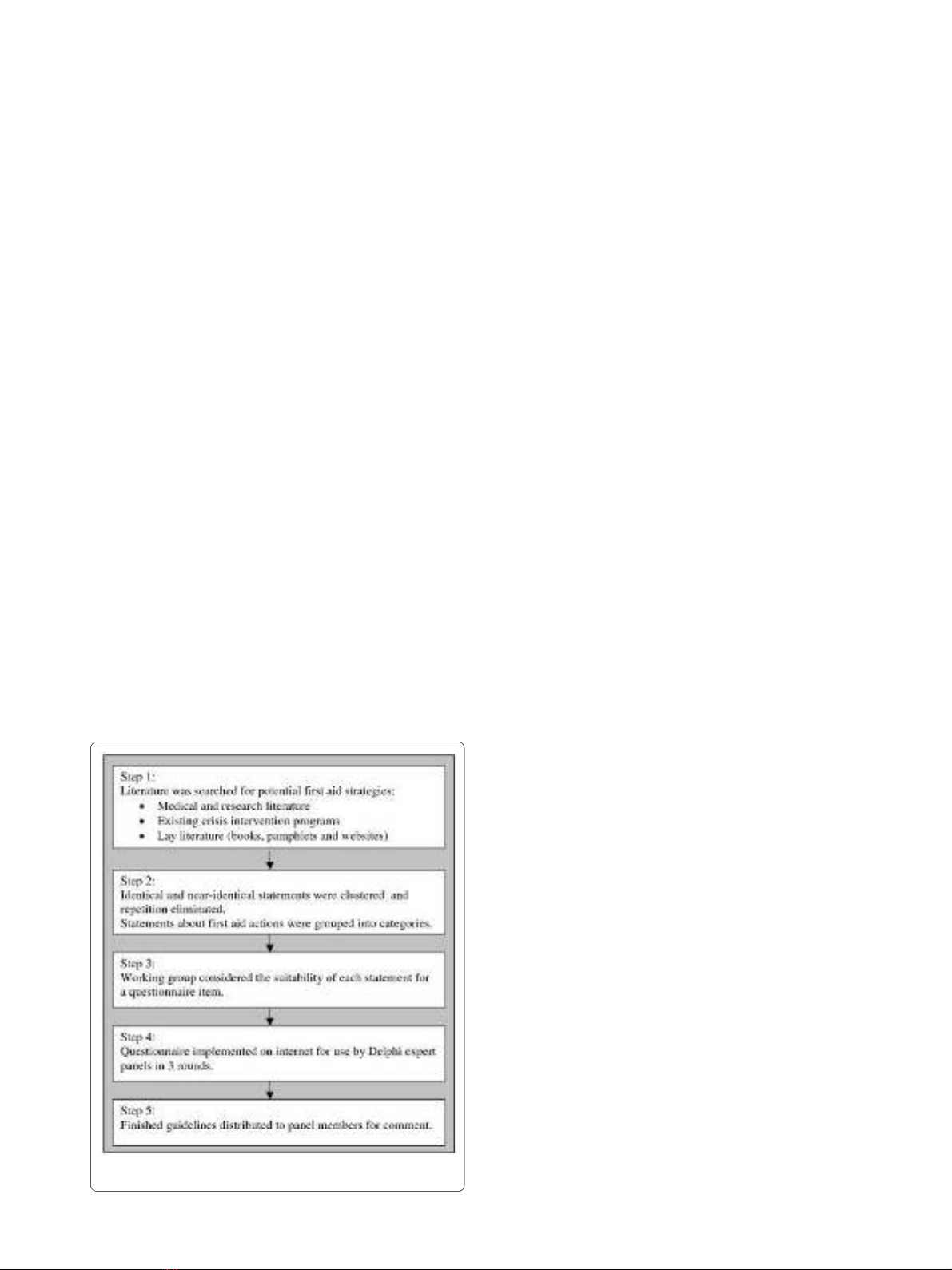
Please see Figure 1 for a summary of the steps.
Literature search
The aim of the literature search was to find statements
about helping someone who has experienced a traumatic
event which would be input for the expert panels to con-
sider. The focus for the search was to find statements
which instruct the reader on how to respond immediately
after a traumatic event (or the disclosure of a past
trauma), how to offer assistance in the short and medium
term, and how and when to access professional help for a
traumatised individual.
The literature search was conducted across three
domains: the medical and research literature, the content
of existing crisis intervention guidelines and relevant
courses for the public, and lay literature. The lay literature
included books written for the general public, particularly
consumers' and carers' guides, websites and pamphlets.
The medical and research literature was accessed
through searches of PsycInfo and PubMed. This was not a
systematic review. No judgment was made about the
quality of the evidence or the methods. Any claim about
an action that might be effective when assisting someone
who has experienced a traumatic event was considered
for inclusion in the list of items to be assessed by the
panel members (for further details see "Questionnaire
development" below).
The search term was 'trauma*' and all records for the 20
years leading to the search date were reviewed. The
search term 'trauma*' generated far too many records,
including large numbers of records relevant only to phys-
ical trauma, but all attempts to narrow the search were
found to exclude too many possibly relevant records.
Papers were therefore excluded first on the basis of their
titles and then on the basis of their abstracts.
Papers were read if they described actions to prevent to
development of PTSD after a traumatic event, described
risk and protective factors that were modifiable post-
trauma (e.g. social bonds and social isolation can be acted
on and enhanced after someone has experienced a trau-
matic event; whereas pre-event trait anxiety cannot), or
included guidelines for treating patients who had recently
been exposed to trauma (a total of 194 papers). State-
ments meeting our criteria were drawn from 32 of the
194 relevant records, as most of the advice given in these
papers was very clinically orientated, or required exten-
sive training, to be applicable.
To find appropriate websites, we used the search
engines Google [26], Google Australia [27], and Google
UK [28] using the search term 'traumatic event'; the first
50 websites listed by each were reviewed; beyond the first
50 websites, quality declined rapidly. Since most websites
were listed by more than one search engine, only 63 web-
sites were reviewed. The websites were read thoroughly,
once again looking for statements which suggested a
potential first aid action (what the first aider should do)
or relevant awareness statement (what the first aider
should know). Any external links to other websites were
followed and the same process applied to each of them.
It emerged that there was a great deal of information
about how to assist children who had been affected by
traumatic events. It was therefore decided that an addi-
tional search of websites should be conducted to find
statements about helping children. The process was
repeated, using the search terms 'traumatic event' and
'children'. This time, 55 websites were identified by the
three Google search engines, of which 45 had not
appeared in the original search.
The fifty most popular books on the Amazon [29] web-
site which listed the word 'trauma' or 'posttraumatic
Figure 1 Stages in guideline development.

Kelly et al. BMC Psychiatry 2010, 10:49
http://www.biomedcentral.com/1471-244X/10/49
Page 4 of 15
stress disorder' in the title or keywords were selected.
This site was chosen because of its extensive coverage of
books in and out of print, including works about mental
health aimed at the public. Books which were autobio-
graphical in nature, self-help workbooks constituting a
program of self-treatment and clinical manuals were
excluded. The remaining books were read to find useful
statements. The majority of these were carers' guides,
which do contain advice relevant for first aid, but
focussed on general caring for a mentally ill family mem-
ber.
Any relevant pamphlets were sought and read, and
statements were taken from these as well. The majority of
the pamphlets were written and distributed by organisa-
tions focussing on specific sorts of traumas, such as sex-
ual assault or violent crime, and generally directed the
reader to appropriate authorities and support organisa-
tions. There were also a large number of pamphlets and
fact sheets focussing on specific large-scale traumas,
which were frequently written in response to a specific
event, such as Hurricane Katrina in 2005, and the shoot-
ings at Virginia Polytechnic Institute in 2007. While these
documents did contain a lot of specific advice about
where to get practical or emotional help after such an
event, there was also information relevant to first aid giv-
ers about how to support people affected by such events.
Most of these pamphlets were obtained from websites,
but where these were not available online, a request was
made for relevant materials from large mental health and
community organisations.
Guidelines written for professionals responding to trau-
matic events were reviewed and relevant statements were
drawn from these. While a small number of relevant
statements were found in these documents, they fre-
quently emphasised the policies and procedures relevant
to the specific organisation for which they were devel-
oped.
Only one training course for members of the public was
found to be relevant, as most training in critical incident
response is designed for professional responders such as
paramedics and the police. Material from the Mental
Health First Aid Program [30] was reviewed and state-
ments drawn from it.
Questionnaire development
The questionnaire on possible first aid actions was devel-
oped by first grouping statements into categories: imme-
diate assistance after a traumatic event; communicating
with a traumatised person; discussing the traumatic
event; assisting after a large-scale traumatic event; after-
care for large-scale traumatic events; coping strategies in
the weeks following the event (talking and actions); and
when to seek professional help.
The categories for the children's statements were
slightly different, and included: immediate assistance
after a traumatic event; communicating with a trauma-
tised child; children at large-scale traumatic events;
advice for parents and guardians in the weeks following
the event; dealing with avoidance behaviour and temper
tantrums; legal issues if a child discloses abuse; and when
to seek professional help for a child.
Similar or near-identical statements were frequently
derived from multiple sources, and they were not
repeated in the questionnaire. A working group com-
prised of the authors of this paper and colleagues working
on similar projects convened at each stage of the process
to discuss each item in the questionnaire. The role of the
working group was to ensure that the questionnaire did
not include ambiguity, repetition, items containing more
than one idea or other problems which might impede
comprehension. The working group made no judgements
about the value of the first aid actions in the statements,
since that was the role of the expert panels.
The wording of each item was carefully designed to be
as clear, unambiguous and action-oriented as possible.
For example, 'the first aider should talk about what hap-
pened' is highly ambiguous. It is better to specify 'the first
aider should encourage the person to talk about the trau-
matic event', or 'the first aider should tell the person that
if they want to talk about the event, the first aider is pre-
pared to listen'. All statements were written as an instruc-
tion as shown in the above examples. The only items
which were not included in the questionnaire were those
which were so ambiguous that the working party was not
able to agree on the meaning of the statement, those
which were deemed too clinical or relevant only to a spe-
cific professional group, and those which called upon
'intuition', 'instinct' or 'common sense', as these cannot be
taught.
All participants answered the questionnaire via the
Internet, using an online survey website, Surveymonkey
[31]. Participants were able to stop filling in their ques-
tionnaires at any time and log back in to continue, with-
out the risk of losing the completed section of their
questionnaire. Using the Internet also made it very easy
for the researchers to identify those who were late in
completing questionnaires and send reminders, with no
need to send extra copies of the questionnaire. No ques-
tions were inadvertently missed, as the web survey was
set up so that each question was mandatory. In addition,
such survey software allows for branching, so partici-
pants who did not feel qualified to answer questions
about assisting children who had experienced trauma
were not asked to complete those sections of the ques-
tionnaire.
Expert panel recruitment
Participants were recruited into one of three panels: pro-
fessionals (clinicians and researchers), consumers (people
who had experienced a traumatic event, some of whom

Kelly et al. BMC Psychiatry 2010, 10:49
http://www.biomedcentral.com/1471-244X/10/49
Page 5 of 15
had post-traumatic stress disorder) and carers (family
members or loved ones of consumers who have a primary
role in maintaining their wellbeing). Consumers and car-
ers had public roles, either in advocacy, as the authors of
books or websites or as speakers on the topic. The profes-
sional panel had 37 experts, the consumer panel 13, and
the carer panel 4. The carers were also consumers them-
selves, and because of the small numbers, the consumer
and carer panels were combined into one panel of 17.
All panel members were from developed English speak-
ing countries (Australia, Canada, New Zealand, The
United Kingdom and The United States). Only partici-
pants from developed English speaking countries were
sought, as these countries were known to have compara-
ble cultures and health systems. It was also felt that a
guaranteed degree of fluency was important because
some items vary from each other in important, but very
subtle ways, which might escape the notice of a non-
native speaker.
Participants were recruited in a number of ways. Pro-
fessionals recruited were those who had publications in
the areas of traumatic stress, PTSD, or treatment of
patients who had experienced traumatic events. When
letters were sent (by email) to professionals asking them
to be involved, they were also invited to nominate any
colleagues who they felt would be appropriate panel
members. Those active in clinical practice were also
asked to consider any former patients who might be will-
ing to be involved and also met our other criteria.
No attempt was made to make panels representative.
The Delphi method does not require representative sam-
pling; it requires panel members who are information-
and experience-rich. This may be one reason that con-
sumers and carers were difficult to recruit. To be
included on the panel, they needed experience beyond
their own; for example, involvement in facilitating mutual
help support groups or advocacy roles.
It is not possible to report accurately the rate of accep-
tance or rate of refusal, as it is not known how many of
the invitations were received. Changes and errors in
email addresses, email filtering programs and other fac-
tors make it impossible to report how many of the invita-
tions were read by the person they were addressed to.
However, we can report that 190 email invitations were
initially sent out. Some of those approached may have
passed the information on to others. Some approaches
were made to organisations, and may or may not have
been read by the relevant individuals. Reasons for refusal
included being too busy (this project represented a signif-
icant time commitment), no longer working in the area,
or working in a related area of less relevance to the proj-
ect (e.g. brain imaging studies). As the research was to be
conducted online, only email contact was initiated.
The 37 professional participants included 21 academics
(researchers, lecturers and professors), 15 psychologists,
8 psychiatrists, 7 managers of mental health services or
clinical research centres, 2 social workers, 2 nurses, 2
public health policy and program professionals in disaster
planning, 1 drug and alcohol therapist working with vic-
tims of trauma who abuse drugs, and 1 attorney (also a
clinical psychologist). Some participants had multiple
roles in research, teaching and clinical work.
Consumers were recruited from advocacy organisa-
tions and referral by clinicians. They were also identified
if they had written websites offering support and infor-
mation to other consumers. Carers were recruited
through carers' organisations, but were difficult to recruit
for this study.
The Delphi process
Three rounds of questionnaires were distributed as fol-
lows, with each item being rated up to two times. In
round 1 the questionnaire, derived from the process
described above, was given to the panel members. The
questionnaire included space after each of the sections to
add any suggestions for additional items.
In each round of the study, the usefulness of each item
for inclusion in the mental health first aid guidelines was
rated as essential, important, don't know or depends,
unimportant, or should not be included. The options don't
know and depends were collapsed into one point on the
scale because operationally, they are the same response;
most of the items were, very reasonably, noted to be use-
ful in some cases and not others, meaning they could not
be generalised in guidelines, which is also true of items
participants did not feel confident to rate.
The suggestions made by the panel members in the first
round were reviewed by the working group and used to
construct new items for the second round. Suggestions
were accepted and added to round 2 if they represented a
truly new idea, could be interpreted unambiguously by
the working group, and were actions. Suggestions were
rejected if they were near-duplicates of items in the ques-
tionnaire, if they were too specific (for example, "Should
make sure that the child will be picked up from school"),
too general ("just be there"), or were more appropriate to
therapy than first aid ("reframe memories of trauma into
life lessons, get to the real root of anger, fear, create learn-
ings from experience").
Items rated as essential or important by 80% or more of
the professional and consumer/carer panels were consid-
ered to have met consensus for inclusion in the guide-
lines. If they were endorsed by 80% or more of one of the
panels, or by 70-80% of both panels, they were re-rated in
the subsequent round. Items which met neither condition
were considered to have met consensus for rejection from
the guidelines and were not re-rated because previous
research by our group has shown that major changes in
ratings do not occur in the next round. Before the second
and third rounds of the study, each participant was sent a

![Vaccine và ứng dụng: Bài tiểu luận [chuẩn SEO]](https://cdn.tailieu.vn/images/document/thumbnail/2016/20160519/3008140018/135x160/652005293.jpg)