Open Access
Available online http://ccforum.com/content/13/5/R151
Page 1 of 11
(page number not for citation purposes)
Vol 13 No 5
Research
Duration of red blood cell storage is associated with increased
incidence of deep vein thrombosis and in hospital mortality in
patients with traumatic injuries
Philip C Spinella1,2, Christopher L Carroll1, Ilene Staff3, Ronald Gross4, Jacqueline Mc Quay4,
Lauren Keibel1, Charles E Wade2 and John B Holcomb5
1Department of Pediatrics, Connecticut Children's Medical Center, 282 Washington Street, Hartford, CT 06106, USA
2Department of Combat Casualty Care Research, United States Army Institute of Surgical Research, 3400 Rawley E. Chambers Avenue, Fort Sam
Houston, TX 78234, USA
3Department of Research, Hartford Hospital, 80 Seymour Street, Hartford, CT 06102-5037, USA
4Department of Surgery and Emergency Medicine, Hartford Hospital, 80 Seymour Street, Hartford, CT 06102-5037, USA
5Department of Acute Care Surgery, University of Texas Health Science Center, 6410 Fanin St, Houston, TX 77030, USA
Corresponding author: Philip C Spinella, phil_spinella@yahoo.com
Received: 12 Jun 2009 Revisions requested: 31 Jul 2009 Revisions received: 6 Aug 2009 Accepted: 22 Sep 2009 Published: 22 Sep 2009
Critical Care 2009, 13:R151 (doi:10.1186/cc8050)
This article is online at: http://ccforum.com/content/13/5/R151
© 2009 Spinella et al.; licensee BioMed Central Ltd.
This is an open access article distributed under the terms of the Creative Commons Attribution License (http://creativecommons.org/licenses/by/2.0),
which permits unrestricted use, distribution, and reproduction in any medium, provided the original work is properly cited.
Abstract
Introduction In critically ill patients the relationship between the
storage age of red blood cells (RBCs) transfused and outcomes
are controversial. To determine if duration of RBC storage is
associated with adverse outcomes we studied critically ill
trauma patients requiring transfusion.
Methods This retrospective cohort study included patients with
traumatic injuries transfused ≥5 RBC units. Patients transfused
≥ 1 unit of RBCs with a maximum storage age of up to 27 days
were compared with those transfused 1 or more RBC units with
a maximum storage age of ≥ 28 days. These study groups were
also matched by RBC amount (+/- 1 unit) transfused. Primary
outcomes were deep vein thrombosis and in-hospital mortality.
Results Two hundred and two patients were studied with 101
in both decreased and increased RBC age groups. No
differences in admission vital signs, laboratory values, use of
DVT prophylaxis, blood products or Injury Severity Scores were
measured between study groups. In the decreased compared
with increased RBC storage age groups, deep vein thrombosis
occurred in 16.7% vs 34.5%, (P = 0.006), and mortality was
13.9% vs 26.7%, (P = 0.02), respectively. Patients transfused
RBCs of increased storage age had an independent association
with mortality, OR (95% CI), 4.0 (1.34 - 11.61), (P = 0.01), and
had an increased incidence of death from multi-organ failure
compared with the decreased RBC age group, 16% vs 7%,
respectively, (P = 0.037).
Conclusions In trauma patients transfused ≥5 units of RBCs,
transfusion of RBCs ≥ 28 days of storage may be associated
with deep vein thrombosis and death from multi-organ failure.
Introduction
In 2004, 29 million units of blood components were trans-
fused in the US [1]. Due to advances in testing for infectious
agents, the risk of transmitted diseases associated with blood
products continues to dramatically decrease [1]. However,
there are still significant risks associated with red blood cell
(RBC) transfusion [2-8]. In particular, an increased volume of
RBC transfusion has been associated or independently asso-
ciated with adverse outcomes, including sepsis, deep vein
thrombosis (DVT), multi-organ failure, and death [2-8]. A meta-
analysis that included 270, 000 patients found that the risks of
RBC transfusion were greater than the benefits in 42 of the 45
studies examined [9]. Additionally, a recent large prospective
randomized controlled study in critically ill patients reported as
a secondary outcome that in-hospital mortality was related to
the amount of RBCs transfused [10].
CI: confidence interval; CNS: central nervous system; DVT: deep vein thrombosis; GCS: Glasgow Coma Score; ICU: intensive care unit; IL: inter-
leukin; ISS: Injury Severity Score; MOF: multi-organ failure; OR: odds ratio; RBC: red blood cell; rFVIIa: recombinant activated factor VII.

Critical Care Vol 13 No 5 Spinella et al.
Page 2 of 11
(page number not for citation purposes)
Several investigators have attempted to determine reasons for
the association between RBC transfusion and poor outcomes.
A plausible biologic explanation is that lesions occurring to
RBCs during prolonged storage contribute to these poor out-
comes. Stored RBCs have been associated with inflammatory
injury, immunomodulation, altered tissue perfusion, and
impaired vasoregulation [2-6]. In vitro studies also document
increased risk of hypercoagulation with aged RBCs [11,12]. In
addition, transfusion of RBCs stored for greater than 14 to 28
days has been linked to poor outcomes [2-4,6]. However, the
studies supporting the association between RBC storage and
poor outcomes are mainly retrospective or prospective cohort
studies, and a few studies have failed to find an association
[13-18]. As a result, the theory that prolonged storage of
RBCs lead to poor outcomes remains controversial [19].
We suspect that poor outcomes associated with the transfu-
sion of RBCs stored for a prolonged period may be due, in
part, to an increased inflammatory and hypercoagulable state
induced by 'old RBCs' in critically ill patients. Patients with sig-
nificant traumatic injuries develop a hyper-inflammatory and
hypercoagulable state [20]. The pro-inflammatory and immu-
nomodulatory nature of old RBCs [21,22] may further promote
a hypercoagulable state [23,24]. DVT may be promoted in
patients who are in a hypercoagulable state and multi-organ
failure (MOF) is well known to occur via hypercoagulable
mechanisms. We therefore hypothesized that the transfusion
of old RBCs to critically ill trauma patients would be associ-
ated with an increased incidence of DVT and in-hospital mor-
tality. A secondary hypothesis was that death secondary to
MOF would be increased for patients transfused old RBCs.
Materials and methods
This study was approved by the Institutional Review Board at
Hartford Hospital, Hartford, CT, USA. We performed a retro-
spective cohort study of patients aged 16 years or older admit-
ted to the Hartford Hospital intensive care unit (ICU) with
traumatic injuries who received five or more units of RBCs dur-
ing the hospital admission between 2004 and 2007. Patients
who died in the emergency or operating room prior to ICU
admission were excluded.
Data were retrospectively analyzed from prospectively popu-
lated hospital databases and patient charts. To ensure ade-
quate follow up or to account for deaths that occurred in
patients discharged prior to 180 days from admission, the
social security index and Hartford Hospital databases were
used to determine if there were any deaths prior to this time.
In addition to mortality, information collected included patient
age, race, sex, ABO blood type, admission vital signs and lab-
oratory values, Glasgow Coma Score (GCS), Injury Severity
Score (ISS), total units of RBCs given during the entire hospi-
talization, plasma, apheresis platelets, cryoprecipitate, per-
centage of RBCs that were leukoreduced, mechanism of
injury, use of DVT prophylaxis, ICU free days, and cause of
death. The GCS recorded was the lower value recorded by
either emergency medical providers pre-hospital or by provid-
ers in the emergency department. Race was determined by
the trauma registrar and recorded in the hospital database by
the following categories: white, black, Hispanic, Asian, Pacific
Islander, or other. Mechanism of injury was categorized as
either blunt or penetrating injury.
The incidence of DVT was determined by reviewing ultrasound
results for DVT screening tests that are routinely performed on
days 2 to 3 of admission for all trauma patients in the ICU. In
addition to these empiric screens, if a DVT was diagnosed
later in the admission due to clinical suspicion it was also
included in our analysis. A DVT was defined as a thrombus that
was detected by ultrasound in a deep vein. Superficial venous
thrombi were not included. All forms of DVT prophylaxis were
recorded including intravenous and subcutaneous heparin,
subcutaneous enoxaparin, and pneumatic compression
devices. The frequency of DVT prophylaxis was then com-
pared between RBC storage age study groups. The ISS was
calculated by trained staff within the Hartford Hospital Trauma
Program according to the methods described by the Associa-
tion for the Advancement of Automotive Medicine Abbreviated
Injury Scale, 1998 Revision. Cause of death was determined
by chart review and was categorized as either death due to
hemorrhage, primary central nervous system (CNS) injury, or
MOF. MOF was defined as two or more organ failures at the
time of death. Organ failure at time of death was defined as fol-
lows: cardiac failure as requiring vasoactive agents, pulmonary
failure as requiring mechanical ventilation with radiographic
evidence of lung pathology, CNS failure as GCS less than 6,
and renal failure as requiring dialysis or serum creatinine more
than 3 mg/dl. Patients with traumatic brain injuries who
remained intubated at time of death without evidence of lung
injury or who were on minimal mechanical ventilator settings
were determined to have died secondary to primary CNS
injury and not MOF. The cause of death and organ failure at
time of death was determined by chart review by a single
reviewer (PCS) who was blinded to patient RBC age category
and all other variables recorded for the study patients. This
was accomplished by this reviewer being blinded to the data-
base and just reviewing death certificates and patient charts.
Organ failure scores such as the Sequential Organ Failure
Assessment or Marshall Multi Organ Dysfunction Score were
not able to be calculated from our database.
Data analysis
We defined our study groups according to the maximum stor-
age age of RBCs. Previous studies that used either non
prestorage leukocyte reduced or prestorage leukocyte
reduced RBCs have reported that RBCs above (mean or max-
imum) 14 to 28 days were associated with adverse events or
outcomes [11,13,25-31]. Clinical studies have also reported
on univariate analysis that MOF and mortality have been
Available online http://ccforum.com/content/13/5/R151
Page 3 of 11
(page number not for citation purposes)
associated with the transfusion of RBCs of 30 and 25 days,
respectively [25,26]. Therefore, as a result of our blood bank
issuing RBCs that were both not prestorage leukocyte
reduced and were leukocyte reduced during the time period of
the study, we a priori decided to categorize patients according
to a maximum RBC storage age of 14 or more, 21 or more, and
28 or more days. The primary groups analyzed are defined by
a maximum RBC age of less than 28 days or 28 or more days,
unless otherwise noted. To ensure equal amounts of RBCs
transfused we matched all study groups within +/- one unit of
total RBCs transfused. This was accomplished by a computer-
ized random sampling program ("SAMPLE", SPSS, Chicago,
IL, USA). The matching of patients by RBC volume was per-
formed for each maximum RBC age analyzed (14, 21 and 28
days).
We defined study groups according to maximum RBC age,
rather than mean RBC age, because the mean can obscure
potential effects of older RBCs [32]. We categorized transfu-
sion amount as 5 or more, and 10 or more units of RBCs. This
was based on previous findings demonstrating that mortality
dramatic increases after five or more units of RBCs have been
transfused to patients with traumatic injuries [33]. To deter-
mine if there was an increased size effect with increased injury,
we decided to analyze patients transfused 10 or more units of
RBCs because RBC volume is associated with severity of ill-
ness [19].
The primary outcomes were DVT, and in-hospital mortality.
Non-parametric and parametric data are presented as median
(interquartile range) or mean (standard error of mean), respec-
tively. The Wilcoxon Rank-sum test was used for comparison
of non-parametric continuous data. The Fisher Exact or Chi
Squared test was used for comparison of categorical data as
appropriate. Variables with a P value of less than 0.1 on uni-
variate analysis with in-hospital mortality were considered for
inclusion for the multivariate logistic regression analysis. A
best-fit model was determined by using changes in the log
likelihood between models to determine which variables pro-
duced the most accurate model. The model with the highest
chi squared statistic per degree of freedom was reported. A
survival analysis at 180 days from admission was performed
with a Kaplan Meier curve and Log Rank test. Statistical anal-
ysis performed with SPSS 15.0 (Chicago, IL, USA).
Results
There were 270 patients identified who were admitted to the
ICU with traumatic injuries and were transfused 5 or more
units of RBCs. There were 202 patients who were able to be
matched within 1 unit of RBC amount transfused according to
the cut-off point of 28 days of RBC storage. Admission varia-
bles, ISS and outcomes were similar between the 202
patients included in the analysis and the 68 patients excluded
as a result of not being able to match them with patients in the
other treatment group (data not shown). In this cohort of
patients who received 5 or more units of RBCs and matched
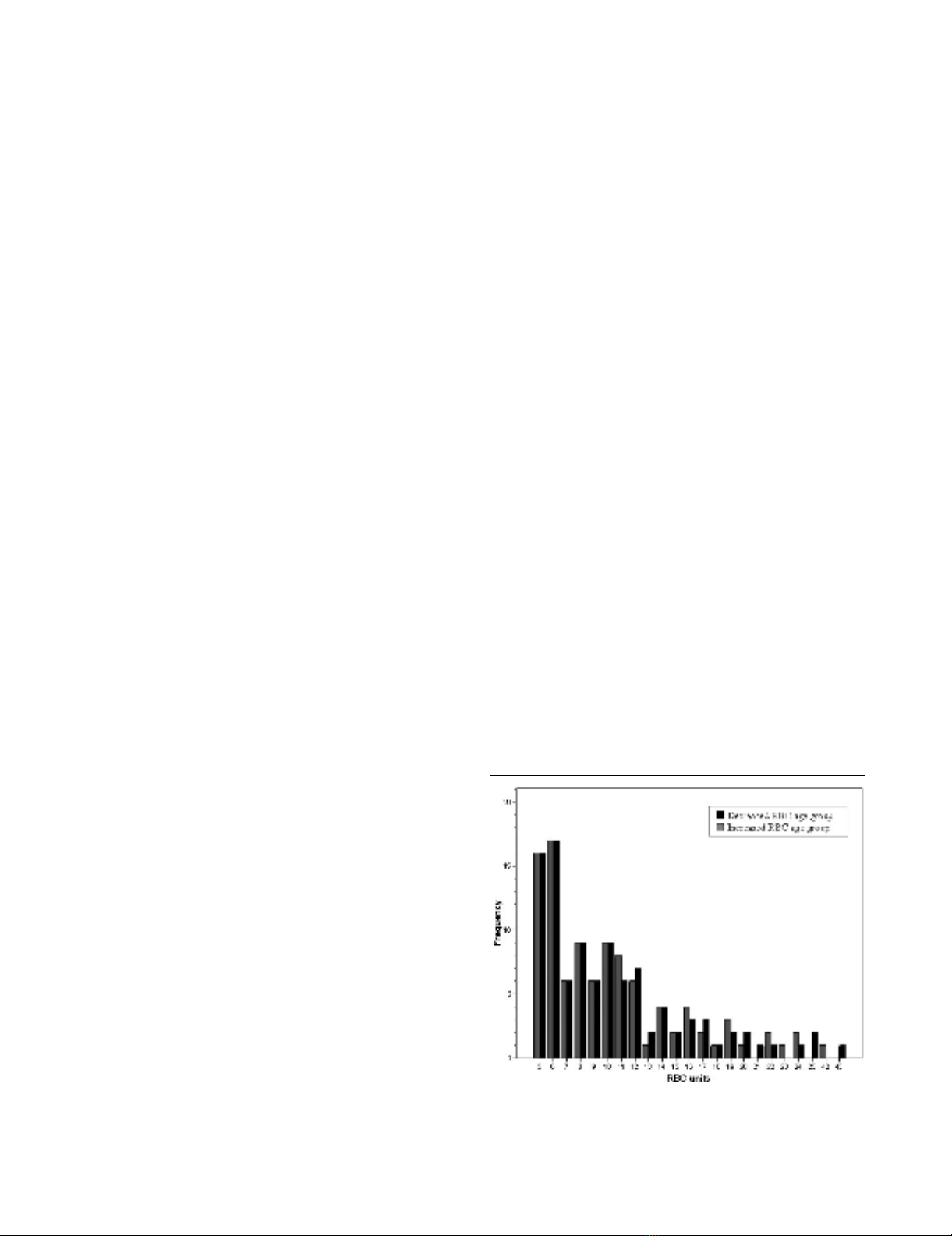
by RBC amount (Figure 1), patient age, sex, race, admission
vital signs and laboratory values, amount of blood products
transfused, percentage leukoreduced RBCs, and ISS were
similar between patients receiving RBCs of decreased and
increased storage age (Table 1). Most of the patients (163 of
202 or 81%) received both prestorage leukoreduced and non-
leukoreduced RBCs. There were only 39 of 202 (19%)
patients who received 100% leukoreduced RBCs. The per-
centage of prestorage leukoreduced RBCs of all RBCs trans-
fused was similar between RBC storage age groups (Table 1),
and there was no relation between percentage of leukore-
duced RBCs and mortality by chi squared analysis (Table 1)
nor by logistic regression analysis with percent leukocyte
reduction treated as a continuous variable (odds ratio (OR) =
1, 95% confidence interval (CI) = 0.99 to 1.01; P = 0.8).
There were similar percentages of patients in the decreased
and increased RBC storage groups who received plasma;
41.6% (42 of 101) vs 45.5% (46 of 101); platelets 17.8% (18
of 101) vs 24.8% (25 of 101), and cryoprecipitate 9.9% (10
of 101) vs 6.9% (7 of 101; P < 0.05). No patients in either
study group received recombinant activated factor VII (rFVIIa).
Blunt injury was less common in the decreased RBC storage
age group compared with the increased RBC age group, 89%
vs. 96%, respectively, (P = 0.05). Mechanism of injury was not
associated with mortality on univariate analysis nor did it meet
criteria for inclusion in the multivariate logistic regression anal-
ysis. The distribution of patient ABO blood group types was
not similar between both study groups. Patients in the
decreased RBC age group had a higher incidence of blood
group type O and those in the increased RBC age group had
a higher incidence of blood group type B (Table 2). No statis-
tical differences were measured for patients with blood group
Figure 1
Frequency of patients transfused by total amount of RBCs for both study groupsFrequency of patients transfused by total amount of RBCs for both
study groups. RBC = red blood cells.

Critical Care Vol 13 No 5 Spinella et al.
Page 4 of 11
(page number not for citation purposes)
types A and AB between study groups (Table 2). The maxi-
mum RBC storage age was (median, interquartile range) 19
days (16 to 24) and 34 (31 to 38) for decreased and
increased RBC age groups, respectively (P < 0.001).
DVT prophylaxis was initiated in 93.1% (94 of 101) of patients
in the decreased RBC age group compared with 89.1% (90
of 101) in the increased RBC age group (P = 0.46). There
were no differences between the methods of prophylaxis
between the two groups (Table 1). There were 183 of 202
(91%) of patients screened for DVT with 5 of 101 (5%) not
screened in the decreased RBC age group and 14 of 101
(14%) not screened in the increased RBC age group. These
19 patients not screened for DVT had similar ISS compared
with the 183 screened for DVT. Additionally, for these 19
patients without DVT screening performed, the five patients
transfused RBCs of decreased storage age had similar ISS
compared with the 14 patients transfused RBCs of increased
storage age. ABO blood group types were similar between
patients who did and did not develop DVT (P = 0.69; Table 2).
In the 183 patients screened for DVT, the incidence of DVT
was higher in the increased compared with the decreased
RBC age group, 34.5% vs 16.7%, respectively, (P = 0.006;
Table 1). The median day of DVT diagnosis was not different
Table 1
Comparison of variables between patients transfused RBCs of decreased and increased storage age for patients transfused 5 or
more units of RBCs
Variables Decreased RBC age group (n = 101) Increased RBC age group (n = 101) P value
Age 48.0 (27.0 to 60.5) 45.0 (27.0 to 63.0) 0.83
Male% 78/101 (77.2%) 73/101 (72.3%) 0.42
Race (W, B, H, AP, O)% (76.2, 6.9, 9.9, 2.0, 5.0) (82.2, 5.9, 8.9, 0, 3.0) 0.58
Blunt injury 90/101 (89.1%) 97/101 (96.0%) 0.05
Glasgow Coma Score 14.0 (3.0 to 15.0) 14.0 (3.0 to 15.0) 0.48
Systolic blood pressure 126.0 (103.0 to 141.0) 123.0 (99.3 to 143.0) 0.57
Heart rate 100.0 (80.0 to 120.0) 99 (79.5 to 120.0) 0.57
Temperature (F) 96.5 (95.6 to 97.4) 96.5 (95.2 to 98.0) 0.75
HCO3 21.0 (19.0 to 23.0) 21 (19.3 to 23.8) 0.81
pH 7.3 (7.2 to 7.4) 7.3 (7.2 to 7.4) 0.37
Prothrombin time (seconds) 13.0 (12.2 to 14.5) 13.2 (12.2 to 14.2) 0.91
Hematocrit (%) 36.9 (32.9 to 39.2) 36.1 (31.1 to 39.6) 0.32
Heparin IV (%)* 14/101 (13.9%) 19/101 (18.8%) 0.34
Heparin SC (%)* 48/101 (47.5%) 51(101) (50.1%) 0.67
Enoxaparin SC (%)* 21/101 (20.8%) 25/101 (24.8%) 0.50
Pneumatic compression device (%)* 79/101 (78.2%) 72/101 (71.3%) 0.26
Long bone fracture (%) 46/101 (45.5%) 48/101 (47.5%) 0.78
Spinal cord injury (%) 5/101 (5.0%) 10/101 (9.9%) 0.28
RBC amount (Units) 9.0 (6.0 to 12.5) [10.5, 6.0] 9.0 (6.0 to 12.0) [10.4, 5.9] 0.95
RBC leukoreduced% 50.0 (25.8 to 85.7) 62.5 (37.3 to 83.3) 0.49
Maximum RBC storage age (days) 19.0 (16.0 to 24.0) 34.0 (31.0 to 38.0) < 0.001
Median RBC storage age (days) 14.0 (11.0 to 17.0) 20.5 (15.5 to 26.0) < 0.001
FFP (Units) 0.0 (0.0 to 4.0) [2.5] 0.0 (0.0 to 4.0) [2.5] 0.82
aPLT (Units) 0.0 (0.0 to 0.0) [0.2] 0.0 (0.0 to 0.5) [0.2] 0.24
Cryoprecipitate (Units) 0.0 (0.0 to 0.0) [.1] 0.0 (0.0 to 0.0) [0.1] 0.44
Injury Severity Score 24.0 (14.0 to 34.0) 24 (13.5 to 33.5) 0.82
Data presented as median (interquartile range [mean] or as percentages
* indicates deep vein thrombosis prophylaxis methods prescribed
AP: Asian/Pacific Islander; aPLT: apheresis platelets; B: black; FFP: fresh frozen plasma; GCS: Glasgow Coma Score; H: hispanic; IV:
intravenous; O: Other; RBC: red blood cell; SC: subcutaneous; W: white.
Available online http://ccforum.com/content/13/5/R151
Page 5 of 11
(page number not for citation purposes)
between increased and decreased RBC age groups, 8 days
(6 to 14) vs 10 days (7 to 19), respectively (P = 0.58). When
alternative definitions of old RBCs were used, the transfusion
of one or more units of RBCs 21 or more days old was asso-
ciated with increased DVT and there was an association that
approached significance with the transfusion of 1 or more
units of RBCs 14 or more days old (Table 3).
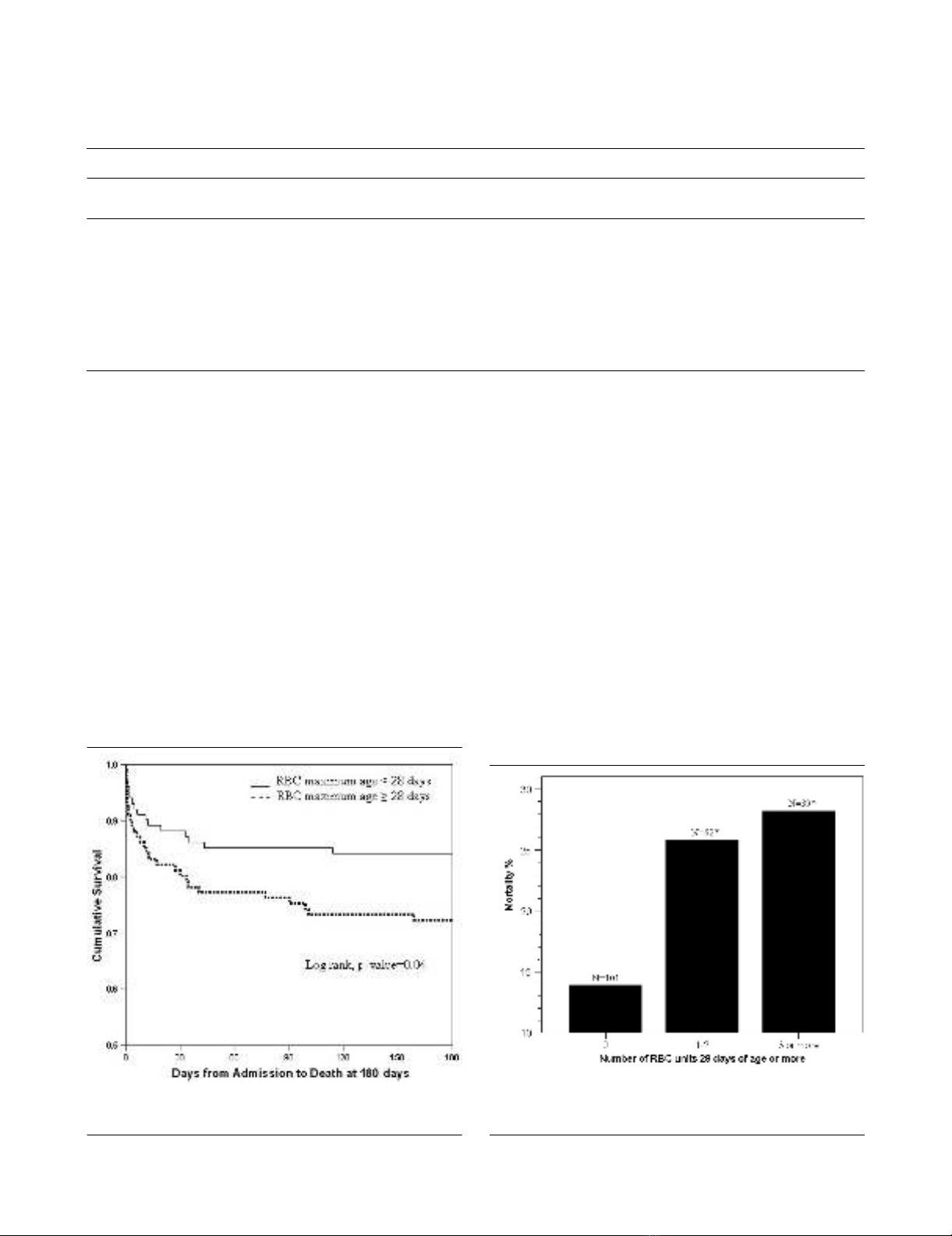
In-hospital mortality was increased for those who received
RBCs of increased (maximum RBC age 28 or more days)
compared with decreased (maximum RBC age of less than 28
days) RBC age, 27 of 101 (26.7%) vs. 14 of 101 (13.9%),
respectively (P = 0.02; Table 3). Additionally, patients in the
increased RBC age group had an increased incidence and
rate of death out to 180 days (Kaplan-Meier statistic; Figure
2). Survival rates were similar according to ABO blood group
types (P = 0.39; Table 2). When the number of transfused
RBC units 28 or more days old was analyzed to determine
how many are required to measure an association with
increased mortality, the transfusion of just 1 to 2 units of RBCs
28 or more days old was associated with increased in-hospital
mortality (Figure 3). The mean (± standard error of the mean)
ICU-free days were also increased in the patients transfused
RBCs of decreased storage age compared with the increased
RBC age group, 64.2 ± 2.9 vs. 54.5 ± 3.6 days, respectively
(P = 0.036). Although the absolute mortality rate increased as
the cut off of RBC age lengthened from 14 to 28 days of stor-
age there was no statistical difference between groups when
defined at 14 and 21 days of storage (Table 3).
On multivariate logistic regression, in-hospital mortality was
independently associated with the transfusion of older RBCs
for patients transfused 5 or more units of RBCs (OR = 4, 95%
Table 2
Comparisons of ABO blood groups for study groups and outcomes measured
Blood group Decreased RBC age group (n =
101)
Increased RBC age group*
(n = 101)
- DVT (%) (n = 137) + DVT (%)
(n = 46)
Survived (%)
(n = 161)
Died (%)
(n = 41)
A (n = 72) 38.6%
(39/101)
32.7%
(33/101)
37.2%
(51/137)
30.4%
(14/46)
34.8%
(56/161)
39.0%
(16/41)
B (n = 38) 9.9%
(10/101)
27.7% *
(28/101)
17.5%
(24/137)
19.6%
(9/46)
18.6%
(30/161)
19.5%
(8/41)
AB (n = 12) 0.0%
(0/12)
11.9%
(12/101)
5.1%
(7/137)
10.9%
(5/46)
6.2%
(10/161)
4.9%
(2/41)
O (n = 80) 51.5%
(52/101)
27.7% *
(28/101)
40.1%
(55/137)
39.1%
(18/46)
40.4%
(65/161)
36.6%
(15/41)
* indicates P value of 0.001 for comparison of ABO blood groups between decreased and increased red blood cell (RBC) age group (chi-
squared test). DVT: deep vein thrombosis.
Figure 2
Kaplan Meier Curve of trauma associated survival over 180 days for patients transfused fresh and old RBCsKaplan Meier Curve of trauma associated survival over 180 days for
patients transfused fresh and old RBCs. RBC: red blood cells.
Figure 3
The relation between in-hospital mortality and the amount of RBC units transfused at 28 or more days of storage in patients transfused 5 or more units of RBCsThe relation between in-hospital mortality and the amount of RBC units
transfused at 28 or more days of storage in patients transfused 5 or
more units of RBCs. RBC: red blood cells.

![Vaccine và ứng dụng: Bài tiểu luận [chuẩn SEO]](https://cdn.tailieu.vn/images/document/thumbnail/2016/20160519/3008140018/135x160/652005293.jpg)