Hindawi Publishing Corporation
EURASIP Journal on Advances in Signal Processing
Volume 2008, Article ID 247354, 13 pages
doi:10.1155/2008/247354
Research Article
Arabic Handwritten Word Recognition Using
HMMs with Explicit State Duration
A. Benouareth,1A. Ennaji,2and M. Sellami1
1Laboratoire de Recherche en Informatique, D´
epartement d’Informatique, Universit´
e Badji Mokhtar, Annaba,
BP 12- 23000 Sidi Amar, Algeria
2Laboratoire LITIS (FRE 2645), Universit´
e de Rouen, 76800 Madrillet, France
Correspondence should be addressed to A. Benouareth, benouareth@lri-annaba.net
Received 09 March 2007; Revised 20 June 2007; Accepted 28 October 2007
Recommended by C.-C. Kuo
We descri b e an offline unconstrained Arabic handwritten word recognition system based on segmentation-free approach and
discrete hidden Markov models (HMMs) with explicit state duration. Character durations play a significant part in the recognition
of cursive handwriting. The duration information is still mostly disregarded in HMM-based automatic cursive handwriting
recognizers due to the fact that HMMs are deficient in modeling character durations properly. We will show experimentally that
explicit state duration modeling in the HMM framework can significantly improve the discriminating capacity of the HMMs to
deal with very difficult pattern recognition tasks such as unconstrained Arabic handwriting recognition. In order to carry out
the letter and word model training and recognition more efficiently, we propose a new version of the Viterbi algorithm taking
into account explicit state duration modeling. Three distributions (Gamma, Gauss, and Poisson) for the explicit state duration
modeling have been used, and a comparison between them has been reported. To perform word recognition, the described system
uses an original sliding window approach based on vertical projection histogram analysis of the word and extracts a new pertinent
set of statistical and structural features from the word image. Several experiments have been performed using the IFN/ENIT
benchmark database and the best recognition performances achieved by our system outperform those reported recently on the
same database.
Copyright © 2008 A. Benouareth et al. This is an open access article distributed under the Creative Commons Attribution License,
which permits unrestricted use, distribution, and reproduction in any medium, provided the original work is properly cited.
1. INTRODUCTION
The term handwriting recognition (HWR) refers to the
process of transforming a language, which is presented
in its spatial form of graphical marks, into its symbolic
representation. The problem of handwriting recognition can
be classified into two main groups, namely offline and online
recognition, according to the format of handwriting inputs.
In offline recognition, only the image of the handwriting
is available, while in the online case temporal informa-
tion such as pentip coordinates as a function of time is
also available. Typical data acquisition devices for offline
and online recognition are scanners and digitizing tablets,
respectively. Due to the lack of temporal information, offline
handwriting recognition is considered more difficult than
online. Furthermore, it is also clear that the offline case is
the one that corresponds to the conventional reading task
performed by humans.
Many applications require offline HWR capabilities
such as bank processing, mail sorting, document archiving,
commercial form-reading, and office automation. So far,
offline HWR remains a very challenging task in spite of
dramatic boost of research [1–3] in this field and the latest
improvement in recognition methodologies [4–7].
Studies on Arabic handwriting recognition, although
not as advanced as those devoted to other scripts (e.g.,
Latin), have recently shown a renewed interest [8–10]. We
point out that the techniques developed for Latin HWR
are not appropriate for Arabic handwriting because Arabic
script is based on alphabet and rules different from those
of Latin. Arabic writing, both handwritten and printed, is
semicursive (i.e., the word is a sequence of disjoint connected
components called pseudowords and each pseudoword is a
sequence of completely cursive characters and is written from
right to left). The character shape is context sensitive, that is,
depending on its position within a word. For instance, a letter
2 EURASIP Journal on Advances in Signal Processing
as
has 4 different shapes: isolated “
”asin“
,”
beginning as “
”, middle as “
”, and end as
“
”. Arabic writing is very rich in diacritic marks (e.g.,
dots, Hamza, etc.) because some Arabic characters may have
exactly the same main shape, and are distinguished from each
other only by the presence or the absence of these diacritics
and their number and their position with respect to the
main shape. The main characteristics of Arabic writing are
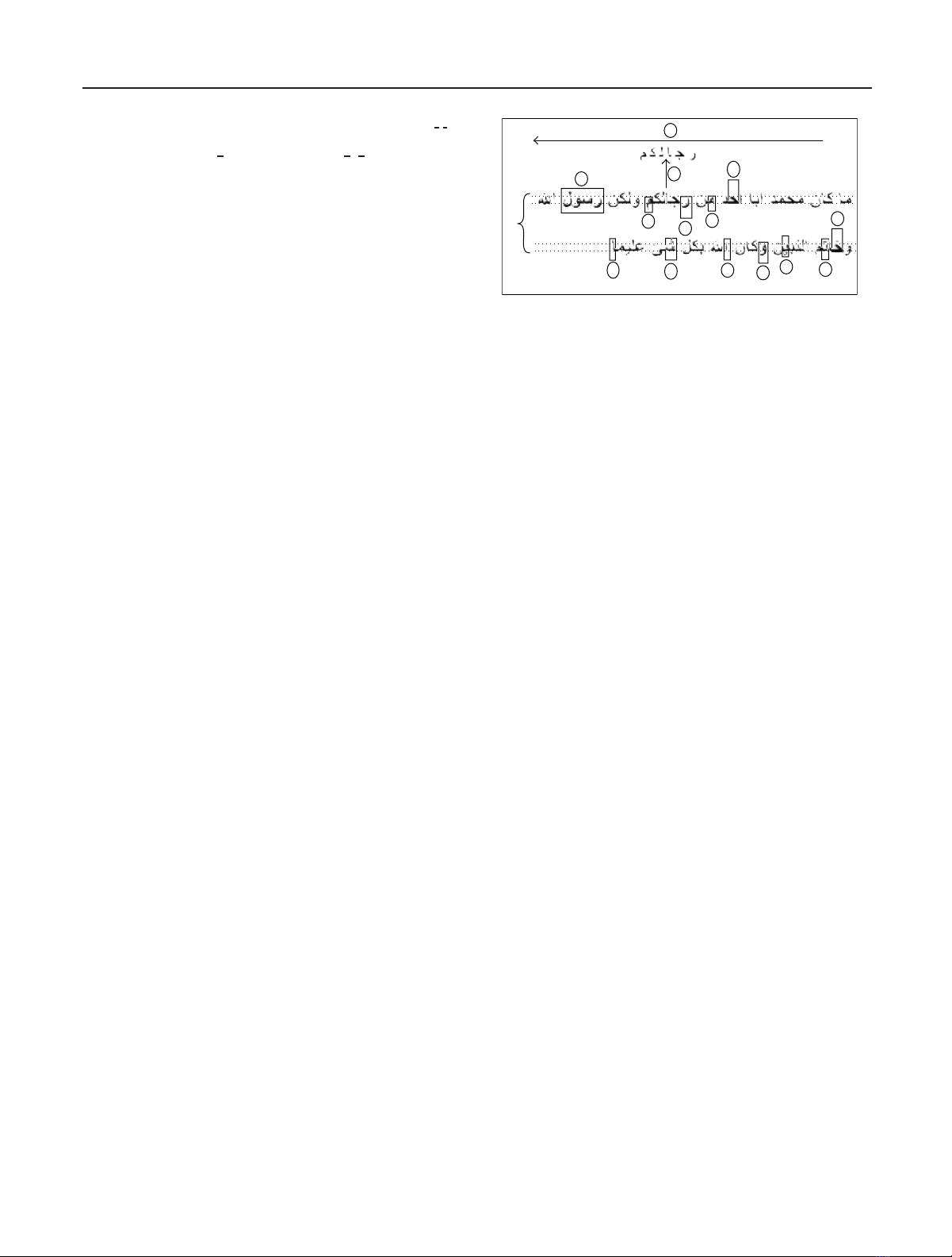
summarized by Figure 1 [11].
One can classify the field of offline handwriting cursive
word recognition into four categories according to the size
and nature of the lexicon involved: very large; large; limited
but dynamic; and small and specific. Small lexicons do not
include more than 100 words, while limited lexicons may
go up to 1000. Large lexicons may contain thousands of
words, and very large lexicons refer to any lexicon beyond
that. When a dynamic lexicon (in contrast with specific or
constant) is used, it means that the words that will be relevant
during a recognition task are not available during training
because they belong to an unknown subset of a much larger
lexicon.
The lexicon is a key point to the success of any HWR
system, because it is a source of linguistic knowledge that
helps to disambiguate single characters by looking at the
entire context. As the number of words in the lexicon grows,
the more difficult the recognition task becomes, because
more similar words are more likely to be present in the
lexicon. The computational complexity is also related to the
lexicon, and it increases according to its size [1].
The word is the most natural unit of handwriting, and
its recognition process can be done either by an analytic
approach of recognizing individual characters in the word or
holistic approach of dealing with the entire word image as a
whole.
Analytical approaches (e.g., [13]) basically have two
steps, segmentation and combination. First the input image
is segmented into units no bigger than characters, then
segments are combined to match character models using
dynamic programming. Based on the granularity of seg-
mentation and combination, analytical approaches can be
further divided into three subcategories: (i) character-
based approaches [14] that recognize each character in
the word and combine the character recognition results
using either explicit or implicit segmentation and requiring
high-performance character recognizer; (ii) grapheme-based
approaches [4,13] that use graphemes (i.e., structural parts
in characters, e.g., the loop part in “
”, arcs, etc.) instead of
characters as the minimal unit being matched; and (iii) pixel-
based approaches [15–18] that use features extracted from
pixel columns in sliding window to form words models for
word recognition.
Holistic approaches [19] deal with the entire input
image. Holistic features, like translation/rotation invariant
quantities, word length, connected components, ascenders,
descenders, dots, and so forth, are usually used to eliminate
less likely choices in the lexicon. Since holistic models
must be trained for every word in the lexicon, compared
against analytical models that need only be trained for every
1
237
5457
664488
Baseline
Figure 1: An Arabic sentence demonstrating the main character-
istics of Arabic text [12]. (1) Written from right to left. (2) One
Arabic word includes three cursive subwords. (3) A word consisting
of six characters. (4) Some characters are not connectable from
the left side with the succeeding character. (5) The same character
with different shapes depends on its position in the word. (6)
Different characters with different sizes. (7) Different characters
with a differentnumberofdots.(8)Different characters have the
same number of dots but different positions of dots.
character, their application is limited to those with small and
constant lexicons, such as reading the courtesy amount on
bank checks [20,21].
The analytical approach is theoretically more efficient
in handling a large vocabulary. Indeed with a constant
number of classification classes (e.g., the number of letters
in the alphabet), it can handle any string of characters
and therefore an unlimited number of words. However, the
Sayere’s paradox (a word cannot be segmented before being
recognised and cannot be recognized before being segmented
[22]) was shown to be a significant limit of any analytical
approach. The holistic approach on the other hand must
generally rely on an established vocabulary of acceptable
words. Its number of classification classes increases with the
size of the lexicon. The “whole word” scheme is potentially
faster when considering a relatively small lexicon. It is also
more accurate having to consider only the legitimate word
possibilities. One disadvantage of a whole word recognizer
is its inability to identify a word not contained in the
vocabulary. On the other hand, it has greater tolerance in
the presence of noise, spelling mistakes, missing characters,
unreadable part of the word, and so forth.
Stochastic models, especially hidden Markov models
(HMMs) [23], have been successfully applied to offline HWR
in recent years [4,6,7]. This success can be attributed to
the probabilistic nature of HMM models, which can perform
a robust modeling of the handwriting signal with huge
variability and sometimes corrupted by noise. Moreover,
HMMs can efficiently integrate the contextual information
at different levels of the recognition process (morphological,
lexical, syntactical, etc.).
Character durations play a significant part in the recog-
nition of cursive handwriting. The duration information is
still mostly disregarded in HMMs-based automatic cursive
handwriting recognizers due to the fact that HMMs are
deficient in modeling character durations properly. We will
show experimentally that explicit state duration modeling

A. Benouareth et al. 3
in the HMM framework can significantly improve the
discriminating capacity of the HMMs to deal with very
difficult pattern recognition tasks such as unconstrained
Arabic handwriting recognition on a large lexicon. In order
to carry out the letter and word model training and
recognition more efficiently, we propose a new version of the
Viterbi algorithm taking into account explicit state duration
modeling.
This paper describes an extended version of an offline
unconstrained Arabic handwritten word recognition sys-
tem based on segmentation-free approach and discrete
HMMs with explicit state duration [24]. Three distributions
(Gamma, Gauss, and Poisson) for the explicit state duration
modeling have been used and a comparison between them
has been reported. To the best of our knowledge, this is the
first work that uses explicit state duration of discrete and
continuous distribution for the offline Arabic handwriting
recognition problem. After preprocessing intended to sim-
plify the later stages of the recognition process, the word
image is first divided according to two different schemes
(uniform and nonuniform) from right to left into frames
using a sliding window. We have introduced the nonuni-
form segmentation in order to tackle the morphological
complexity of Arabic handwriting characters. Then each
frame is analyzed and characterized by a vector having 42
components and combining a new set of relevant statistical
and structural features. The output of this stage is a
sequence of feature vectors which will be transformed by
vector quantization into a sequence of discrete observations.
This latter sequence is submitted to an HMM classifier to
carry out word discrimination by a modified version of
the Viterbi algorithm [15,25]. The HMMs relating to the
word recognition lexicon are built during a training stage,
according to two different methods. In the first method, each
word model is created separately from its training samples.
The second method associates a distinct HMM for each basic
shape of Arabic character, and thus, each word model is
generated by linking its character models. This efficiently
allows character model sharing between word models using
a tree-structured lexicon.
Significant experiments have been performed on the
IFN/ENIT benchmark database [26]. They have shown on
the one hand a substantial improvement in the recognition
rate when HMMs with explicit state duration of either
discrete or continuous distribution is used instead of classical
HMMs (i.e., with implicit state duration, cf. Section 3.2). On
the other hand, the system has achieved best performances
with the Gamma distribution for state duration. Our
best recognition performances outperform those recently
reported on the same database. The HMM parameter
selection is discussed and the resulting performances are
presented with respect to the state duration distribution type,
as well as to the word segmentation scheme into frames and
the word model training method.
The rest of this paper is organized as follows. Section 2
sketches some related studies in HWR using HMMs.
Section 3 briefly introduces the classical HMMs and details
HMMs with different explicit state duration types and their
parameter estimation. A modified version of the Viterbi
algorithm used in the training and recognition of letter
and word models is also presented in this section. Section 4
summarizes the developed system architecture in a block
diagram. Section 5 explains the preprocessing applied to the
word image. Section 6 describes the features extraction stage.
Section 7 is devoted to the training and the classification
process. Section 8 illustrates and outlines the results achieved
by the experiments performed on the IFN/ENIT benchmark
database, and makes a comparison between our best recog-
nition performances and those recently reported on the same
database. Finally, a conclusion is drawn with some outlooks
in Section 9.
2. RELATED WORKS
Since the end of 1980s, the very successful use of HMMs in
speech recognition has led many researchers to apply them
to various problems in the field of handwriting recognition
such as character recognition [27], offline word recognition
[28], and signature verification and identification [12]. These
HMM frameworks can be distinguished from each other
by the state meaning, the modeled units (stroke, character,
word, etc.), the unit model topology (ergodic or left-to-
right), the HMM type (discrete or continuous), the HMM
dimensionality (one-dimensional, planar, bidimensional, or
random fields), the state duration modeling type (implicit
or explicit), and the modeling level (morphological, lexical,
syntactical, etc.).
Gillies [29] has used an implicit segmentation-based
HMM for cursive word recognition. First, a label is given
to each pixel in the image according to its membership in
strokes, holes, and concavities. Then, the image is trans-
formed into a sequence of symbols by vector quantization
of each pixel column. Each letter is modeled by a different
discrete HMM whose parameters are estimated from hand-
segmented data. The Viterbi algorithm [25]isusedfor
recognition and it allows an implicit segmentation of the
word into letters by a by-product of the word matching.
Mohamed and Gader [30] used continuous HMMs to
segmentation-free modeling of handwritten words in which
the observations are based on the location of black-white
and white-black transitions on each image column. They
designed a 12-state left-to-right HMM for each character.
Chen et al. [28] used HMMs with explicit state duration
named continuous density variable duration HMM. After
explicit segmentation of the word into subcharacters, the
observations used are based on geometrical and topological
features (pixel distribution, etc.). Each letter is identified
with a state which can account for up to four segments per
letter. The parameters of the HMM are estimated using the
lexicon and the manually labeled data. A modified Viterbi
algorithm is applied to provide the Nbest paths, which are
postprocessed using a general string edit distance method.
Vinciarelli and Bengio [31] employed continuous density
HMM to recognize offline cursive words written by a single
writer. Their system is based on a sliding window approach
to avoid the need of independent explicit segmentation
stage. As the sliding window blindly isolates the pattern
frames from which the feature vectors are extracted, the

4 EURASIP Journal on Advances in Signal Processing
used features are computed by partitioning each frame
into cells regularly arranged in 4 ×4 grids and by locally
averaging the pixel distribution in each cell. The HMM
parameter number is reduced by using diagonal covariance
matrices in the emission probabilities. These matrices are
derived from the decorrelated feature vectors that result
from applying principal component analysis (PCA) and
independent component analysis (ICA) to the basic features.
Adifferent HMM is created for each letter in which the
number of states and the number of Gaussian in the mixtures
are selected through the cross-validation method. The word
models are established as concatenations of letter models.
Bengio et al. [32] have proposed an online word
recognition system using convolutional neural networks and
HMMs. After word normalization by fitting a geometrical
model to the word structure using the expectation maximiza-
tion (EM) algorithm, an annotated image representation
(i.e., a low-resolution image in which each pixel contains
information about the local properties of the handwritten
strokes) is derived from the pen trajectory. Then, character
spotting and recognition is done by convolutional neural
network, and its outputs are interpreted by HMM that
takes into account word-level constraints to produce word
scores. A three-state HMM for each character with a left and
right state to model transitions and a center state for the
character itself are used to form an observation graph by
connecting these character models, allowing any character
to follow any other character. The word level constraints are
the constraints that are independent of observations (i.e.,
grammar graph) and can embody lexical constraints. The
recognition finds the best path in the observation graph that
is compatible with the grammar graph.
El-Yacoubi et al. [4] have designed an explicit
segmentation-based HMM approach to recognize offline
unconstrained handwritten words for a large but dynam-
ically limited vocabulary. Three sets of features have been
used: the first two are related to the shape of the segmented
units (letters or subletters) while the features of the third set
describe the segmentation points between these units. The
first set is based on global features, such as loops, ascenders,
and descenders; and the second set is based on features
obtained by the analysis of the bidimensional contour tran-
sition histogram of each segment. Finally, segmentation fea-
tures correspond to either spaces, possibly occurring between
letters or words, or to the vertical position of segmentation
points that split connected letters. The two shape-feature
sets are separately extracted from the segmented image; this
allows representing each word by two feature sequences of
equal length, each consisting of an alternating sequence of
segment shape symbols and associated segmentation points
symbols. Since the basic unit in the model is the letter, then
the word (or word sequence) model is dynamically made up
of the concatenation of appropriate letter models consisting
of elementary HMMs, and an interpolation technique is used
to optimally combine the shape symbols and the segmenta-
tion symbols. Character model is related to the behavior of
the segmentation process. This process can produce either
a correct segmentation of a letter, a letter omission, or an
oversegmentation of a letter into two or three segments. As
a result, an eight-state HMM having three paths, in order to
take into account these configurations, is built for each letter.
Observations are then emitted along transitions. Besides, a
special model is designed for interword space, in the case
in which the input image contains more than one word. It
consists of two states linked by two transitions, modeling a
space or no space between a pair of words.
Koerich et al. [13] have improved the system of El-
Yacoubi et al. [4] to deal with a large vocabulary of 30,000
words. The recognition is carried out with a tree-structured
lexicon, and the characters are modeled by multiple HMMs
that are concatenated to build the word models. The tree
structure of lexicon allows, during the recognition stage,
words to share the same computation steps. To avoid an
explosion of the search space due to presence of multiple
character models, a lexicon-driven level building algorithm
(LDLBA) has been developed to decode the lexicon tree
and to choose the more likely models at each level. Bigram
probabilities related to the variation of writing styles within
the word are inserted between the levels of the LDLBA to
improve the recognition accuracy. To further speed up the
recognition process, some constraints on the number of
levels and on the number of observations aligned at each level
are added to limit the search scope to more likely parts of the
search space.
Amara and Belaid [33] used planar HMMs [34]with
aholisticapproachforoffline-printed Arabic pseudowords
recognition. The adopted pseudoword model topology, in
which the main model (i.e., HMM with superstates) is
vertical, allows modeling of the different variations of the
Arabic writing such as elongation of the horizontal ligatures
and the presence of vertical ligatures. Firstly, the pseudoword
image is vertically segmented into strips according to the
considered pattern. These strips reflect the morphological
features of different characters forming the pseudoword
such as ascenders, the upper diacritic dots, holes and/or
vertical ligature position, the lower diacritic dots and/or
vertical ligature position, and descenders. Then, each strip
is modeled by a left-to-right horizontal secondary model
(1D HMM) whose parameters are tightly related to the
strip topology. In the horizontal model, the observations
are computed on the different segments (runs) of the
pseudoword image, and they consist of the segment color
(black or white) together with its length and its position
with respect to the segment situated above it. In the vertical
model, the duration (assimilated to the lines number in each
strip) in each superstate is explicitly modeled by a specific
function, in order to take into account the height of each
strip.
Khorsheed [35] has presented a method for offline-
handwritten script recognition, using a single HMM with
structural features extracted from the manuscript words.
The single HMM is composed of multiple character models
where each model is left-to-right HMM, and represents one
letter from the Arabic alphabet. After preprocessing, the
skeleton graph of the word is decomposed into a sequence
of links in the order in which the word is written. Then,
each link is further broken into several line segments using
a line approximation technique. The line segment sequence

A. Benouareth et al. 5
is transformed into discrete symbols by vector quantization.
The symbol sequence is presented to the single HMM which
outputs an order list of letter sequence associated with the
input pattern by applying a modified version of the Viterbi
algorithm.
Pechwitz and Maergner [17] have described an HMM-
based approach for offline-handwritten Arabic word recog-
nition using the IFN/ENIT benchmark database [26]. Pre-
processing is applied to normalize the height, length, and the
baseline of the word, and followed by a feature extraction
stage based on a sliding window approach. The features
used are collected directly from the gray values of the
normalized word image, and reduced by a Loeve-Karhunen
transformation. Due to the fact that Arabic characters might
have several shapes depending on their position in a word,
a semicontinuous HMM (SCHMM) is generated for each
character shape. This SCHMM has 7 states, in which each
state has 3 transitions: a self-transition, a transition to the
next state, and one allowing skipping a single state. The
training process is performed by a k-mean algorithm where
a model parameter initialization is done by a dynamic
programming clustering approach. The recognition is car-
ried out by applying a frame synchronous network Viterbi
search algorithm together with a tree-structured lexicon
representing the valid words.
From this quick survey, we can conclude that HMMs
dominate the field of cursive handwriting recognition, but
there are few works in this field in which HMMs with explicit
state duration have been employed.
3. HIDDEN MARKOV MODELS (HMMS) AND
STATE DURATION MODELING
Before introducing the notion of explicit state modeling
in HMMs, we will shortly recall the definition of one-
dimensional discrete HMMs.
3.1. Hidden Markov models (HMMs)
A hidden Markov model (HMM) [23] is a type of stochastic
model appropriate for nonstationary stochastic sequences
with statistical properties that undergo distinct random
transitions among a set of different stationary processes.
In other words, the HMM allows to model a sequence
of observations as a piecewise stationary process. More
formally, an HMM is defined by N: the number of states, M:
the number of possible observation symbols, T: the length of
the observation sequence, Q={qt}: the set of possible states,
qt∈{1, 2, ...,N},1≤t≤T,V={vk}: the codebook or the
discrete set of possible observation symbols, 1 ≤k≤M.
A={aij}: the state transition probability: aij =P(qt+1 =j|
qt=i), 1 ≤i,j≤N,B={bj(vk)}: the observation symbol
probability distribution:
bjvk=Pvkat t|qt=j,1≤i≤N,1≤k≤M,
(1)
π={πi}: the initial state probability, πi=P(q1=i), 1 ≤
i≤N. More compactly, an HMM can be represented by the
parameter λ(π,A,B).
To suitably use HMMs in handwriting recognition, three
problems must be solved. The first problem is concerned
with the probability evaluation of an observation sequence
given the model λ(i.e., the observation matching). The
second problem is that we attempt to determine the state
sequence (i.e., state decoding) that “best” explains the input
sequence of observations. The third problem consists of
determining a method to optimize the model parameters
(i.e., the parameter re-estimation) to satisfy a certain opti-
mization criterion.
The evaluation probability problem can be efficiently
solved by the forward-backward procedure [23]. A solution
to the state decoding problem, based on dynamic program-
ming, has been designed, namely, the Viterbi algorithm
[25]. The model parameter determination is usually done by
the Baum-Welch procedure based on the expectation max-
imization (EM) algorithm [23], and consists in iteratively
maximizing the observation likelihood given the model, and
often converges to a local maximum.
3.2. Duration modeling in the HMM framework
We clearly distinguish between two discrete HMM types:
HMM with implicit state duration (i.e., classical HMM)
and HMM with explicit state duration. Classical HMMs do
not allow explicit duration modeling (i.e., duration that the
model can spend in some state). Indeed, the probability
distribution of staying for a duration din the state i(i.e.,
probability of consecutively observing dsymbols in state i),
noted Pi(d), is always considered as a geometric one with
parameter aii:
P(d/qi)=ad−1
ii 1−aii.(2)
The form of this distribution is exponentially decreasing
(i.e., it gets to its maximal value at the minimal duration
d=1, and decays exponentially as dincreases). Described
with one parameter, the distribution can effectively depict
only the mean duration. Beyond that, it is unable to model
any variation in the duration distributions, and hence, its
use is not appropriate when the states have some explicit
significance. For example, in handwriting they represent the
letters or letter fragments, because, in this case, narrow letters
(e.g., “
”) are modeled as being more probable than wide
letters (e.g., “”). As a result, it is suitable to explicitly model
the duration spent in each state.
An HMM λwith explicit state duration probability
distribution is mainly defined by the following parameters:
A,B,N,p(d), and πthat are, respectively, state transition
probability matrix, output probability matrix, a total number
of HMM states, a state duration probability vector, and initial
state probability vector.
In HMM with explicit state duration, the sequence of
observations is generated along the following steps.
(1) Generate q1from the initial state distribution π.
(2) Set t=1.

![PET/CT trong ung thư phổi: Báo cáo [Năm]](https://cdn.tailieu.vn/images/document/thumbnail/2024/20240705/sanhobien01/135x160/8121720150427.jpg)