BioMed Central
Page 1 of 12
(page number not for citation purposes)
Implementation Science
Open Access
Research article
Exploring the black box of quality improvement collaboratives:
modelling relations between conditions, applied changes and
outcomes
Michel LA Dückers*1, Peter Spreeuwenberg1, Cordula Wagner1,2 and
Peter P Groenewegen1,3
Address: 1NIVEL - Netherlands Institute for Health Services Research, Utrecht, the Netherlands, 2EMGO Institute for Health and Care Research,
Free University Medical Centre, Amsterdam, the Netherlands and 3Department of Sociology, Department of Human Geography, Utrecht
University, Utrecht, the Netherlands
Email: Michel LA Dückers* - m.l.duckers@amc.uva.nl; Peter Spreeuwenberg - p.spreeuwenberg@nivel.nl; Cordula Wagner - c.wagner@nivel.nl;
Peter P Groenewegen - p.groenewegen@nivel.nl
* Corresponding author
Abstract
Introduction: Despite the popularity of quality improvement collaboratives (QICs) in different
healthcare settings, relatively little is known about the implementation process. The objective of
the current study is to learn more about relations between relevant conditions for successful
implementation of QICs, applied changes, perceived successes, and actual outcomes.
Methods: Twenty-four Dutch hospitals participated in a dissemination programme based on
QICs. A questionnaire was sent to 237 leaders of teams who joined 18 different QICs to measure
changes in working methods and activities, overall perceived success, team organisation, and
supportive conditions. Actual outcomes were extracted from a database with team performance
indicator data. Multi-level analyses were conducted to test a number of hypothesised relations
within the cross-classified hierarchical structure in which teams are nested within QICs and
hospitals.
Results: Organisational and external change agent support is related positively to the number of
changed working methods and activities that, if increased, lead to higher perceived success and
indicator outcomes scores. Direct and indirect positive relations between conditions and
perceived success could be confirmed. Relations between conditions and actual outcomes are
weak. Multi-level analyses reveal significant differences in organisational support between hospitals.
The relation between perceived successes and actual outcomes is present at QIC level but not at
team level.
Discussion: Several of the expected relations between conditions, applied changes and outcomes,
and perceived successes could be verified. However, because QICs vary in topic, approach,
complexity, and promised advantages, further research is required: first, to understand why some
QIC innovations fit better within the context of the units where they are implemented; second, to
assess the influence of perceived success and actual outcomes on the further dissemination of
projects over new patient groups.
Published: 17 November 2009
Implementation Science 2009, 4:74 doi:10.1186/1748-5908-4-74
Received: 28 January 2009
Accepted: 17 November 2009
This article is available from: http://www.implementationscience.com/content/4/1/74
© 2009 Dückers et al; licensee BioMed Central Ltd.
This is an Open Access article distributed under the terms of the Creative Commons Attribution License (http://creativecommons.org/licenses/by/2.0),
which permits unrestricted use, distribution, and reproduction in any medium, provided the original work is properly cited.

Implementation Science 2009, 4:74 http://www.implementationscience.com/content/4/1/74
Page 2 of 12
(page number not for citation purposes)
Background
In the last decade, many countries have initiated quality
improvement collaboratives (QICs) in healthcare settings.
QICs bring together 'groups of practitioners from different
healthcare organisations to work in a structured way to
improve one aspect of the quality of their service. It
involves them in a series of meetings to learn about best
practices in the area chosen, about quality methods and
change ideas, and to share experiences of making changes
in their own local setting' [1]. Another important feature
of collaboratives is the use of continuous quality improve-
ment methods to realise changes. Continuous quality
improvement is a proactive philosophy of quality man-
agement featuring multi-disciplinary teamwork, team
empowerment, an iterative approach to problem solving,
and ongoing measurement [2,3]. QICs are presented as
'arguably the healthcare delivery industry's most impor-
tant response to quality and safety gaps', representing sub-
stantial investments of time, effort, and funding [4].
Nevertheless, the problem is that despite its popularity,
the evidence for QIC effectiveness is positive but limited
[3-5]. Effects cannot be predicted with great certainty [6].
Therefore researchers urge for more investigation into the
different types of QICs and their effectiveness, as well as
linking QIC practices explicitly to organisational and
change management theory [1,4,7-9]. Or, as stated by Cre-
tin et al., it is important to open the 'black box' of QIC
implementation [3].
The current study intends to contribute to a better under-
standing of the processes and outcomes of QIC imple-
mentation in the context of a change programme for 24
Dutch hospitals based on 18 QICs. This programme--a
multi-level quality collaborative--is aimed at organisa-
tional development and the dissemination of healthcare
innovations [10]. It is the third pillar of 'Better Faster', a
programme embedded in a broader national policy mix
involving an increase in managed competition and trans-
parency, a new reimbursement system based on standard-
ised output pricing, and an intensified role for public
actors (like the Healthcare Inspectorate), patient repre-
sentatives, and healthcare insurers in monitoring the
quality and safety of care (see Appendix 1) [10-14]. The
multi-level quality collaborative is based on the imple-
mentation of different breakthrough collaboratives in the
areas of patient safety and logistics. The patient safety tar-
gets involve pressure ulcers, medication safety, and post-
operative wound infections. Logistics teams deal with
operating theatre productivity, throughput times, length
of in-hospital stay, and access time for outpatient appoint-
ments (for details see Table 1).
Table 1: Breakthrough collaboratives and external change agents within Better Faster pillar 3
Quality area Breakthrough project Programme targets Planned year-one projects per
hospital
Patient logistics WWW: working without waiting lists Access time for out-patient appointments 2
OT: operating theatre Increasing the productivity of operating
theatres by 30%
1
PRD: process redesign Decreasing the total duration of diagnostics
and treatment by 40 to 90%, reducing
length of in-hospital stay by 30%
2
Patient safety MS: medication safety
PU: pressure ulcers
Decreasing the number of medication
errors by 50%
The percentage of pressure ulcers is lower
than 5%
2
2
POWI: postoperative wound infections Decreasing postoperative wound infections
by 50%
1
Programme hospitals participated for two years in Better Faster pillar 3 (Table 1). During the first year, multi-disciplinary teams in each hospital
implemented the following projects that were to be disseminated further in the following year and afterwards [34].
Overview of the breakthrough projects: targets and planned number per hospital in two years
As well as having organisational support provided by the hospitals, each collaborative was organised and facilitated by a small team of external
change agents: experts and advisors responsible for the general contents of the projects carried out by the teams in the hospitals. While the multi-
level quality collaborative was in its preparation phase, the external change agents served as developers. Their task was to translate promising
change ideas into a more or less generally applicable improvement concept, meeting the prerequisites for successful adoption (e.g., perceived
advantage, low complexity, compatibility [15]). They combined a rapid cycle improvement model with a series of recommended topic related
interventions plus performance indicators to monitor progress. Improvement concepts and best practices were transferred at several team training
meetings. The teams were trained to apply breakthrough methods, requiring the application of plan-do-study-act improvement cycles and the
answering of three questions: 'What are we trying to accomplish?' 'How will we know that a change is an improvement?' and 'What change can we
make that will result in an improvement?'[41,42] The one- or two-day training meetings took place at central locations in the county. The agendas
contained presentations about background information on the project, team instruction sessions and group assignments, and guest speakers with
knowledge about the topic or best practice experience as well as plenary discussion. On average, a delegation of four team members visited four
QIC meetings [34].

Implementation Science 2009, 4:74 http://www.implementationscience.com/content/4/1/74
Page 3 of 12
(page number not for citation purposes)
Study objective
This study aims to answer two questions: to what extent
do expected relationships between conditions, applied
changes, and outcomes of QIC-implementation exist; and
can differences in conditions and outcomes be explained
by the fact that the teams belong to different QICs and
hospitals?
Conceptual framework
This study focuses on relations between relevant condi-
tions for successful QIC implementation, on changes in
working methods and activities, and on patient-related
outcomes. In opposite order, the outcomes involve per-
ceived project successes and actual progress made in the
area of patient safety and logistics. Changes in working
methods and activities have to do with all the new or
intensified efforts taken by the teams on behalf of their
project. The literature on the implementation and dissem-
ination of innovations in health service organisations
contains many descriptions of success conditions, linked
to the tasks and responsibilities of the actors involved in
QIC efforts [15,16]. An important assumption behind
QICs as an improvement and spread tool [1] is that
knowledge about best practice is made available to teams
by external change agents. The teams implement this in
their own hospital setting. For this reason, three categories
of conditions can be recognised: the organisation of the
multi-disciplinary teams that join a QIC and transform
the knowledge into action (to avoid confusion, in this
study team organisation and teamwork have the same
meaning); the degree of support these teams receive from
their hospital organisation; and the support given by the
external consultants/change agents who facilitate the QIC
and its meetings [17].
Team organisation
This affects the teams joining a QIC. Cohen and Bailey
defined a team as 'a collection of individuals who are
interdependent in their tasks, who share responsibility for
outcomes, who see themselves and who are seen by others
as an intact social entity embedded in one or more larger
social systems (e.g., business unit or corporation), and
who manage their relationships across organisational
boundaries' [18]. There is a general consensus in the liter-
ature that a team consists of at least two individuals who
have specific roles, perform interdependent tasks, are
adaptable, and share a common goal [19]. To increase
team effectiveness, it is important to establish timely,
open, and accurate communication among team mem-
bers [20]. The notion that QIC teams are responsible and
in charge of project progress [1] is in line with the litera-
ture suggesting that operational decision-making during
implementation processes should be devolved to teams
[21].
Organisational support
Other imperatives for team success are strong organisa-
tional support and integration with organisational key
values [22]. Within QICs, organisational support has to
do with the leadership, support, and active involvement
by top management [21,23,24]. Regular contact is needed
between team and hospital leaders, and the innovation
must match the goals of the management [24]. Øvretveit
et al. state that topics should be of strategic importance to
the organisation [1]. In addition to the presence of neces-
sary means and instruments [25], many of the internal
support tasks are to be executed by the strategic manage-
ment. Executives have to communicate a vision or key val-
ues throughout the organisation [26,27], and must
stimulate the organisation's and employees' willingness
to change [28]. These tasks fall within the priority setting
areas defined by Reeleeder et al.: namely, foster vision, cre-
ate alignment, develop relationships, live values, and
establish processes [29].
External change agent support
The involvement of external change agents, arranging
group meetings for teams of different organisations, is a
typical QIC feature. In Table 1, the role of the external
change agents within the larger programme is described.
Their efforts should contribute to the empowerment and
motivation of teams to implement new working methods
in order to alter a quality aspect of their care delivery.
Team training is a success factor for team-based imple-
mentation [22], and can be more effective than individual
training, especially when the learning is about a complex
technology [30]. External change agents should provide
teams with an applicable model together with appealing
performance expectations [31]. This implies and requires
a gap between a desirable and an actual situation, as well
as outlining the potential added value of the innovation
to the teams [1]. A second prerequisite is that teams join-
ing the QIC need to gain information and skills that are
new to them, otherwise an important argument for join-
ing the QIC is void.
Hypotheses
In an earlier study, a questionnaire was developed and
validated to measure the extent to which these conditions
are met [17]. In this article, a model will be tested based
on a number of hypotheses that affect the relation
between conditions, team-initiated changes due to QIC
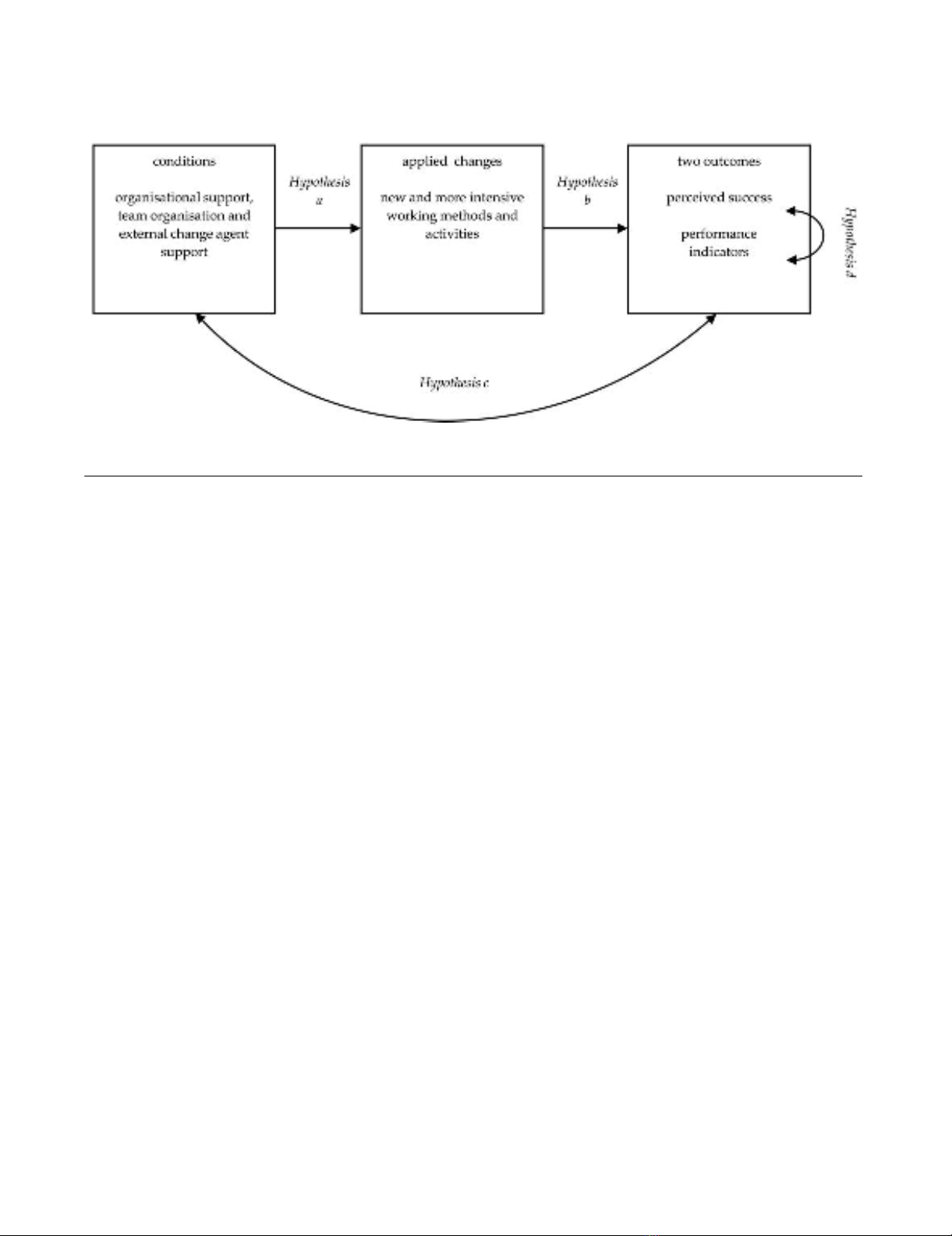
participation, and two outcome measures (Figure 1).
In the literature, a positive relation is suggested between
the presence of these conditions and successful imple-
mentation of change [15,16,24]. Successful implementa-
tion means that teams manage to adopt new working
methods or to alter existing practices. The 18 QICs within
Implementation Science 2009, 4:74 http://www.implementationscience.com/content/4/1/74
Page 4 of 12
(page number not for citation purposes)
the multi-level quality collaborative were aimed at achiev-
ing specific targets in the area of patient safety and patient
logistics. The implementation of the new working meth-
ods and improvement concepts was to be advocated and
supported by the external change agents of the QICs. Pro-
gramme hospitals were expected to provide the necessary
internal support. The teams, moreover, were made
responsible for the progress of the implementation in
their own local hospital setting. Based on the literature
and the tasks and responsibilities of actors within the pro-
gramme in which the QICs are implemented, two hypoth-
eses can be formulated:
Hypothesis A: organisational support, team organisation
and external support have a positive effect on the number
of applied changes by teams.
Hypothesis B: the number of applied changes has a posi-
tive effect on perceived and actual outcomes.
Both hypotheses imply a causal relation. In other
instances, it is more difficult to determine the direction of
an effect. This applies to hypotheses C and D. Because (A)
the number of applied changes is hypothesised to be
influenced by the presence of the right conditions and (B)
an increase in the number of applied changes has a posi-
tive effect on the outcomes, it is logical that (C) the pres-
ence of the conditions is expected to be positively related
to the outcomes of the implementation:
Hypothesis C: a positive relation exists between condi-
tions and outcomes.
A final assumption has to do with the relation between
perceived and actual project outcomes. If an outcome
indicator shows that a project's main topic is improved, a
project leader is more likely to be positive about the suc-
cess of the project. Or conversely, if the team leader has a
tendency to think more positively about the result, this
may have influenced his or her behaviour in such a way
that it actually contributed to a higher level of improve-
ment.
Hypothesis D: a positive relation exists between perceived
and actual outcomes.
Methods
Study population
The total study population consists of 168 teams from 24
hospitals and 18 QICs. Project teams from three hospital
groups started, one group after the other, in October
2004, October 2005, and October 2006, with the imple-
mentation of the six types of QIC projects as described in
Table 1.
Data sources and variables
Two data sources were accessed to gain information on six
variables that were used for the purpose of statistical mod-
elling. The QIC team leaders served as a first data source.
In January 2006, 2007, and 2008, the team leaders
received a questionnaire at the end of the first year of
implementation and were asked to rate the overall success
of their project on a scale from zero (min) to ten (max).
Other questions reflected relevant conditions for success-
ful implementation. Principal component analysis
showed that several of the items measured with the ques-
tionnaire (on a seven-point scale) cluster together into
three constructs, resembling the categories described in
the introduction: organisational support, team organisa-
tion, and external change agent support (for information
Study model: hypothesised relations between conditions, applied changes and outcomesFigure 1
Study model: hypothesised relations between conditions, applied changes and outcomes.

Implementation Science 2009, 4:74 http://www.implementationscience.com/content/4/1/74
Page 5 of 12
(page number not for citation purposes)
on the items see the notes under Table 2). Scale reliability,
internal item consistency, and divergent validity were sat-
isfactory [17]. To measure the number of applied changes,
eight activities, relevant for achievement of the project
goal, were selected for each QIC from the QIC instruction
manuals. Team leaders could mark one out of four
options--this is something: we do not do, we have already
done, we have intensified/improved since the start of the
project, or completely new. For each team, the number of
applied changes (intensified/improved or new since the
project began) was counted. The applied change rate
ranges from zero (no change) to eight (high number of
changes).
Each QIC served a particular purpose. The external change
agents translated project targets into measurable indica-
tors, and teams had to deliver monitoring data to a central
database. In this study, these monitoring data were used
to model the actual success of the teams. An agreement
was made with the organisation funding the programme
(as well as the independent evaluation, of which the cur-
rent study is a part) that the data collection burden for
participating hospital staff was to be minimised. There-
fore, the central database was the sole source for team per-
formance indicators. Spreadsheet files with team
monitoring data were provided three times by the change
agency approximately six months after the end of the first
implementation year (April to June 2006, 2007, and
2008). These data were used in the analyses that are
described later. Project indicators were: prevalence of
pressure ulcers (pressure ulcers), prevalence of wound
infections (postoperative wound infections), access time
for outpatient appointments in days (waiting lists),
throughput time for diagnostics and treatment in days
(process redesign), and percentage of allocated time actu-
ally used (operating theatre productivity). Three types of
medication-safety projects had their own indicators: per-
centage of unnecessary blood transfusions, intravenous
antibiotics, or patients with a pain score above four. Med-
ication-safety scores were calculated using the first and last
20 patients treated. Pressure ulcers, operating theatre pro-
ductivity, and waiting-list project results were based on
the change between the scores of the first and last two
months. In the case of process redesign and postoperative
wound infections, the project period was compared to an
identical period in the past.
The change percentages in this study were converted into
a three-point scale: (1) at least 10% worse than before, (2)
neutral, and (3) improved by at least 10%. Compared to
goals such as 30%, 40 to 90% and 50% improvement
(Table 1), 10% improvement seems modest. However,
several evaluations revealed that even 10% is unrealistic
for some teams, making a higher threshold too strict
[32,33]. A lower threshold is not an option either, because
then the improvement is no longer substantial. It is
known from research that an average improvement rate of
10% is common [34], particularly if the improvement
strategy--e.g., breakthrough--is based on feedback [35].
Analyses
Multi-level regression analyses were conducted to answer
the research questions. The main argument behind multi-
level modelling is that social processes often take place
within a layered structure. The assumption that data struc-
tures are purely hierarchical, however, is often an over-
simplification. Entities, such as people or teams, may
belong to more than one grouping, and each grouping can
be a source of variation. Each team in the current study
belongs to one of the 18 QICs and to one of the 24 pro-
gramme hospitals. For that reason, a cross-classified
multi-level model is the most accurate model to study the
hypothesised relations between conditions, applied
changes and outcomes (Figure 2).
Table 2: The means, medians, inter-quartile ranges (IQR) and ranges of the six variables
Variable name:N Mean Median IQR Min-Max
External change agent support1168 4.56 4.65 1.46 1.50-6.75
Team organisation2168 5.27 5.40 1.20 1.60-7.00
Organisational support3168 4.60 4.78 1.75 1.40-7.00
Number of applied changes 159 3.73 4.00 2.00 0.00-8.00
Perceived success (overall judgement project leader) 137 6.69 7.00 2.00 1.00-9.00
Actual success (performance indicator) 103 2.28 3.00 2.00 1.00-3.00
1 Items: at collaborative meetings I always gain valuable insights, and external change agents a) provide sufficient support and instruments; b) raise
high expectations about performance and improvement potential; c) make clear from the beginning what the goal of the project is and the best way
to achieve it; Cronbach's alpha: 0.77.
2 Items: good communication and coordination, clear division of tasks, everyone is doing what he or she should do, team is responsible and in
charge of implementation; Cronbach's alpha: 0.84.
3 Items: project is important to strategic management, strategic management supports project actively, hospital gives support needed in the
department(s) to make the project a success, board does everything in its power to increase the willingness to change and pays attention to the
activities of the project team; Cronbach's alpha: 0.91.