
Original article
Natural durability, physical and mechanical properties
of Atlas cedar (Cedrus atlantica Manetti) wood from
Southern Italy
Michele Brunetti*, Enrico L. De Capua, Nicola Macchioni and Salvatore Monachello
Istituto per la Ricerca sul Legno, CNR, Via Barazzuoli, 23, 50136 Firenze, Italy
(Received 3 April 2000; accepted 21 December 2000)
Abstract – This paper deals with the technological characterisation of Atlas cedar wood from artificial plantation in South Italy. Atlas
cedar seems to be one of the most promising species for reforestation in Central-South Italy, due to its ecological adaptability, quality of
standing trees, even without thinnings and pruning, and productivity of the stands. From a 30-year-old stand in Sicily 6 trees were selec-
ted in order to analyse the natural durability of wood against fungi, according to European Standards, and the main physical and mecha-
nical properties from clear specimens, according to ISO Standards. The heartwood resulted classified from “durable” to “very durable”,
while sapwood is “not durable”. The wood is quite dense, taking into account the fast-grown characteristics of the stand, but the volume-
tric shrinkage is limited and the ratio between tangential and radial shrinkages is less than 1.5. Mechanical characteristics show a wood
with a quite high ratio of static quality. From first results the Atlas cedar seems to be a promising tree species from ecological and silvi-
cultural point of view.
wood / durability / properties / Atlas cedar / South Italy
Résumé – Durabilité naturelle et propriétés physiques et mécaniques du bois de cèdre de l’Atlas (Cedrus atlantica Manetti), de
l’Italie du sud. Les auteurs ont étudié la caractérisation technologique du bois de cèdre de l’Atlas qui provient de plantations artificielles
de l’Italie du sud. Le cèdre de l’Atlas semble être une des espèces qui pourra obtenir de bons résultats dans la reforestation en Italie du
centre et du sud, soit pour sa faculté d’adaptation écologique, soit pour la qualité des arbres sur pied, même sans opérations d’éclaircie et
d’élagage, et enfin pour la productivité des plantations. Dans une région de Sicile on a prélevé d’une plantation de 30 ans 6 arbres pour
analyser leur durabilité naturelle vis-à-vis des champignons lignivores, selon les normes européennes, et les caractéristiques physiques
et mécaniques d’échantillons, selon les normes ISO. On peut classifier le duramen de « durable » à « très durable », l’aubier au contraire
est « nondurable ». Le bois est assez dense si l’on considère les caractéristiques de croissance rapide de la plantation, mais le retrait volu-
métrique est limité et le rapport entre le retrait tangentiel et le retrait radial est inférieur a 1,5. Les caractéristiques mécaniques montrent
un bois avec une assez haute cote spécifique de qualité. Selon ces premiers résultats le cèdre de l’Atlas semble être, du point de vue éco-
logique et sylvicultural, très satisfaisant.
bois / durabilité / propriétés / cèdre de l’Atlas / Italie du sud
Ann. For. Sci. 58 (2001) 607–613 607
© INRA, EDP Sciences, 2001
* Correspondence and reprints
Tel. +39 055 661750; Fax. +39 055 670624; e-mail: brunettim@irl.fi.cnr.it

ABBREVIATIONS
List of symbols used in the text, in alphabetical order.
Symbol Units Description
DBH cm Diameter at breast height
f.s.p. % fiber saturation point
H m Height
m.c. % Moisture content
MOE MPa Modulus of elasticity
MOR MPa Modulus of rupture
R.H. % Relative humidity
1. INTRODUCTION AND AIM OF THE PAPER
The Atlas cedar wood has a fine texture, a fragrant
smell and it is easy to be converted.
The aim of the paper is an improvement of the techno-
logical characteristics and a valorisation of the wood
from Atlas cedar, a forest species largely introduced in
southern Italy in reforestations.
Even if they rarely had any thinning or pruning, those
artificial plantations showed good increments in many
European regions where Atlas cedar has been introduced
(France, Italy, Hungary, Bulgaria). That’s why many
countries started finalised projects toward the improve-
ment of the silvicultural management of existent stands
and of the knowledge of that wood, in order to find its
best end use.
2. DISTRIBUTION AND ECOLOGICAL
CHARACTERS
The Cedrus genus includes three species native from
Mediterranean mountains and one species from
Himalaya:
–Cedrus atlantica Manetti, from Algeria and Morocco;
–Cedrus libani Rich., from Asia Minor;
–Cedrus brevifolia (Hooker fil.) Henry, from Cyprus;
–Cedrus deodara Don, from Afghanistan and southern
slopes of western Himalaya.
These species are interfertile, mostly Cedrus libani
and Cedrus atlantica, with a lot of ornamental cultivars,
frequently giving origin to hybrids.
The Atlas cedar can reach 50 m height and 1.50 m
DBH. The species is light demanding and cannot stand
too much cold and long winters, withstanding summer
droughts only when the year precipitation exceeds the
800 mm.
Cedar needs silicaceous soils, while the carbonatic
ones are tolerated when deep and in sufficiently rainy sta-
tions. The specie’s optimum is located in elevations from
1 400 m to 2 000 m a.s.l., with rainfalls from 900 to
1 500 mm per year.
The young tree has a slender and elegant bearing, as
adult shows an expanded crown, without showing the
tabular crown typical of the Lebanon cedar, from which
it is also differentiated by shorter needles.
Bark is light greyish, smooth and brilliant till about
25 years, and then it cracks in small scales.
The needles are 15–20 mm long, the cones are green,
upright, 8 cm long and with a diameter of about 7.5 cm,
then smaller than the Lebanon cedar ones. Mature cones
are brown.
Seeds are oval and flat, 10–12 mm long, witha2cm
long wing. The plantula has from 7 to 10 cotyledons.
The indigenous range of the Atlas cedar is this way
distributed [3]:
– In Morocco: in the Rif Region (about 16 000 ha), in
Medium Atlas (about 100 000 ha) and Grand Eastern At-
las (about 10 000 ha);
– In Algeria the range of cedar is fragmented, in differ-
ent ecological regions, with a total extension of about
20 000 ha.
In the native range, this species has a good adaptability
and lives in high atmospheric humidity regions in
Morocco as well as in xerophile environments in other
Moroccan and Algerian regions [3].
In Europe the Atlas cedar was introduced during the
first half of 19th century as an ornamental tree and only
in a second time for forest purposes. In many European
countries and in USA some introduction trials are now
under way, in order to evaluate the real diffusion possi-
bility.
The first forest diffusion trials in Italy started during
the second half of 19th century in Tuscany.
Starting during the 30’s of 20th century some shields
plantations were made, mixing cedar with other species,
particularly with black pine (Pinus nigra Arnold).
608 M. Brunetti et al.
According to some estimations, at present the surface
covered by the Atlas cedar in Italy is about 1 000 ha [3].
The highest diffusion is in Tuscany, with recent exten-
sive plantations in Abruzzo, Molise, Calabria, Sardinia
and Sicily.
Often it was introduced in chestnut coppices and in
oak stands, mixed with Turkey Oak (Quercus cerris L.),
pubescent Oak (Quercus pubescens Wild.) and ever-
green Oak (Quercus ilex L.), or in Hop Hornbeam
(Ostrya sp.) stands, where it forms sparse formations.
The data about the growth in native ranges vary ac-
cording to the soil and climate conditions and to other
factors such as composition, structure, age and cutting
system. Increments vary indeed between 1–1.5 and
6–7 m3ha–1 per year in the best conditions.
The increments variation recorded in Italy is mostly
caused by the soil: average increments are between 3 and
14 m3ha–1 per year.
3. MATERIALS AND METHODS
3.1. Materials
The trees utilised for the trials come from thirty years
old reforestation plants in Sicily, from mountains located
between the Provinces of Palermo and Agrigento.
The forest has a changing exposition from SW to NW
and an elevation from 1 090 to 1 250 m a.s.l. Mean pre-
cipitations are 800 mm per year.
The soils are clay with sub alkaline reaction, brown,
leached, typical of the inner, hilly regions of Sicily.
The stand is mixed, with a percent variation of Euro-
pean Black Pine (Pinus nigra Arnold) and Aleppo Pine
(Pinus halepensis Mill.) at lower elevations.
Six trees were randomly selected with following me-
dium characteristics: age = 31 years, H = 12.7 m, DBH =
23.6 cm. The diametric percentage of heartwood at
1.30 m was 36.2%.
From the roundwood the DBH bolts were obtained,
from which the radial boards were sawn. For the different
purposes the sample were obtained from those boards,
according to the scheme on table I.
3.2. Methods for natural durability tests
The analysis of the natural durability to wood-de-
stroying fungi (Basidiomycetes) of Atlas cedar wood
was performed according to the European standards
EN 350-1 and EN 113.
Samples were selected in order to analyse different
zones of the section:
– zone A, sapwood near cambial region;
– zone B, sapwood near heartwood;
– zone C, external heartwood;
– zone D, inner heartwood (three cm from the pith).
Before the test, all the samples were put into a climatic
chamber in order to reach the equilibrium m.c. 12%.
The standard previews the calculation of the theoreti-
cal oven-dry mass (Mto), obtained from the measurement
of the m.c. on another series of oven dried samples, of
each test specimen before tests as follows:
Mto Mu
u
=+()100
where Mu is the mass of the samples to be tested after
conditioning.
Each sample was placed side by side with a control
sample of sapwood of Scots Pine (Pinus sylvestris L.), as
a reference species, selected by the standard for the dura-
bility tests on softwoods.
Wood technology of Atlas cedar from Southern Italy 609
Table I. Performed tests, dimensions of utilised samples and
standard followed for the tests.
Test type Sample dimension (cm)
long ×transerve
dimensions
Standard
reference
Natural durability 5 ×2.5 ×1.5 UNI EN 113;
EN 350/1
Density 2.5 ×2×2 ISO 3131
Shrinkages 2.5 ×2×2 ISO 4858,
ISO 4469
Bending MOR 32 ×2×2 ISO 3133
Bending MOE 32 ×2×2 Dynamic method
Compression 3 ×2×2 ISO 3787
Shear 2 ×2×2 ISO 3347
The wood was tested for the durability against the fol-
lowing fungi:
–Coniophora puteana (Schumacher e Fries) Karsten,
strain BAM Ebw. 15;
–Poria placenta (Fries) Cooke sensu J. Eriksson strain
FPRL 280;
–Gloeophyllum trabeum (Persoon ex Fries) Murril,
strain BAM Ebw. 109.
The calculation of the natural durability was made
through the measurement of the mass loss of wood due to
a fungal attack under controlled environment (22 ± 1 oC;
70 ± 5% R.H.) after four months.
According to the mass loss due to the fungal attack, re-
ferred to the oven dry weight, the wood must be classi-
fied on five durability classes (EN 350-1), pointed out by
an index (x) calculated from the ratio between percent
mass loss of the samples and mass loss of control samples
(Scots pine samples) (table II).
3.3. Methods for physical and mechanical tests
For physical tests, samples were rewetted through
vacuum impregnation in demineralised water, over the
f.s.p. Density at 12% m.c. and basic density were mea-
sured, according to ISO3131.
Before mechanical testing, the samples were stored in
controlled environment in order to reach the 12% m.c.
The mechanical tests were performed on a 20 tons hy-
draulic computer controlled universal testing machine.
The list of performed tests is on table I.
The bending MOE were determined through a dy-
namic test, developed by Cirad Forêt (Bing 6.1), on the
same samples prepared for the bending MOR test. This
method has been chosen because it is very quick;
furthermore, several authors (e.g. [2]) demonstrated its
reliability, particularly on clear samples.
4. RESULTS
4.1. Natural durability
The mean mass loss on all the Pinus sylvestris refer-
ence specimens was 38.87% for Gloeophyllum trabeum,
41.80% for Coniophora puteana, 16.21% for Poria pla-
centa.
The results about natural durability against fungi of
Atlas cedar wood will be detailed according to each test-
ing fungal species. It must be noticed that no other dura-
bility results about Atlas cedar wood are available in
literature.
–Gloeophyllum trabeum: the average mass loss of sap-
wood is 28% and the durability index is 0.72 (class 4,
slightly durable). Heartwood showed a mass loss of 0.5%
and a durability index 0.01 (class 1, very durable).
–Poria placenta: the Atlas cedar wood gave the best re-
sults against this fungus: the sapwood showed a mean
mass loss of 10% and a durability index of 0.61 (class 4,
slightly durable), as for previous fungus, while heart-
wood had a mass loss of 1.1% and a durability index of
0.06 (class 1, very durable).
–Coniophora puteana: the average mass loss of the sap-
wood is 39%, the highest, with a durability index of 0.93
(class 5, not durable). The heartwood zone gave good re-
sults: the average mass loss is 1.0%, with a durability in-
dex 0.02 (class 1, very durable).
The mass losses of heartwood for each tree are reported
on table III.
610 M. Brunetti et al.
Table II. Durability classes for the different durability indexes,
according to EN 113.
Durability
class Description Results of laboratory
tests (expressed as x*)
1 Very durable x#0.15
2 Durable x> 0.15 but #0.30
3 Moderately durable x> 0.30 but #0.60
4 Slightly durable x> 0.60 but #0.90
5 Not durable x> 0.90
* value x= average corrected mass loss of test specimens / ave-
rage mass loss of reference specimens.
Table III. Mean mass loss (%) for each cedar tree and for each
fungi test; standard deviation on brackets.
Tree noMass loss (%) for each fungi test
Gloeophyllum
trabeum Poria
placenta Coniophora
puteana
1 0.58 (0.18) 0 (0) 0.26 (0.16)
200.9 (0.91) 0.65 (0.08) 0.35 (0.15)
3 1.15 (0.58) 1.09 (0.2)00.40 (0.19)
4 0.21 (0.1)01.43 (1.11) 00.8 (0.05)
500 (0)03.14 (0.63) 0.05 (0.1)
6 0.35 (2.92) 0 (0) 03.9 (0.3)
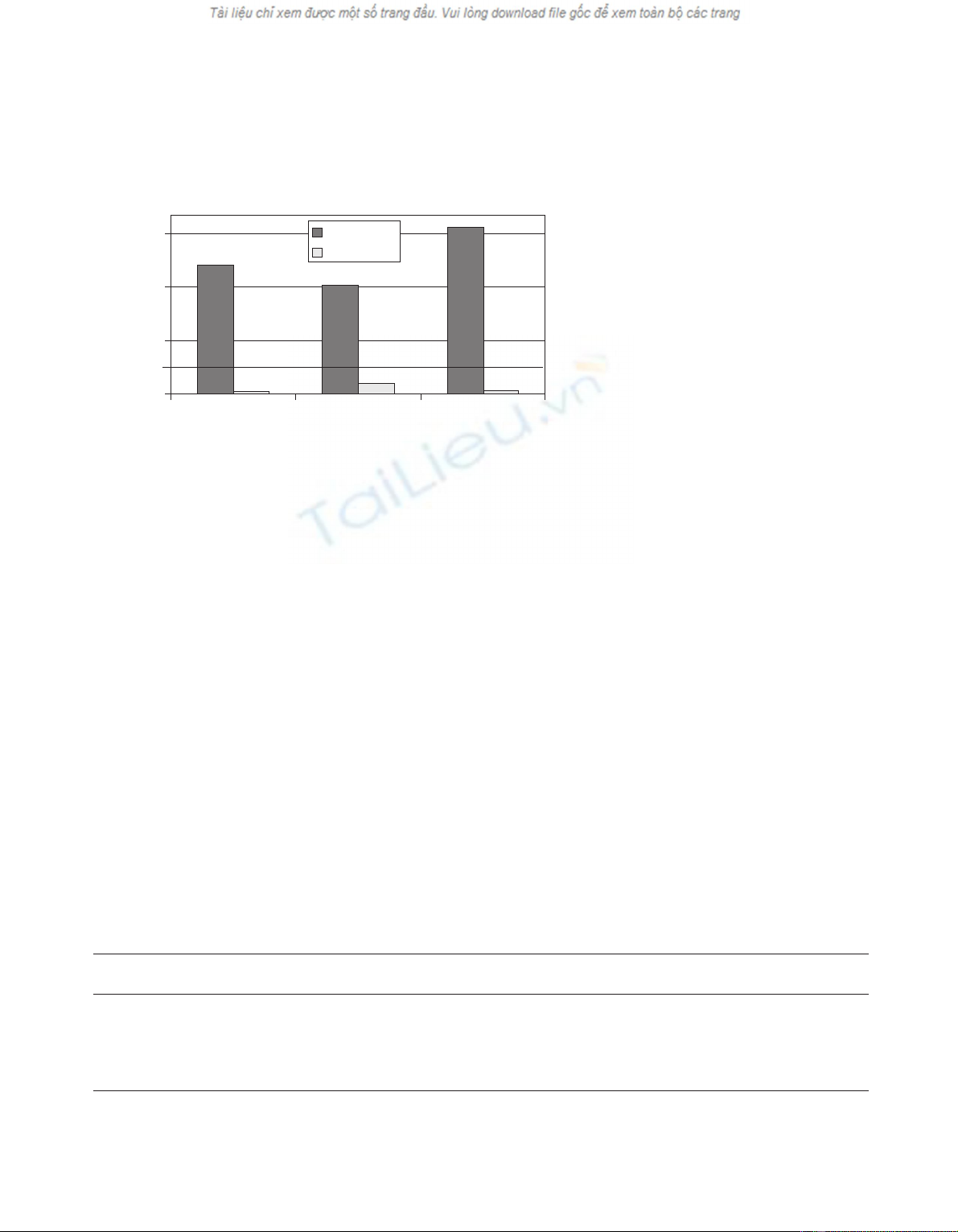
The percent mass loss of the sapwood is different in a
very significant way from heartwood mass loss (see fig-
ure 1): both the near the cambium and near the heartwood
regions of sapwood have a durability index included
among the class 4 and 5 (“slightly durable” and “not du-
rable”); while the heartwood samples had neglectable
percent mass loss with the three fungi, so that it can be
considered as “very durable”.
4.2. Physical and mechanical characteristics
The results of physical and mechanical characterisa-
tion of Atlas cedar wood from Southern Italy are summa-
rised on table IV.Table V refers about physical and
mechanical properties found on the same species by
other authors.
From the physical point of view the most important
points are the following:
The wood density is quite similar to that found by
other Authors on the same species [6, 8, 3] and it seems
quite high, even if the station allowed good increments
and wide growth rings (measured average width was
about 4 mm) [5].
Despite that, measured shrinkages were low; the ratio
Tangential/Radial shrinkage underlines that this wood is
stable and it would allow the opening of very small radial
cracks. Also the shrinkage values are on the same line as
the literature data [3, 4, 5, 8].
From the statistical analysis we can underline the
presence of standard deviation values rather high. This is
due to the presence of anomalous results from one tree,
giving uniformly low shrinkage values (mean volumetric
shrinkage = 8.95%), while the values obtained from each
tree were uniform.
Wood technology of Atlas cedar from Southern Italy 611
Average natural durability indexes
0
0.3
0.6
0.9
Gloeophyllum
trabeum Poria
placenta Coniophora
puteana
Sapwood
Heartwood
0.15
Durability index
Figure 1. Average natural durability indexes of
Atlas cedar heartwood and sapwood to the three
fungal agents. The 0.15 level indicates the limit
value for the class 1.
Table IV. Main average results of the physical and mechanical characterisation (ry= basic density; r12 = density at 12% m.c.; brad = ra-
dial shrinkage; btang = tangential shrinkage; T/R = ratio tangential/radial shrinkages; bvol = volumetric shrinkage; E = bending
MOE; sb= bending MOR; sc= parallel compression strength; t= shear strength).
ry
(g cm–3)r12
(g cm–3)brad
(%) btang
(%) T/R bvol
(%) E
(MPa) sb
(MPa) sc
(MPa) t
(MPa)
Noof specimens 76 76 76 76 76 76 74 66 73 68
Mean 0.44 0.53 4.77 6.35 1.35 11.26 10 101 94 48.8 13.6
Standard deviation 0.03 0.04 0.69 0.84 0.16 1.16 2 439 13 5.2 1.7
Variation Coefficient (%) 6.28 6.80 14.47 13.17 11.94 10.34 24.14 14.03 10.73 12.78