
RESEARC H Open Access
Treatment of symptomatic macromastia in a
breast unit
Fernando Hernanz
1,3*
, Rosa Santos
2
, Arantxa Arruabarrena
1
, José Schneider
2,3
, Manuel Gómez Fleitas
1
Abstract
Background: Patients suffering from symptomatic macromastia are usually underserved, as they have to put up
with very long waiting lists and are usually selected under restrictive criteria. The Oncoplastic Breast Surgery
subspeciality requires a cross-specialty training, which is difficult, in particular, for trainees who have a background
in general surgery, and not easily available. The introduction of reduction mammaplasty into a Breast Cancer Unit
as treatment for symptomatic macromastia could have a synergic effect, making the scarce therapeutic offer at
present available to these patients, who are usually treated in Plastic Departments, somewhat larger, and
accelerating the uptake of oncoplastic training as a whole and, specifically, the oncoplastic breast conserving
procedures based on the reduction mammaplasty techniques such as displacement conservative techniques and
onco-therapeutic mammaplasty. This is a retrospective study analyzing the outcome of reduction mammaplasty for
symptomatic macromastia in our Breast Cancer Unit.
Methods: A cohort study of 56 patients who underwent bilateral reduction mammaplasty at our Breast Unit
between 2005 and 2009 were evaluated; morbidity and patient satisfaction were considered as end points. Data
were collected by reviewing medical records and interviewing patients.
Results: Eight patients (14.28%) presented complications in the early postoperative period, two of them being
reoperated on. The physical symptoms disappeared or significantly improved in 88% of patients and the degree of
satisfaction with the care process and with the overall outcome were really high.
Conclusion: Our experience of the introduction of reduction mammaplasty in our Breast Cancer Unit has given
good results, enabling us to learn the use of different reduction mammaplasty techniques using several pedicles
which made it posssible to perform oncoplastic breast conserving surgery. In our opinion, this management policy
could bring clear advantages both to patients (large-breasted and those with a breast cancer) and surgeons.
Background
Oncoplastic breast surgery (OBS), understood as the
seamless joining of the extirpative and reconstructive
aspects of breast surgery that is performed by a single
surgeon, is an efficient model which requires a new spe-
cialized training [1]. In our opinion, mammaplasty tech-
niques are a very important skill which makes it
possible to perfom a variety of options in the context of
OBS: onco-therapeutic mammaplasty, volume displace-
ment oncoplastic procedures, controlateral symmetry
procedures relative to the opposite breast in breast
reconstruction or surgical correction of cosmetic seque-
lae after breast conserving surgery [2].
We have adopted this model of OBS, comprehensive
breast surgeon who performs oncologic and reconstruc-
tive procedures, and reduction mammaplasty (RM) has
been included in the service catalogue of our Breast
Cancer Unit (BCU) in an attempt to achieve two main
objetives:
a) to increase the offer of treatment to patients with
symptomatic macromastia who are an underserved
population having to put up with a long waiting list and
b) to make the uptake of the new oncoplastic training
easier and quicker because one of the disavantages of
this oncoplastic model is that not only is the training
programme long but also not commonly available.
* Correspondence: cgdhff@humv.es
1
Department of Surgery, University of Cantabria, Hospital “Marqués de
Valdecilla”, Avda Valdecilla s/n, 39008 Santander, Cantabria, Spain
Full list of author information is available at the end of the article
Hernanz et al.World Journal of Surgical Oncology 2010, 8:93
http://www.wjso.com/content/8/1/93 WORLD JOURNAL OF
SURGICAL ONCOLOGY
© 2010 Hernanz et al; licensee BioMed Central Ltd. This is an Open Access article distributed under the terms of the Creative Commons
Attribution License (http://creativecommons.org/licenses/by/2.0), which permits unrestricted use, distribution, and reproduction in
any medium, provided the original work is properly cited.

The aim of this retrospective study is to analyze the
outcome of RM for symptomatic macromastia in our
BCU and comment upon two experiences using differ-
ent types of mammaplasty in the context of OBS.
Methods
A cohort of 56 patients suffering symptomatic macro-
mastia, all of them satisfying at least one of the selection
criteria: distance from the nipple to sternal notch longer
than 33 cm, gigantomastia (the amount of breast tissue
needed to be resected bigger than 1000 g per breast),
specialist recommendation justified in traumatological
or psychological problems, underwent bilateral RM at
our BCU between 2005 and 2009. Demographic and
perioperative data were collected (Table 1). Regardless
of the type of pedicle used to lift the nipple areola com-
plex (NAC) the perioperative management of these
patients consists of certain common measures.
Smokers were strongly urged to give the habit up, and
if they did not do so, they were clearly informed of the
high risk of serious complications before being operated
on. Patients were fully informed, and were required to
sign a specific informed consent form. This form
includes some sketches, information on visible scar loca-
tions, text describing the main complications and where
our general surgery specialty is explicity expressed; there
also appear some photographs showing the average cos-
metic outcome.
A mammogram before breast reduction is not obliga-
tory, the main reason being that the waiting list is so
long that mammograms will be unuseable if they were
to be done at the time the patient is included on the list
and then once surgery is planned there is only a short
time available. Patients aged 50 and over had frequently
had a screening mammogram carried out by the govern-
ment programme for breast cancer detection within the
preceding two years.
All surgical procedures were carried out under general
anesthesia by a breast surgeon (Hernanz, F) and on an
inpatients basis, the hospital stay was very short, one-
two days.
All patients had antibiotic (one preoperative intrave-
nous dose of cephalosporine) and deep venous thrombo-
sis prophylaxis, stocking and chemoprophylaxis being
administered subcutaneously. No tumescent solution
infiltration was used.
We used light suction drainages in all patients, two
per breast, which were placed through the incisions and
fixed with adhesive, so that they could be taken out by
pulling down on them, usually on the second postopera-
tive day, without the dressing bandage having to be
removed or released. Breast incisions were topped with
sterile adhesive plaster in the operating room, and these
were removed in the clinic a week later. A soft bandage
was put on, except for the few cases with NAC free
graft, at the top of which a window was made to moni-
tor NAC viability and to enable patients to carry out a
circular massage every hour during the early postopera-
tive days thus avoiding venous congestion of NAC. In
the first clinic visit, a week after surgery, the bandage
was removed and a nonwired support bra was put on,
this having to be worn until the end of the second
month. Intradermical sutures were taken out at the
third week.
All breast reduction specimens were submitted for
pathological assessment. Three months after surgery a
mammogram was taken to serve as a baseline study
with which to compare further studies.
Morbidity and patient satisfaction were evaluated as
our endpoints.
Data were collected by reviewing medical records, and
then, at least six months after surgery, 47 patients will-
ing to be interviewed were interviewed by one of the
authors (Santos, R). The inteview contains nine ques-
tions which are related with six subject areas: satisfac-
tion with the breast, satisfaction with overall outcome,
Table 1 Patient characteristics and operative data.
Number of Patients 56
Age, years
Mean 42
Range 29-67
Risk Factors, (percentage)
Smoking habit
Yes 9 (16)
No 47 (84)
Co-Morbidity (Diabetes mellitus, arterial hypertension)
Yes 7 (12.5)
No 49 (87.5)
Body-mass index, Kg/m
2
Mean 30.56
Range 21-43.5
N-SN distance, cm
Mean 33.85
Range 26-45
Nipple elevation, cm
Mean 7
Range 7-19
Weight of gland resected per breast, g
Mean 652.50
Range 95-2020
Type of pedicle (percentage)
Superomedial 9 (17)
Inferior 3 (5.3)
Vertical bi-pedicle 41 (73)
Free nipple graft 3 (5.3)
Abreviation: N-SN, nipple-to-sternal notch
Hernanz et al.World Journal of Surgical Oncology 2010, 8:93
http://www.wjso.com/content/8/1/93
Page 2 of 6

psychosocial well-being, sexual well-being, physical well-
being and satisfaction with the care process, these areas
being considered the main issues of concern for breast
surgery [3].
Results
Eight patients (14.2%) presented complications in the
early postoperative period, two of them being reoper-
ated on for evacuation of a hematoma and an abcess.
The remaining complications were: hematoma (3), T-
junction dehiscence (2), necrosis of the skin flaps (1).
None had a total or partial necrosis of NAC. Thirty
patients (64%) of those interviewed presented some
change in nipple sensation, with a reduction of sensa-
tion in 16 (34%) and absence in 7 (14.8%). In the late
postoperative period, four patients were diagnosed via
mammograms as having a focus of fat necrosis and
one epidermic cyst which was extirpated by local
anesthesia. The result of the satisfaction survey is
shown in Table 2.
Discussion
Previous experiences in RM performed by general sur-
geons reported similar outcomes to plastic ones, the
purposes that motivated these practices in the nineties
being to provide surgical care to an underserved popula-
tion and to increase the ‘general surgeon’s’range of
skills [4-6]. These motives are very much in vogue at
the moment, and what is more, they have been strength-
ened by the appearance of OBS.
Although RM has proved to be efficacious in reducing
the symptoms and in improving the quality of life for
patients with macromastia, and despite the effect of RM
being comparable to other unquestionable surgical pro-
cedures such as hip and knee total joint replacement
[7], the fact is that, in the private health sector, this pro-
cedure is only covered by the insurance companies with
very restrictive conditions (most insurance carriers do
not reimburse for this surgery when it involves less than
a specific amount of breast tissue being resected),
whereas, in our public health system, in which the con-
ditions are less rigorous, the waiting lists are very long;
it is clear, then, patients with symptomatic macromastia
are underserved.
Over the last decade OBS has gradually spread all over
the world [1] and has just been considered as the gold
standard for breast conserving surgery[8]; however,
regardless of the oncoplastic model chosen (comprehen-
sive breast surgeon or oncoplastic team), oncoplastic
training is needed. Because of the barriers between spe-
cialities this cross-speciality training is difficult and is
not easily accessible with the exception of the United
Kingdom where an oncoplastic fellowship was created in
2002 [9].
Table 2 Satisfaction survey: data from 47 patients
interviewed (themes and queries)
Satisfaction with breast. Number
Are you satisfied with the breast size?
No 2
only a little 1
fairly 5
quite 20
yes 19
Are you satisfied with the appearance of the scars?
Yes 41
No 6
Considering 1 as very bad and 10 as excellent, how do you
score the overall cosmetic outcome?
1-4 (bad) 3
5-6 (fair) 8
7-8 (good) 11
9-10 (excellent) 25
Satisfaction with overall outcome
Would you recommend it to anybody who is thinking about
it?
Yes 100
No 0
Psychosocial well-being
Have the psychological symptoms which you have been
suffering from disappeared?
No 20
only a little 1
fairly 2
quite a lot 10
yes 14
Sexual well-being
Have your sexual relations improved?
Yes 14
No 33
Physical well-being
Have the physical symptoms which you have been suffering
from disappeared?
No 2
only a little 1
fairly 2
quite a lot 13
yes 29
Satisfaction with the care process
Do you consider that you have received sufficiently complete
preoperative information about the surgical process?
Yes 36
No 11
Are you satisfied with the care provided?
Yes 46
No 1
Hernanz et al.World Journal of Surgical Oncology 2010, 8:93
http://www.wjso.com/content/8/1/93
Page 3 of 6
The introduction of RM in the catalogue of a BCU for
the treatment of patients with symptomatic macromastia
(usually treated in Plastic Departments) could have a
sinergic effect. By treating these patients in a BCU an
underserved population is provided with a larger offer
and the uptake of oncoplastic training, which in the end
means an improvement in the quality of breast cancer
surgery, is facilitated. Patients, whether large-breasted or
with breast cancer, and surgeons both clearly benefit
from this management organization.
We have introduced RM in our BCU with criteria for
inclusion on the waiting list that must be satisfied. Two
of these criteria, which are related with the nipple to
sternal notch distance (> 33 cm) or with the weight of
breast tissue which has to be removed (> 1000 g per
breast), are arbitrary limits that do not take into consid-
eration either a patient’s height or weight or their symp-
toms or the deterioration in quality of life. We are fully
aware that some patients who did not satisfy any of our
selection criteria could clearly benefit from a RM.
36 (64.28%) patients were included in our waiting list
complying the criteria related with the distance from the
nipple to sternal notch being the most frequent criteria.
In 10 patients the amount of breast tissue excised was
equal or bigger than 1000 g but the patients included
for this criteria were 15, the reason for this different it
is that this criteria is an preoperative estimation based
on the surgeon experience and it could be inaccurate;
our experience with mathematical models which calcu-
late this amount using several variables as IMC, distance
from the nipple to the infra-mammary fold, etc, is that
they overestimate it. Other 12 (20%) patients were
included with inform from a specialist (orthopedic,
rheumatologist, physiotherapist) who recommends the
reduction mammaplasty as way to improve a concomi-
tant pathology.
According to our results, the majority of patients were
satisfied with the cosmetic outcome and their final
breast size, only 3 patients considering the cosmetic
results as bad and another 3 patients wishing the sur-
geon had carried out a larger resection. As might well
be expected, the physical symptoms disappeared or sig-
nificantly lessened in 88% of patients because our selec-
tion criteria imply that all selected patients had a
symptomatic macromastia and in 34 of interviewed
patients (72.34%) back pain was the main reason for
being operated on.
Although the degree of satisfaction with the care pro-
cess and with the overall outcome was high we are con-
cerned about data showing that 23% of patients felt that
they had not received appropriate information about the
surgical procedure. In this type of surgery, we consider
that information is an essential part of the overall pro-
cess, so patients must be fully informed about the
surgical procedure and its potential complications,
which could be cause of serious cosmetic sequelae such
as loss of the nipple areola. Taking in account this data
the information process will be improved and we think
itwouldbeagoodideatoarrangeavisittheweek
before the surgery to focus on this point. At the same
time a mammogram could be taken in women of 40 or
over, providing us with a good opportunity to detect
occult carcinomas because mammograms taken within
one year preceding surgery are not an accurate detection
test [10]. We found neither occult carcinomas nor any
significant pathologic findings in the breast tissue
removed, although our series has an average age of 42
years and pathologic findings increase significantly in
patients over 40.
We have used a variety of pedicles with the same inci-
sion pattern (T-inverted), the pedicle chosen depending
on several variables such as projected nipple movement,
risk of serious complications and patient/surgeon prefer-
ences; we have also taken into account the use of differ-
ent technical options thinking wherever possible of their
application in OCS because real versatility is needed to
cope with the different situations that could arise
[11-13].
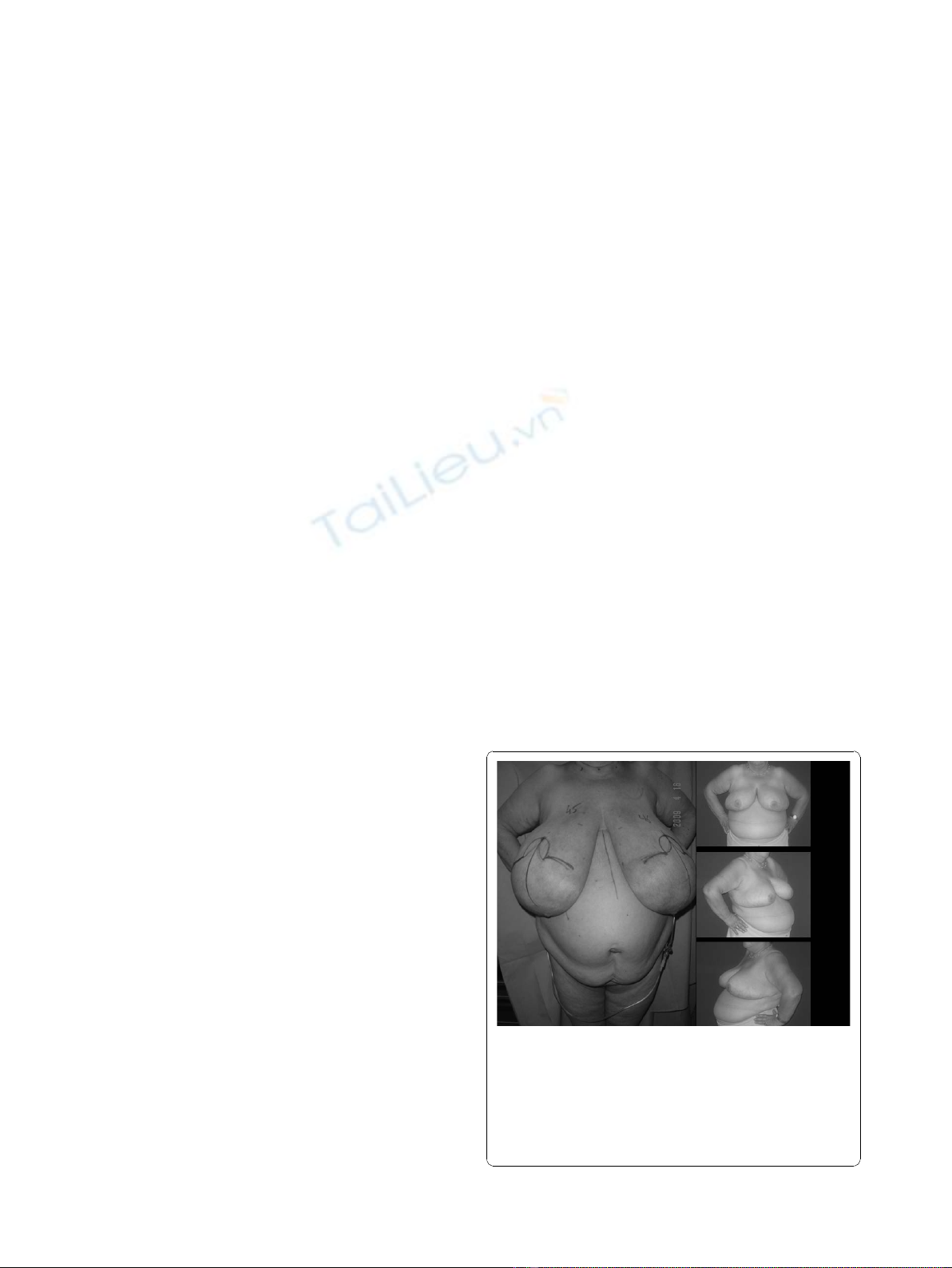
Freenippleareolagrafthasbeenusedinonlythree
patients, who have a high risk of complications (high
Body Mass Index (BMI), comorbidity and big resection
is needed) and they had no interest in nipple sensitivity
or breast feeding preservation (Figure 1). We think that
knowledge and management of this technique is very
Figure 1 Patient with severe symptomatic macromastia. A 67-
year-old woman with gigantomastia, who was treated using an RM
with free nipple areola graft because she had several complication
risk factors such as BMI 39, arterial hipertension, diabetes and
projected movement of the NAC longer than 15 cm and, in
addition, she was not worried about nipple conservation. The
amount of breast tissue resected weighed 3626 g. Appearance
before and five months after breast reduction.
Hernanz et al.World Journal of Surgical Oncology 2010, 8:93
http://www.wjso.com/content/8/1/93
Page 4 of 6
useful in OBS for central quadrant tumors involving the
nipple (Figure 2).
The inferior pedicle is easier and safer and in OBS can
be used in tumors situated in all other quadrants of the
breast [14], but as time passes it is frequently accompa-
nied by pseudoptosis or bottoming.
Although excellent results can be produced with a
variety of procedures the latest patients have been pre-
ferably treated using a superomedial pedicle to transport
NAC and the inferior one used to make an inferior
cone pole to achieve an appropriate breast projection;
the good cosmetic outcomes and the safety and reliabil-
ity for big resections [15,16] are two important reasons
which have led to this technique becoming our first
choice.
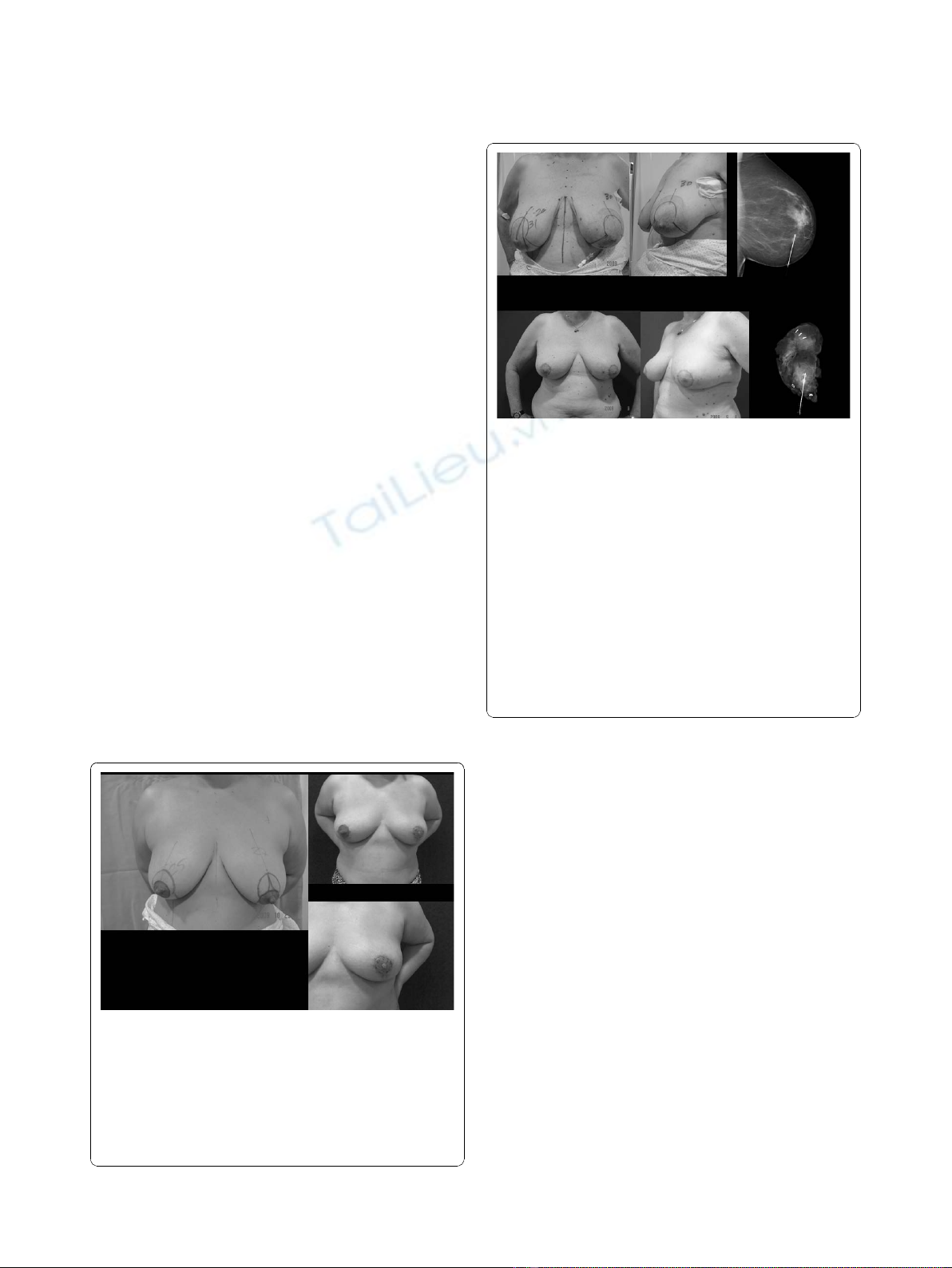
Another reason for this statement is that the supero-
medial pedicle is used in the management of tumors
situated in the upper outer quadrant, the most frequent
location. It can also be used in other tumor locations
such as in the patient shown in Figure 3, who had a
small tumor located in the retro-inferior-areolar area of
a large left breast. By using an onco-therapectic mam-
maplasty (Wise pattern incision with superomedial pedi-
cle for traslating the NAC to an inferior one to improve
the breast projection) the patient enjoyed certain advan-
tages [17]: a wide tumor resection avoiding any cosmetic
sequelae, a reduction in the size of her breasts offering a
medium size left breast to the radiotherapist and reliev-
ing such symptoms as neck pain and, finally, an
improvement in her body-image thanks to the good cos-
metic outcome.
Nevertheless, the possible disadvantages that this man-
agement policy could bring to the BCU should also be
discussed. The main one it is that RM is a time-con-
suming procedure. In this series of patients the average
operating time was 200 minutes but what should be
taken in account is that, to begin with, it takes longer
and the operating time varies much more because it all
depends on surgical skill level [18], so the majority of
cases are performed as an isolated procedure; for that
reason our offer is limited to about 20 patients per year.
This number might be enough to improve oncoplastic
training but it is clearly insufficient for the demand
from large-breasted patients.
Conclusion
Our experience of introducing RM in our BCU has
given good results with low morbidity and a high degree
of patient satisfaction. In our opinion, this synergic
management policy increases the scarce therapeutic
offer available to these patients and has led to a faster
uptake of oncoplastic training, bringing clear advantages
Figure 2 Oncoplastic breast conserving surgery. Central tumor
treated using a mammaplasty technique. A 52-year-old woman
who presented with an invasive ductal carcinoma situated in the
retro-areolar area of the left breast with a complete response after
neoadjuvant chemotherapy was treated by oncoplastic conserving
surgery using an onco-therapeutic mammaplasty (central
cuadrantectomy and reshaping). Below left. Nipple areola complex
reconstructed using a free graft from the skin of the right breast.
Appearance before and one month after surgery.
Figure 3 Oncoplastic breast conserving surgery. Breast cancer
and macromastia treated using a mammaplasty technique.A
58-year-old woman with large breasts who presented with an
invasive small ductal carcinoma of 7 mm. in the inferior retroareolar
area of the left breast diagnosed by screening programme. She was
treated using an onco-therapeutic mammaplasty with a T-inverted
pattern incision and a superomedial pedicle to transpose the NAC
to 6 cm up and the inferior one to increase the inferior pole breast
projection. Above. Preoperative view. We used a wire for tumor
location. Sentinel lymph node biopsy was carried out resulting
negative. On the left side, above, mammogram with a wire inserted
in the tumor. On the left side, below, the x-ray test of the surgical
specimen of a really wide resection weighing 175 g. can be seen.
Below. Appearance at five weeks postoperatively with a good
cosmetic outcome before adjuvant radiotherapy. It can be seen that
there are shoulder bra strap groovings and that the left breast is
intentionally slightly bigger than the right one because the effect of
radiotheraphy would equalize them.
Hernanz et al.World Journal of Surgical Oncology 2010, 8:93
http://www.wjso.com/content/8/1/93
Page 5 of 6