

A Short Proof of the Rook Reciprocity Theorem
Timothy Chow
Dept. of Mathematics, Univ. of Michigan, Ann Arbor, MI 48109, U.S.A.
email: tchow@umich.edu
Submitted: February 12, 1996; Accepted: March 4, 1996.
Abstract. Rook numbers of complementary boards are related by a reciprocity
law. A complicated formula for this law has been known for about fifty years,
but recently Gessel and the present author independently obtained a much more
elegant formula, as a corollary of more general reciprocity theorems. Here, fol-
lowing a suggestion of Goldman, we provide a direct combinatorial proof of this
new formula.
MR primary subject number: 05A19
MR secondary subject numbers: 05A05, 05A15
Aboard Bis a subset of [d]×[d](where[d]isdefinedtobe{1,2,...,d})andtherook
numbers rB
kof a board are the number of subsets of Bof size ksuch that no two elements
have the same first coordinate or the same second coordinate (i.e., the number of ways of
“placing knon-taking rooks on B”). It has long been known [5] that the rook numbers
of a board Bdetermine the rook numbers of the complementary board B(defined to be
([d]×[d])\B) according to the polynomial identity
d
X
k=0
rB
k(d−k)! xk=
d
X
k=0
(−1)krB
k(d−k)! xk(x+1)
d−k.
Recently, a simpler formulation of this identity was found independently by Gessel [2] and
Chow [1]. To state it, we follow [4] in defining
R(B;x)def
=
d
X
k=0
rB
kxd−k,
where xndef
=x(x−1)(x−2) ···(x−n+1). Then we have the following reciprocity theorem.
Theorem. For any board B⊂[d]×[d],
R(B;x)=(−1)dR(B;−x−1).
The existing proofs derive this as a corollary of other reciprocity theorems, but Gold-
man [3] has suggested that a direct combinatorial proof ought to be possible. Indeed, it
1
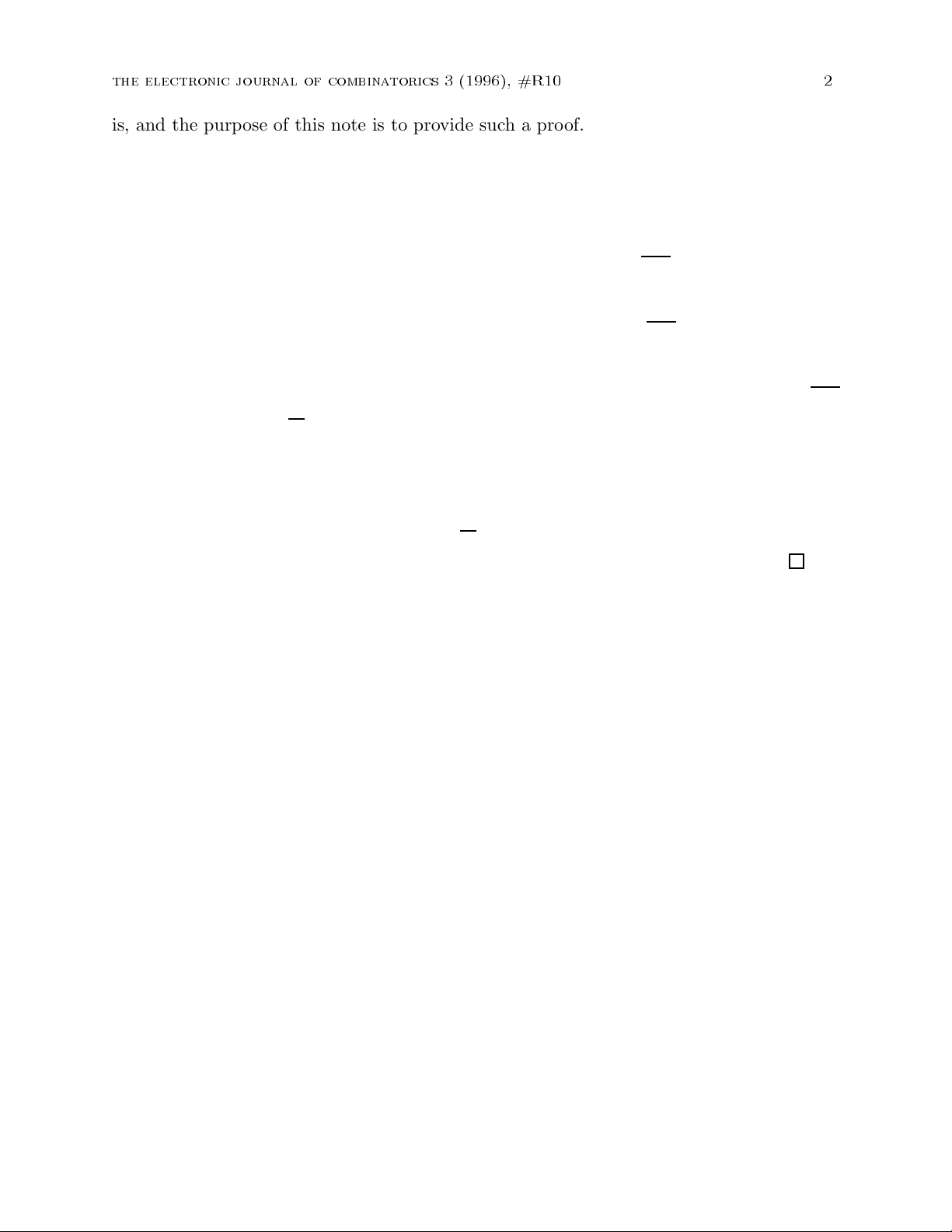
is, and the purpose of this note is to provide such a proof. The knowledgeable reader will
recognize that the main idea is borrowed from [4].
Proof. Observe that
(−1)dR(B;−x−1) = (−1)d
d
X
k=0
rB
k(−x−1)d−k
=
d
X
k=0
(−1)krB
k(x+d−k)d−k.
First assume xis a positive integer. Add xextra rows to [d]×[d]. Then rB
k(x+d−k)d−k
is the number of ways of first placing krooks on Band then placing d−kmore rooks
anywhere (i.e., on B,Bor on the extra rows) such that no two rooks can take each other
in the final configuration. By inclusion-exclusion, we see that the resulting configurations
in which the set Sof rooks on Bis nonempty cancel out of the above sum, because they
are counted once for each subset of S, with alternating signs. Thus what survives is the
set of placements of dnon-taking rooks on the extended board such that no rook lies on B.
But it is clear that this is precisely what R(B;x) enumerates. Therefore the theorem holds
for all positive integers xand since it is a polynomial equation it holds for all x.
Acknowledgments
This work was supported in part by a National Science Foundation Graduate Fellowship
and a National Science Foundation Postdoctoral Fellowship.
References
[1] T. Chow, The path-cycle symmetric function of a digraph, Advances in Math., in
press.
[2] I. M. Gessel, personal communication.
[3] J. R. Goldman, personal communication.
[4] J. R. Goldman, J. T. Joichi, and D. E. White, Rook theory I. Rook equivalence of
Ferrers boards, Proc. Amer. Math. Soc. 52 (1975), 485–492.
[5] J. Riordan, “An Introduction to Combinatorial Analysis,” Wiley, New York, 1958.
2


