Open Access
Available online http://ccforum.com/content/12/4/R85
Page 1 of 7
(page number not for citation purposes)
Vol 12 No 4
Research
Procalcitonin in liver transplantation: are high levels due to
donors or recipients?
Daniel Eyraud1, Saïd Ben Ayed2, Marie Laure Tanguy3, Corinne Vézinet1, Jean Michel Siksik4,
Maguy Bernard2, Sylvia Fratéa1, Marie Movschin1, Jean-Christophe Vaillant4, Pierre Coriat1 and
Laurent Hannoun4
1Département d'Anesthésie-Réanimation, Hôpital Pitié-Salpêtrière 43-47 Boulevard de l'Hôpital, 75013 Paris, France
2Laboratoire de Biochimie, Hôpital Pitié-Salpêtrière 43-47 Boulevard de l'Hôpital, 75013 Paris, France
3Unité de Recherche Clinique, département de Statistiques, Hôpital Pitié-Salpêtrière 43-47 Boulevard de l'Hôpital, 75013 Paris, France
4Service de chirurgie digestive et de transplantation hépatique, Hôpital Pitié-Salpêtrière 43-47 Boulevard de l'Hôpital, 75013 Paris, France
Corresponding author: Daniel Eyraud, daniel.eyraud@psl.aphp.fr
Received: 11 Mar 2008 Revisions requested: 9 Apr 2008 Revisions received: 24 Jun 2008 Accepted: 4 Jul 2008 Published: 4 Jul 2008
Critical Care 2008, 12:R85 (doi:10.1186/cc6942)
This article is online at: http://ccforum.com/content/12/4/R85
© 2008 Eyraud et al.; licensee BioMed Central Ltd.
This is an open access article distributed under the terms of the Creative Commons Attribution License (http://creativecommons.org/licenses/by/2.0),
which permits unrestricted use, distribution, and reproduction in any medium, provided the original work is properly cited.
Abstract
Introduction To date, a specific marker to evaluate and predict
the clinical course or complication of the liver-transplanted
patient is not available in clinical practice. Increased
procalcitonin (PCT) levels have been found in infectious
inflammation; poor organ perfusion and high PCT levels in the
cardiac donor appeared to predict early graft failure. We
evaluated PCT as a predictor of early graft dysfunction and
postoperative complications.
Methods PCT serum concentrations were measured in samples
collected before organ retrieval from 67 consecutive brain-dead
donors and in corresponding recipients from day 0, before liver
transplantation, up to day 7 after liver transplantation. The
following parameters were recorded in donors: amount of
vasopressive drug doses, cardiac arrest history 24 hours before
retrieval, number of days in the intensive care unit, age of donor,
and infection in donor, and the following parameters were
recorded in recipients: cold and warm ischemia time, veno-
venous bypass, transfusion amount during orthotopic liver
transplantation (OLT), and occurrence of postoperative
complication or hepatic dysfunction.
Results In the donor, the preoperative level of PCT was
associated with cardiac arrest and high doses of
catecholamines before organ retrieval. In the recipient, elevated
PCT levels were observed early after OLT, with a peak at day 1
or 2 after OLT, then a decrease until day 7. A postoperative peak
of PCT levels was associated neither with preoperative PCT
levels in the donor or the recipients nor with hepatic post-OLT
dysfunction or other postoperative complications, but with two
donor parameters: infection and cardiac arrest.
Conclusion PCT level in the donor and early PCT peak in the
recipient are not predictive of post-OLT hepatic dysfunction or
other complications. Cardiac arrest and infection in the donor,
but not PCT level in the donor, are associated with high post-
OLT PCT levels in the recipient.
Introduction
Procalcitonin (PCT) is a 116-amino acid precursor protein of
calcitonin and, in 1992, was identified as a new diagnostic
marker for various processes [1-3]. Normally, in healthy individ-
uals, PCT serum concentrations are very low, often even
below the detection limit of the presently used assay. The in
vivo half-life of PCT is approximately 24 to 30 hours [2,4]. Ele-
vated PCT levels are observed early after orthotopic liver trans-
plantation (OLT) [5]. The origin of inflammatory synthesis-
induced PCT has not been clarified yet: neuroendocrine cells
of different organs (lung, intestinium, kidney, pancreas, adrenal
gland, and more recently the liver) have been proposed as a
major source of PCT production [1]. The main stimulus for
PCT induction is probably a systemic challenge of the organ-
ism with bacterial endotoxin (bacterial lipopolysaccharides)
[2]. Because the delay between the induction of PCT
CA = cardiac arrest; CI = confidence interval; CMV = cytomegalovirus; I = infection; OLT = orthotopic liver transplantation; PCT = procalcitonin;
PNF = primary nonfunction.

Critical Care Vol 12 No 4 Eyraud et al.
Page 2 of 7
(page number not for citation purposes)
synthesis and the increase in serum level is short [3,4], the ele-
vated level of PCT just after OLT [5,6] can be due to recipient
causes or donor causes. Moreover, if the liver is a major source
of PCT production, serum levels of PCT could vary could vary
with a given factor, depending on the liver graft. The aim of this
prospective study was, first, to clarify in a large cohort of con-
secutive patients whether PCT in the donor or early in the
recipient could be predictive of hepatic dysfunction or compli-
cations of other causes. Second, we tried to identify parame-
ters associated with an increase in PCT in donors and
recipients.
Materials and methods
After approval by the local ethics committee, all patients admit-
ted for liver transplantation at our institution, Pitié Salpétrière
Hospital (Assistance Publique-Hôpitaux de Paris), between
July 2003 and March 2005 were prospectively included in the
study. The ethical committee waived the need for informed
consent because alicots were taken from routine samples. For
each recipient, the following were recorded: age, gender,
presence of severe portal hypertension, need for veno-venous
bypass, number of blood cell transfusions, and PCT serum
concentration before anhepatic phase and then 12 hours after
reperfusion and daily during the first week after OLT. Postop-
erative clinical course was analyzed from main clinical data:
hepatic dysfunction, pulmonary and renal failure, and overall
complications. For each donor, the following were collected:
full cadaveric, age, occurrence of cardiac arrest (CA) 24 hours
before the retrieval of the organs, occurrence of infection (I),
possibility of retrieving the heart with the liver, amount of cate-
cholamine (epinephrine or norepinephrin) administered before
organ retrieval, and number of days in the intensive care unit
before retrieval. All organs were retrieved and flushed using
the same procedure: Wisconsin solution for preservation and
4% human albumin solution for hepatic flush before graft
reperfusion.
Procalcitonin measurement
Blood samples were obtained for routine testing (biochemical
parameters), and for each patient, serum aliquots were used
for PCT determination. A blood sample from the donor was
obtained after installation of the donor in the operating room.
An investigator blinded to clinical data used a time-resolved
amplified cryptate emission technology on a Kryptor analyser
(Brahms Diagnostica GmbH, Berlin, Germany) to measure
PCT in 100 μL of serum. The analytic sensitivity of the assay
was 0.06 ng/mL and the detection threshold was 0.02 ng/mL;
the normal range detected was from 0.1 to 0.5 ng/mL.
Definitions
Graft dysfunction was defined as the occurrence of at least
one of the following four criteria: the need for retransplantation
(primary nonfunction, PNF), a rise in aminotransferases of
above 2,000 UI/L [7], the need for plasma transfusion for hem-
orrhagic ascites in relation to factor V of less than 30% or poor
discolored bile, and an increase in bilurubinemia without a ret-
rospective need for retransplantation. Death was defined as
death from any cause occurring during the hospital stay. Pul-
monary complication was defined as continuation of mechani-
cal ventilation for more than 48 hours or the need to replace
mechanical ventilation the first week post-OLT. Acute renal
failure was defined as plasma creatinemia of greater than 180
μmol/L and urine output of less than 0.5 mL/hour. Renal com-
plication was defined as the need for dialysis after OLT or
greater than 100% of creatinine levels compared with preop-
erative values. Postoperative complication was defined as
hepatic dysfunction, infection, or pulmonary or renal complica-
tion. Infection was diagnosed if microbiological cultures
obtained from the patients at possible sites of infection were
positive (proven infection) or if clinical signs of infection were
evident. Pneumonia was diagnosed if radiological signs of
pneumonia (infiltration) on chest x-rays and at least one of the
following two criteria was present: leukocytosis of greater than
12,000 × 109/L or less than 4,000 × 109/L or body tempera-
ture of greater than 38°C or less than 36°C. Severe portal
hypertension in recipients was defined as hepatic venous por-
tal gradient of greater than 20 mm Hg if the patient had a pre-
operative hepatic transjugular exploration or a decrease in
portal output of less than 500 mL/minute, estimated with Dop-
pler ultrasonography. Poor tolerance to vascular liver exclusion
was defined as a macroscopic disturbance of bowel colora-
tion or persistence of mean arterial pressure of less than 50
mm Hg and oxygen mixed venous saturation of less than 60%
despite fluid loading.
Clinical protocols
All patients were treated using our standard protocol for immu-
nosuppression: cyclosporine A (trough residual concentration
of 200 to 400 ng/mL at day 7) or FK 507 (trough concentra-
tion of 10 to 15 ng/mL at day 7), prednisolone, starting at 10
mg/kg of body weight on the day of transplantation and
reduced to half doses each day to 0.3 mg/kg at day 7, and
mycophenolate mofetil (1 g per day) from the day of the liver
transplantation. Acute rejection was diagnosed based on clin-
ical and biochemical data and liver biopsy if required. All recip-
ients received broad-spectrum antibiotic treatment with
piperacilline-tazobactam for 7 days and ciprofloxacin for 3
days. Cytomegalovirus (CMV) infection was defined by the
appearance of CMV antigen polymerase chain reaction in the
blood. This measure was performed once a week.
Statistics
Linear regression was used in univariate analysis to identify
predictors of donor or recipient PCT concentrations. Predic-
tors with a P value of less than 0.1 in univariate analysis were
included in a multivariable linear regression model, with a step-
wise variable selection method. Potential associations
between graft dysfunction or overall complications and clinical
or biological parameters were tested with univariate proce-
dures, using Mann-Whitney tests for continuous variables and

Available online http://ccforum.com/content/12/4/R85
Page 3 of 7
(page number not for citation purposes)
chi-square or Fisher exact tests for categorical variables. The
evolution over time of recipient PCT concentration was stud-
ied with an analysis of variance for repeated measurements.
The multiplicity associated with the comparisons between
times was addressed using Scheffe adjustments. The alpha
level was set at 0.05. All analyses were performed with the
SAS software version 8.2 (SAS Institute Inc., Cary, NC, USA).
Results
Sixty-seven patients (19 women and 48 men) were included.
Thirty-eight were transplanted because of postviral hepatitis
cirrhosis, 19 because of alcoholic cirrhosis, and 10 for other
causes. The main characteristics of donors are reported in
Table 1. Infection was confirmed in 4 cases by positive blood-
stream culture (2 Gram-positive and 2 Gram-negative) and in
5 cases by positive bronchoalveolar lavage fluid sample (2
Gram-positive and 3 Gram-negative). In 3 cases, no microor-
ganism was found but the patient was already treated with
antibiotics and the clinical presentation (fever hypoxemia and
hyperleukocytemia with chest radiologic abnormality) was
strongly evocative of pneumonia. The main characteristics of
recipients before OLT are reported in Table 2. None of them
received catecholamines or had severe infection before OLT.
Of the 67 patients, 12 presented hepatic dysfunction after
OLT: 8 with pulmonary complications and 4 with renal compli-
cations (2 patients were dialysed after day 8). No patient pre-
sented PNF. Of the other 55 OLT patients without hepatic
dysfunction, we observed 11 pulmonary complications and 3
renal complications. No patient required post-liver transplanta-
tion catecholamines. In 4 patients, a significant growth of
quantitative cultures of distal bronchoalveolar lavage was
demonstrated (cocci Gram-positive). No patient presented
acute rejection before day 7. Two patients with initial hepatic
dysfunction died at months 2 and 4, without hospital dis-
charge, and one other patient died without initial hepatic
dysfunction.
Procalcitonin in recipients
PCT concentration was normal, less than 0.5 ng/mL, in 61
recipients before OLT (D0). Cause of transplantation did not
influence PCT level in recipients before total hepatectomy:
median 0.1 ng/mL (range 0.1 to 0.8) versus 0.1 ng/mL (range
0.1 to 2) versus 0.2 ng/mL (range 0.1 to 1.1) in cirrhosis from
viral, alcoholic, and other causes, respectively. Peak PCT val-
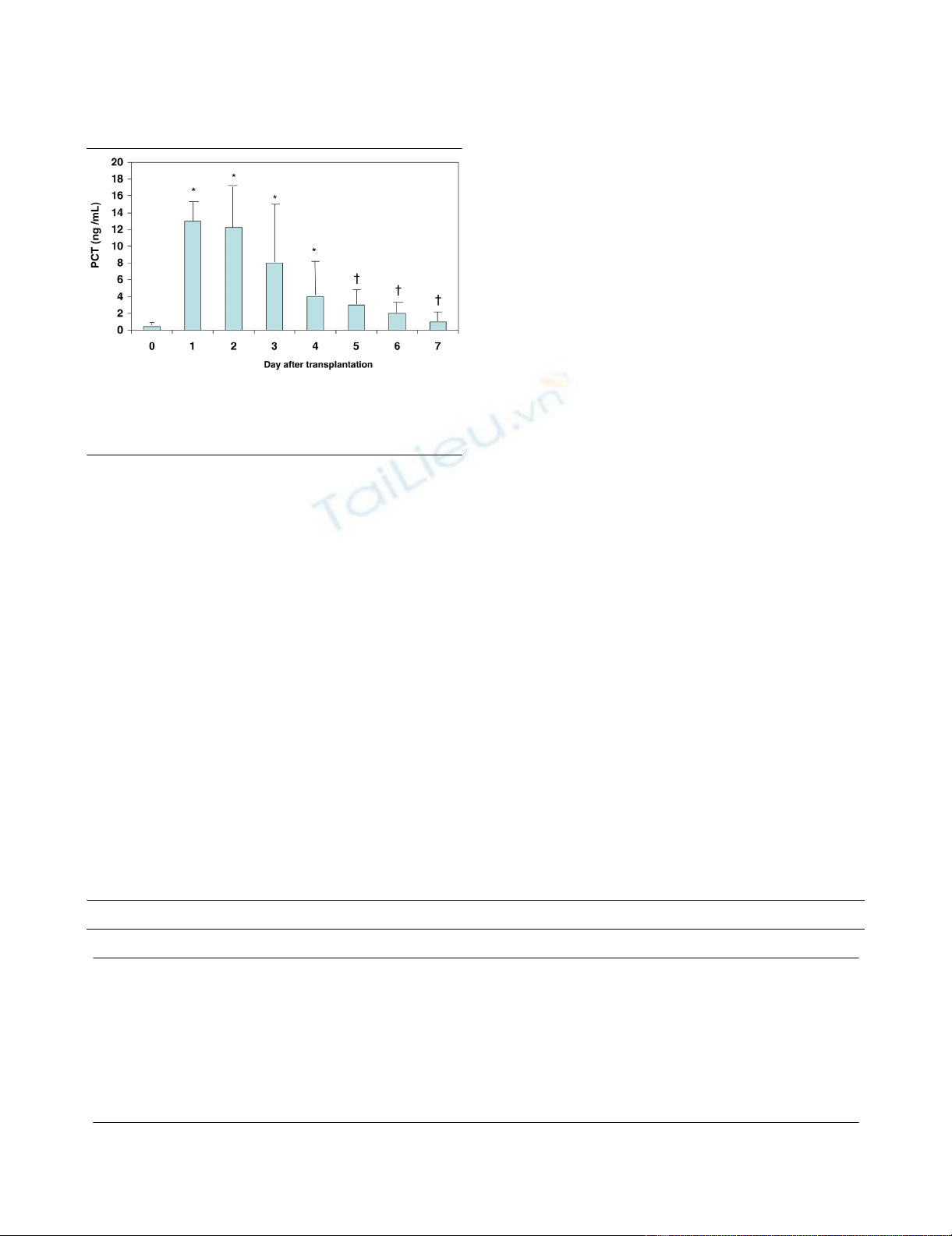
ues were observed at D1 or D2. Then, PCT mean concentra-
tions decreased from D2 to D7. Mean values are reported in
Figure 1. A second increase in PCT was observed at D6 in five
patients whose bacterium was isolated in bronchoalveolar lav-
age (without the need of mechanical ventilation). PCT concen-
tration at D0 did not significantly differ in either type of
recipient (with or without hepatic dysfunction): median 0.1 ng/
mL (range 0.1 to 0.3) versus 0.1 ng/mL (range 0.1 to 3). PCT
peak serum level (D1) was not significantly different in recipi-
ents with hepatic dysfunction versus no hepatic dysfunction:
median 7.8 ng/mL (range 1.1 to 45) versus 7.3 ng/mL (range
0.6 to 85). PCT at D0 or D1 in recipients who would develop
a complication was not different from that in recipients who
would not. Parameters in multivariate analysis significantly
associated with a peak in recipient PCT concentration (D1)
were occurrence of CA in the 24 hours before retrieval in the
donor and presence of infection in the donor (Table 3). The
adjusted mean PCT concentration at D1 was 32.1 ng/mL
(95% confidence interval [CI] 24.1 to 40.1) versus 16.3 ng/
mL (95% CI 11.9 to 20.8) in patients with and without CA in
the donor. The mean adjusted difference between the two
groups was 15.8 ng/mL (95% CI 6.9 to 24.6). The adjusted
mean PCT concentration at D1 was 32.9 ng/mL (95% CI 25.6
to 40.3) versus 15.5 ng/mL (95% CI 10.7 to 20.4) in patients
with and without infection in the donor. The adjusted mean dif-
ference between the two groups was 17.4 ng/mL (95% CI 9.2
to 25.7).
Table 1
Main donor characteristics
Main donor characteristics Number or mean ± standard deviation
Age, years 48 ± 16
Gender, male/female 38/29
Epinephrine or norepinephrine dose, mg/hour 2.4 ± 2.7
Cardiac arrest, yes/no 10/57
General infection, yes/no 12/55
Days in the intensive care unit 3.6 ± 3.5
Heart retrieval, yes/no 36/31
Procalcitonin concentration, ng/mL 4.5 ± 14.6
Acute renal failure 0

Critical Care Vol 12 No 4 Eyraud et al.
Page 4 of 7
(page number not for citation purposes)
Procalcitonin in donor
PCT was normal in 38 donors. Median PCT concentrations
were 0.8 ng/mL (range 0.1 to 8.7) in 49 patients I-/CA-, 16.5
ng/mL (range 0.2 to 91) in 6 patients I-/CA+, 1.8 ng/mL (range
0.7 to 4.7) in 8 patients I+/CA-, and 1.1 ng/mL (range 0.1 to
10.1) in 4 patients I+/CA+. The multivariate analysis did not
show any association between donor PCT concentration and
OLT hepatic dysfunction or overall complications. The param-
eters studied for this analysis were donor age, donor PCT
level, cold ischemia, warm ischemia, operative transfusion,
veno-venous bypass, a high dose of catecholamines in donors,
CA and infection in donors, days in intensive care of donor
before organ retrieval, and age of recipient. Donor age was the
only parameter associated with hepatic dysfunction in univari-
ate analysis (P = 0.03). In this model (adjusted with age), the
median levels of PCT were 6.7 ng/mL (range 0.56 to 85) in
recipients without hepatic dysfunction and 8.7 ng/mL (range
1.13 to 45) in recipients with hepatic dysfunction. Donor
Table 2
Main recipient characteristics
Main recipient characteristics Number or mean ± standard deviation
Age, years 50 ± 11
Cold ischemia, minutes 485 ± 99
Warm ischemia, minutes 56 ± 18
Veno-venous bypass, yes/no 16/51
Very severe portal hypertension, yes/no 39/28
Low tolerance to liver vascular exclusion, yes/no 13/54
Operative transfusion, blood cell packs 6.4 ± 3.7
Alanine aminotransferase peak, UI/L 1,455 ± 1,527
Aspartate aminotransferase peak, UI/L 871 ± 981
Acute renal failure before transplantation 0
Table 3
Multivariate analysis of predictive factors of peak concentration of procalcitonin in recipients
Variable P univariate P multivariate
Age of recipient 0.7 NS
Cold ischemia 0.97 NS
Warm ischemia 0.18 NS
Veno-venous bypass 0.34 NS
Liver vascular exclusion tolerance 0.01 NS
Transfusion of recipient 0.22 NS
Procalcitonin donor concentration 0.005 NS
Pre-liver transplantation procalcitonin concentration 0.37 NS
Severe portal hypertension 0.07 NS
Epinephrine or norepinephrine doses in donor 0.07 NS
Days in intensive care unit of donor 0.03 NS
Age of donor 0.5 NS
Heart retrieval 0.16 NS
Cardiac arrest in donor <0.0001 0.001
Infection in donor <0.0001 0.0039
NS, not significant.
Available online http://ccforum.com/content/12/4/R85
Page 5 of 7
(page number not for citation purposes)
parameters significantly associated in multivariate analysis
with donor concentration of PCT were a dose of epinephrine
or norepinephrin administered before liver retrieval and occur-
rence of CA in the 24 hours prior to retrieval (Table 4).
Discussion
This study could not confirm the hypothesis that the donor
PCT could be predictive of hepatic dysfunction or post-OLT
complications in the recipient. Second, it showed that a peak
in PCT in the recipient was associated with the clinical char-
acteristics of donors but not with recipient characteristics and
post-OLT complications. Third, our study confirmed the time
course of PCT serum concentration in recipients after liver
transplantation [5,6]. Conditions of sampling, timing after graft
flushing, and the technique of the graft flushing were well
standardized as Fazakas and colleagues [8] proposed in order
to avoid any bias in intensity of PCT peak after reperfusion.
Our results were compatible with other studies about the nor-
mal range of serum PCT levels [9-11] in cirrhotic patients with-
out infection.
Liver graft dysfunction and postoperative complications
Our results were not in agreement with those of Fazakas and
colleagues [12], who found higher PCT peak levels in patients
with postoperative complications. Precise assessment of the
liver donor is essential because this is an important prognostic
factor for outcome after OLT [13]. The decision to accept a
donor liver is based on many variables, such as medical his-
tory, hemodynamic parameters, vasopressive support, labora-
tory parameters, liver echography, and (in selected cases) liver
biopsy. The visual inspection is a subjective parameter to rule
out major liver diseases such as cirrhosis or major steatosis. In
contrast with heart transplantation, when elevated donor PCT
did indicate early graft failure [14,15], we did not confirm these
results, even after adjusted analysis. Postoperative hepatic
dysfunction and complications are multifactorial processes
that are probably too complex to be predicted by a sample
marker such as donor PCT level or early post-OLT PCT level.
Procalcitonin and infection
Our study did not find any association in donors between PCT
concentration and infection, which is in contrast to the current
concept [4]. To assess the diagnosis of infection, fever or
white blood cell count is the most-used parameter, however
unspecific it may be. Brain death, the associated adrenergic
storm, and subsequent physiopathological changes make the
diagnosis of infection difficult. Many multiple-organ donors
require fluid resuscitation with plasma expanders and vaso-
pressor therapy. The difficulty of assessing infection in donors
and the lack of sepsis severity in some cases could explain the
absence of an increase in PCT in donors in our study. Indeed,
a few years ago, PCT was identified as a marker of inflamma-
tory host responses which is particularly induced in severe
bacterial infections and sepsis [3]. Not infection per se but
infection associated with a severe systemic response or poor
organ perfusion is thought to induce PCT release [16]. In the
present study, PCT levels were elevated only in a minority of
donors and no difference was found in donors with infection
or not. An explanation could be that infection was not so
severe as to induce PCT production in the donor. Maybe infec-
tion, even not severe infection, could induce modification in
Figure 1
Time course of procalcitonine (PCT) in the recipient before liver trans-plantation and during the first week after liver transplantationTime course of procalcitonine (PCT) in the recipient before liver trans-
plantation and during the first week after liver transplantation. Results
are expressed as mean ± standard deviation. *P < 0.05 (versus D0), †P
< 0.05 (versus D1).
Table 4
Multivariate analysis of predictive factors of peak concentration of procalcitonin in donors
Variable P univariate P multivariate
Days in intensive care unit of donor 0.52
Age of donor 0.5
Heart retrieval 0.16
Infection in donor 0.75
Cardiac arrest in donor 0.0001 0.003
Epinephrine or norepinephrine doses in donor 0.002 0.046