RESEARCH Open Access
Evaluation of a blocking ELISA for the detection
of antibodies against Lawsonia intracellularis in
pig sera
Magdalena Jacobson
1*
, Per Wallgren
1,2
, Ann Nordengrahn
3
, Malik Merza
3
and Ulf Emanuelson
1
Abstract
Background: Lawsonia intracellularis is a common cause of chronic diarrhoea and poor performance in young
growing pigs. Diagnosis of this obligate intracellular bacterium is based on the demonstration of the microbe or
microbial DNA in tissue specimens or faecal samples, or the demonstration of L. intracellularis-specific antibodies in
sera. The aim of the present study was to evaluate a blocking ELISA in the detection of serum antibodies to
L. intracellularis, by comparison to the previously widely used immunofluorescent antibody test (IFAT).
Methods: Sera were collected from 176 pigs aged 8-12 weeks originating from 24 herds with or without problems
with diarrhoea and poor performance in young growing pigs. Sera were analyzed by the blocking ELISA and by
IFAT. Bayesian modelling techniques were used to account for the absence of a gold standard test and the results
of the blocking ELISA was modelled against the IFAT test with a “2 dependent tests, 2 populations, no gold
standard”model.
Results: At the finally selected cut-off value of percent inhibition (PI) 35, the diagnostic sensitivity of the blocking
ELISA was 72% and the diagnostic specificity was 93%. The positive predictive value was 0.82 and the negative
predictive value was 0.89, at the observed prevalence of 33.5%.
Conclusion: The sensitivity and specificity as evaluated by Bayesian statistic techniques differed from that
previously reported. Properties of diagnostic tests may well vary between countries, laboratories and among
populations of animals. In the absence of a true gold standard, the importance of validating new methods by
appropriate statistical methods and with respect to the target population must be emphasized.
Background
Lawsonia intracellularis is a common cause of chronic
diarrhoea and poor performance in young growing pigs
[1,2]. In some herds, the disease may also be manifested
as severe haemorrhagic diarrhoea with high mortality
rates [3]. Cultivation of this obligate intracellular bacter-
ium is difficult and the diagnosis is therefore based on
demonstration of the microbe or microbial DNA in tis-
sue specimens or faecal samples by techniques such as
PCR [4]. Further, the development of specific antibodies
to L. intracellularis are monitored by serology and used,
for instance, in the screening of herd prevalence and
herd profiling.
Several serological methods have been described. The
first method commercially available was an immuno-
fluorescent antibody test, IFAT [5], with a stated sensi-
tivity of 91% and specificity of 97% (Elanco Animal
Health Indianapolis, Indiana, USA). This widely used
method is based on the incubation of sera with semi-
purified L. intracellularis antigen, and the results are
visualised following incubation with anti-porcine fluor-
escein isothiocyanate conjugate. More recently a princi-
pally similar method, the immunoperoxidase monolayer
assay (IPMA), has been developed [6]. The latter
method is however only commercially available to a lim-
ited extent.
Furthermore, several enzyme-linked immunosorbent
assays have been described. Such methods include
* Correspondence: Magdalena.Jacobson@kv.slu.se
1
Department of Clinical Sciences, Faculty of Veterinary Medicine and Animal
Husbandry, Swedish University of Agricultural Sciences, 750 07 Uppsala,
Sweden
Full list of author information is available at the end of the article
Jacobson et al.Acta Veterinaria Scandinavica 2011, 53:23
http://www.actavetscand.com/content/53/1/23
© 2011 Jacobson et al; licensee BioMed Central Ltd. This is an Open Access article distributed under the terms of the Creative
Commons Attribution License (http://creativecommons.org/licenses/by/2.0), which permits unrestricted use, distribution, and
reproduction in any medium, provided the original work is properly cited.

indirect ELISAs employing whole-cell antigens [7,8],
DOC -extracted antigens [9], or targeting L. intracellu-
laris-specific antigenic epitopes such as LPS [10], LsaA
[11], or the FliC protein [12]. The stated sensitivities
vary from 67 to 99.5% and the specificities from 93 to
100%. None of these methods are however available for
the use in other laboratories. A blocking ELISA for the
detection of antibodies to L. intracellularis has been
developed and is commercially available [13]. To ensure
a high specificity, the blocking ELISA is a direct sand-
wich ELISA that is based on monoclonal antibody-
coated wells for capture of cell-cultured antigen and
utilizes peroxidase-conjugated monoclonal antibodies as
competitive antibodies. Several studies on prevalence
and epidemiology of L. intracellularis have been per-
formed employing this ELISA but the results have only
been presented in conference proceedings. The method
is reported to have a sensitivity of 96.5% and specificity
of 98.7% with less than 10% coefficient of variation [13].
However, properties of diagnostic tests may well vary
among populations of animals [14]. Therefore, they should
always be validated in the target population and not solely
in experimental animals [15], which is most commonly
done. There is currently no scientific publication available
on the evaluation of the blocking ELISA. Estimating the
diagnostic sensitivity and specificity requires that a true
gold standard is available. However, although the IFAT
has been frequently used as a reference test, it cannot be
considered to be a gold standard test. Still, validation is
possible even without a true gold standard, but it require
that appropriate statistical methods should be used to cor-
rect the estimates of sensitivity and specificity of the new
test with respect to the imperfect reference test [15].
The aim of the present study was to evaluate the
blocking ELISA in the detection of serum antibodies to
L. intracellularis, by comparison to the previously widely
used IFAT. Bayesian modelling techniques were used to
account for the absence of a gold standard test. In addi-
tion, the current infection status of the animals was also
estimated by other techniques.
Methods
The study was approved by the Ethical Committee for
Animal Experiments, Uppsala, Sweden.
Herds and animals
Altogether, 176 pigs from 24 herds were included. Sera
had been collected during two previous studies, A [1]
and B [16], and were stored at -80°C. The pigs were 8-12
weeks old and had not been treated with antibiotics dur-
ing the last two weeks prior to sampling. In study A, 54
pigs from nine poor-performance herds with diarrhoea
among growing pigs and 12 pigs from four herds with a
good performance and no problems with diarrhoea were
included. In study B, sera were obtained from eleven
herds that were selected on the basis of an ongoing pro-
blem with diarrhoea among growing pigs. From each
herd, ten pigs that were suffering from diarrhoea and
poor performance were selected (in total 110 pigs).
Sampling and analysis
Theoretically, the number of samples required validating
an assay at 0.95 confidence levels with a 2% error allowed
and an estimated diagnostic sensitivity (DSn) of 0.965
should be 324, and the number of samples required to
obtain an estimated diagnostic specificity (DSp) of 0.987
should be 123. With a 3% error allowed, the number of
samples would be 144 and 55, respectively [17].
In study A, the pigs were transported to the labora-
tory, stunned and exsanguinated, and a blood sample
was collected. At necropsy, individual samples were
analysed for the presence of Lawsonia intracellularis,
Brachyspira spp, Campylobacter spp, Clostridium per-
fringens,Escherichia coli, Salmonella spp, Yersinia spp,
parasites and rotavirus [1]. In study B, individual blood
and rectal faecal samples were collected at the herd visit
for analysis of serum antibodies to L. intracellularis and
for L. intracellularis DNA by nested PCR, respectively
[16].
Sera were analysed by the blocking ELISA (Product
No. 461379, German registration number FLI-B 390,
bioScreen European Veterinary Disease Management
Center GmbH, D-481 49 Münster, Germany). Positive
and negative control sera were supplied by the manufac-
turer. Test sera were added in duplicate, incubated for
one hour at 37°C, washed three times and incubated
with horseradish peroxidase-conjugated anti-Lawsonia
intracellularis monoclonal antibody for one hour at
37°C. Following washing, substrate were added, incu-
bated for 10 minutes at room temperature, stop solution
was added and the resulting OD value was read within
15minutesat450nm.AsitisablockingELISA,a
negative result would thus have a high absorbance
value.Theabsorbancevalueswerethenconvertedto
the calculated percent inhibition (PI) by the formula
OD negative control −OD test sample/positive control
OD ne
g
ative control ×100
.
Sera were also prepared by the IleiTest and analysed
according to the manufacturer’s instructions (Elanco
Animal Health, Indianapolis, Indiana, USA). The slides
were read in a fluorescencemicroscopeat470nmin
100 × magnification (FL-filter, Zeiss/Axioskop 20, C.
Zeiss Svenska AB, Stockholm, Sweden) and all samples
were independently examined by three persons and
judged as positive or negative with respect to the pre-
sence of antibodies to L. intracellularis by comparison
to the positive and negative controls included.
Jacobson et al.Acta Veterinaria Scandinavica 2011, 53:23
http://www.actavetscand.com/content/53/1/23
Page 2 of 6

Statistical analysis
The estimation of the diagnostic sensitivity and specifi-
city of the blocking ELISA was performed in WinBUGS
version 1.4 [18] using Bayesian techniques as described
by Branscum et al. The results of the blocking ELISA
was modelled against the IFAT test with a “2 dependent
tests, 2 populations, no gold standard”model [19]. Win-
BUGS version 1.4 code for models based on conditional
dependence among pair of tests is available from http://
www.epi.ucdavis.edu/diagnostictests. This method does
not employ a gold standard but requires results from
two tests in two populations that differ in the prevalence
of the disease. In this analysis, animals in study A and
study B were considered as the two populations.
The method also requires prior information about
some of the unknown parameters, e.g. sensitivity and
specificity of the tests. Such prior information is often
specified either from published papers or expert’sbest
guess and the uncertainty is modelled through the use
of beta distributions [20]. The prior mode (most prob-
able) value for the sensitivity of the ELISA was consid-
ered to be 0.96, and the 5th percentile 0.75, with a
corresponding transformed distribution beta(a, b) of
beta(13.44, 1.52). The specificity mode prior for the
ELISA was 0.98, the 5th percentile 0.75, with beta(11.74,
1.22). Corresponding values for the sensitivity of the
IFAT were 0.85, 0.30 and beta(2.86, 1.33), and for the
specificity 0.95, 0.30 and beta(2.59, 1.08), i.e.ratherdif-
fuse distributions [21]. The beta prior distributions for
the prevalence in the two populations were also diffuse
and equal for the two populations with a mode of 0.60,
a 5th percentile of 0.30 and beta(4.84, 3.56). The beta
prior distributions for the conditional probabilities (lDc
and gDc) were the same as for the sensitivity and speci-
ficity, respectively, of the IFAT. These prior distributions
were selected based on prior experiences gained from
diagnostic work. The construction of prior distributions
was done by the use of the Betabuster public domain
software http://www.epi.ucdavis.edu/diagnostictests.
Estimates of sensitivity and specificity for the ELISA
was first determined at PI-values ranging from 10 to 80
(by increments of 2), with results plotted in a two-graph
receiver operating characteristic curve. Subsequently,
estimates at PI-values 25 and 35 were also determined.
All models were run with 100,000 iterations, where the
initial 10,000 iterations were considered as burn-in and
discarded from the evaluation.
Results
Herds and animals
In study A, L. intracellularis DNA was demonstrated by
PCR in 29 of 54 animals from the poor performance
herds. By IFAT, 47 sera from these pigs were judged as
positive, while 37 and 34 sera were positive by the
ELISA using cut-off levels of PI 30 and 35, respectively.
L. intracellularis was not demonstrated in any of the
pigs (n = 12) from the good performance herds, and by
the ELISA, PI was <21 in all pigs, whereas three pigs
were positive by IFAT. In study B, L. intracellularis
DNA was demonstrated in 24 of 110 animals from 5
herds. According to the IFAT, 20 animals from 4 herds
were seropositive. By employing a cut-off value of PI 30
in the ELISA, 46 animals from 9 herds were seroposi-
tive.UsingacutofvalueofPI35,25animalsfrom5
herds were seropositive (Table 1).
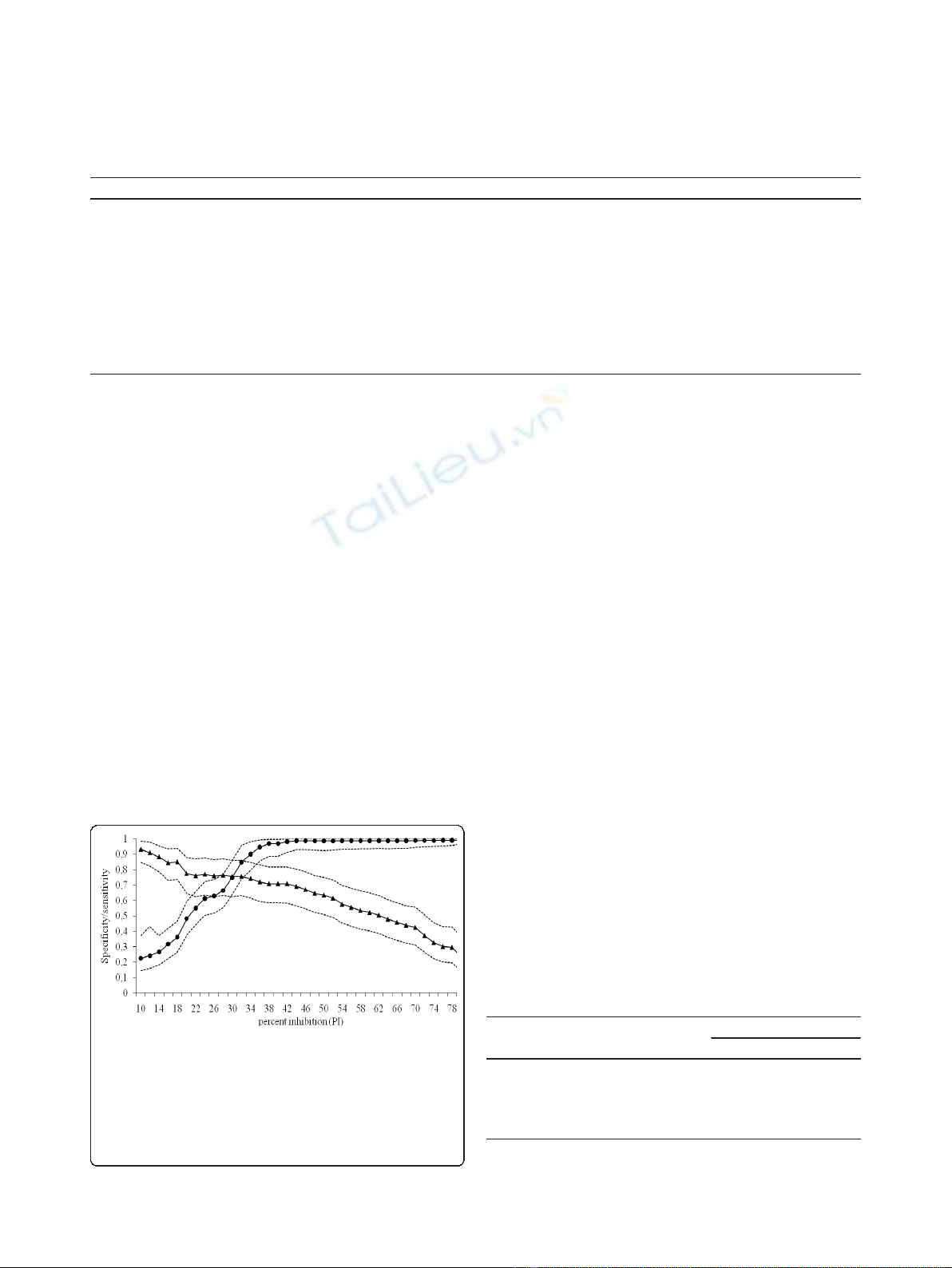
Statistical analysis
The two-graph receiver operating characteristics curve,
with cut-off values for the ELISA test ranging from 10
to 80, is presented in Figure 1. The intersection of the
lines corresponds to the cut-off value for the ELISA test
recommended by the manufacturer, i.e. PI 30. The med-
ian of the posterior estimates of the sensitivity and spe-
cificity of the ELISA test was 0.76 and 0.62, respectively,
at a cut-off of PI 25 with the 95% probability intervals
0.63 - 0.87 and 0.51 - 0.73, respectively. Employing a
cut-off value of PI 30, the estimated sensitivity and
specificity was 0.75, with 95% probability intervals 0.63 -
0.86 and 0.64 - 0.86, respectively, and employing a cut-
off value of PI 35, the estimated sensitivity was 0.72 and
the specificity was 0.93, with 95% probability intervals
0.59 - 0.83 and 0.83 - 0.99, respectively. The median of
the posterior estimate for the sensitivity of the IFAT
was 88% and the specificity was 95%. The estimates
were very stable irrespective of the cut-off used for the
ELISA test.
Using PI 30 as cut-off, the IFAT and the blocking
ELISA had an observed agreement of 70%. Using PI 35
as cut-off, the agreement was 80% (Table 2). The posi-
tive predictive value, i.e. the probability of disease given
a positive test result, would be 0.82 at a cut-off of PI 35
(sensitivity 0.72, specificity 0.93) and an estimated preva-
lence of 30%. The corresponding negative predictive
value would be 0.89.
Discussion
To assess the performance of a new method, the diag-
nostic sensitivity (DSn) and specificity (DSp) should be
determined in reference samples with known history
and infection status [8,9,22]. However, these samples
may not reflect the actual population for which the
methods are intended and thus, the accuracy of the test
might vary. In the present study, Dsn and Dsp of the
ELISA applied to samples obtained from the target
population differed from the previously established
values. To cope with the problem of having an imperfect
gold standard, Bayesian estimation was applied as
recommended by OIE. The Bayesian estimation is a
Jacobson et al.Acta Veterinaria Scandinavica 2011, 53:23
http://www.actavetscand.com/content/53/1/23
Page 3 of 6
latent class model that does not assume the previously
used method to be the best method (i.e.usedasgold
standard) and the known sensitivity and specificity of
the reference test are not a prerequisite.
To further illustrate the importance of evaluating the
method in the target population with a “natural”distri-
bution of positive and negative animals, reference sam-
ples from two populations with known disease status
(animals that were confirmed to be infected with
L. intracellularis by PCR on faecal samples and animals
from a high health herd where L. intracellularis had not
been demonstrated) were analysed by both methods and
compared by a 2 × 2 table using the IFAT as gold stan-
dard. This resulted in 100% specificity and sensitivity for
both methods employed (data not shown).
Several cross-sectional studies on the serological pre-
valence of L. intracellularis in Europe and Asia have
been conducted using the blocking ELISA but very few
studies have attempted to validate the method. Keller
et al. (2006) reported a good reproducibility between
different laboratories. Further, in comparison to IFAT,
the ELISA provided a higher sensitivity and more unam-
biguous results. By comparison to an in-house IFA,
the DSn and DSp were estimated to 92 and 98%, respec-
tively [23]. However, these results have only been
presented in conference proceedings. In previous valida-
tions of the IFAT, the DSn varied from 58 to 90% and
the DSp from 92 to 100% [5,21,24].
The results partly reflect the difficulties to clinically
assess the stage of infection. Based on previous results,
>40% of the pigs aged 9 to 15 weeks with clinical signs
indicative of proliferative enteropathy were expected to
shed the microbe in faeces [25,26]. Experimentally, pigs
developed diarrhoea 7-14 days post inoculation in a
dose-dependent manner [27], and circulating L. intracel-
lularis-specific antibodies was first detected 2 weeks after
challenge [28]. The purpose of study A was to determine
the primary cause of diarrhoea in growing pigs and there-
fore, pigs were sampled immediately at the commence-
ment of clinical signs. Hence, only a few pigs were
expected to have seroconverted. However, most pigs
turned out to be seropositive and slowly progressing
infections will probably remain subclinical for some time
Table 1 Positive results obtained by analysis of faeces and sera from 176 pigs in 24 herds collected during two
previous studies, A and B, and analysed by nested PCR and by two serological methods, ELISA and IFAT
PCR ELISA (PI > 30)* ELISA (PI > 35)* IFAT
Study A. Pigs from poor performance herds
No of positive animals (%) 29 (44) 37 (56) 34 (52) 47 (71)
No of positive herds (%) 8 (89) 9 (100) 9 (100) 9 (100)
Study A. Pigs from good performance herds
No of positive animals (%) 0 0 0 3 (25)
No of positive herds (%) 0 0 0 3 (75)
Study B. Pigs with diarrhoea and poor performance
No of positive animals (%) 24 (22) 46 (42) 25 (23) 20 (18)
No of positive herds (%) 5 (45) 9 (82) 5 (45) 4 (36)
*In the blocking ELISA, two cut-off values (PI 30 and PI 35, respectively) were evaluated.
Figure 1 The two-graph receiver operating characteristics curve,
with cut-off values for the blocking ELISA test given as percent
inhibition (PI) and ranging from PI 10 to 80 (by increments of 2).
Sensitivity (black triangle) and specificity (black dot) for the ELISA
were estimated by the use Bayesian modelling techniques. The
intersection of the lines corresponds to the cut-off value for the ELISA
test recommended by the manufacturer, PI 30. The 95% probability
intervals are given by the dotted lines.
Table 2 The number of positive (+) and negative (-)
results in the analysis of antibodies to L. intracellularis in
176 sera obtained from growing pigs with or without
diarrhoea and analysed by two different methods, an
immunofluorescent antibody test, IFAT, and a blocking
ELISA
IFAT
+-
ELISA (PI >30)* + 49 34
-18 75
ELISA (PI >35)* + 45 14
-22 95
*In the blocking ELISA, two cut-off values (PI 30 and PI 35, respectively) were
evaluated.
Jacobson et al.Acta Veterinaria Scandinavica 2011, 53:23
http://www.actavetscand.com/content/53/1/23
Page 4 of 6

before being detected [29]. Study B targeted growing pigs
with diarrhoea, irrespective of the commencement of
clinical signs and therefore, most pigs were expected to
have seroconverted [16]. Furthermore, some animals will
not seroconvert in response to infection [3,26].
Several other methods are reported to have a good
performance with high DSn and DSp [8,9,22]. However,
these methods use various gold standards and target
populations and the results given in previous papers are
therefore not possible to use for comparison. Further,
they are presently not commercially available. Hence,
sera must be submitted to these particular laboratories
and factors such as geographical variation and local var-
iations in infectious load may not be accounted for.
Only the two methods employed in the present study
are commercially available and may be adapted to var-
ious laboratories. The IFAT have been widely used, but
the method is laborious and time-consuming, and dis-
crepancies in interpretation of the results between var-
ious laboratories have been reported [30].
On the other hand, several studies report a high pre-
valence (90-100%) of seropositive finisher pigs close to
slaughter (25-27 weeks of age), despite that shedding of
L. intracellularis or chronic intestinal lesions are rarely
reported [9,21]. This may be caused by booster infec-
tions [9], but since shedding in growing pigs may occur
at short intervals [21,26], and circulating antibodies may
be detected for 5 weeks only [3,21], the consistently
high levels of antibody found in older pigs remains to
be clarified. The blocking ELISA is based on monoclonal
antibodies for capture and blocking to ensure a defined
analytic sensitivity and specificity and, assumingly, an
increased diagnostic specificity. However, if antibodies
are formed towards other antigens with similar antigenic
epitopes, unspecific or crossreactivity reactions may
occur [24]. This was however not investigated in the
present study.
In conclusion, the diagnostic sensitivity of the block-
ing ELISA was 72% and the diagnostic specificity was
93%, as evaluated by Bayesian statistic techniques. This
technique allows the validation of a diagnostic method
also without a true gold standard. The positive predic-
tive value was 0.82 and the negative predictive value was
0.89, when the analysis was applied on samples from
growing pigs in the age of 8-12 weeks. The sensitivity
and specificity demonstrated in the present study dif-
fered from that previously reported and the importance
of validating new methods with respect to the target
population was emphasised.
Acknowledgements
This study was financed by grants from the Swedish Farmer’s Foundation for
Agricultural Research. We also want to thank Maria Persson for skilful
technical assistance.
Author details
1
Department of Clinical Sciences, Faculty of Veterinary Medicine and Animal
Husbandry, Swedish University of Agricultural Sciences, 750 07 Uppsala,
Sweden.
2
National Veterinary Institute, 751 89 Uppsala, Sweden.
3
Svanova
Biotech, 751 45 Uppsala, Sweden.
Authors’contributions
MJ, PW, AN and MM participated in the design of the study. MJ were
responsible for the coordination of the work, for collecting the samples, for
the PCR analyses and drafted the manuscript. PW were responsible for the
serological analyses. UE were responsible for the statistical analyses and
drafted this part of the manuscript. All the authors red and approved the
manuscript.
Competing interests
The authors declare that they have no competing interests.
Received: 24 June 2010 Accepted: 1 April 2011 Published: 1 April 2011
References
1. Jacobson M, Hård af Segerstad C, Gunnarsson A, Fellström C, de Verdier
Klingenberg K, Wallgren P, Jensen-Waern M: Diarrhoea in the growing pig
- a comparison of clinical, morphological and microbial findings
between animals from good and poor performance herds. Res Vet Sci
2003, 74:163-169.
2. Stege H, Jensen TK, Möller K, Vestergaard K, Baekbo P, Jorsal SE: Infection
dynamics of Lawsonia intracellularis in pig herds. Vet Microbiol 2004,
104:197-206.
3. Guedes RMC, Gebhart CJ, Armbruster GA, Roggow BD: Serologic follow-up
of a repopulated swine herd after an outbreak of proliferative
hemorrhagic enteropathy. Can J Vet Res 2002, 66:258-263.
4. Jacobson M, Aspan A, Heldtander Königsson M, Hård af Segerstad C,
Wallgren P, Fellström C, Jensen-Waern M, Gunnarsson A: Routine
diagnostics of Lawsonia intracellularis performed by PCR, serological and
post mortem examination, with special emphasis on sample preparation
methods for PCR. Vet Microbiol 2004, 102(3-4):189-201.
5. Knittel JP, Jordan DM, Schwartz K, Janke BH, Roof MB, McOrist S, Harris DL:
Evaluation of antemortem polymerase chain reaction and serologic
methods for detection of Lawsonia intracellularis-exposed pigs. Am J Vet
Res 1998, 59(6):722-726.
6. Guedes RMC, Gebhart CJ, Winkelman N, Mackie-Nuss RA: A comparative
study of an indirect fluorescent antibody test and an immunoperoxidase
monolayer assay for the diagnosis of porcine proliferative enteropathy.
J Vet Diagn Invest 2002, 14:420-423.
7. Holyoake PK, Cutler RS, Caple IW, Monckton RP: Enzyme-linked
immunosorbent assay for measuring ileal symbiont intracellularis-
specific immunoglobulin G response in sera of pigs. J Clin Microbiol 1994,
32(8):1980-1985.
8. Wattanaphansak S, Asawakarn T, Gebhart C, Deen J: Development and
validation of an enzyme-linked immunosorbent assay for the diagnosis
of porcine proliferative enteropathy. J Vet Diagn Invest 2008,
20(2):170-177.
9. Boesen HT, Jensen TK, Möller K, Nielsen LH, Jungersen G: Evaluation
of a novel enzyme-linked immunosorbent assay for serological
diagnosis of porcine proliferative enteropathy. Vet Microbiol 2005,
109:105-112.
10. Kroll JJ, Eichmeyer MA, Schaeffer ML, McOrist S, Harris DL, Roof MB:
Lipopolysaccharide-based enzyme-linked immunosorbent assay for
experimental use in detection of antibodies to Lawsonia intracellularis in
pigs. Clin Diagn Lab Immunol 2005, 12(6):693-699.
11. Watarai M, Yamoto Y, Horiuchi N, Kim S, Omata Y, Shirahata T, Furuoka H:
Enzyme-linked immunosorbent assay to detect Lawsonia intracellularis in
rabbits with proliferative enteropathy. J Vet Med Sci 2004, 66(6):735-737.
12. Wattanaphansak S: Development and validation of an enzyme-linked
immunosorbent assay for the diagnosis of porcine proliferative
enteropathy. Proceedings of the 19th International Pig Veterinary Society
Congress: 2006; Copenhagen, Denmark 2006, 193.
13. Keller C, Schoeder H, Ohlinger VF: A new blocking ELISA kit for the
detection of antibodies specific to Lawsonia intracellularis in porcine
blood samples. the 4th International Veterinary Vaccines and Diagnostics
Conference Oslo, Norway; 2006.
Jacobson et al.Acta Veterinaria Scandinavica 2011, 53:23
http://www.actavetscand.com/content/53/1/23
Page 5 of 6