Comparative
growth
analysis
of
five
first
year
establishment
poplar
clones
(Populus
sp.)
grown
under
a
short-rotation
intensive
culture
system
F.
Mau
I. Impens
Laboratory
of
Planty
Ecology,
Department
of
Biology,
University
of
Antwerp,
Universiteitsplein
1,
2610
Wilrijk,
Belgium
Introduction
Interest
in
fast
growing
poplar
clones
for
maximum
production
in
short-rotation
intensive
culture
is
obvious.
Clones
from
Aigeiros
and
Tacamahaca
sections
are
well
suited
for
short-rotation
intensive
cul-
ture
because
of
their
rapid
juvenile
growth.
’Fast
starter’
clones
are
most
suited
for
a
1-3
yr
old
coppice
stand
rotation
ac-
cording
to
Zsuffa
(1979).
Superior
hybrid
growth
was
indicated
as
a
factor
respon-
sible
for
the
good
performance
of
hybrid
poplar
in
comparison
with
mere
species
clones
(Cain
and
Ormrod,
1984).
Materials
and
Methods
Five
poplar
clones:
P.
x euramericana
cv.
Robusta;
P.
trichocarpa
cv.
Fritzi
Pauley;
P.
tri-
chocarpa
cv.
Columbia
River;
P.
trichocarpa
x
P.
deltoides
cv.
Beaupr6;
P.
trichocarpa
x
P.
deltoides
cv.
Raspalie;
were
grown
from
cut-
tings
planted
in
a
0.80
x
0.80
m
pattern
at
Afsnee
(51 °02’N,
3°39’E;
Belgium)
in
1987.
The
trees
were
well
irrigated,
fertilized
and
the
plots
kept
free
of
weeds.
Primary
parameters,
such
as
basal
diameter
and
height,
were
measured
every
2
wk
for
each
plot
consisting
of
81
trees.
Height
was
mea-
sured
to
an
accuracy
of
0.5
cm
by
means
of
a
measuring
rod
and
diameter
was
determined
on
each
stem
with
a
vernier
caliper
22
cm
above
ground
level.
Other
parameters,
such
as
num-
bers
of
leaves,
height
of
leaf
implantation
and
leaf
orientation,
were
monitored
on
8
model
trees
of
each
clone.
Leaf
development,
leaf
demography
and
leaf
area
distribution
were
stu-
died
in
relation
to
aboveground
leaf
and
wood
biomass
productions.
Leaf
area
was
calculated
from
allometric
relations
between
leaf
area
and
leaf
dimensions.
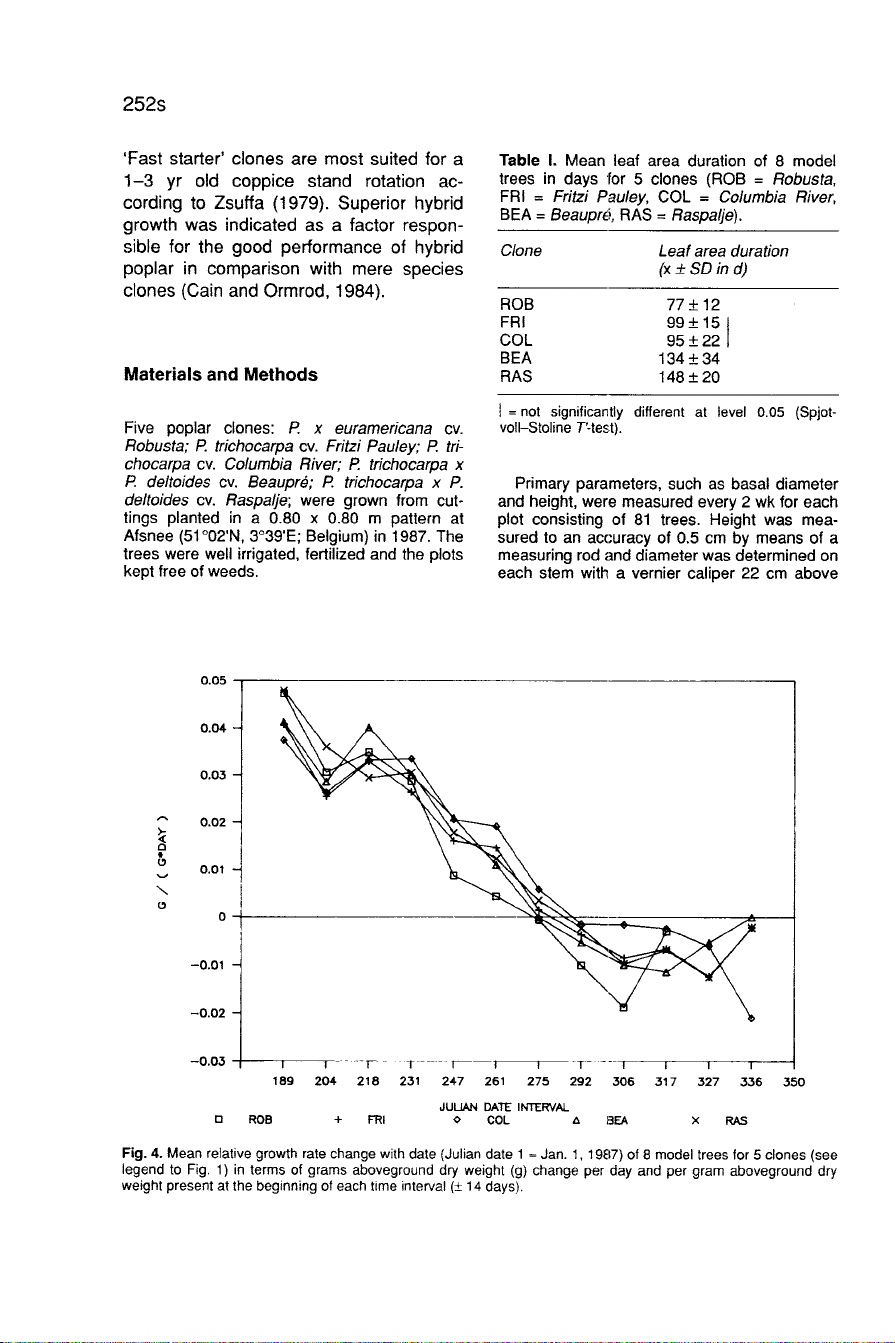
Seasonal
growth
was
also
analyzed
in
terms
of
relative
growth
rate
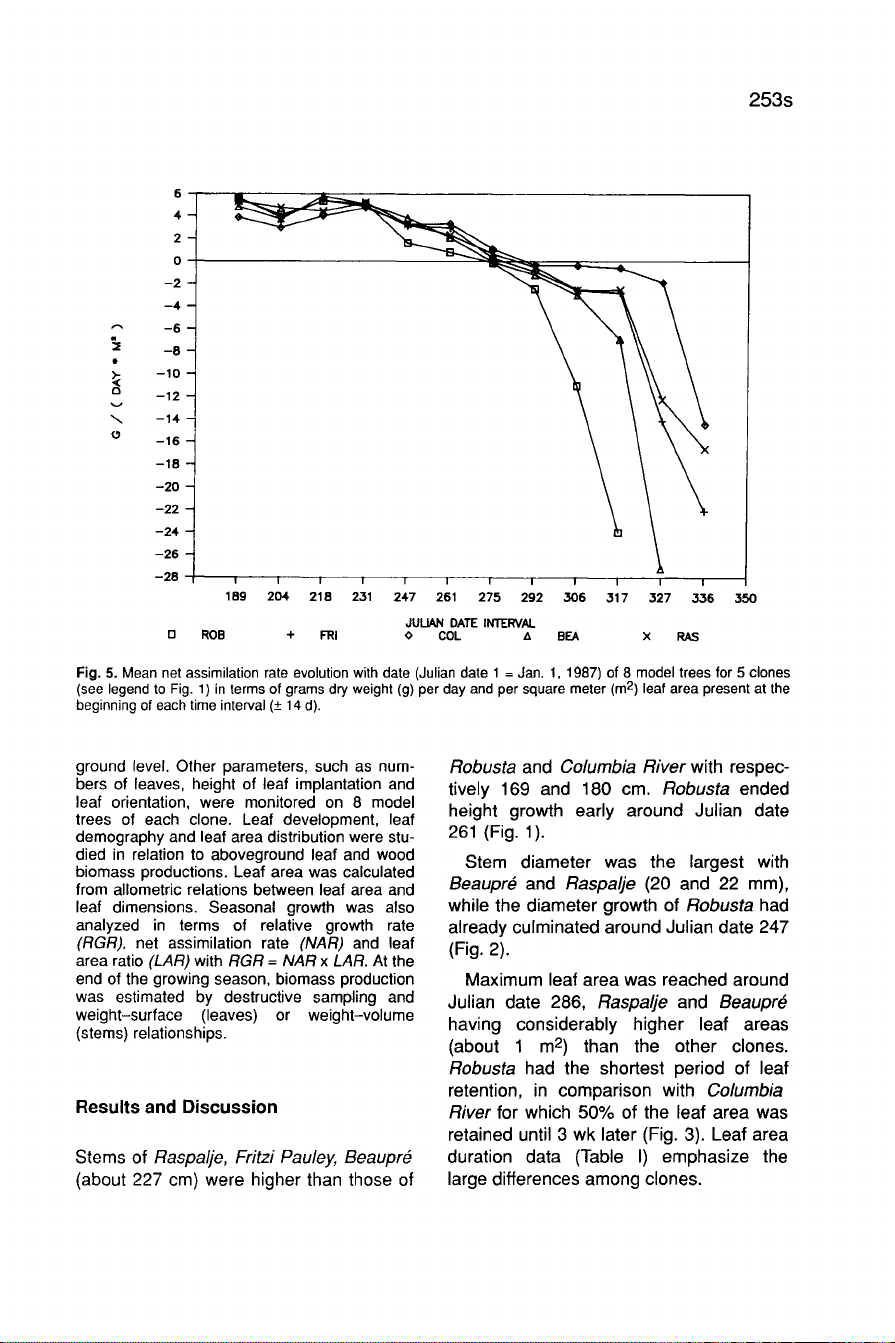
(RGR),
net
assimilation
rate
(NAR)
and
leaf
area
ratio
(LAR)
with
RGR
=
NAR
x
LAR.
At
the
end
of
the
growing
season,
biomass
production
was
estimated
by
destructive
sampling
and
weight-surface
(leaves)
or
weight-volume
(stems)
relationships.
Results
and
Discussion
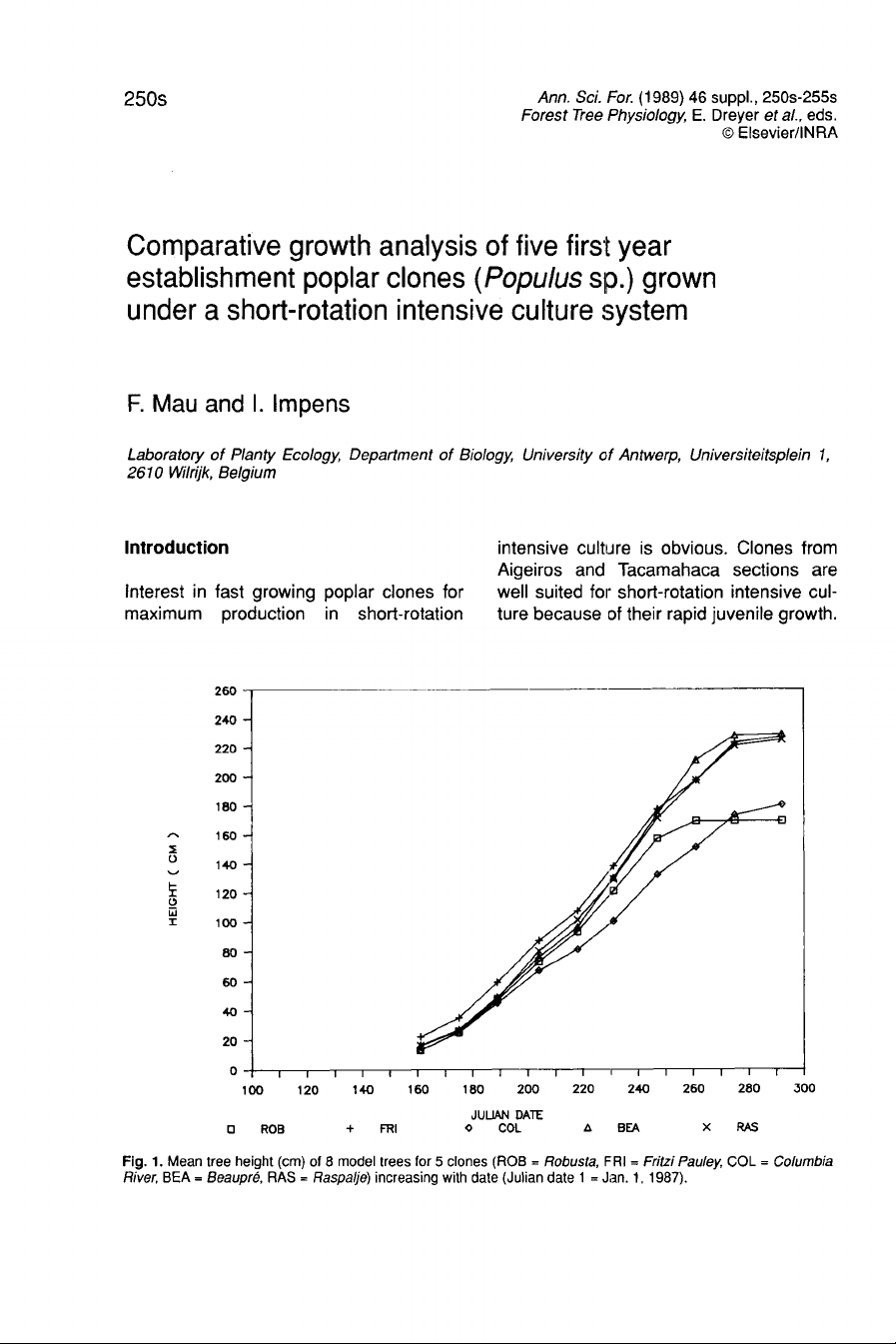
Stems
of
Raspalje,
Fritzi
Pauley,
Beaupré
(about
227
cm)
were
higher
than
those
of
Robusta
and
Columbia
River
with
respec-
tively
169
and
180
cm.
Robusta
ended
height
growth
early
around
Julian
date
261
(Fig.1).
).
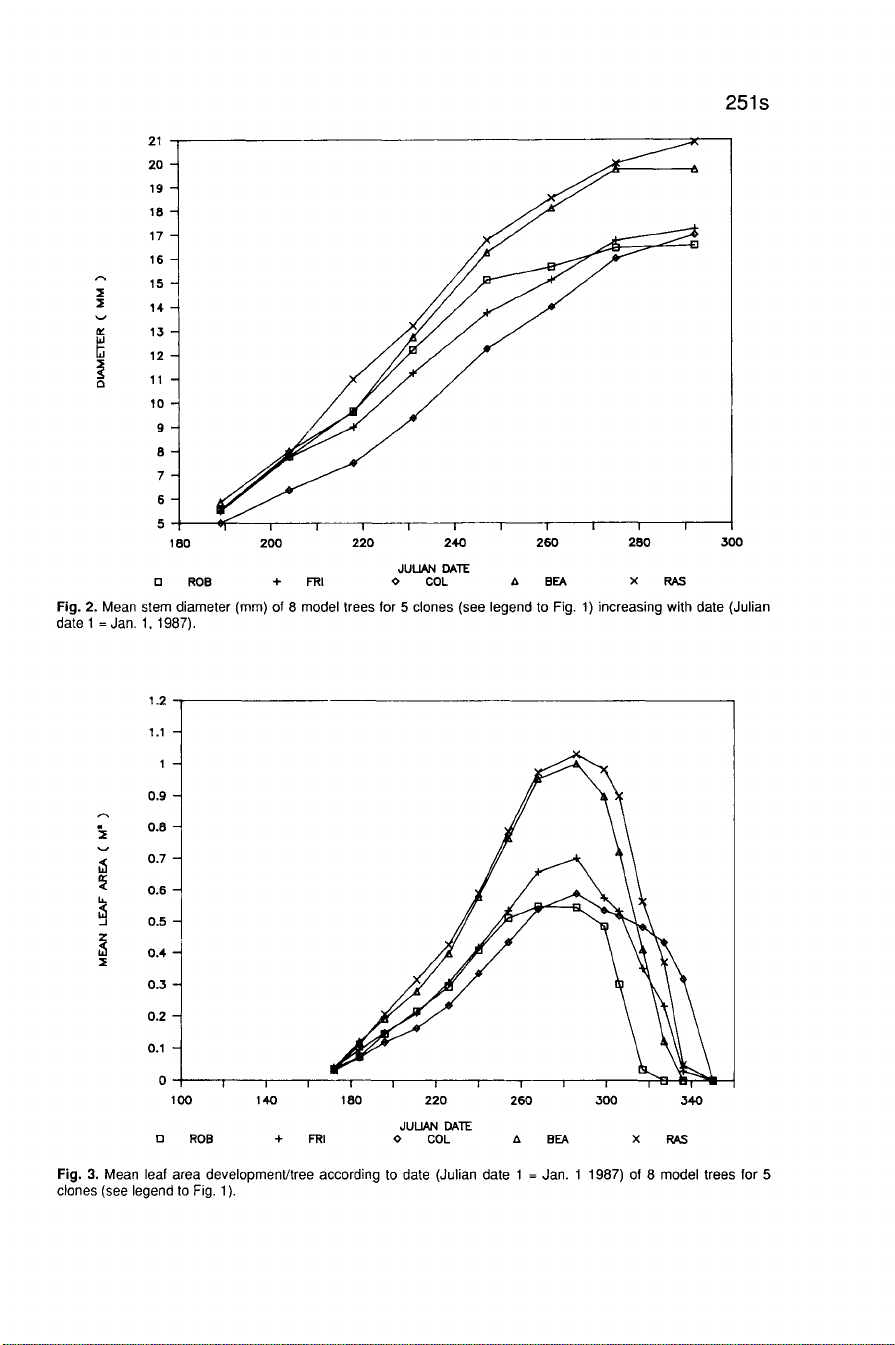
Stem
diameter
was
the
largest
with
Beaupré
and
Raspalje
(20
and
22
mm),
while
the
diameter
growth
of
Robusta
had
already
culminated
around
Julian
date
247
(Fig.
2).
Maximum
leaf
area
was
reached
around
Julian
date
286,
Raspalje
and
Beaupré
having
considerably
higher
leaf
areas
(about
1
m2)
than
the
other
clones.
Robusta
had
the
shortest
period
of
leaf
retention,
in
comparison
with
Columbia
River
for
which
50%
of
the
leaf
area
was
retained
until
3
wk
later
(Fig.
3).
Leaf
area
duration
data
(Table
I)
emphasize
the
large
differences
among
clones.