Genome Biology 2004, 5:243
comment reviews reports deposited research interactions information
refereed research
Minireview
Global nucleosome distribution and the regulation of transcription
in yeast
Sevinc Ercan*†, Michael J Carrozza* and Jerry L Workman*
Addresses: *Stowers Institute for Medical Research, 1,000 East 50th Street, Kansas City, MO 64110, USA. †Department of Biochemistry and
Molecular Biology, The Pennsylvania State University, University Park, PA 16802, USA.
Correspondence: Jerry L Workman. E-mail: JLW@Stowers-Institute.org
Abstract
Recent studies show that active regulatory regions of the yeast genome have a lower density of
nucleosomes than other regions, and that there is an inverse correlation between nucleosome
density and the transcription rate of a gene. This may be the result of transcription factors
displacing nucleosomes.
Published: 30 September 2004
Genome Biology 2004, 5:243
The electronic version of this article is the complete one and can be
found online at http://genomebiology.com/2004/5/10/243
© 2004 BioMed Central Ltd
It has been known for nearly three decades that there is a
relationship between the chromatin structure of a gene and
its transcriptional status. This relationship was first identi-
fied when nuclease-hypersensitive sites were observed to
appear at the 5⬘end of genes upon activation of transcription
[1,2]. Later, the transcription-dependent changes in the
chromatin of a gene came to be understood better through
examination of the chromatin structures of individual genes
- such as PHO5, GAL1 and GAL10 - under active and inactive
conditions [3-7]. These studies found that the nucleosomes -
the basic repeating units of chromatin, each consisting of a
histone octamer encircled by about 146 base-pairs of DNA -
are modified, unfolded or lost at the promoters of genes
upon activation of transcription. It remains unclear,
however, whether such remodeling or loss of nucleosomes is
a general feature of eukaryotic gene regulation. Recently,
two papers have analyzed the nucleosome distribution
throughout the yeast genome. The authors of the new
studies [8,9] propose that the genome-wide distribution of
nucleosomes is heterogeneous and that this pattern may be
involved in, or result from, the regulation of gene expression.
Nucleosomes are depleted from regulatory
regions of the yeast genome
A recent study by Lee et al. [8] analyzes nucleosome distribu-
tion over the entire yeast genome, and another by Bernstein
et al. [8] investigates nucleosome occupancy specifically at
yeast promoters [9]. Both groups used a combination of
chromatin immunoprecipitation and microarray analysis:
after cross-linking proteins to DNA, different sets of anti-
bodies were used to immunoprecipitate histones from yeast
cell extracts, thereby enriching for DNA that is bound to his-
tones. Lee et al. [8] performed comparative hybridization of
the enriched DNA and total genomic DNA on microarrays in
order to determine the relative histone occupancy at the
entire genome, whereas Bernstein et al. [9] used the same
approach with only intergenic DNA in order to determine
histone occupancy in intergenic regions. Although it should
be kept in mind that the degree of histone cross-linking may
not always accurately reflect the presence or absence of his-
tones, these studies do make a compelling argument for dif-
ferences in nucleosome density across the genome.
One of the recent studies [8] found that the distribution of
histones is heterogeneous over the genome, such that inter-
genic regions appear to have a sparser distribution of nucle-
osomes than the open reading frames (ORFs). Furthermore,
the regulatory regions, such as promoters, have even fewer
nucleosomes than other intergenic regions. Importantly,
there is an inverse correlation between nucleosome occu-
pancy at a promoter region and the transcription rate of the
gene downstream of the promoter: the upstream regions of
active genes have a lower density of nucleosomes than those

of less-transcribed genes. Interestingly, the transcription
rate also affects nucleosome occupancy within the ORFs.
ORFs that are transcribed at rates of more than about 30
mRNAs per hour have a lower density of nucleosomes than
ORFs overall. This is an important observation because it
suggests not only that nucleosomes are transiently dissoci-
ated from DNA during the elongation phase of transcription
but also that they are not fully replaced within at the coding
regions of heavily transcribed genes after each RNA poly-
merase passes along [10-12].
The heterogeneous distribution of nucleosomes over the
genome is consistent with an earlier study showing that one
can physically fractionate regions transcribed by RNA poly-
merase II from other regions in the genome [13]. This frac-
tionation is done by cross-linking chromatin to DNA in vivo
and then separating the aqueous phase from the organic
phase in phenol:chloroform extractions. Free DNA segregates
into the aqueous phase and DNA bound to proteins remain s
in the organic phase. This results in differential segregation of
intergenic regions of the genome into the aqueous phase.
Nagy et al. [13] proposed that this may be a result of different
efficiency of chromatin cross-linking along the genome and
that these differences in efficiency might be mediated
through differentially modified histone tails. The heteroge-
neous distribution of nucleosomes suggests, however, that
the regulatory regions are simply depleted of nucleosomes,
and other proteins bound at these regions may not cross-link
to DNA as efficiently as histones. In either case, the physical
fractionation of yeast chromatin suggests that the chromatin
is organized differently between coding and noncoding
regions of the genome, and the heterogeneous distribution of
nucleosomes may be part of this organization.
Nucleosome occupancy at the promoters of
individual genes is inversely proportional to
their transcription rate
In order to understand further the relationship between
nucleosome occupancy and the transcriptional status of a
gene, Lee et al. [8] analyzed nucleosome occupancy over the
entire genome after heat shock, a treatment that changes the
transcription profile of the yeast genome considerably.
When yeast cells are growing rapidly at an optimal tempera-
ture, some of the most active genes are those encoding ribo-
somal proteins, and these genes are also most repressed
upon heat shock. Both studies [8,9] observed that the pro-
moters of ribosomal protein genes are the most depleted of
nucleosomes when cells are rapidly growing. When the cells
are heat shocked, these genes are rapidly repressed and their
nucleosome occupancy increases [8]. This suggests that
nucleosome occupancy is either the cause or the result of the
transcriptional status of a gene.
This raises an important question: what are the determi-
nants of nucleosome occupancy, and how do they relate to
transcription? An attractive answer to this question might be
that transcription factors replace nucleosomes at the pro-
moters. One transcription factor that is known to target the
promoters of ribosomal protein genes is Rap1p [14]. An
unbiased search for sequence motifs at the promoters that
are most depleted of nucleosomes during rapid growth also
identified Rap1p-binding sites in ribosomal protein promot-
ers [9]. What role, then, does Rap1p play in nucleosome
occupancy after heat shock? It was previously shown that
Rap1p can move or displace nucleosomes at the promoters of
ribosomal protein genes [15], so one prediction is that the
loss of nucleosomes may be a result of Rap1p binding at the
promoters. This idea is supported by the results of an experi-
ment showing that when the Rap1p-binding site is deleted at
a number of ribosomal protein promoters, nucleosome occu-
pancy increases at these promoters [9]. In contrast, after
heat shock, although nucleosome occupancy at the promot-
ers increases, Rap1p remains bound [8]. This observation is
consistent with the result of another experiment: when the
transcription of ribosomal proteins is repressed by
rapamycin treatment and nucleosomes return to their pro-
moters, Rap1p remains bound [9]. Together, these observa-
tions suggest that Rap1p binding alone is insufficient to keep
nucleosomes off promoters, and it probably requires addi-
tional cofactors and/or chromatin-remodeling factors.
The determinants of global nucleosome
distribution
Although the determinants of global nucleosome distribu-
tion are not known, transcription factors and the cofactors
they recruit to the regulatory regions of the genes are strong
candidates. Recent studies show that the relationship
between transcription-factor binding and nucleosome occu-
pancy is not simple. One reason for this complexity may be
the presence of more than one binding site for transcription
factors in a promoter region, such that a number of tran-
scription activators and repressors will bind to their sites
and influence the nucleosome occupancy of that region.
Moreover, remodeling and displacement of nucleosomes
often requires protein complexes to be targeted to promoters
by specific transcription factors [16]. How these numerous
proteins interact with the promoters and how transcriptional
activators act synergistically has been an area of intense
investigation. Although the promoter of each gene is unique,
the possibility of a general rule that nucleosomes are dis-
placed upon gene activation remains attractive. More impor-
tantly, the general depletion of nucleosomes from regulatory
regions might be a fundamental property of genome organi-
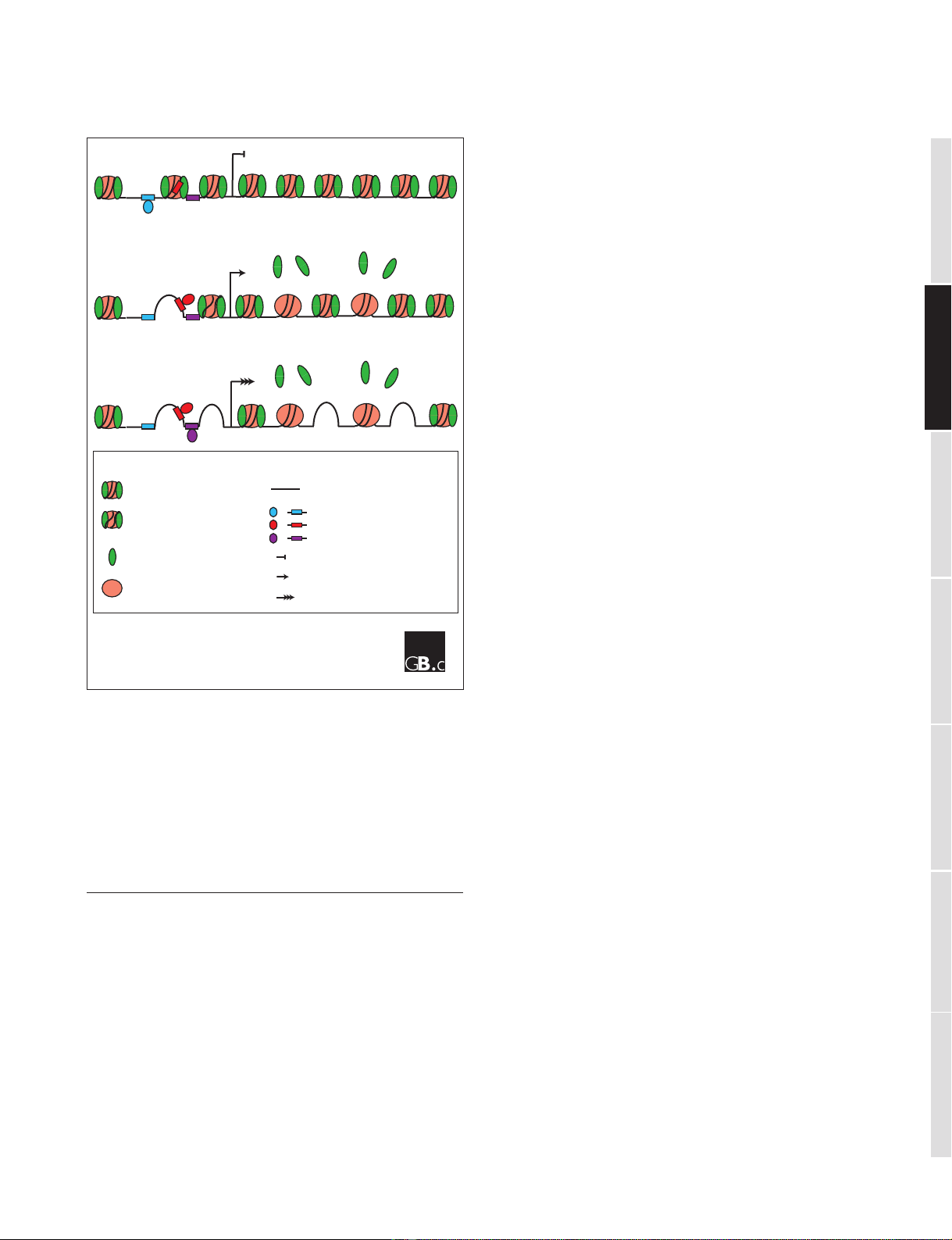
zation in eukaryotes. A simplified model of this organization
for one gene under different transcriptional states is shown
in Figure 1.
As well as suggesting the general model shown in Figure 1,
the recent studies identify a heterogeneous distribution of
nucleosomes in the yeast genome [8,9]. These findings offer
243.2 Genome Biology 2004, Volume 5, Issue 10, Article 243 Ercan et al. http://genomebiology.com/2004/5/10/243
Genome Biology 2004, 5:243
an important factor that should be taken into account when
interpreting genome-wide experiments involving post-trans-
lationally modified nucleosomes. When examining the dis-
tribution of modified histones in the genome, one should
keep in mind that the histones are organized heteroge-
neously in the genome such that the regulatory regions
possess fewer nucleosomes. Thus, the apparent loss of a
histone modification may in fact represent the absence of
histones [3]. Overall, recent studies suggest a genome-wide
depletion of nucleosomes over regulatory regions that might
be a common feature of eukaryotic genomes.
Acknowledgements
This work was supported by postdoctoral fellowship grant PF-02-012-01-
GMC from the American Cancer Society to M.J.C., and NIGMS, National
Institutes of Health grant GM047867 to J.L.W.
References
1. Wu C, Wong YC, Elgin SC: The chromatin structure of specific
genes: II. Disruption of chromatin structure during gene
activity. Cell 1979, 16:807-814.
2. Weintraub H, Groudine M: Chromosomal subunits in active
genes have an altered conformation. Science 1976, 193:848-
856.
3. Reinke H, Horz W: Histones are first hyperacetylated and
then lose contact with the activated PHO5 promoter. Mol
Cell 2003, 11:1599-1607.
4. Boeger H, Griesenbeck J, Strattan JS, Kornberg RD: Nucleosomes
unfold completely at a transcriptionally active promoter.
Mol Cell 2003, 11:1587-1598.
5. Fedor MJ, Kornberg RD: Upstream activation sequence-depen-
dent alteration of chromatin structure and transcription
activation of the yeast GAL1-GAL10 genes. Mol Cell Biol 1989,
9:1721-1732.
6. Boeger H, Griesenbeck J, Strattan JS, Kornberg RD: Removal of
promoter nucleosomes by disassembly rather than sliding in
vivo.Mol Cell 2004, 14:667-673.
7. Lohr D: Nucleosome transactions on the promoters of the
yeast GAL and PHO genes. J Biol Chem 1997, 272:26795-26798.
8. Lee CK, Shibata Y, Rao B, Strahl BD, Lieb JD: Evidence for nucleo-
some depletion at active regulatory regions genome-wide.
Nat Genet 2004, 36:900-905.
9. Bernstein BE, Liu CL, Humphrey EL, Perlstein EO, Schreiber SL:
Global nucleosome occupancy in yeast. Genome Biol 2004,
5:R62.
10. Kaplan CD, Laprade L, Winston F: Transcription elongation
factors repress transcription initiation from cryptic sites.
Science 2003, 301:1096-1099.
11. McKittrick E, Gafken PR, Ahmad K, Henikoff S: Histone H3.3 is
enriched in covalent modifications associated with active
chromatin. Proc Natl Acad Sci USA 2004, 101:1525-1530.
12. Belotserkovskaya R, Oh S, Bondarenko VA, Orphanides G, Studitsky
VM, Reinberg D: FACT facilitates transcription-dependent
nucleosome alteration. Science 2003, 301:1090-1093.
13. Nagy PL, Cleary ML, Brown PO, Lieb JD: Genomewide demarca-
tion of RNA polymerase II transcription units revealed by
physical fractionation of chromatin. Proc Natl Acad Sci USA
2003, 100:6364-6369.
14. Lieb JD, Liu X, Botstein D, Brown PO: Promoter-specific binding
of Rap1 revealed by genome-wide maps of protein-DNA
association. Nat Genet 2001, 28:327-334.
15. Yu L, Morse RH: Chromatin opening and transactivator
potentiation by RAP1 in Saccharomyces cerevisiae.Mol Cell Biol
1999, 19:5279-5288.
16. Owen-Hughes T, Utley RT, Cote J, Peterson CL, Workman JL: Per-
sistent site-specific remodeling of a nucleosome array by
transient action of the SWI/SNF complex. Science 1996,
273:513-516.
comment reviews reports deposited research interactions information
refereed research
http://genomebiology.com/2004/5/10/243 Genome Biology 2004, Volume 5, Issue 10, Article 243 Ercan et al. 243.3
Genome Biology 2004, 5:243
Figure 1
A model for the change in nucleosome occupancy in a typical yeast gene
in different transcriptional states. (a) When there is no transcription,
repressor proteins bind to their DNA-binding sites and maintain a
repressive chromatin configuration with nucleosomes all along the gene
and most of the promoter. (b) When activator proteins bind their DNA
elements, they promote changes in chromatin that disrupt or displace
nucleosomes from promoter regions, leading to transcription of the
gene. Subsequent transcript elongation through coding regions causes
the transient displacement of histones. (c) With higher levels of
transcription, nucleosomes become depleted from coding regions as well
as from the promoter.
Key
Nucleosome
Disrupted
nucleosome
Histone
H2A-H2B dimer
Histone
H3-H4 tetramer
Transcription factors
and their binding sites
DNA
Start site
No transcription
Low transcription level
High transcription level
(a)
(b)
(c)

![PET/CT trong ung thư phổi: Báo cáo [Năm]](https://cdn.tailieu.vn/images/document/thumbnail/2024/20240705/sanhobien01/135x160/8121720150427.jpg)