

http://www.iaeme.com/IJM/index.asp 107 editor@iaeme.com
International Journal of Management (IJM)
Volume 10, Issue 3, May-June 2019, pp. 107-118, Article ID: IJM_10_03_011
Available online at http://www.iaeme.com/ijm/issues.asp?JType=IJM&VType=10&IType=3
Journal Impact Factor (2019): 9.6780 (Calculated by GISI) www.jifactor.com
ISSN Print: 0976-6502 and ISSN Online: 0976-6510
© IAEME Publication
ANALYSIS OF FACTORS INFLUENCING
MILLENNIAL’S TECHNOLOGY ACCEPTANCE
OF CHATBOT IN THE BANKING INDUSTRY IN
INDONESIA
Richad Richad, Vivensius Vivensius, Sfenrianto Sfenrianto and Emil R. Kaburuan
Department of Information Systems Management
BINUS Graduate Program – Master of Information Systems Management
Bina Nusantara University, Jakarta, Indonesia, 11480.
ABSTRACT
The purpose of this research is to analyze factors that influence millennial’s
technology acceptance of chatbot in the banking industry in Indonesia. In this
quantitative research, innovativeness is the exogenous variable, while the endogenous
variables are perceived usefulness, perceived ease of use, and attitude towards using
and behavioral intention. This research used primary data gathered from distributed
questionnaires, directly from the millennial people in Indonesia. Using simple random
sampling technique to total sample of 400 people out of the total population of 90
million people. Statistical analysis in this research is conducted using Partial Least
Square Structural Equation Model (PLS–SEM). The result shows that innovativeness,
perceived usefulness, perceived ease of use and attitude towards using the chatbot
affected behavioral intention.
Keywords: Chatbot, Banking Industry, Millennial, Technology Acceptance Model
(TAM), Partial Least Square–Structural Equation Model (PLS–SEM).
Cite this Article: Richad Richad, Vivensius Vivensius, Sfenrianto Sfenrianto and Emil
R. Kaburuan, Analysis of Factors Influencing Millennial’s Technology Acceptance of
Chatbot in the Banking Industry in Indonesia, International Journal of Management,
10 (3), 2019, pp. 107 - 118,
http://www.iaeme.com/IJM/issues.asp?JType=IJM&VType=10&IType=3
1. INTRODUCTION
The technological developments have touched every aspect of human life from business,
education, health, to financial services for the community. One form of technological
development in the field of financial services is the emergence of chatbot applications that are
part of artificial intelligence and are available for various platforms such as LINE, Facebook
Messenger and Google Assistant. The presence of several chatbots in the banking industry in

Richad Richad, Vivensius Vivensius, Sfenrianto Sfenrianto and Emil R. Kaburuan
http://www.iaeme.com/IJM/index.asp 108 editor@iaeme.com
Indonesia such as Vira, Sabrina and Mita is also due to the existence of several supporting
technologies such as the development of the internet and smartphones in Indonesia.
Among on data from wearesocial.com specifically in Indonesia itself as of January 2018
internet usage has touched the figure of 50% or half of the total population of 265.4 million.
This shows that most people in Indonesia have used internet technology, where several
activities carried out by the people in Indonesia are to access social media, online shopping,
and browsing. Likewise, with data obtained from statista.com regarding the development of
smartphone use in Indonesia which has reached 26.26% of the total population in Indonesia in
2018.
There are many organizations, including banks, use chatbot applications that are available
in various social media platforms, such as LINE and Facebook Messenger. With the chatbot,
banks can provide customer services for 24 hours per day in a week, can be accessed anywhere,
and can also provide efficiency in customer service activities. Chatbot can provide a quick
response to questions from customers, to provide a good customer experience.
Millennials with a population of 90 million, or around 34.45% of Indonesia's total
population constitute a large market share for the banking industry. Based on the Indonesia
Millennial Report 2019 report conducted by the IDN Research Institute, the results of the
research show that 94.4% of millennials in Indonesia have been connected to the internet. The
internet is a major need for millennials. And most or about 98.2% of activities carried out on
the internet are accessed via smartphones. With the chatbot, millennial customers are now able
to find out various kinds of banking products and services quickly, such as promotion
information, exchange rates, the nearest ATM location, and can also register for credit cards
and mortgages. In addition, millennial customers can also check balances, check accounts,
credit card information, and other administrative services.
The purpose of this study was to determine the factors of acceptance of chatbot technology
in the banking industry in Indonesia, especially for the millennial generation. Therefore, an
appropriate model is needed to be able to know the factors of acceptance of the technology, so
we used the Technology Acceptance Model (TAM), modified by Davis in 1989.
2. LITERATURE REVIEW
2.1. Chatbot
Chatbot (also known as a talkbot, chatterbox, Bot, Instant Messaging-bot or Artificial
Conversational Entity) is a computer program that mimics human conversations in its natural
format including text or spoken language using artificial intelligence techniques such as Natural
Language Processing (NLP), image and video processing, and audio analysis [4].
Chatbot enables its users to communicate with it to form an intelligent communication [9,
11] along with providing results or completed tasks as the user instructed it to [12]. The
implementation of Chatbot has existed for years, but in various forms—it gained popularity
ever since the release of Apple’s Siri and Alexa for Amazon [11].
The advancement of Chatbot technology development, mainly in programming language,
drives the performance of Chatbot known nowadays [19]. While it is used to performed tasks
and answers questions, Chatbot are now capable of doing the business itself [16]. Even so,
Chatbot are still facing issues regarding securities and trusts [8]. It is still vulnerable to web
attacks and needs serious attention in development of its security systems. Regardless of it,
Chatbot are still proven to be in the leading position of business enabler, due to having various
utilities and little to none compatibility issues, it is the future of business assistance tool. [15,
25, 27].

Analysis of Factors Influencing Millennial’s Technology Acceptance of Chatbot in the Banking
Industry in Indonesia
http://www.iaeme.com/IJM/index.asp 109 editor@iaeme.com
2.2. Millennials
Individuals who are born in between year 1980 and 2000 are called Millennials, due to having
been born close to the next millennium (year 2000) and were raised in modern age where
technology have been further advanced. The millennials are easily identified by having high
acceptance rate on new technologies, and even greater acceptance on capturing new values of
non-traditional families and customs [24].
2.3. Banking Industry
As an intermediary for financial transactions, a bank is doing its business processes primarily
on offering savings and lending money to potential borrowers in order to develop economy
within organizations. Advancement of technology enables a bank to penetrate market on larger,
wider scale by further enhancing its presence and it is obligated to provide fast, secure and
ubiquitous services (as in financial services) to customers, in order to create profit, with the
implementation of various business objectives and strategies [1].
Compilations of bank are known as banking industry; this is to segregate the purposes of
the banking itself—from financial support, savings, and insurance, banking industry are moving
toward to provide beneficial supports for people [7, 21, 23].
2.4. Technology Acceptance Model (TAM)
TAM helps researchers determine which factors dominates the acceptance rate within a system,
or subsystems [17]. It was developed by researchers to achieve its main purpose—determining
the acceptance rate of a technology by individuals or organizations and its usage; thus called
behavioral intention, which is determined from two subsets; the perceived usefulness and
perceived ease of use. Perceived usefulness depends on how a technology enhances one’s daily
routines by measuring the improvement of the performance of oneself, whilst perceived ease of
use defined as the effortless attempt in using the technology to do the daily routines [26].
2.5. Partial Least Square – Structural Equation Model (PLS–SEM)
PLS-SEM differs from general, factor-based SEM. In fact, PLS-SEM does calculation on
several values of latent variables in research with specified algorithm. Different from factor-
based SEM, PLS-SEM explicitly calculates case values for the latent variables as part of the
algorithm, with unobservable variables defines the estimate for exact linear combinations from
indicators within it, empirically. It is then resulting composite results for most of the exogenous
constructs’ indicators variant—which is useful to predict the endogenous ones. It is using the
composite to determine constructs in its path model, as an estimation of the conceptual variable
of the research [22].
2.6. Previous Study
Based on the empirical study determination that in the last time of the last 10 years,
accumulatively there are 5 international publications that discuss about the technology
acceptance in several applications that can be seen on Table 1.
Table 1 Previous Study on Significant Factors
Reference
[2]
[3]
[6]
[13]
[20]
Perceived Usefulness
Perceived Ease of Use

Richad Richad, Vivensius Vivensius, Sfenrianto Sfenrianto and Emil R. Kaburuan
http://www.iaeme.com/IJM/index.asp 110 editor@iaeme.com
Attitude Towards Using
Behavioral Intention
Innovativeness
3. THEORETICAL ANALYSIS
3.1. Research Model
This research aims to examine the millennial’s technology acceptance of chatbot in banking
industry in Indonesia with TAM, consisting of external variables, perceived usefulness,
perceived ease of use, attitude towards of using and behavioral intention. External variable that
will be discussed in this paper is Innovativeness of chatbot. The variable indicators in this paper
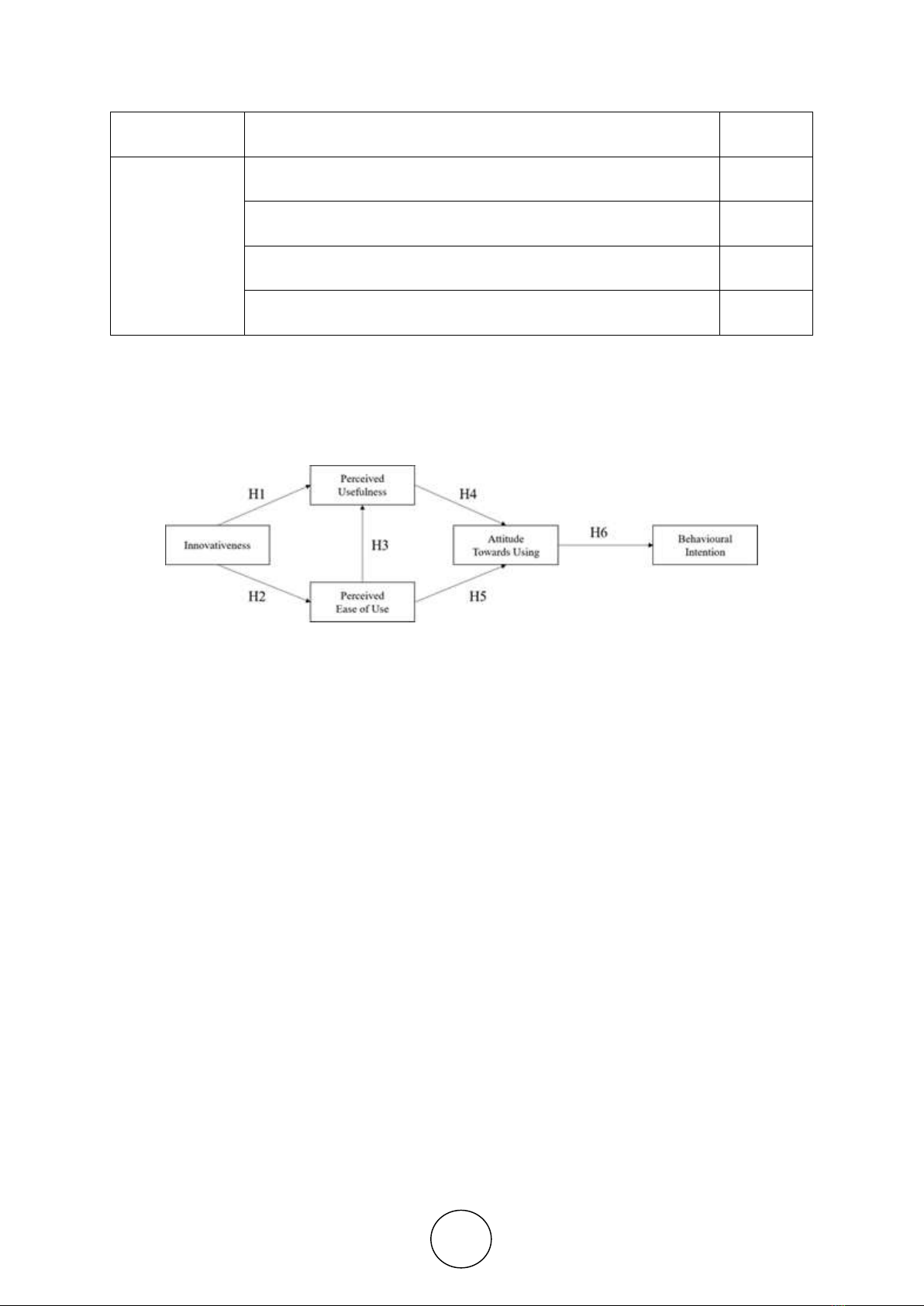
can be seen in Table 2.
Table 2 Variable Indicators
Variable
Variable Indicator
References
Innovativeness
(IV)
IV1: New innovations in chatbot application
[5]
IV2: Innovation can increase convenience using chatbot
IV3: Innovation can increase customer desires using chatbot
IV4: In general, customer is ready to accept new ideas
Perceived
Usefulness (PU)
PU1: Chatbot can improve performance of getting information and
doing transactions.
[10,18]
PU2: By using chatbot, customer can get information and do
transaction faster
PU3: Chatbot can improve productivity of customer transactions
PU4: Chatbot can improve the quality of getting information and
doing transactions
Perceived Ease
of Use (PEOU)
PEOU1: Chatbot is easy to learn
[18, 25]
PEOU2: Customer can use chatbot without help from anyone
PEOU3: Interaction between customer and chatbot is clear and
easy to understand
PEOU4: Customer need much effort to use chatbot
Attitude
Towards Using
(AT)
AT1: Getting information and transaction in chatbot is not a good
idea
[18]
AT2: Customer is willing to use chatbot if it is affordable
AT3: Customer like the idea of using chatbot to facilitate getting
information and doing transactions
Analysis of Factors Influencing Millennial’s Technology Acceptance of Chatbot in the Banking
Industry in Indonesia
http://www.iaeme.com/IJM/index.asp 111 editor@iaeme.com
AT4: Using chatbot can be a good experience
Behavioral
Intention (BI)
BI1: Customer choose to use chatbot for getting information and
doing transaction
[18]
BI2: There is possibility that Customer will use chatbot
BI3: Customer will not recommend anyone to use chatbot
BI4: Customer expect to always be able to use chatbot
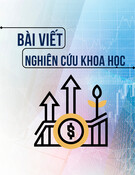
The research model used in this article is a modification to fit the scope of the research,
which is derived from modified version of TAM developed by Davis, Bogozzi and Warshaw
in 1989 [14]. This modified version firstly defined in order to explain various behavior of users
on using a technology, where it is believed that an external variable is influencing the
acceptance of the users. It is illustrated in Figure 1.
Figure 1. Research Model a
a Adapted from a research article by Lai, P. C. (2017) [14]
3.2. Analysis Model
The process of analysis is carried out on the results of the stages of data collection with
questionnaire instruments. Data analysis was supported using SmartPLS version 2 software.
Scenario analysis was carried out using the Structural Equation Model Partial Least Squares
(SEM-PLS) method. PLS method consists of 2 models, namely measurement (outer model) and
structural (inner model).
4. RESULTS AND DISCUSSIONS
4.1. Results
Data type used in this research is primary data that is obtained by collecting questionnaire
directly from millennials in Indonesia with a total population of 90 million. Sampling method
that is used in this research is simple random sampling and Slovin’s formula to determine
sample size, which is 400 respondents. Statistical analysis that is used in this research is PLS-
SEM.
4.1.1. The Assessment of Measurement Model
The measurement model used in this research consist of six constructs, Innovativeness (IV) as
external variable, Perceived Usefulness (PU), Perceived Ease of Use (PEOU), Attitude towards
Using (AT) and Behavioural Intention (BI). Assessment of the reflective measurement model
requires to examine the validity and reliability for every latent variable in the model. First, to





![Câu hỏi ôn tập Tài chính tiền tệ: Tổng hợp [Mới nhất]](https://cdn.tailieu.vn/images/document/thumbnail/2025/20251230/phuongnguyen2005/135x160/49071768806381.jpg)


![Câu hỏi ôn tập Tài chính Tiền tệ: Tổng hợp [mới nhất/chuẩn nhất]](https://cdn.tailieu.vn/images/document/thumbnail/2025/20251015/khanhchi0906/135x160/49491768553584.jpg)


