

Chapter 8
Application: the Costs of Taxation
TRUE/FALSE
1. Total surplus is always equal to the sum of consumer surplus and producer surplus.
ANS: F DIF: 2 REF: 8-1 NAT: Analytic
LOC: Supply and demand TOP: Total surplus
MSC: Interpretive
2. Total surplus in a market does not change when the government imposes a tax on that market because the loss
of consumer surplus and producer surplus is equal to the gain of government revenue.
ANS: F DIF: 2 REF: 8-1 NAT: Analytic
LOC: Supply and demand TOP: Total surplus
MSC: Interpretive
3. When a tax is imposed on buyers, consumer surplus and producer surplus both decrease.
ANS: T DIF: 2 REF: 8-1 NAT: Analytic
LOC: Supply and demand TOP: Consumer surplus | Producer surplus
MSC: Interpretive
4. When a tax is imposed on buyers, consumer surplus decreases but producer surplus increases.
ANS: F DIF: 2 REF: 8-1 NAT: Analytic
LOC: Supply and demand TOP: Consumer surplus | Producer surplus
MSC: Interpretive
5. When a tax is imposed on sellers, producer surplus decreases but consumer surplus increases.
ANS: F DIF: 2 REF: 8-1 NAT: Analytic
LOC: Supply and demand TOP: Consumer surplus | Producer surplus
MSC: Interpretive
6. When a tax is imposed on sellers, consumer surplus and producer surplus both decrease.
ANS: T DIF: 2 REF: 8-1 NAT: Analytic
LOC: Supply and demand TOP: Consumer surplus | Producer surplus
MSC: Interpretive
7. Taxes affect market participants by increasing the price paid by the buyer and received by the seller.
ANS: F DIF: 1 REF: 8-1 NAT: Analytic
LOC: Supply and demand TOP: Taxes MSC: Applicative
8. Taxes affect market participants by increasing the price paid by the buyer and decreasing the price received by
the seller.
ANS: T DIF: 1 REF: 8-1 NAT: Analytic
LOC: Supply and demand TOP: Taxes MSC: Applicative
9. A tax raises the price received by sellers and lowers the price paid by buyers.
ANS: F DIF: 1 REF: 8-1 NAT: Analytic
LOC: Supply and demand TOP: Efficiency MSC: Interpretive
10. Normally, both buyers and sellers of a good become worse off when the good is taxed.
ANS: T DIF: 2 REF: 8-1 NAT: Analytic
LOC: Supply and demand TOP: Welfare MSC: Interpretive
17

18 Chapter 8 /Application: the Costs of Taxation
11. When a good is taxed, the tax revenue collected by the government equals the decrease in the welfare of
buyers and sellers caused by the tax.
ANS: F DIF: 2 REF: 8-1 NAT: Analytic
LOC: Supply and demand TOP: Welfare | Tax revenue
MSC: Interpretive
12. A tax places a wedge between the price buyers pay and the price sellers receive.
ANS: T DIF: 1 REF: 8-1 NAT: Analytic
LOC: Supply and demand TOP: Efficiency MSC: Interpretive
13. A tax on a good causes the size of the market to increase.
ANS: F DIF: 1 REF: 8-1 NAT: Analytic
LOC: Supply and demand TOP: Efficiency MSC: Interpretive
14. A tax on a good causes the size of the market to shrink.
ANS: T DIF: 1 REF: 8-1 NAT: Analytic
LOC: Supply and demand TOP: Efficiency MSC: Interpretive
15. When a tax is imposed, the loss of consumer surplus and producer surplus as a result of the tax exceeds the tax
revenue collected by the government.
ANS: T DIF: 2 REF: 8-1 NAT: Analytic
LOC: Supply and demand TOP: Welfare MSC: Interpretive
16. Economists use the government’s tax revenue to measure the public benefit from a tax.
ANS: T DIF: 2 REF: 8-1 NAT: Analytic
LOC: Supply and demand TOP: Welfare MSC: Interpretive
17. Because taxes distort incentives, they cause markets to allocate resources inefficiently.
ANS: T DIF: 2 REF: 8-1 NAT: Analytic
LOC: Supply and demand TOP: Efficiency MSC: Interpretive
18. Taxes cause deadweight losses because they prevent buyers and sellers from realizing some of the gains from
trade.
ANS: T DIF: 2 REF: 8-1 NAT: Analytic
LOC: Supply and demand TOP: Deadweight loss
MSC: Interpretive
19. As the price elasticities of supply and demand increase, the deadweight loss from a tax increases.
ANS: T DIF: 2 REF: 8-2 NAT: Analytic
LOC: Elasticity TOP: Elasticity | Deadweight loss MSC: Applicative
20. The greater the elasticity of demand, the smaller the deadweight loss of a tax.
ANS: F DIF: 2 REF: 8-2 NAT: Analytic
LOC: Elasticity TOP: Elasticity | Deadweight loss MSC: Interpretive
21. The more inelastic are demand and supply, the greater is the deadweight loss of a tax.
ANS: F DIF: 2 REF: 8-2 NAT: Analytic
LOC: Elasticity TOP: Elasticity | Deadweight loss MSC: Applicative
22. The elasticities of the supply and demand curves in the market for cigarettes affect how much a tax distorts
that market.
ANS: T DIF: 2 REF: 8-2 NAT: Analytic
LOC: Elasticity TOP: Elasticity | Deadweight loss MSC: Interpretive
23. If a tax did not induce buyers or sellers to change their behavior, it would not cause a deadweight loss.
ANS: T DIF: 2 REF: 8-2 NAT: Analytic
LOC: Supply and demand TOP: Deadweight loss
MSC: Interpretive

Chapter 8 /Application: the Costs of Taxation 19
24. The most important tax in the U.S. economy is the tax on corporations’ profits.
ANS: F DIF: 1 REF: 8-2 NAT: Analytic
LOC: Supply and demand TOP: Labor MSC: Definitional
25. The Social Security tax, and to a large extent, the federal income tax, are labor taxes.
ANS: T DIF: 1 REF: 8-2 NAT: Analytic
LOC: Supply and demand TOP: Labor MSC: Interpretive
26. Taxes on labor tend to increase the number of hours that people choose to work.
ANS: F DIF: 1 REF: 8-2 NAT: Analytic
LOC: Supply and demand TOP: Labor MSC: Interpretive
27. Taxes on labor tend to encourage the elderly to retire early.
ANS: T DIF: 1 REF: 8-2 NAT: Analytic
LOC: Supply and demand TOP: Labor MSC: Interpretive
28. Taxes on labor tend to encourage second earners to stay at home rather than work in the labor force.
ANS: T DIF: 1 REF: 8-2 NAT: Analytic
LOC: Supply and demand TOP: Labor MSC: Interpretive
29. Economists disagree on whether labor taxes have a small or large deadweight loss.
ANS: T DIF: 1 REF: 8-2 NAT: Analytic
LOC: Supply and demand TOP: Labor | Deadweight loss
MSC: Definitional
30. The demand for bread is less elastic than the demand for donuts; hence, a tax on bread will create a larger
deadweight loss than will the same tax on donuts, other things equal.
ANS: F DIF: 2 REF: 8-2 NAT: Analytic
LOC: Elasticity TOP: Elasticity | Deadweight loss MSC: Applicative
31. The larger the deadweight loss from taxation, the larger the cost of government programs.
ANS: T DIF: 2 REF: 8-2 NAT: Analytic
LOC: Supply and demand TOP: Deadweight loss
MSC: Interpretive
32. A tax on insulin is likely to cause a very large deadweight loss to society.
ANS: F DIF: 2 REF: 8-2 NAT: Analytic
LOC: Elasticity TOP: Deadweight loss | Elasticity MSC: Applicative
33. The deadweight loss of a tax rises even more rapidly than the size of the tax.
ANS: T DIF: 2 REF: 8-3 NAT: Analytic
LOC: Supply and demand TOP: Deadweight loss
MSC: Interpretive
34. As the size of a tax increases, the government's tax revenue rises, then falls.
ANS: T DIF: 2 REF: 8-3 NAT: Analytic
LOC: Supply and demand TOP: Laffer curve MSC: Interpretive
35. Tax revenues increase in direct proportion to increases in the size of the tax.
ANS: F DIF: 2 REF: 8-3 NAT: Analytic
LOC: Supply and demand TOP: Tax revenue MSC: Interpretive
36. If the size of a tax doubles, the deadweight loss doubles.
ANS: F DIF: 3 REF: 8-3 NAT: Analytic
LOC: Supply and demand TOP: Deadweight loss
MSC: Applicative

20 Chapter 8 /Application: the Costs of Taxation
37. If the size of a tax triples, the deadweight loss increases by a factor of six.
ANS: F DIF: 3 REF: 8-3 NAT: Analytic
LOC: Supply and demand TOP: Deadweight loss
MSC: Applicative
38. A tax on unimproved land falls entirely on landowners because the supply of land is perfectly inelastic.
ANS: T DIF: 2 REF: 8-3 NAT: Analytic
LOC: Supply and demand TOP: Land tax MSC: Interpretive
39. Because the supply of land is perfectly elastic, the deadweight loss of a tax on land is very large.
ANS: F DIF: 2 REF: 8-3 NAT: Analytic
LOC: Elasticity TOP: Land tax | Deadweight loss MSC: Interpretive
40. Economist Arthur Laffer made the argument that tax rates in the United States were so high that reducing the
rates would increase tax revenue.
ANS: T DIF: 2 REF: 8-3 NAT: Analytic
LOC: Supply and demand TOP: Laffer curve MSC: Definitional
41. The Laffer curve is the curve showing how tax revenue varies as the size of the tax varies.
ANS: T DIF: 2 REF: 8-3 NAT: Analytic
LOC: Supply and demand TOP: Laffer curve MSC: Definitional
42. The result of the large tax cuts in the first Reagan Administration demonstrated very convincingly that Arthur
Laffer was correct when he asserted that cuts in tax rates would increase tax revenue.
ANS: F DIF: 2 REF: 8-3 NAT: Analytic
LOC: Supply and demand TOP: Laffer curve MSC: Interpretive
43. The idea that tax cuts would increase the quantity of labor supplied, thus increasing tax revenue, became know
as supply-side economics.
ANS: T DIF: 2 REF: 8-3 NAT: Analytic
LOC: Supply and demand TOP: Supply-side economics
MSC: Definitional
44. The Laffer curve illustrates how taxes in markets with greater elasticities of demand compare to taxes in
markets with smaller elasticities of supply.
ANS: F DIF: 2 REF: 8-3 NAT: Analytic
LOC: Supply and demand TOP: Laffer curve MSC: Definitional
45. The more elastic are supply and demand in a market, the greater are the distortions caused by a tax on that
market, and the more likely it is that a tax cut in that market will raise tax revenue.
ANS: T DIF: 3 REF: 8-3 NAT: Analytic
LOC: Elasticity TOP: Elasticity | Deadweight loss MSC: Applicative
46. When the government imposes taxes on buyers and sellers of a good, society loses some of the benefits of
market efficiency.
ANS: T DIF: 1 REF: 8-4 NAT: Analytic
LOC: Supply and demand TOP: Efficiency MSC: Interpretive
Chapter 8 /Application: the Costs of Taxation 21
SHORT ANSWER
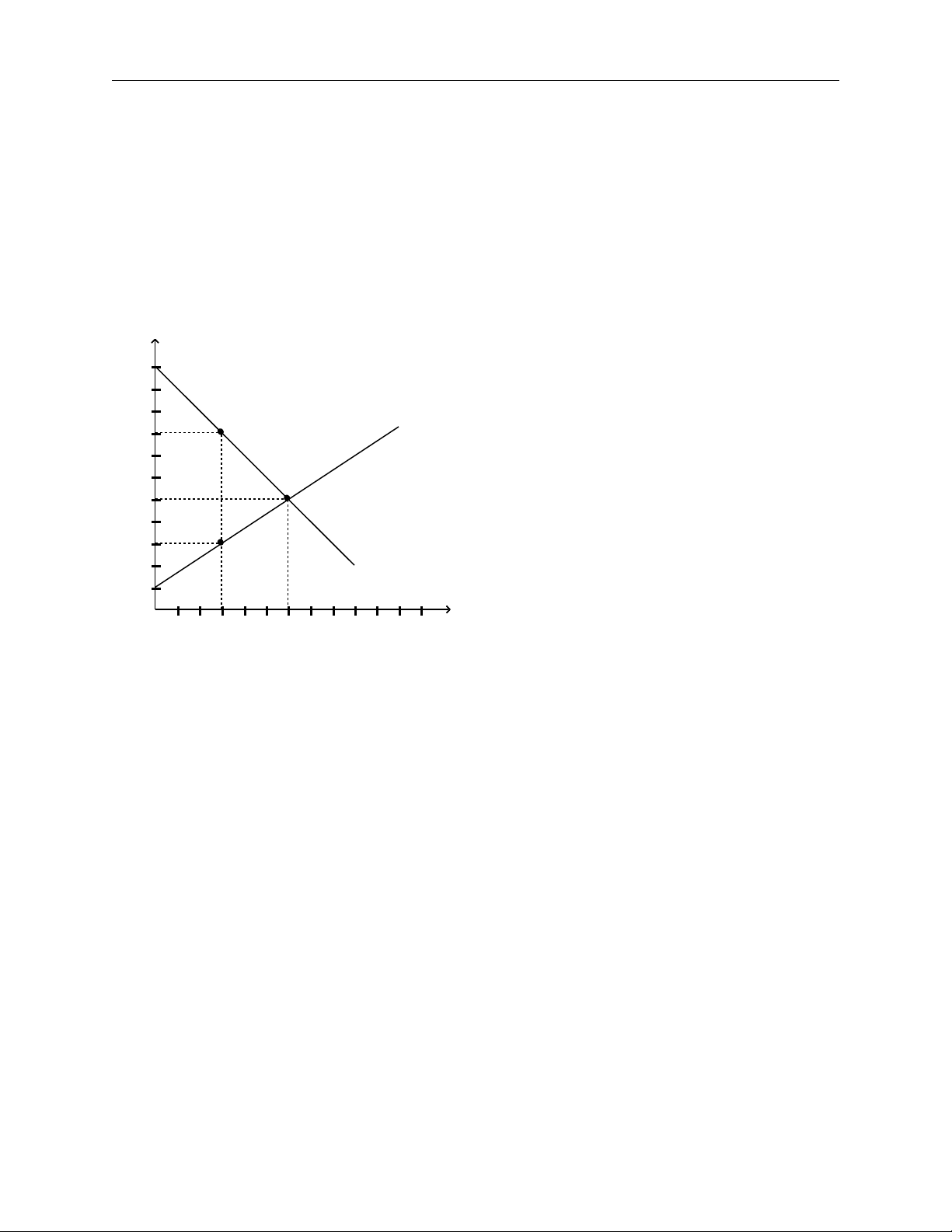
1. Suppose the government levies a tax of the vertical distance from point A to point B. Using the graph shown,
determine the value of each of the following:
a. equilibrium price before the tax
b. consumer surplus before the tax
c. producer surplus before the tax
d. total surplus before the tax
e. consumer surplus after the tax
f. producer surplus after the tax
g. total tax revenue to the government
h. total surplus (consumer surplus+producer surplus+tax revenue) after the tax
i. deadweight loss
A
B
Demand
Supply
100 200 300 400 500 600 700 800 900 1000 Quantity
2
4
6
8
10
12
14
16
18
20
22
Price
ANS:
a. $10
b. $3,600
c. $2,400
d. $6,000
e. $900
f. $600
g. $3,000
h. $4,500
i. $1,500
DIF: 3 REF: 8-1 NAT: Analytic LOC: Supply and demand
TOP: Welfare MSC: Applicative
2. John has been in the habit of mowing Willa's lawn each week for $20. John's opportunity cost is $15, and
Willa would be willing to pay $25 to have her lawn mowed. What is the maximum tax the government can
impose on lawn mowing without discouraging John and Willa from continuing their mutually beneficial
arrangement?
ANS:
If the tax is less than $10, there will exist a price at which both John and Willa will still benefit from the lawn-
mowing arrangement. If the tax is $10, a price can be set which will leave John and Willa neither better off nor
worse off from the lawn-mowing arrangement. If the tax is greater than $10, all possible prices will leave at least
one of the parties worse off from the lawn-mowing arrangement.
DIF: 2 REF: 8-1 NAT: Analytic LOC: Supply and demand
TOP: Efficiency MSC: Applicative








![Đề cương ôn tập Khoa học quản lý [năm học] chi tiết, chuẩn nhất](https://cdn.tailieu.vn/images/document/thumbnail/2026/20260506/camtucau2026/135x160/62691778123105.jpg)


%20--%3e%3cdefs%3e%3cstyle%3e%20.st0%20{%20fill:%20%23fff;%20}%20.st1%20{%20fill:%20%237800fa;%20}%20%3c/style%3e%3c/defs%3e%3cpath%20class='st1'%20d='M117.78,12.18H43.11c2.9,3.47,4.65,7.94,4.65,12.82,0,5.6-2.3,10.66-6.01,14.29h76.02l7.22-13.56-7.22-13.56Z'/%3e%3cg%3e%3cpath%20class='st0'%20d='M53.58,26.17h-.59v-1.46h.59v-4.96h2.83c1.78,0,2.67.94,2.67,2.82v5.76c0,1.87-.89,2.81-2.67,2.81h-2.83v-4.96ZM55.36,21.37v3.34h1.1v1.46h-1.1v3.34h1.01c.61,0,.91-.37.91-1.1v-5.93c0-.74-.3-1.1-.91-1.1h-1.01Z'/%3e%3cpath%20class='st0'%20d='M65.99,31.14h-1.8l-.31-2.07h-2.19l-.31,2.07h-1.64l1.82-11.39h2.62l1.82,11.39ZM65.28,18.04c-.25.46-.51.77-.75.94-.21.15-.47.22-.79.22-.26,0-.57-.07-.92-.22l-.38-.15c-.14-.05-.26-.07-.37-.07-.3,0-.53.18-.71.54l-.91-.68c.25-.46.51-.77.75-.94.21-.14.48-.21.79-.21.26,0,.57.07.92.21l.38.15c.14.05.26.07.37.07.3,0,.53-.18.71-.54l.91.68ZM61.91,27.52h1.73l-.87-5.76-.87,5.76Z'/%3e%3cpath%20class='st0'%20d='M74.53,26.89v1.52c0,1.91-.89,2.86-2.67,2.86s-2.67-.95-2.67-2.86v-5.93c0-1.91.89-2.86,2.67-2.86s2.67.95,2.67,2.86v1.11h-1.69v-1.22c0-.75-.31-1.12-.93-1.12s-.93.37-.93,1.12v6.15c0,.74.31,1.11.93,1.11s.93-.37.93-1.11v-1.63h1.69Z'/%3e%3cpath%20class='st0'%20d='M81.4,31.14h-1.8l-.31-2.07h-2.19l-.31,2.07h-1.64l1.82-11.39h2.62l1.82,11.39ZM75.9,19.2l1.52-1.91h1.71l1.51,1.91h-1.61l-.76-.95-.75.95h-1.61ZM77.32,27.52h1.73l-.87-5.76-.87,5.76ZM83.1,15.99l-1.76,1.91h-1.26l1.17-1.91h1.86Z'/%3e%3cpath%20class='st0'%20d='M84.86,19.75c1.78,0,2.67.94,2.67,2.82v1.48c0,1.87-.89,2.81-2.67,2.81h-.85v4.28h-1.79v-11.39h2.64ZM84.01,21.37v3.86h.85c.58,0,.87-.36.87-1.08v-1.71c0-.71-.29-1.07-.87-1.07h-.85Z'/%3e%3cpath%20class='st0'%20d='M93.51,19.75c1.78,0,2.67.94,2.67,2.82v1.48c0,1.87-.89,2.81-2.67,2.81h-.85v4.28h-1.79v-11.39h2.64ZM92.66,21.37v3.86h.85c.58,0,.87-.36.87-1.08v-1.71c0-.71-.29-1.07-.87-1.07h-.85Z'/%3e%3cpath%20class='st0'%20d='M98.8,31.14h-1.79v-11.39h1.79v4.88h2.03v-4.88h1.83v11.39h-1.83v-4.88h-2.03v4.88Z'/%3e%3cpath%20class='st0'%20d='M105.36,24.55h2.46v1.62h-2.46v3.34h3.09v1.63h-4.88v-11.39h4.88v1.63h-3.09v3.18ZM108.17,17.29l-1.76,1.91h-1.26l1.17-1.91h1.86Z'/%3e%3cpath%20class='st0'%20d='M112.2,19.75c1.78,0,2.67.94,2.67,2.82v1.48c0,1.87-.89,2.81-2.67,2.81h-.85v4.28h-1.79v-11.39h2.64ZM111.35,21.37v3.86h.85c.58,0,.87-.36.87-1.08v-1.71c0-.71-.29-1.07-.87-1.07h-.85Z'/%3e%3c/g%3e%3ccircle%20class='st1'%20cx='25'%20cy='25'%20r='20'/%3e%3cpath%20class='st0'%20d='M32.78,19.27c2.92,0,4.43,2.55,5.28,5.33l.71,2.17c.14.38-.33.75-.71.75h-5.61c.19-.33.24-.71.09-1.08l-.75-2.45c-.43-1.32-.99-2.64-1.79-3.77.75-.57,1.65-.94,2.78-.94h0ZM25,18.38c3.25,0,4.9,2.78,5.89,5.89l.76,2.45c.14.42-.33.8-.8.8h-11.69c-.42,0-.94-.38-.8-.8l.75-2.45c.99-3.11,2.64-5.89,5.89-5.89h0ZM25,11.35c1.74,0,3.11,1.37,3.11,3.11s-1.37,3.11-3.11,3.11-3.11-1.41-3.11-3.11,1.41-3.11,3.11-3.11h0ZM17.27,19.27c1.08,0,1.98.38,2.73.94-.8,1.13-1.37,2.45-1.74,3.77l-.8,2.45c-.14.38-.05.75.09,1.08h-5.56c-.42,0-.9-.38-.75-.75l.71-2.17c.9-2.78,2.41-5.33,5.33-5.33h0ZM17.27,12.91c1.51,0,2.78,1.27,2.78,2.83s-1.27,2.83-2.78,2.83-2.83-1.27-2.83-2.83,1.27-2.83,2.83-2.83h0ZM32.78,12.91c1.56,0,2.78,1.27,2.78,2.83s-1.23,2.83-2.78,2.83-2.83-1.27-2.83-2.83,1.27-2.83,2.83-2.83h0ZM27.07,28.56v.09c0,.57-.24,1.08-.61,1.46h0v.05c-.38.33-.9.57-1.46.57s-1.08-.24-1.46-.61h0c-.38-.38-.61-.9-.61-1.46v-.09h1.41v.09c0,.19.05.38.19.47v.05c.09.09.28.19.47.19s.38-.09.47-.19v-.05c.14-.09.24-.28.24-.47t-.05-.09h1.41ZM30.99,28.56v.09c0,1.65-.66,3.16-1.74,4.24-1.08,1.08-2.59,1.79-4.24,1.79s-3.16-.71-4.24-1.79l-.05-.05c-1.04-1.08-1.7-2.55-1.7-4.2v-.09h1.41v.09c0,1.27.47,2.4,1.27,3.25h.05c.85.85,1.98,1.37,3.25,1.37s2.4-.52,3.25-1.37c.85-.8,1.37-1.98,1.37-3.25v-.09h1.37ZM34.99,28.56v.09c0,2.78-1.13,5.28-2.92,7.07-1.79,1.79-4.29,2.92-7.07,2.92s-5.23-1.13-7.07-2.92c-1.79-1.79-2.92-4.29-2.92-7.07v-.09h1.41v.09c0,2.4.94,4.53,2.5,6.08,1.56,1.56,3.72,2.5,6.08,2.5s4.52-.94,6.08-2.5c1.56-1.56,2.5-3.68,2.5-6.08v-.09h1.41Z'/%3e%3c/svg%3e)