
Schildgen et al. Virology Journal 2010, 7:167
http://www.virologyj.com/content/7/1/167
Open Access
CASE REPORT
© 2010 Schildgen et al; licensee BioMed Central Ltd. This is an Open Access article distributed under the terms of the Creative Commons
Attribution License (http://creativecommons.org/licenses/by/2.0), which permits unrestricted use, distribution, and reproduction in
any medium, provided the original work is properly cited.
Case Report
Novel mutation in YMDD motif and direct
neighbourhood in a child with chronic
HBV-infection and clinical lamivudine and adefovir
resistance - a scholarly case
Verena Schildgen
1,4
, Susanne Ziegler
2,3
, Ramona L Tillmann
4
and Oliver Schildgen*
2,3
Abstract
Context: Chronic HBV infection is a major cause of hepatocellular carcinoma (HCC) which meanwhile has become the
5th most reason for a fatal outcome of cancer. Worldwide, approximately 350 million people are chronically HBV
infected and as such of risk to develop HCC, of those an estimated high rate of children. Treatment of chronic infection
is sufficient to reduce the rate of HCC but the rate of sustained virological response remains to low, not at least due to
emergence of resistant virus strains. Less is known on HBV infection in children despite the extremely high rate of
chronicity.
Objective, Design, Setting, and Patient: The case of a nine years old male with a 6 year history of chronic HBV
infection, of those 5 years with antiviral treatment is described.
Interventions and Main Outcome Measure(s): Before our lab was consulted, the patient was unsuccessfully treated
with interferon, an obscure drug named Hepon, which should activate antiviral immune response, and Lamivudine,
the latter most likely becoming ineffective due to the mergence of resistant subpopulations (rtL180 M, rtV207 M, two
strains with stop codons at position rt188 and rt198, rtM204V (YVDD), rtM204K (YKDD)). Replacement of Lamivudine
by adefovir displayed no advantage despite the lack of resistance mutations, thus no decrease in viremia was observed
under adefovir treatment.
Results and Conclusions: Novel mutations in the YMDD motif and its direct neighbourhood were observed, both
being compatible with Lamivudine resistance. No mutations were found that are associated with ADF resistance. Both,
the clinical course of treatment and the genotypic resistance profile emphasize the need for systematic analyses of the
HBV resistance mechanisms and structured therapy concept also for children chronically infected with HBV.
Introduction
Hepatitis B virus (HBV), discovered in 1966, is one of the
major serious and global public health problems affecting
approximately 2 billion people worldwide http://
www.who.org. Estimated 350 million persons are chroni-
cally infected with HBV. Approximately 15-40% of
infected patients will develop cirrhosis, liver failure or
hepatocellular carcinoma (HCC) [1]. HCC incidence has
increased worldwide to the 5th most frequent cancer kill-
ing 300,000 - 500,000 people each year.
The estimated worldwide mortality caused by HBV
infection is 0.5-1.2 million deaths per year, although safe
and effective vaccines against HBV infections have been
available since 1982 [2]. Furthermore, the approval of oral
antiviral agents has revolutionised HBV treatment since
1998, and enabled effective clinical management of the
disease. Acute hepatitis B in adults is self-limiting in most
cases (95% of adults), therefore antiviral therapy is indi-
cated only for patients with protracted severe acute hepa-
titis or fulminant hepatitis [3,4]. Although this scheme
should be applied also for pediatric patient cohorts less is
known on the treatment of chronically HBV infected
children. Also in those patients two major strategies are
* Correspondence: schildgeno@kliniken-koeln.de
2 Institute for Virology, University Hospital Essen, Essen, Germany
Full list of author information is available at the end of the article

Schildgen et al. Virology Journal 2010, 7:167
http://www.virologyj.com/content/7/1/167
Page 2 of 6
believed to have potential to treat chronic HBV infection
in adults, namely direct interference with viral replication
and modulation of the host's immune responses, the lat-
ter known to be immature in pediatric patients and thus
resulting in high chronicity rates.
The lack of knowledge in this cohort may be a result of
lacking clinical studies, the lack of drugs approved for the
treatment of chronically HBV infected children, and the
fact that the majority of chronically HBV infected chil-
dren comes from poor countries never having access to
antiviral therapy. Here we report the case of a young male
patient suffering from chronic HBV who after non-
response to interferon and initial treatment with lamivu-
dine developed resistance associated with YVDD and a
novel mutation in the YMDD motif. Furthermore, the
patient showed initial non-response to adefovir despite
the lack of resistance mutations, giving raise to the
hypothesis that host factors influenced this treatment
failure.
Case Report/Clinical Data
A male patient adopted from Cameroon, 4-year-old at the
beginning of the therapy history, was chronically infected
with Hepatitis B virus infection perinatally, as assumed
from anamnestic investigations. Chronic Hepatitis B
virus infection was diagnosed at the age of 3. Written
informed consent for publication of the clinical course
was obtained by the legal representatives of the patient.
First, he had undergone unsuccessful therapy with
Intron® A (recombinant interferon alpha-2b, 3 × injec-
tions per week) for nine month, leading to severe side
effects, including fever, insomnia with disorientation and
ostealgia. Within the first seven month of IFN-treatment,
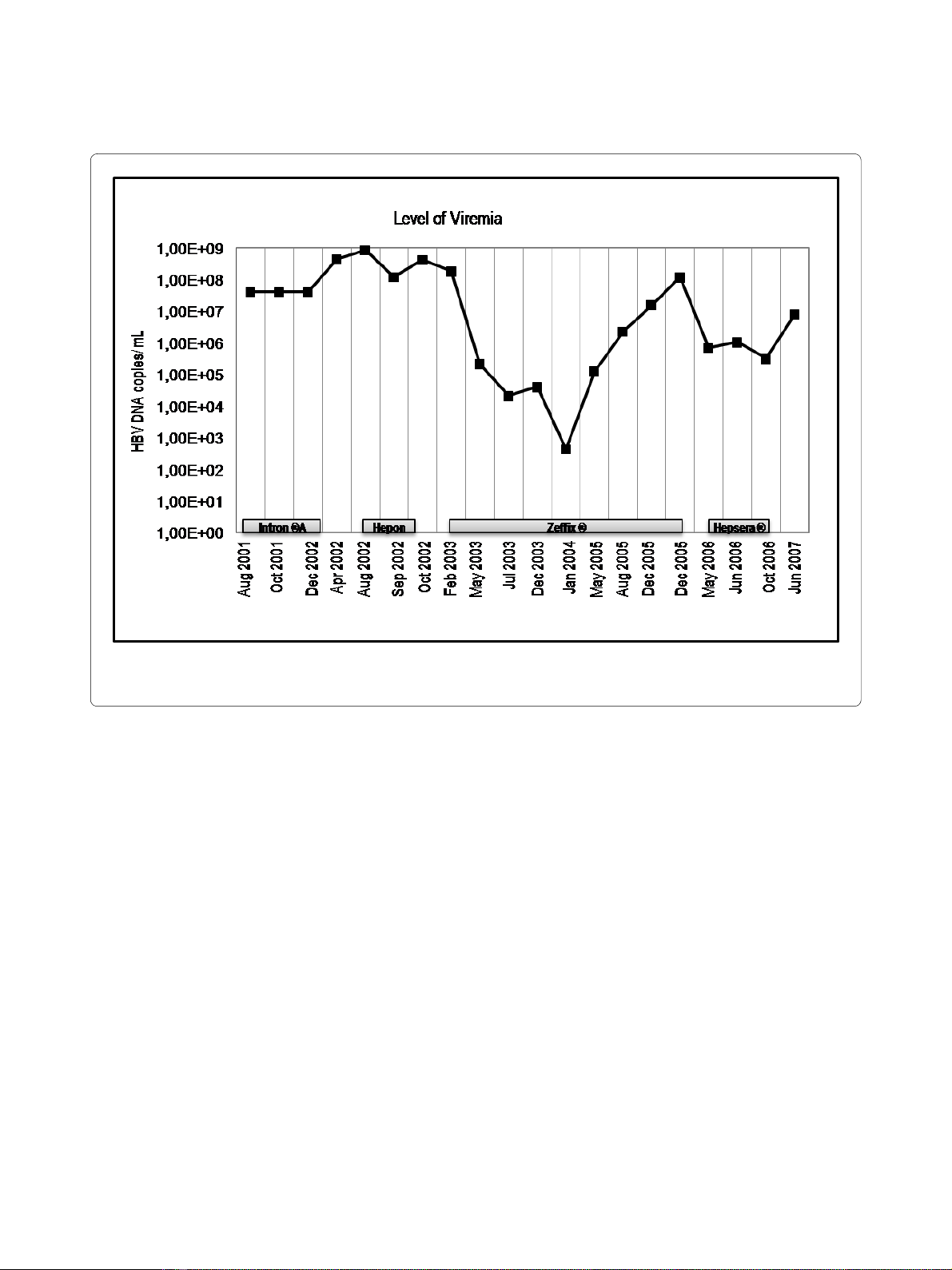
the level of viremia increased from 4.0 × 10⁷ molecules of
HBV DNA per milliliter to 8.4 × 10⁸ molecules of HBV
DNA per milliliter (figure 1). Interferon therapy was
replaced by Hepon application (2 × daily sublingual appli-
cations). Hepon is suspected to be an immunmodulator
with antiviral activity [5], but clinical data and studies are
missing and the drug is not approved. The level of vire-
mia did not change significantly upon Hepon treatment.
Replacement of Hepon with lamivudine (Zeffix® 100 mg
per day) resulted in HBV DNA levels below the detection
limit of the PCR assay -about 170 molecules of HBV DNA
per milliliter, within 12 month. However, the level of
transaminases (GOT, GPT) increased drastically (figure
2a). Lamivudine therapy was continued, with a dose
adjustment to 40 mg per day and transaminase levels
decreased to normal level. After three years of lamivu-
dine treatment resistance developed and the viremia
increased again to up to 1.3 × 10⁸ HBV DNA molecules
per mL accompanied by slightly increased GOT levels.
This increase of viremia was suspected to be a clinical
and virological resistance to lamivudine which could be
confirmed by the existence of remaining viral subpopula-
tions with lamivudine resistance mutations (YVDD) (see
below). Therapy was switched to adefovir dipivoxil (Hep-
sera® 5 mg per day), which did not respond sufficient and
viremia increased further to 7.94 × 10⁶ molecules per mL.
Throughout the entire observation period, the patient
was positive for hepatitis B surface antigen (HBsAg) and
had antibodies against hepatitis Bc antigen (anti-HBcAg).
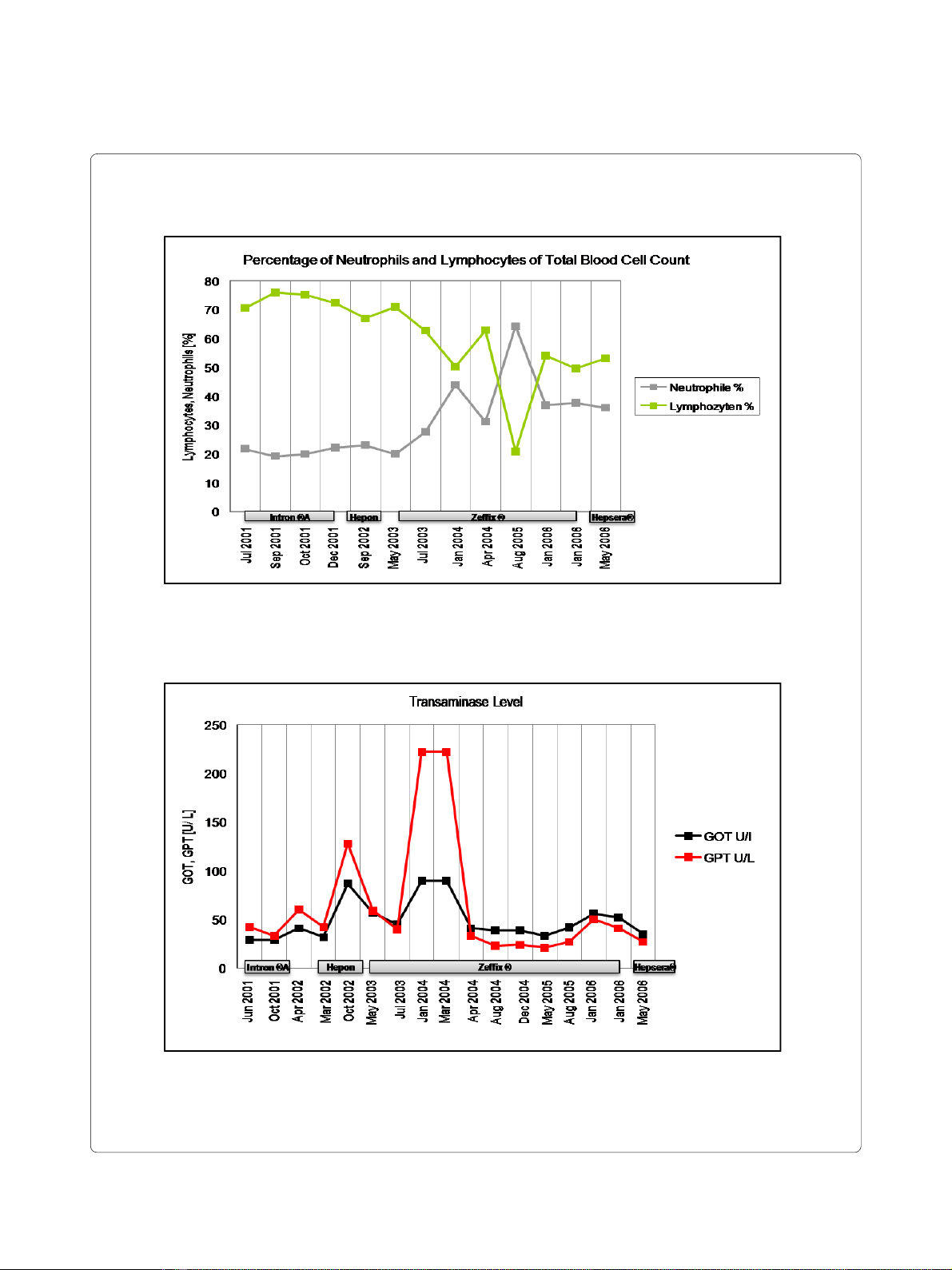
Because lymphocytes are essential inflammation mark-
ers in viral infections, the level of neutrophils and lym-
phocytes were analyzed throughout the observation
period as depicted in figure 2b. The percentage of lym-
phocytes throughout the observation correlates with the
level of HBV DNA. During the first 2 years of treatment,
only small fluctuations (65-75%) were observed in the
amount of lymphocytes. Replacement of Hepon with
lamivudine resulted in a decrease in lymphocyte level
from 70.9% lymphocytes to 50.2% lymphocytes and, after
an intermittent elevation to 62.9% lymphocytes, to 20.8%
lymphocytes. When resistance developed, the lympho-
cyte amount increased again up to 50% lymphocytes. The
reference value for the percentage of lymphocytes from
total blood cell count lies in a range of 25-40%. The per-
centage of neutrophils behaved converse to the amount of
lymphocytes. During the first 2 years of treatment, only
small fluctuations (~20% neutrophils) were observed in
amount of lymphocytes. Replacement of Hepon with
lamivudine resulted in an increased level of neutrophils
from 20% neutrophils to 44% neutrophils and, after an
interceptive decrease to 31.2% neutrophils, to 64.3% neu-
trophils. When lamivudine resistance developed, the per-
centage of neutrophils decreased again to ~35%. The
reference value for the percentage of lymphocytes from
total blood cell count lies in a range from 47-72%.
Throughout the observation period, the patient had
elevated levels of transaminases (reference value <23U/
L). The levels of transaminases during the treatment of
CHB with interferon, hepon, lamivudine and adefovir
didivoxil are depicted. After application of hepon, GOT
increases from 32-57U/L and GPT from 42-128U/L,
which significantly decreases again after application of
lamivudine to 40U/L GPT and 45U/L GOT. GPT level
drastically increase to 222U/L after eight months of lami-
vudine therapy, which again decreased to 33U/L after
adjustment of dosage. Replacement of lamivudine with
adefovir dipivoxil again resulted in a slight decrease in
both enzymes.
Gentotypic Analyses
For quasispecies analysis, HBV DNA was isolated from
patients' serum after failure of adefovir dipivoxil treat-
ment (06/2007) and parts of the polymerase gene of HBV
were amplified and cloned into pCR® 4-TOPO® vector as
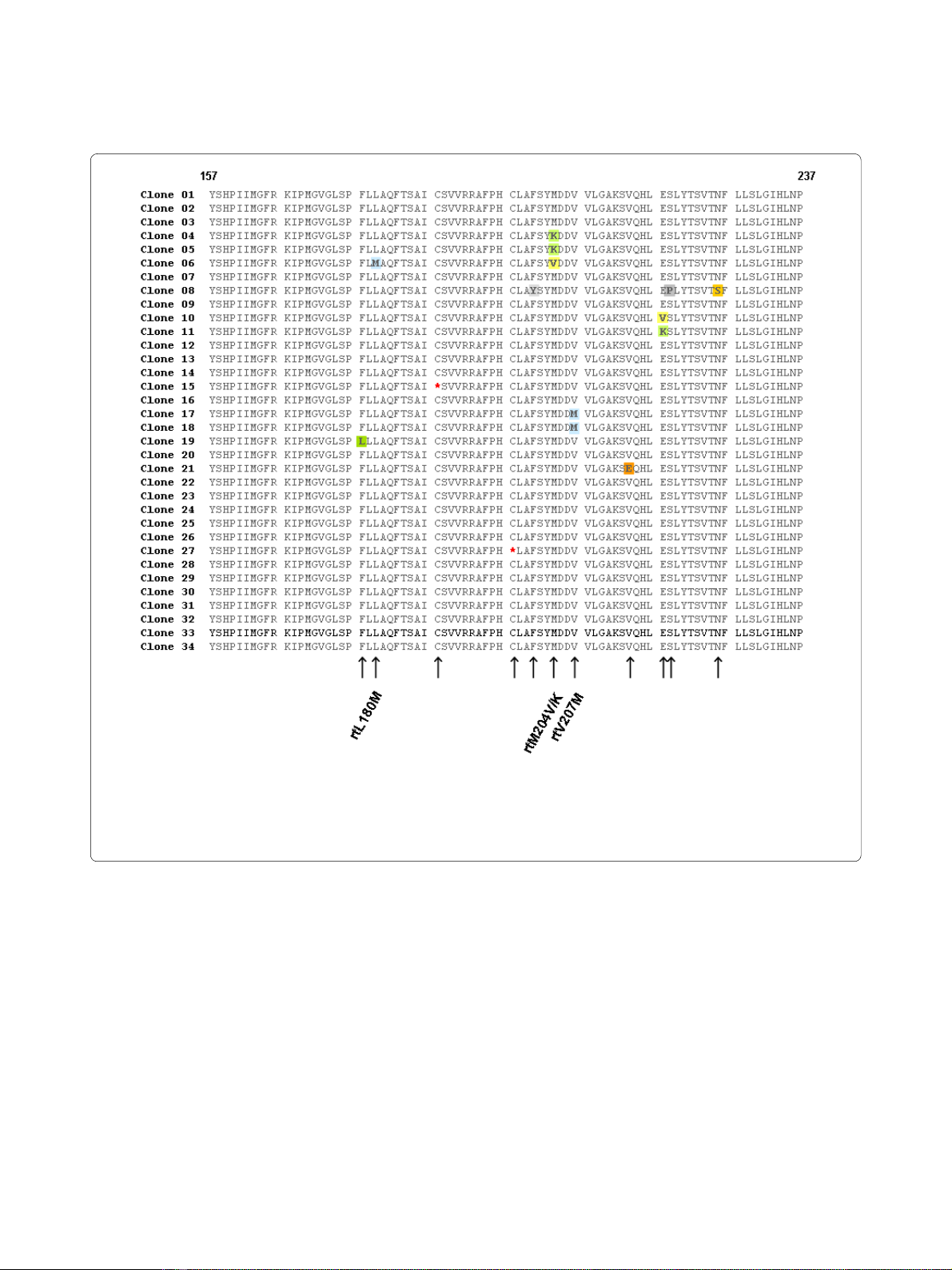
previously described [6,7]. A total number of 34 clones
Schildgen et al. Virology Journal 2010, 7:167
http://www.virologyj.com/content/7/1/167
Page 3 of 6
were sequenced from both termini and in silico translated
into their amino acid sequences (figure 3).
The patient had virus variants containing a mutation
resulting in a substitution of leucine to methionine at
position rt180, as well as valine to methionine at position
rt207. In addition, the patient had a virus variant contain-
ing mutations that result in a stop codon (at position
rt188 and rt198). The analyses revealed that, beside the
above mentioned mutations, also virus variants with
mutations in the YMDD motif, namely a substitution of
methionine to valine (YVDD) and methionine to lysine
(YKDD) at position rt204 were present in patients'
serum, which is compatible with lamivudine resistance.
Especially this latter mutation rtM204K and the mutation
in the direct neighbourhood of the so called YMDD
motif, the rtV207 M exchange, may be considered as
novel mutations. No further mutations previously associ-
ated to antiviral resistance have been detected.
Discussion and Conclusions
A young male chronically infected with HBV failed sev-
eral therapy approaches, including INF-α and NRTIs.
Quasispecies analyses revealed and proofed the presence
of several mutations, including the rtM204V substitution,
which is well known to be associated with the selection of
lamivudine-resistance virus variants [8-11]. In addition to
the known rtM204V substitution, a novel virus variant
with a methionine to lysine (YKDD) substitution was
found. To the very best of our knowledge this mutation
was previously not reported and might also be associated
with lamivudine resistance.
Induction of isoleucine or valine in the YMDD motif
results in a sterical hindrance, preventing lamivudine
from appropriately configuring into the nucleotide bind-
ing site of the reverse transcriptase [12], and so the
rtM204K substitution may also do. The substitution of
lysine to methionine at position rt180 is also connected
and approved to contribute to lamivudine resistance and
is known to augments the lamivudine resistant in con-
junction with rtM204V [11]. Resistance-associated muta-
tions outside the YMDD motiv include amino acid
exchanges at the reverse transcriptase codon L180 M
(rtL180M) or the rtV207I codon [13]. In this latter report,
a novel valine to methionine substitution was present at
the above mentioned position rt207. Furthermore, at
position rt188 and rt198 nonsense mutations were identi-
fied in two clones, which can yield a truncated abbrevi-
ated protein often associated with loss of function. As a
Figure 1 Level of viremia in a patient receiving Interferon, Hepon, Lamivudine and Adefovir. The levels of viremia were measured by PCR-
based amplification. The limit of detection of each assay is 0.17 × 10³ copies per mL.
Schildgen et al. Virology Journal 2010, 7:167
http://www.virologyj.com/content/7/1/167
Page 4 of 6
Figure 2 a. Level of neutrophiles and lymphocytes during CHB treatment with interferon, hepon, lamivudine and adefovir dipivoxil. b. Lev-
el of the transaminases GOT and GPT during CHB patient receiving interferon, hepon, lamivudine and adefovir dipivoxil.
2a
2b
Schildgen et al. Virology Journal 2010, 7:167
http://www.virologyj.com/content/7/1/167
Page 5 of 6
matter of speculation, such a truncated form of the pro-
tein could still be able to bind nucleos(t)ides and their
analogues that in turn are not available anymore in a con-
centration necessary to efficiently suppress viral replica-
tion, which besides host factors may have led to the
subsequent failure of ADF therapy. Furthermore it cannot
be excluded that viral genomes with stop codon muta-
tions may be packaged into Dane particles in liver cells
coinfected with wildtype or other viral strains. Surpris-
ingly, despite the well known fact that HBV forms qua-
sispecies, the concept of double infections or even
multiinfections of a single liver cell is only rarely taken
into account in the analyses of HBV quasispecies. Conse-
quently we assume that the mutations at position rt188
and rt198 may be not artefacts but true mutations,
although this hypothesis needs to be tested in further
studies.
The selection pressure caused by adefovir can lead to
upraise of the mutations rtA181V and rtN236T [14] or
rtI233V [6]. None of those substitutions were found in
the quasispecies analysis of the patient described. How-
ever, as a moderate response to adefovir was observed
due to the 2 log drop in viremia the patient's compliance
was good and does not explain the stagnation at the high
level of viral load.
This might be indicative for further mutations outside
the polymerase gene that have not been identified so far.
Other options for adefovir treatment failure might be that
either the applied prodrugs are not efficiently processed
into the active metabolites, or that the drugs are not effi-
Figure 3 Alignment of quasispecies analysis. Sequence of amino acids 157 - 237 in the reverse transcriptase domain of HBV polymerase is shown.
The mutations that are associated with lamivudine restistance are at position rt204. The mutations that resulted in a stop codon are highlighted in
yellow. A further mutation is located at position rtL180 M The HBV polymerase was amplified from patient material and cloned into TOPO vector,
which was transformed into E. coli. After purification of plasmid DNA, parts of the pol gene were sequenced as described above. Alignment was done
using Vector NTi software.






![Hình ảnh học bệnh não mạch máu nhỏ: Báo cáo [Năm]](https://cdn.tailieu.vn/images/document/thumbnail/2024/20240705/sanhobien01/135x160/1985290001.jpg)